固定资产投资

Search documents
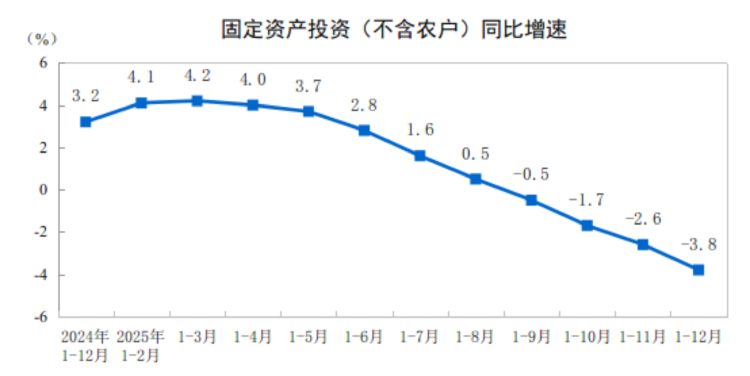
国家统计局:2025年全国固定资产投资485186亿元 比上年下降3.8%
智通财经网· 2026-01-19 02:25
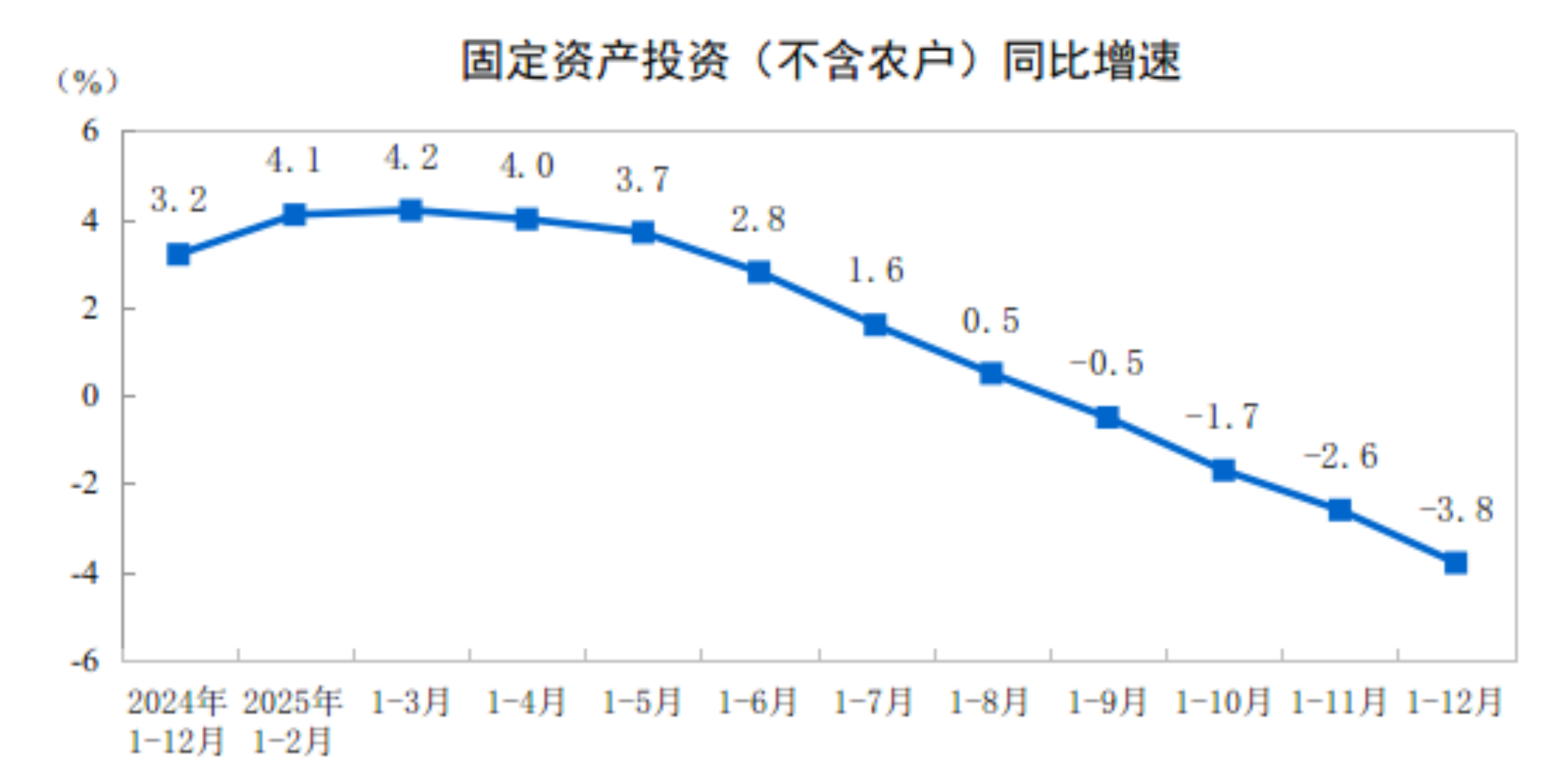
分产业看,第一产业投资9570亿元,比上年增长2.3%;第二产业投资177368亿元,增长2.5%;第三产业投资298248亿元,下降7.4%。 第二产业中,工业投资比上年增长2.6%。其中,采矿业投资增长2.5%,制造业投资增长0.6%,电力、热力、燃气及水生产和供应业投 资增长9.1%。 第三产业中,基础设施投资(不含电力、热力、燃气及水生产和供应业)比上年下降2.2%。其中,管道运输业投资增长36.0%,多式联运 和运输代理业投资增长22.9%,水上运输业投资增长7.7%。 分地区看,东部地区投资比上年下降8.4%,中部地区投资下降2.7%,西部地区投资下降1.3%,东北地区投资下降15.5%。 智通财经APP获悉,1月19日,国家统计局发布2025年全国固定资产投资基本情况。2025年,全国固定资产投资(不含农户)485186亿 元,比上年下降3.8%(按可比口径计算)。其中,民间固定资产投资比上年下降6.4%。从环比看,12月份固定资产投资(不含农户)下降 1.13%。分产业看,第一产业投资9570亿元,比上年增长2.3%;第二产业投资177368亿元,增长2.5%;第三产业投资298248亿元,下 ...

2025年我国固定资产投资同比下降3.8%
Sou Hu Cai Jing· 2026-01-19 02:24
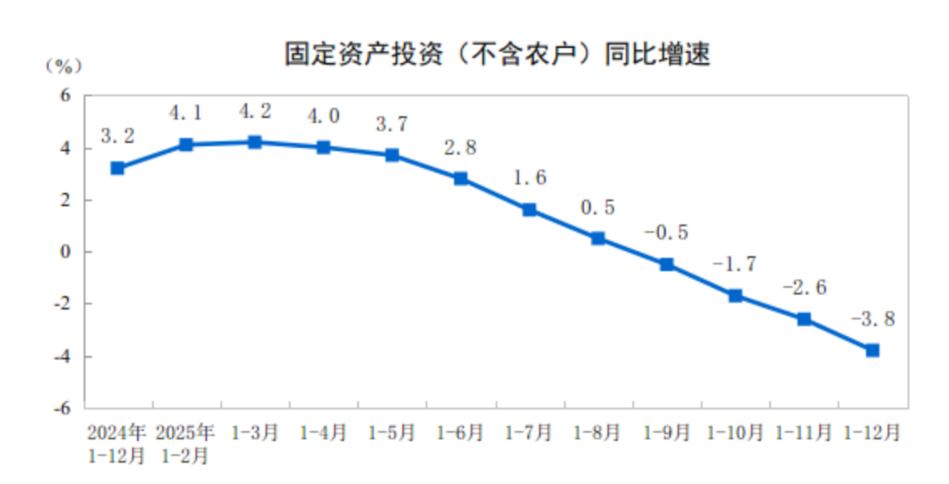
Core Insights - In 2025, China's fixed asset investment (excluding rural households) reached 48,518.6 billion yuan, representing a decline of 3.8% compared to the previous year [1] - Private fixed asset investment decreased by 6.4% year-on-year [1] - Month-on-month, fixed asset investment fell by 1.13% in December [1] Investment by Industry - Primary industry investment was 957 billion yuan, showing a growth of 2.3% year-on-year [3] - Secondary industry investment totaled 177,368 billion yuan, with a growth of 2.5% [3] - Tertiary industry investment was 298,248 billion yuan, experiencing a decline of 7.4% [3] - Within the secondary industry, industrial investment grew by 2.6%, with mining investment up by 2.5%, manufacturing investment up by 0.6%, and investment in electricity, heat, gas, and water production and supply up by 9.1% [3] - In the tertiary industry, infrastructure investment (excluding electricity, heat, gas, and water production and supply) decreased by 2.2% [3] - Notable growth in specific sectors included pipeline transportation investment up by 36.0%, multimodal transport and logistics investment up by 22.9%, and water transportation investment up by 7.7% [3] Investment by Region - Investment in the eastern region declined by 8.4% year-on-year [3] - The central region saw a decrease of 2.7% in investment [3] - Investment in the western region fell by 1.3% [3] - The northeastern region experienced the most significant decline, with a drop of 15.5% [3] Investment by Registration Type - Domestic enterprises' fixed asset investment decreased by 3.8% year-on-year [4] - Investment from Hong Kong, Macau, and Taiwan enterprises fell by 2.2% [4] - Foreign enterprises' fixed asset investment saw a significant decline of 13.8% [4]
中国2025年固定资产投资同比下降3.8%,采矿业投资增长2.5%、制造业增长0.6%
Hua Er Jie Jian Wen· 2026-01-19 02:21
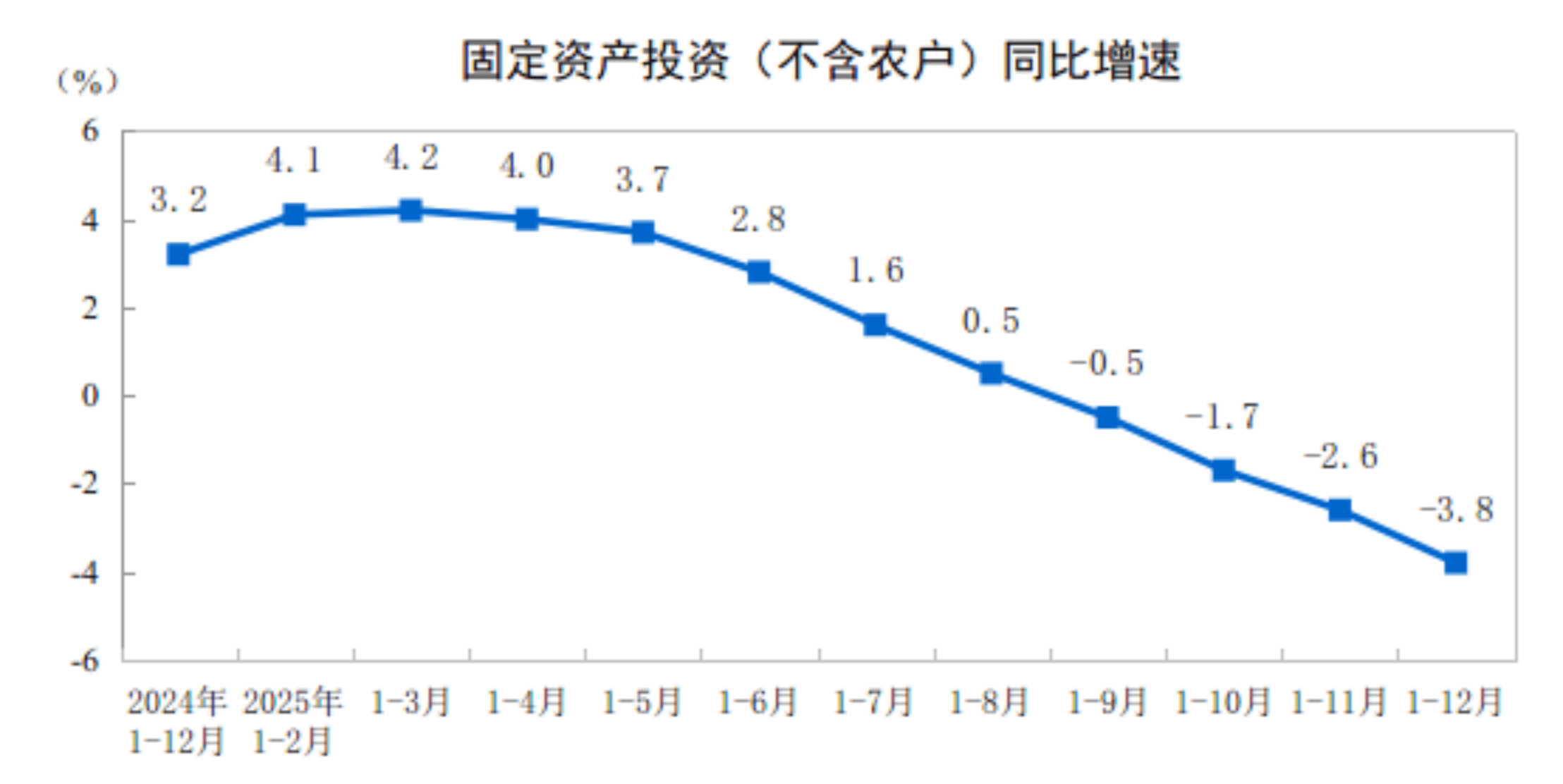
Core Insights - In 2025, China's total fixed asset investment (excluding rural households) reached 48,518.6 billion yuan, representing a decline of 3.8% compared to the previous year [1][3] - Private fixed asset investment decreased by 6.4% year-on-year, indicating a significant contraction in private sector investment [1][4] - The industrial investment within the secondary sector grew by 2.6% year-on-year, with mining investment increasing by 2.5% and manufacturing investment rising by 0.6% [1][3] Investment by Sector - Primary sector investment amounted to 957 billion yuan, showing a growth of 2.3% year-on-year [3] - Secondary sector investment totaled 177,368 billion yuan, reflecting a growth of 2.5% [3] - Tertiary sector investment was 298,248 billion yuan, which saw a decline of 7.4% [3] Regional Investment Trends - Investment in the eastern region decreased by 8.4% year-on-year, while the central region saw a decline of 2.7% [3] - The western region experienced a decrease of 1.3%, and the northeastern region faced a significant drop of 15.5% [3] Investment by Registration Type - Domestic enterprises' fixed asset investment fell by 3.8% year-on-year [4] - Investment from Hong Kong, Macau, and Taiwan enterprises decreased by 2.2% [4] - Foreign enterprises' fixed asset investment saw a substantial decline of 13.8% [4]
2025年全国固定资产投资485186亿元,比上年下降3.8%
Guo Jia Tong Ji Ju· 2026-01-19 02:19
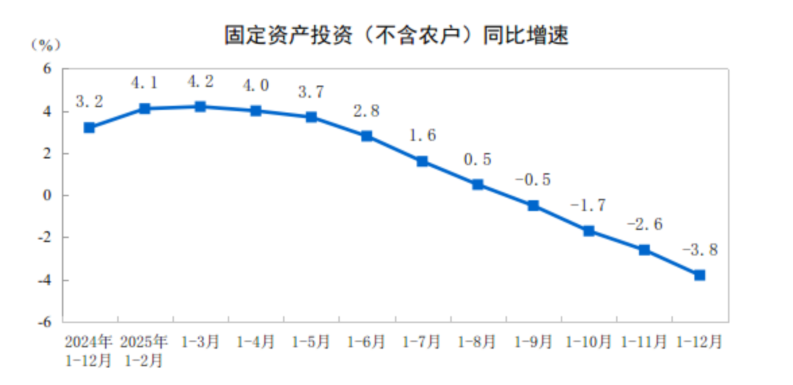
Core Viewpoint - In 2025, China's fixed asset investment (excluding rural households) is projected to be 48,518.6 billion yuan, representing a decline of 3.8% compared to the previous year [1][4]. Investment by Sector - Investment in the primary industry reached 957 billion yuan, showing a growth of 2.3% year-on-year [3][4]. - Investment in the secondary industry totaled 177,368 billion yuan, with a growth of 2.5% [3][4]. - Investment in the tertiary industry was 298,248 billion yuan, reflecting a decline of 7.4% [3][4]. Secondary Industry Breakdown - Industrial investment in the secondary industry increased by 2.6% year-on-year [3]. - Mining investment grew by 2.5%, while manufacturing investment saw a modest increase of 0.6% [3]. - Investment in the electricity, heat, gas, and water production and supply industry surged by 9.1% [3]. Tertiary Industry Breakdown - Infrastructure investment (excluding electricity, heat, gas, and water production and supply) decreased by 2.2% [3]. - Notable growth was observed in pipeline transportation (36.0%), multimodal transport and agency services (22.9%), and water transportation (7.7%) [3]. Regional Investment Trends - Investment in the eastern region declined by 8.4% year-on-year [3]. - The central region experienced a decrease of 2.7%, while the western region saw a decline of 1.3% [3]. - The northeastern region faced the most significant drop at 15.5% [3]. Investment by Registration Type - Domestic enterprises' fixed asset investment fell by 3.8% [4]. - Investment from Hong Kong, Macau, and Taiwan enterprises decreased by 2.2% [4]. - Foreign enterprises experienced a substantial decline of 13.8% in fixed asset investment [4].
国家统计局:2025年全国固定资产投资485186亿元,比上年下降3.8%
Sou Hu Cai Jing· 2026-01-19 02:19
分产业看,第一产业投资9570亿元,比上年增长2.3%;第二产业投资177368亿元,增长2.5%;第三产业投资298248亿元,下降7.4%。 第二产业中,工业投资比上年增长2.6%。其中,采矿业投资增长2.5%,制造业投资增长0.6%,电力、热力、燃气及水生产和供应业投资增长9.1%。 第三产业中,基础设施投资(不含电力、热力、燃气及水生产和供应业)比上年下降2.2%。其中,管道运输业投资增长36.0%,多式联运和运输代理业投资 增长22.9%,水上运输业投资增长7.7%。 据国家统计局,2025年,全国固定资产投资(不含农户)485186亿元,比上年下降3.8%(按可比口径计算,详见附注7)。其中,民间固定资产投资比上年 下降6.4%。从环比看,12月份固定资产投资(不含农户)下降1.13%。 分地区看,东部地区投资比上年下降8.4%,中部地区投资下降2.7%,西部地区投资下降1.3%,东北地区投资下降15.5%。 -3.8 其中:国有控股 -2.5 其中:民间投资 -6.4 按构成分 建筑安装工程 -8.4 设备工器具购置 11.8 其他费用 -2.3 分产业 第一产业 2.3 第二产业 2.5 第三 ...
国家统计局:2025年全年全国固定资产投资(不含农户)485186亿元
Guo Jia Tong Ji Ju· 2026-01-19 02:15
Core Insights - The total fixed asset investment in China for 2025 is projected to be 48,518.6 billion yuan, reflecting a decrease of 3.8% compared to the previous year [1] - Excluding real estate development investment, the overall fixed asset investment has decreased by 0.5% [1] Investment Breakdown - Infrastructure investment has declined by 2.2% [1] - Manufacturing investment has seen a slight increase of 0.6% [1] - Real estate development investment has significantly decreased by 17.2% [1] Real Estate Market - The sales area of newly built commercial housing reached 88,101 million square meters, down by 8.7% [1] - The sales revenue from newly built commercial housing amounted to 83,937 billion yuan, a decline of 12.6% [1] Sector Performance - Investment in the primary industry has increased by 2.3% [1] - Investment in the secondary industry has grown by 2.5% [1] - Investment in the tertiary industry has decreased by 7.4% [1] Private Investment Trends - Private investment has decreased by 6.4% [1] - Excluding real estate development investment, private investment has declined by 1.9% [1] High-Tech Industry - In high-tech industries, investment in information services has surged by 28.4% [1] - Investment in aerospace and aircraft manufacturing has increased by 16.9% [1] Monthly Trends - In December, fixed asset investment (excluding rural households) experienced a month-on-month decline of 1.13% [1]
国家统计局:2025年全国固定资产投资(不含农户)485186亿元,比上年下降3.8%
Zheng Quan Shi Bao Wang· 2026-01-19 02:13
Core Insights - The National Bureau of Statistics reported a decline in national fixed asset investment (excluding rural households) to 48,518.6 billion yuan in 2025, a decrease of 3.8% compared to the previous year [1] - Excluding real estate development investment, national fixed asset investment fell by 0.5% [1] Investment by Sector - Infrastructure investment decreased by 2.2% [1] - Manufacturing investment saw a slight increase of 0.6% [1] - Real estate development investment experienced a significant decline of 17.2% [1] Real Estate Market - The sales area of newly built commercial housing reached 88,101 million square meters, down 8.7% [1] - The sales value of newly built commercial housing was 83,937 billion yuan, a decrease of 12.6% [1] Investment by Industry - First industry investment grew by 2.3% [1] - Second industry investment increased by 2.5% [1] - Third industry investment declined by 7.4% [1] - Private investment fell by 6.4%, and when excluding real estate development investment, private investment decreased by 1.9% [1] High-tech Industry - In high-tech industries, investment in information services and aerospace equipment manufacturing grew by 28.4% and 16.9%, respectively [1] Monthly Trends - In December, fixed asset investment (excluding rural households) decreased by 1.13% month-on-month [1]
国家统计局:2025年,全国固定资产投资(不含农户)485186亿元
Mei Ri Jing Ji Xin Wen· 2026-01-19 02:13
每经AI快讯,国家统计局:2025年,全国固定资产投资(不含农户)485186亿元,比上年下降3.8%。其 中,民间固定资产投资比上年下降6.4%。从环比看,12月份固定资产投资(不含农户)下降1.13%。 ...
国家统计局:中国2025年固定资产投资同比下降3.8%
Guo Jia Tong Ji Ju· 2026-01-19 02:04
2025年,全国固定资产投资(不含农户)485186亿元,比上年下降3.8%。其中,民间固定资产投资比上年下降6.4%。从环比 看,12月份固定资产投资(不含农户)下降1.13%。 第二产业中,工业投资比上年增长2.6%。其中,采矿业投资增长2.5%,制造业投资增长0.6%,电力、热力、燃气及水生产和供 应业投资增长9.1%。 分产业看,第一产业投资9570亿元,比上年增长2.3%;第二产业投资177368亿元,增长2.5%;第三产业投资298248亿元,下降 7.4%。 第三产业中,基础设施投资(不含电力、热力、燃气及水生产和供应业)比上年下降2.2%。其中,管道运输业投资增长36.0%, 多式联运和运输代理业投资增长22.9%,水上运输业投资增长7.7%。 分地区看,东部地区投资比上年下降8.4%,中部地区投资下降2.7%,西部地区投资下降1.3%,东北地区投资下降15.5%。 分登记注册类型看,内资企业固定资产投资比上年下降3.8%,港澳台企业固定资产投资下降2.2%,外商企业固定资产投资下降 13.8%。 | 指 标 | 比上年增长(%) | | --- | --- | | 固定资产投资(不含农户) ...
2025年全国固定资产投资基本情况
Guo Jia Tong Ji Ju· 2026-01-19 02:01
Core Insights - In 2025, China's fixed asset investment (excluding rural households) reached 48,518.6 billion yuan, a decrease of 3.8% compared to the previous year, with private fixed asset investment declining by 6.4% [1][6] Investment by Industry - Investment in the primary industry was 957 billion yuan, showing a growth of 2.3% year-on-year [3] - Investment in the secondary industry totaled 177,368 billion yuan, with a growth of 2.5% [3] - The tertiary industry saw a decline in investment, amounting to 298,248 billion yuan, down by 7.4% [3] Secondary Industry Breakdown - Within the secondary industry, industrial investment grew by 2.6% year-on-year [4] - Mining investment increased by 2.5%, while manufacturing investment grew by 0.6% [4] - Investment in the electricity, heat, gas, and water production and supply industry rose significantly by 9.1% [4] Infrastructure and Regional Investment - Infrastructure investment (excluding electricity, heat, gas, and water production and supply) decreased by 2.2% [4] - Investment in pipeline transportation surged by 36.0%, while multimodal transport and logistics saw a growth of 22.9% [4] - Investment trends varied by region, with the eastern region experiencing an 8.4% decline, the central region down by 2.7%, the western region down by 1.3%, and the northeastern region down by 15.5% [4] Investment by Registration Type - Domestic enterprises' fixed asset investment fell by 3.8%, while investment from Hong Kong, Macau, and Taiwan enterprises decreased by 2.2% [5] - Foreign enterprises saw a significant decline in fixed asset investment, down by 13.8% [5]