
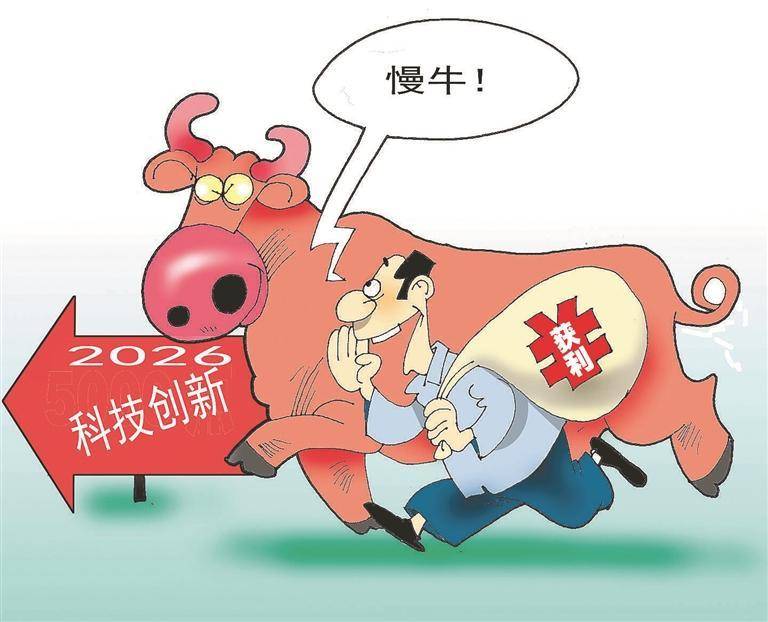
慢牛

Search documents
A股两大信号警示历史将重演,散户如何避免成为“接盘侠”?
Sou Hu Cai Jing· 2026-01-02 04:26
Core Insights - The A-share market has shown remarkable performance over the past year, with a total market capitalization increase from 70.79 trillion yuan to 103.92 trillion yuan, a growth of 33.13 trillion yuan [1][3] - The core driver of this bull market is the technology sector, with significant gains in electronic, communication, and comprehensive industries, while traditional sectors like oil and coal have seen minimal growth [3][5] - The market structure has shifted from a broad rally to a high-growth rotation model, with funds moving towards sectors with stronger earnings certainty, such as healthcare and biotechnology [7][11] Market Performance - On the anniversary of the "924 market," 4,458 stocks rose, with an average profit of 50,000 yuan per investor, although this figure masks the structural disparities in stock performance [1][8] - Major indices like the ChiNext Index and STAR Market have seen their values double, with nearly 3,000 stocks increasing by over 50% [1][3] - The number of stocks priced over 100 yuan has doubled from 71 to 139 since the beginning of the year, indicating a concentration of market gains in fewer stocks [8] Policy and Economic Environment - The policy environment has shifted from broad easing to targeted measures focusing on weak economic areas, contrasting with last year's comprehensive easing that coincided with unexpected rate cuts by the Federal Reserve [5][12] - The current market is characterized by a structural differentiation in capital flows, with significant net outflows from major funds and inflows into smaller retail investments [5][12] Investment Strategies - Institutional investors have a clear advantage due to in-depth research, with public funds achieving an average return of 12.3%, while retail investors face a 23.6% annualized loss rate [11][12] - The investment strategy divergence is notable, with institutions employing a high-risk-reward approach, while retail investors tend to react more emotionally to market fluctuations [11][12] Sector Focus - Key sectors benefiting from liquidity improvements include communication equipment and semiconductors, while high-end manufacturing and financial services are also seen as areas of structural opportunity [12][13] - The technology sector, particularly AI and semiconductor industries, has attracted significant investment, with domestic firms like DeepSeek driving advancements in related fields [7][12] Market Sentiment and Future Outlook - The market sentiment remains cautious, with a significant portion of new affluent investors unwilling to accept losses exceeding 10%, reflecting a risk-averse attitude [12] - Historical data suggests that the A-share market is unlikely to replicate last year's explosive growth, entering a "slow bull" phase characterized by lower volatility and distinct structural features [12][15]


“慢牛”领跑!估值驱动转向盈利驱动
Sou Hu Cai Jing· 2026-01-01 23:12
Group 1 - The A-share market is expected to shift from valuation-driven to profit-driven, exhibiting a "slow bull" characteristic in 2026 [2][3] - Investors are advised to focus on four major directions: technology innovation, advanced manufacturing, upstream cycles, and domestic consumption [2][8] - Technology investment difficulty in 2026 will be greater than in 2025, requiring precise grasp of industry rhythms and deep stock selection for excess returns [11] Group 2 - The macroeconomic policy is expected to support resilient growth and structural upgrades, with a GDP growth target of around 5% for 2026 [5][6] - Manufacturing investment is anticipated to receive support from strong export resilience and continued policy backing for advanced manufacturing [5][6] - The focus on expanding domestic demand is crucial for stabilizing growth, with measures including increased consumption subsidies and support for service industries [5][6] Group 3 - A-share earnings are expected to enter a new phase of slow recovery in 2026, driven by technology manufacturing, inventory replenishment, and profit margin recovery [7][9] - The investment strategy should focus on cyclical recovery and technological self-reliance, with an emphasis on sectors like non-ferrous metals, machinery, and social services [7][8] Group 4 - The market is likely to see a convergence of technology and value styles, with structural opportunities emerging in value sectors as the economy stabilizes [12] - The focus on "outbound + technology" is expected to dominate market trends, particularly in the AI industry chain and resource sectors [13] Group 5 - The overall market is anticipated to be balanced between growth and value, with significant opportunities in both large-cap and small-cap stocks [14][16] - The recovery in earnings and return on equity (ROE) levels is expected to support stock market performance, with long-term funds increasingly entering the market [16]
新年快乐!
集思录· 2025-12-31 13:28
Market Performance Summary - The article provides a detailed overview of the performance of various stock indices in 2023, highlighting significant year-to-date gains for several indices, such as the ChiNext Index with a 49.57% increase and the Sci-Tech Innovation Index with a 46.30% increase [1]. - The article notes a general trend of declining volatility and growth in the market since September, suggesting a shift towards a slow bull market [1]. Index Performance Breakdown - The ChiNext Index (399006) is currently at 3203.17, with a year-to-date increase of 49.57% [1]. - The Sci-Tech Innovation Index (000680) stands at 1636.70, reflecting a 46.30% increase year-to-date [1]. - The Northbound 50 Index (899050) has a year-to-date increase of 38.80%, currently priced at 1440.43 [1]. - The CSI 2000 Index (932000) shows a year-to-date increase of 36.42%, priced at 3203.23 [1]. - The overall performance of major indices indicates a strong recovery in the market, with many indices showing double-digit percentage increases year-to-date [1].

A股2025年收官:沪指11连阳全年收涨超18%,创业板指全年大涨49.57%
2 1 Shi Ji Jing Ji Bao Dao· 2025-12-31 07:25
Market Performance - The Shanghai Composite Index (沪指) closed the year with a 0.09% increase, marking an 11-day consecutive rise and an annual gain of 18.41%, the highest in 10 years [1][3] - The Shenzhen Component Index (深成指) decreased by 0.58% but recorded a yearly increase of 29.87% [1][3] - The ChiNext Index (创业板指) fell by 1.23% but achieved a significant annual increase of 49.57% [1][3] - The Sci-Tech 50 Index (科创50指数) rose by 35.92% over the year, while the Northern Stock Exchange 50 Index (北证50指数) increased by 38.8% [1][3] Sector Performance - Key sectors driving the market included computing hardware, non-ferrous metals, banking, battery supply chain, innovative pharmaceuticals, commercial aerospace, and robotics [1][3] Stock Highlights - The top three performing stocks for the year were: - Shangwei New Materials (上纬新材) with a staggering increase of 1821.41% - Tianpu Co., Ltd. (天普股份) with a rise of 1662.49% - N Hengdong Light (N蘅东光) with an increase of 878.16% [2][4] Future Outlook - Institutions generally hold a positive outlook for the A-share market in 2026, citing factors such as increased domestic and foreign capital inflow, corporate profit recovery, and enhanced policy support as key drivers for a "slow bull" market [2][4]


技术看市:A股罕见特征出现,老百姓的钱小心翼翼,2025年慢牛元年?
Jin Rong Jie· 2025-12-30 12:16
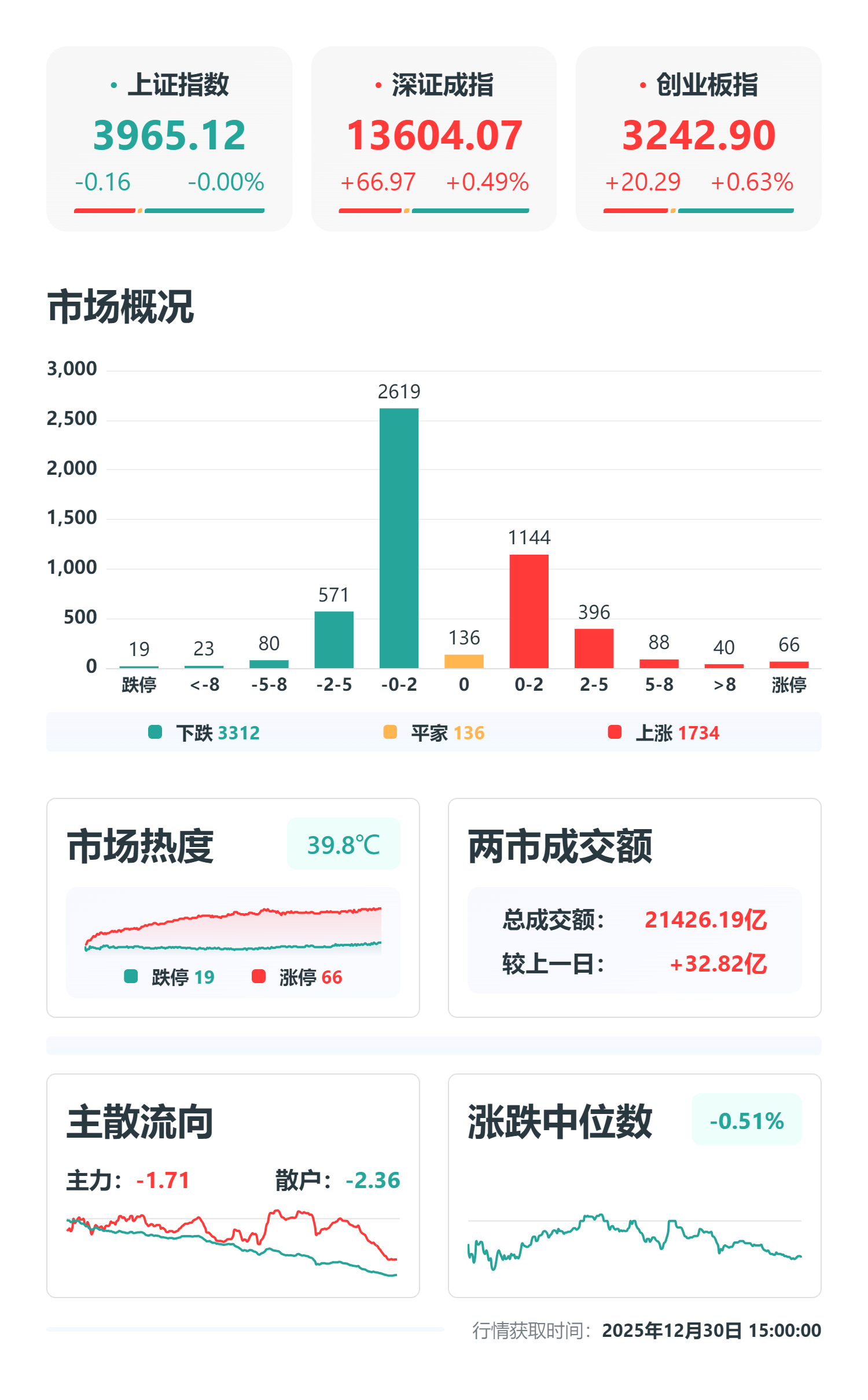
Group 1 - The core viewpoint of the articles highlights the performance of the stock market on the last trading day of the year, with 1,734 stocks rising, 3,306 falling, and 142 remaining unchanged, indicating a mixed market sentiment [5] - The total trading volume reached 2.14 trillion yuan, an increase of approximately 32.81 billion yuan compared to the previous trading day, reflecting heightened market activity [5] - The net outflow of main funds from the market was 38.772 billion yuan, with the automotive parts sector seeing the highest net inflow, followed by home appliances, general equipment, cultural media, and consumer electronics [5] Group 2 - The analysis indicates that 2025 has been characterized by a rare slow bull market, with significant fluctuations including a major drop on April 7, followed by a prolonged period of stability and growth over 148 trading days [5] - The market expert Xu Xiaoming emphasizes the importance of a slow bull market for long-term economic benefits, suggesting that a rational investment approach has emerged this year due to high household savings and reduced risks in the real estate and wealth management sectors [6] - Xu expresses optimism that 2025 could mark the beginning of a slow bull market for the Chinese stock market, which would positively impact the economy and consumer sentiment [6]

慢牛的年度收官!
Sou Hu Cai Jing· 2025-12-28 16:01
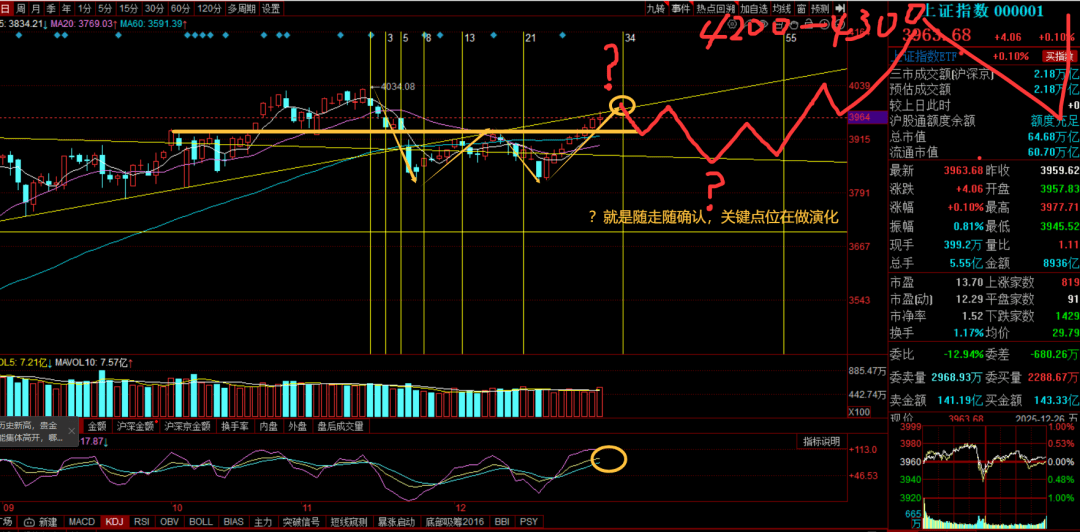
Market Overview - The market has experienced an 8-day upward trend, closing at 3963.68 points with a trading volume of 216.01 billion [1] - Foreign capital remains inactive, indicating a cautious approach from international investors [1] - The Shanghai Free Trade Zone and small metals sectors showed strong performance, while newly listed stocks, consumer electronics, and energy sectors lagged [1] Technical Analysis - Key support levels are identified at 3930 points and strong support at 3900 points, with a pressure point at 4000 [3] - The market is expected to experience fluctuations, with a bullish long-term outlook despite short-term volatility [3] - The upcoming trading days before the holiday are crucial, with expectations of a potential rebound on the last trading day [4] Sector Focus - Attention is drawn to sectors such as brokerage firms, technology (including semiconductors, AI applications, and robotics), and new energy resources [6] - The aerospace sector has shown significant gains, but there may be a divergence in funding next week, suggesting caution in participation [6] - Strategies recommended include defensive positioning and switching between high and low-performing stocks, with a focus on price increases and annual report growth as key drivers [6]
A股新纪元:指数剑指历史高点,日成交额站上3万亿大关!
Sou Hu Cai Jing· 2025-12-28 14:36
Core Insights - The Shanghai Composite Index has finally surpassed the 4000-point mark, marking a significant milestone after a decade, with a market driven by technology and a "slow bull" trend reshaping the Chinese capital market [1][3] - The total market capitalization of A-shares has historically exceeded 100 trillion yuan, indicating a robust recovery and potential for further growth [3] Historical Breakthrough - The Shanghai Composite Index briefly stayed above 4000 points ten years ago before entering a prolonged adjustment period, with the 2015 peak of 5178 points remaining a significant psychological barrier for investors [3] - In 2025, the A-share market has entered a new bull market, breaking through long-standing technical resistance levels, suggesting a departure from previous downward pressures [3] Trading Volume Records - The A-share market has achieved remarkable trading volume records in 2025, with total annual trading volume exceeding 400 trillion yuan, a significant increase from 255.8 trillion yuan in 2024 [5] - On August 25, 2025, the trading volume reached 3.14 trillion yuan, marking the second-highest level in history, reflecting strong market liquidity and activity [5] Three Pillars of the Current Bull Market - The current bull market, termed the "technology revaluation bull," is driven by technological breakthroughs, policy reforms, and increased capital inflows [7][8] - Key sectors such as artificial intelligence and advanced manufacturing are leading the market, supported by government policies aimed at protecting small investors and fostering market health [8] New Market Norms - The number of listed companies in the A-share market has nearly doubled from 2827 to 5448, with total market capitalization growing from 58.4 trillion yuan to 122.23 trillion yuan, indicating enhanced market breadth and depth [10] - The current price-to-earnings ratio of the CSI 300 is approximately 14 times, still below historical averages, suggesting potential for further upward movement in the index [10] Outlook for a Slow Bull Market - Looking ahead to 2026, the A-share market is positioned for a long-term "slow bull" trend, supported by ongoing macroeconomic policies, industry transformations, and continuous capital inflows [12] - The market's foundation appears more solid compared to 2015, with reduced volatility and increased investor willingness to hold stocks for the long term, indicating a healthier investment environment [12][14]

技术看市:沪指时隔1年再现8连阳,低点不完美但达到最低要求,2025或为中国股市慢牛元年
Jin Rong Jie· 2025-12-28 11:28
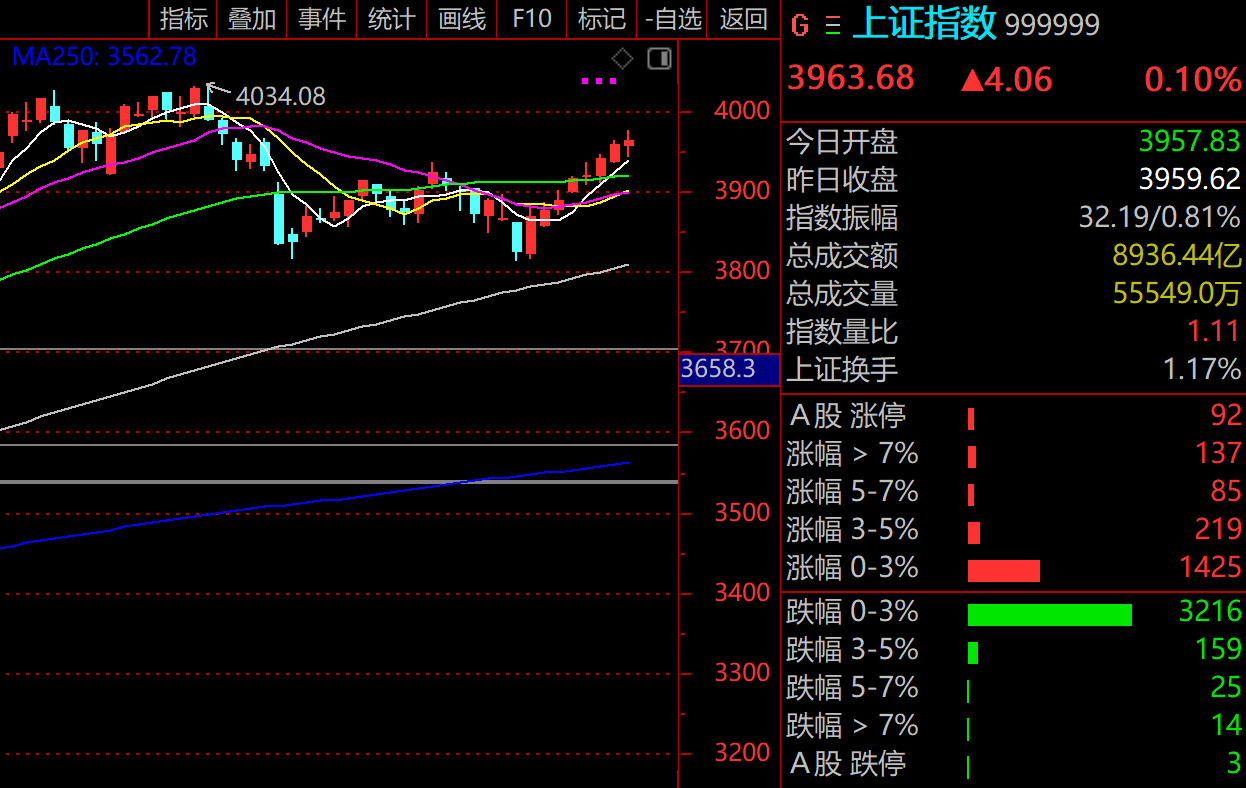
过去的一周,大盘连续5天收涨,日线更是走出8连阳。深证成指、创业板指、科创50指数、北证50指数均有不同程度上涨。市场从前期调整阶段逐步回归上 升通道,整体风险收益比得到改善。 | F10 | G = 上证指数 999999 | 标记 -自选 返回 | 指标 | 统计 画线 | 叠加 | 事件 | MA250: 3562.78 | | --- | --- | --- | --- | --- | --- | --- | --- | | ◇ □ | 3963.68 44.06 | | | | | | | | 4000 | Bearing of the Research and Children and Chi | 今日开盘 | | | | | | | 昨日收盘 | 3900 | 3 | 指数振幅 | | | | | | 总成交额 | 3800 | 总成交量 | | | | | | | 指数量比 | 2700 | 3658.3 | 上证换手 | | | | | | A股 涨停 | 3600 | 涨幅 > 7% | | | | | | | 涨幅 5-7% | 3500 | 涨幅 3-5% | | | | | | | ...
预见2026 | 从“轴中”稳定到全球跃迁 产业新局持续凸显资本市场价值
Xin Hua Cai Jing· 2025-12-28 02:44
Group 1: Economic Outlook - The year 2026 is expected to be a pivotal year for China's economy, showcasing strategic initiatives and a true awakening of stock market value [1] - The actual GDP growth rate is projected to be between 4.8% and 4.9%, with nominal GDP expected to rise to around 4.5% compared to 2025 [1] - The economic landscape is characterized by a structural differentiation where consumption stabilizes, exports provide a reliable growth force, and investment may act as a drag [1] Group 2: Macroeconomic Features - The core features of the macro economy in 2026 will include structural differentiation and stable operation under policy consistency [2] - Retail sales growth is expected to remain around 4%, while actual resident consumption growth, including services, may reach 4.5% to 5% [2] - Export growth is anticipated to be around 5%, supported by a mild recovery in global industrial production [2] Group 3: Fiscal Policy - Fiscal policy in 2026 is expected to act as a stabilizer rather than a strong stimulus, with a slight increase in the narrow deficit ratio to 4.2% to 4.3% [3] - Government debt is projected to increase by approximately 1 to 1.5 trillion yuan, with fiscal spending growth set at around 5% [3] - The approach aims to support economic transformation while maintaining sustainability and flexibility in policy [3] Group 4: Industry Focus - Midstream Manufacturing - Midstream manufacturing is identified as the most certain and verifiable sector in the next 3 to 6 months, driven by improved corporate profitability, global demand, and supportive industrial policies [4] - Export gross margins for midstream manufacturing companies have systematically exceeded domestic margins for the first time, indicating higher value-added profits from exports [4] - The focus of supply-side structural reforms has shifted towards midstream manufacturing, optimizing the competitive ecology and profitability of the sector [4] Group 5: Market Outlook - The A-share market in 2026 is expected to shift from valuation repair to profit-driven growth and deep recognition of allocation value [5] - Market volatility has systematically decreased, with fewer trading days experiencing significant index pullbacks, enhancing long-term asset allocation value [6] - Corporate profit improvements are anticipated, with nominal GDP expected to rise from 4.0% in 2025 to 4.5% in 2026, indicating a healthier foundation for market growth [6] Group 6: New Normal - The economic landscape in 2026 will emphasize quality, structure, and sustainability, moving towards a "new normal" [7]
开源晨会-20251224
KAIYUAN SECURITIES· 2025-12-24 15:28
Core Insights - The report suggests a transition from "asset revaluation" to "profit recovery," indicating that 2026 is likely to experience a "low-slope slow bull" market rather than a "sharp peak short bull" market [7][8] - The report emphasizes that the securities ratio is an effective reference indicator for assessing the space of index bull/valuation bull, with a critical level of 1.1 times [7][8] - It predicts that after the "asset revaluation," the capital market will seek a new stable center rather than a rapid decline, with the securities ratio expected to continue rising [7][8] Industry Overview - The report highlights the performance of various industries, with the defense and military industry leading with a gain of 2.881%, followed by electronics at 2.122% and construction materials at 1.720% [3] - Conversely, the agriculture, forestry, animal husbandry, and fishery sector saw a decline of 0.845%, with coal and food and beverage sectors also experiencing negative growth [4] Company Analysis - The report focuses on Weimais (688612.SH), which plans to repurchase shares worth between 50 million to 100 million RMB to enhance shareholder returns [5][12] - The company is projected to achieve net profits of 726 million, 1.025 billion, and 1.486 billion RMB for the years 2025 to 2027, with corresponding PE ratios of 18.1, 12.8, and 8.8 times [5][12] - Weimais is recognized as a leading player in the domestic vehicle power supply market and is expected to benefit significantly from the growth of the European new energy vehicle market [5][12][14]
