资产多元化

Search documents
在不确定性中锚定增长:2026年资产配置展望
EBSCN· 2025-11-10 11:05
Core Insights - The source of uncertainty in asset returns is influenced by the trend of "de-globalization," which continues to affect economic fundamentals and is gradually incorporated into valuation assumptions [3][10] - Asset diversification is considered a "free lunch" in asset allocation, with its value derived from the correlation between different assets [4][17] - In the current uncertain environment, investment strategies should focus on anchoring growth through income-generating assets, leveraging to enhance returns, and recognizing the ongoing macro narrative surrounding gold [5][21][38] Source of Uncertainty in Asset Returns - The "de-globalization" trend has emerged and will continue to impact economic fundamentals, with the potential for structural risks and profit expectations in certain sectors [10] - The internal macro environment is facing risks of slowing economic growth and a transition in economic drivers, moving from a high-growth phase to a medium-low growth phase [12] - The changes in Sharpe ratios across different asset classes indicate varying performance and risk profiles, with a notable downward trend in bond yield spreads since 2011 [14][15] Asset Diversification - The essence of asset diversification lies in investing in different asset classes to reduce overall portfolio risk while balancing returns, with the underlying value stemming from asset correlations [18] - Historical performance data shows significant fluctuations in quarterly returns across different years, highlighting the importance of diversification in managing risk [18] Income-Generating Assets - Income-generating assets, such as bonds and high-dividend stocks, provide predictable cash flows, enhance liquidity, and can hedge against inflation, making them essential in a diversified portfolio [23][21] - High-dividend strategies focus on stable cash flows and valuation recovery, with companies in mature industries typically exhibiting a higher propensity for dividends [26][28] Leveraging for Growth - The core value of introducing leverage in a portfolio is to enhance expected returns while maintaining overall risk balance, particularly in a risk parity framework [34] - Leveraging can amplify returns from low-risk assets without disrupting the risk contribution structure of the overall portfolio [34] High-Quality Growth - High-quality growth is identified as a key driver for the new phase of economic growth, emphasizing the importance of technological innovation and productivity improvements [35][37] - The focus on new quality production capabilities aims to enhance total factor productivity, with specific attention to sectors such as digital economy, high-end manufacturing, and renewable energy [36] Gold as a Strategic Asset - The ongoing geopolitical tensions and the questioning of the dollar's safety have led to increased global demand for gold as a risk diversification strategy [38][39] - Historical data indicates a significant rise in gold reserves among global economies since 2008, reflecting a shift away from dollar dependency [40]
Tether Surpasses $10B Net Profit in 2025, Expands US Treasuries Holdings
Yahoo Finance· 2025-10-31 17:57
Financial Performance - Tether International reported net profits exceeding $10 billion for the year, with expectations to reach $15 billion by the end of 2025 [1] - The company closed Q3 2025 with excess reserves of $6.8 billion, indicating a strong financial buffer above outstanding liabilities [6] US Treasury Holdings - Tether's total exposure to US Treasuries reached approximately $135 billion, making it the 17th-largest holder of US government debt globally [2] - The company issued over $17 billion in new USDT during Q3, increasing the circulating supply to over $174 billion [3] Market Position and User Base - By October 2025, the number of USDT tokens in circulation surpassed $183 billion, contributing to a stablecoin market cap exceeding $300 billion [4] - Tether's user base has expanded to over 500 million, driven by global demand for reliable stablecoins amid macroeconomic volatility [4] Reserve Strategy - Tether's reserves included $12.9 billion in gold and $9.9 billion in Bitcoin, accounting for around 13% of total reserves [5] - The company maintains a separation between proprietary investments in AI, energy, and communications and the reserves backing USDT [5] CEO Insights - Tether's CEO, Paolo Ardoino, emphasized the results as a sign of continued trust and growth, with increasing investor interest in USDT for stability and liquidity [7]
金价如坐“过山车”,搅动年轻人投资观
Xin Hua Ri Bao· 2025-10-29 21:57
Core Viewpoint - The recent sharp decline in gold prices has created tension among both consumers and investors, raising questions about the future of gold investments and purchasing decisions [1] Group 1: Market Trends - Gold jewelry prices have dropped below 1190 yuan per gram, with a decline of over 7% in domestic gold spot prices [1] - In just seven trading days, gold jewelry prices fell by more than 70 yuan per gram, from a peak of 1262 yuan per gram on October 20 to the current levels [2] - The current market is characterized by two main types of gold jewelry products: "weight gold + processing fee" and "fixed price" products, with the former being more sensitive to gold price fluctuations [2] Group 2: Investment Behavior - The gold spot price reached a peak of 1002.99 yuan per gram on October 17, then fell to 925.00 yuan per gram by October 28 [3] - There has been an increase in the number of investors purchasing physical gold, paper gold, and accumulating gold through banks, as well as interest in gold ETFs and new investment channels [3] - Young investors, including students as young as 20, are increasingly interested in gold investments due to lower entry barriers and perceived lower risks compared to stock and real estate markets [3] Group 3: Future Outlook - The international gold price is projected to be between 3970 and 3930 USD per ounce, with gold seen as a defensive asset amid ongoing trade tensions [5] - Financial institutions are advising investors, particularly inexperienced young ones, to view gold as a long-term hedging tool rather than a short-term speculative asset [5] - The current market environment allows for more diverse investment options, which helps mitigate risks associated with gold price volatility [4]
金价短期回调不改长期韧性,市场关注结构性支撑
Sou Hu Cai Jing· 2025-10-29 09:18
Core Viewpoint - Recent international gold prices have retreated from historical highs, with COMEX gold futures declining for three consecutive trading days, closing at $3968.10 per ounce, approximately 9% lower than the record high set in October. Despite this pullback, gold prices have maintained a 3% increase for the month and over 50% year-to-date, indicating both volatility and resilience in the gold market [1] Group 1: Market Analysis - Analysts note that the current price adjustment coincides with a monetary policy window from the Federal Reserve, suggesting that short-term fluctuations in gold prices should not overshadow its long-term support logic [1] - Sprott's senior partner Ryan McIntyre highlights that the restructuring of the global trust system and rising sovereign risks are creating structural support for gold, particularly due to the ongoing U.S. high deficit and federal debt issues, which may continue to drive demand for asset diversification [3] - Aakash Doshi, head of metal strategy at State Street Bank, identifies a potential technical support range for gold prices between $3600 and $3650, emphasizing that structural factors such as global fiscal debt burdens and central bank gold purchases remain intact [3] Group 2: Price Projections - Doshi's probability analysis suggests that the likelihood of gold prices surpassing $5000 is significantly higher than the chance of falling to $3000, providing a new perspective for market observation [3] - Historical data indicates that after the Federal Reserve's first rate cut since 2020 in September, gold experienced a brief fluctuation but subsequently rose by approximately 13% within a month, reaching a new historical high, demonstrating a multi-stage response of gold prices to monetary policy [3] Group 3: Asset Allocation - Professional institutions generally regard gold as a crucial component of investment portfolios, with risk management models indicating that the allocation of physical gold and gold ETFs typically ranges from 5% to 20% [4] - Market practices show that maintaining a stable allocation ratio through regular adjustments is a common method for institutional investors to manage risk exposure [4]

“美国AI股高估,亚洲客户正转向中国”
Guan Cha Zhe Wang· 2025-10-20 05:49
Core Insights - Asian ultra-wealthy investors are adjusting their investment strategies by significantly increasing allocations to Chinese stocks, fixed income products, and gold, aiming to capitalize on growth opportunities from artificial intelligence while hedging against market volatility and interest rate changes [1][7] Investment Trends - The total wealth of Asian ultra-wealthy individuals (net worth of at least $30 million) surged by 10% in the first half of the year, leading to increased interest in the rising Chinese stock market [1][6] - The Hong Kong benchmark Hang Seng Index has risen approximately 26% this year, while the CSI 300 Index in mainland China has climbed nearly 15% [2][6] Shift in Focus - There is a notable shift in investment focus from U.S. assets to Chinese assets, driven by high valuations of U.S. AI stocks and the phenomenon of "circular investment" among U.S. tech giants [2][4] - The proportion of stock trading concentrated in U.S. listed stocks has decreased from 65% last year to 45% this year, with an equal focus on Chinese stocks [4] Preference for Structured Products - Wealthy investors are increasingly favoring structured products, such as yield enhancement products, for stock allocation rather than direct equity purchases [5] Fixed Income and Gold Investments - As developed countries and Asia enter a rate-cutting cycle, interest in fixed income products among Asian investors has increased, with a shift towards global investment-grade bonds [7] - Gold investments are also on the rise, with prices exceeding $4,300 per ounce this year, marking a more than 60% increase [7][8] Cryptocurrency Sentiment - Despite Asia's leading position in cryptocurrency applications, there is a notable lack of interest among Asian ultra-wealthy individuals, with many viewing the high volatility and risk of digital assets as deterrents [9]

金价狂飙难阻买入冲动,“越涨越买”背后暗藏央行FOMO焦虑
Jin Shi Shu Ju· 2025-10-20 03:15
Core Insights - Central banks continue to buy gold despite record high prices, indicating a strategic shift in their perception of gold as a key reserve asset [1][3] - The global central bank gold purchases reflect concerns over geopolitical uncertainties and the reliability of fiat currencies like the US dollar [1][3] - The US remains the country with the largest gold reserves, with approximately 8,133 tons stored in various locations [2] Group 1: Central Bank Behavior - Central banks added 19 tons of gold reserves in August, following a decrease in July, showing ongoing interest in gold despite high prices [1] - The World Gold Council noted that the record gold prices may limit the pace of central bank purchases, but this does not indicate a waning interest in gold overall [1] - Countries like Kazakhstan, Bulgaria, and El Salvador have recently joined the ranks of gold buyers, with Poland being the largest buyer this year [3] Group 2: Strategic Reasons for Gold Accumulation - Central banks are increasing gold reserves to diversify assets and mitigate risks associated with the US dollar, particularly due to concerns over the US fiscal situation [3] - Nations such as Russia are converting part of their reserves into "sanction-resistant assets," while others are exploring alternatives to reduce reliance on the dollar [3] - The trend of increasing gold reserves is expected to continue, positioning central banks as significant players in the gold market for the foreseeable future [3]
“固收+”产品展望及策略探讨
Sou Hu Cai Jing· 2025-10-20 03:13
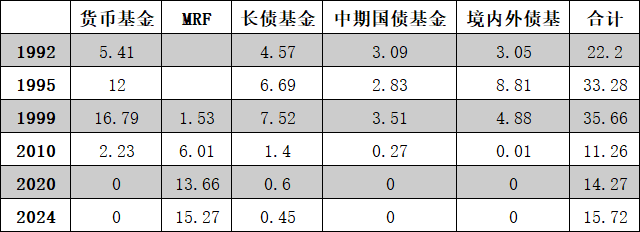
Core Viewpoint - China has entered a low-interest-rate era since 2019, facing constraints on further policy rate cuts due to various factors, including bank net interest margin pressure and residents' savings demands. Despite these challenges, bond assets can still provide underlying returns, and the "fixed income +" strategy is expected to become a significant development direction for asset management institutions, aligning with investors' core demand for stable value growth [1][5][18]. Group 1: Japan's Low-Interest Rate Era and Bond Market Evolution - Japan's low-interest-rate era began in 1999 after a series of financial crises and asset price collapses, leading to a shift in asset allocation towards low-risk assets [2][5]. - The share of overseas bond investments in Japan increased from 33% to 54% between 1997 and 2003, indicating a trend towards globalization in asset management strategies [2][4]. - The introduction of J-REITs in Japan has provided a stable income source, with annualized returns fluctuating between 4.3% and 8.9% from 2013 to 2022, contributing to the growth of the asset management industry [4]. Group 2: Characteristics of China's Low-Interest Rate Era - Since 2019, China's policy interest rates have been on a downward trend, with the 10-year government bond yield dropping below 2.0% [5][6]. - The banking sector's total assets are projected to reach 276.1% of GDP by 2024, with interest income accounting for 77.6%, indicating a significant reliance on interest income [5]. - By the end of 2024, the number of bond funds in China reached 4,534, with a total scale of 23.07 trillion yuan, reflecting a 15.9% year-on-year growth [6][7]. Group 3: Performance of Bond Products - The total scale of money market funds increased by 20.7% in 2024, while short-term bond funds grew by 13%, indicating a strong preference for low-risk investments [6][7]. - The mid-to-long-term pure bond fund index rose by 4.59% in 2024, marking a historical high in returns [8]. - "Fixed income +" products faced redemption challenges in early 2024 but rebounded in the fourth quarter as the stock market recovered, with a projected growth of 13.77% in the first half of 2025 [6][8]. Group 4: "Fixed Income +" Strategy Pathways - The narrow definition of "fixed income +" focuses on equity assets as the core for enhancement, leveraging the dual return attributes of stocks and the supportive policies from the government [10][11]. - The broad definition of "fixed income +" emphasizes a multi-asset integration approach, incorporating commodities, alternative assets, and global diversification to enhance risk-return efficiency [13][14]. - The asset allocation strategy from 2019 to present has yielded an annualized return of 9.17%, demonstrating the effectiveness of diversified asset strategies compared to single assets [14][17]. Group 5: Future Outlook - The "fixed income +" strategy is expected to benefit from the stability of bond underlying returns and the effects of multi-asset enhancement, indicating a broad development space in the future [18].
突破每盎司4000美元!五张图读懂黄金如何强势回归全球货币体系核心舞台
智通财经网· 2025-10-10 02:11
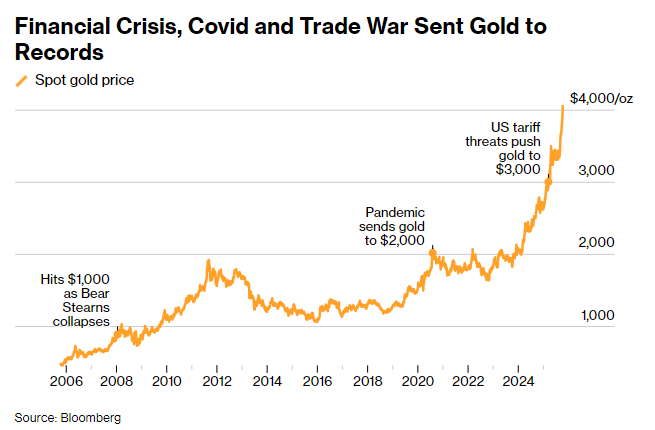
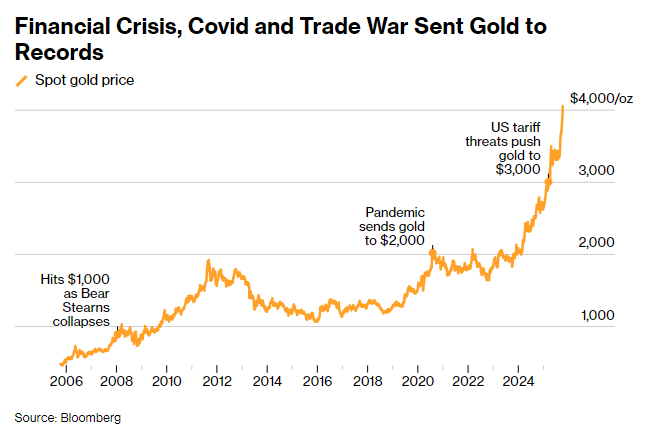
Core Viewpoint - Gold prices have surpassed $4,000 per ounce, marking a significant milestone in a three-year bull market, defying bearish predictions and traditional forecasting models [1] Part 01: Pandemic-Induced Turning Point - Gold prices initially surged past $2,000 per ounce due to market panic triggered by the pandemic, followed by the Russia-Ukraine conflict, which further fueled a 27% increase in gold prices in 2024 [1] - The return of Donald Trump to the White House in March 2025 contributed to gold breaking the $3,000 per ounce barrier [1] - Major macroeconomic factors, including a potential U.S. government shutdown and a weakening dollar, have supported the gold market [1] Part 02: Surpassing Inflation-Adjusted Historical Peaks - Last month, gold prices exceeded the inflation-adjusted historical peak of $850 per ounce set in January 1980 during a period of economic crisis in the U.S. [4] - The current market environment is seen as reminiscent of the conditions that led to the previous gold price surge [4] Part 03: Surpassing U.S. Treasury Status - Central banks have played a dominant role in the gold market, significantly increasing their gold purchases to diversify assets and reduce reliance on the U.S. dollar [7] - Gold's current value has surpassed the amount of U.S. Treasury securities held by non-U.S. central banks, becoming the second-largest asset in central bank foreign exchange reserves [7] - The market value of gold held by the U.S. has exceeded $1 trillion, significantly outpacing the recorded amounts on its government balance sheet [7] Part 04: Temporary Pause in Chinese Demand - In the first four months of 2024, Chinese market demand was a key support for rising gold prices, driven by a new wave of demand for safe-haven assets [10] - Recently, despite record high gold prices, Chinese market prices have fallen below international benchmarks, indicating a shift in market dynamics towards Western investors [10] Part 05: Surge in Gold ETF Holdings - Gold ETFs have become a mainstream channel for Western investors to gain exposure to gold, with significant inflows pushing prices higher [13] - After a period of outflows, gold inflows into ETFs have reversed, with over 16 million ounces added since mid-2024, although current holdings remain below pandemic-era peaks [13] Additional Insights - The recent surge in gold prices reflects a structural shift in investor sentiment and global capital flows, driven by sanctions, asset seizures, and concerns over fiscal sustainability [15]
史上最伟大黄金交易员豪掷10亿美元押注黄金:我们可以从中学到什么?
Sou Hu Cai Jing· 2025-10-09 11:07
Core Insights - The article highlights that gold prices have reached historic highs, surpassing $4,000 per ounce for the first time, with a cumulative increase of over 50% this year, marking the largest annual gain since the 1970s [1][38] - The surge in gold prices is attributed to five key factors, primarily driven by investors seeking safe-haven assets amid rising macroeconomic and policy uncertainties [4][38] Group 1: Factors Driving Gold Price Increase - **Policy and Macroeconomic Uncertainty**: The aggressive policies of the Trump administration have created significant policy uncertainty, prompting investors to turn to gold as a safe-haven asset [5][6] - **Weakening Dollar**: The dollar has depreciated by approximately 10% in recent months, making gold more attractive as its price in dollars becomes lower [7][8] - **Market Sentiment and Fear Trading**: Global economic uncertainties have led investors to prefer tangible assets like gold, which provide a sense of security compared to paper assets [9][10] - **Diversification Needs and Fund Flows**: Despite rising stock markets, investors are increasingly aware of the risks associated with concentrating investments in a single asset class, leading to a shift towards gold for risk hedging [11][12] - **Inflation and Long-term Price Expectations**: Gold is traditionally viewed as an inflation hedge, and while current global inflation is cooling, market expectations suggest rising concerns about inflation, further driving gold prices [13][14] Group 2: John Paulson's Investment Strategy - **Investment in Gold**: John Paulson, recognized as one of the greatest gold traders, has invested $1 billion in gold, leveraging his experience to provide valuable insights for traders [2][16] - **Positioning in Gold Mining Stocks**: Paulson prefers investing in gold mining stocks rather than physical gold, believing that mining companies' profits will increase significantly with rising gold prices [17][18] - **Investment Details**: Paulson holds significant stakes in several North American mining companies, focusing on projects with strong potential [18] Group 3: Trading Options and Platforms - **Diverse Trading Instruments**: Investors can engage in various gold trading options, including CFDs, ETFs, and mining stocks, allowing for a diversified trading strategy [19][20] - **ATFX as a Trading Platform**: ATFX is highlighted as a leading global trading platform, offering a range of gold trading tools and maintaining a strong market presence with significant trading volumes [30][33] - **Safety and Technology Enhancements**: ATFX emphasizes security and trading experience, partnering with reputable institutions to provide insurance and advanced trading technologies [36][37]

告别“野蛮遗迹”、突破4000美元:黄金过去三年因何“疯狂”?
智通财经网· 2025-10-09 00:17
Core Insights - Gold prices have surpassed the $4000 per ounce mark, marking a significant milestone in a three-year bull market [1] - The surge in gold prices has surprised bearish investors and rendered traditional gold forecasting models ineffective [1] Group 1: Market Dynamics - The turning point for gold began during the pandemic, when prices first broke the $2000 per ounce barrier due to market panic [2] - The ongoing Russia-Ukraine conflict has further fueled gold's upward momentum, with a projected 27% increase in 2024 driven by central banks and Chinese investors [2] - Recent macroeconomic factors, including a potential U.S. government shutdown and a weakening dollar, have contributed to the heightened interest in gold [2] Group 2: Historical Context - Gold prices have recently exceeded the inflation-adjusted historical peak set 45 years ago, when prices reached $850 per ounce amid multiple crises in the U.S. [5] - Current market conditions are seen as reminiscent of the past, with some analysts drawing parallels to the economic environment of the late 1970s [5] Group 3: Central Bank Influence - Central banks have played a dominant role in the gold market, significantly increasing their gold purchases to diversify assets and reduce reliance on the U.S. dollar [8] - Gold has now surpassed U.S. Treasury holdings in non-U.S. central bank foreign exchange reserves, becoming the second-largest asset in these reserves [8] - The U.S. government's gold holdings have reached a market value exceeding $1 trillion, significantly outpacing its recorded liabilities [8] Group 4: Chinese Market Trends - In early 2024, Chinese demand was a key support for gold prices, driven by a renewed interest in safe-haven assets due to global market disruptions [11] - Recently, however, Chinese gold prices have fallen below international benchmarks, indicating a shift in market dynamics where Western investors are now the primary drivers of gold price increases [11] Group 5: ETF Market Activity - Gold ETFs have become a mainstream channel for Western investors to gain exposure to gold, with significant inflows observed since mid-2024, totaling over 16 million ounces [14] - Despite the recent inflows, current ETF holdings remain below the peak levels seen during the pandemic, suggesting potential for further growth in gold investment [14] Group 6: Investor Sentiment - The recent surge in gold prices reflects a structural shift in investor sentiment and global capital flows, driven by concerns over sanctions, asset seizures, and fiscal sustainability [16]