AI泡沫

Search documents
美股异动丨财报全面超预期!英伟达盘后涨超5%
Ge Long Hui A P P· 2025-11-20 00:40
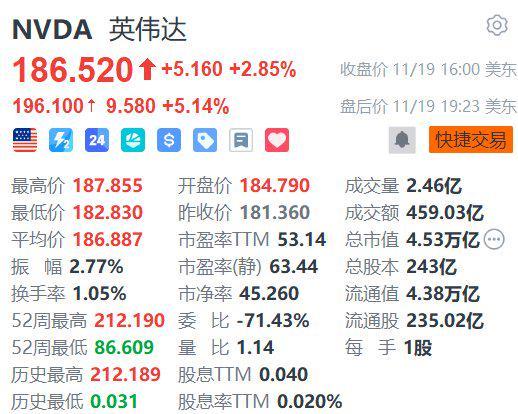
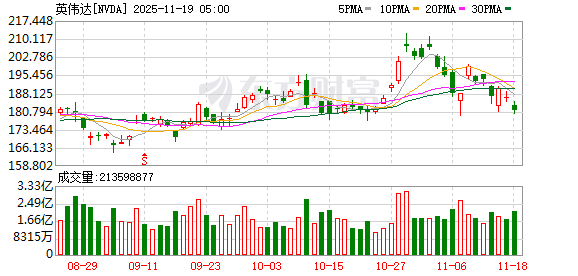
Core Viewpoint - Nvidia reported record revenue of $57.01 billion for Q3 2025, exceeding expectations and showing a year-over-year growth of approximately 62% [1][2] Financial Performance - Revenue reached $57.01 billion, surpassing the expected $55.19 billion and Nvidia's own guidance of $52.92 billion to $55.08 billion, marking a growth acceleration compared to the previous quarter's 56% year-over-year increase [1] - Non-GAAP adjusted EPS was $1.30, a 60% increase year-over-year, exceeding the expected $1.26 and representing the highest growth rate in the fiscal year [1] - Adjusted gross margin was 73.6%, down 1.4 percentage points year-over-year and below the expected 74.0%, with guidance set between 73% and 74% [1] - Adjusted operating expenses were $4.215 billion, a 38% increase year-over-year, slightly below the expected $4.22 billion [1] Future Guidance - For Q4, Nvidia expects revenue of $65 billion, with a range of $63.7 billion to $66.3 billion, compared to analyst median expectations of $61.98 billion [2] - Non-GAAP adjusted gross margin for Q4 is projected at 75.0%, with a range of 74.5% to 75.5%, while analyst median expectations are at 74.6% [2] - Adjusted operating expenses for Q4 are anticipated to be $5 billion, higher than the analyst expectation of $4.59 billion [2] Market Reaction - Following the earnings report, Nvidia's stock rose nearly 3% during regular trading and over 5% in after-hours trading, closing at $196.10 [1][4]


Q3狂揽570亿营收,英伟达九连增封神,黄仁勋放不下失去的中国市场
3 6 Ke· 2025-11-20 00:21
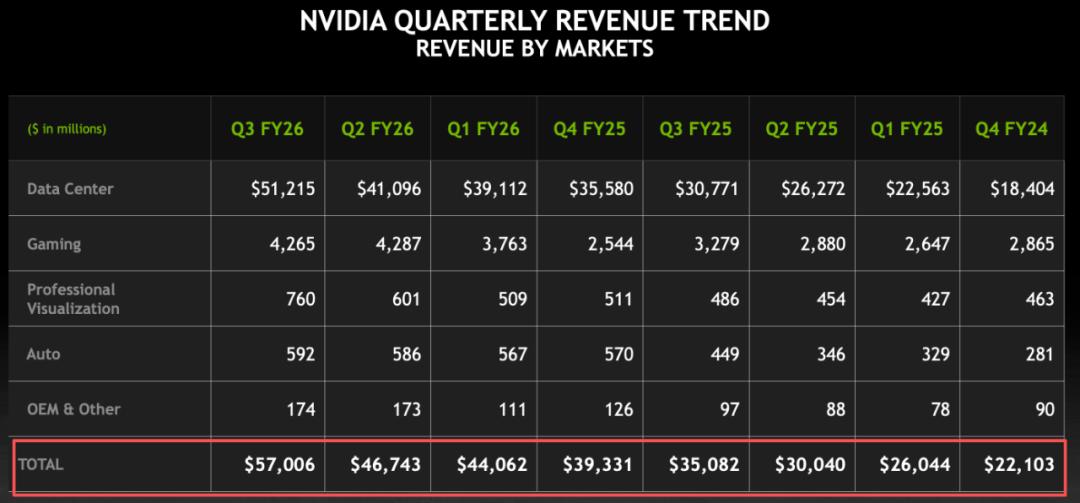
Core Insights - NVIDIA reported Q3 revenue of $57.006 billion, a 62% year-over-year increase, exceeding market expectations by approximately 10% [1][3] - The net profit for the quarter was $31.91 billion, reflecting a 65% year-over-year growth [1][3] - The data center business generated $51.2 billion in revenue, marking a 66% year-over-year increase and a record high [4][5] Financial Performance - NVIDIA's Q3 revenue of $57.006 billion surpassed the market forecast of $55.212 billion [1][3] - The company has achieved nine consecutive quarters of revenue growth [3] - The data center revenue reached a record $51.2 billion, with a 25% quarter-over-quarter increase and a 66% year-over-year increase [4][5] Business Segments - Data Center: Revenue of $51.2 billion, up 66% year-over-year [4][5] - Gaming: Revenue of $4.265 billion, a 30% year-over-year increase, but a slight 1% decrease quarter-over-quarter [6] - Professional Visualization: Revenue increased by 56% year-over-year to $760 million [6] - Automotive: Revenue grew by 32% year-over-year to $592 million [6] Market Impact - NVIDIA's significant market capitalization and weight in indices like S&P 500 and Dow Jones means its stock price movements can influence overall market trends [1] - The company's performance is seen as a critical indicator of the sustainability of AI demand in the market [1] Strategic Outlook - CEO Jensen Huang highlighted a robust demand for the Blackwell architecture, with a backlog of $500 billion in orders, excluding the Chinese market [8][9] - NVIDIA's partnerships and investments in companies like OpenAI and Nokia are aimed at building a strong AI ecosystem [15][16][17] - The company anticipates Q4 revenue to be around $65 billion, continuing its growth trajectory [18]
凌晨,直线猛拉!英伟达,重大发布!
券商中国· 2025-11-19 23:37
Core Viewpoint - Nvidia's latest earnings report for Q3 FY2026 shows a significant revenue increase of 62% year-over-year, reaching $57.01 billion, surpassing analyst expectations and alleviating concerns about an "AI bubble" [2][3][4]. Financial Performance - Nvidia reported Q3 FY2026 revenue of $57.01 billion, a 62% increase compared to the previous year, exceeding the analyst forecast of $55.19 billion [3][7]. - The data center segment contributed $51.2 billion in revenue, marking a 66% year-over-year growth, also above analyst expectations [3][7]. - Adjusted earnings per share for Q3 were $1.30, with an adjusted operating profit of $37.75 billion, both significantly higher than market predictions [3][4]. - The adjusted gross margin for Q3 was 73.6%, slightly below analyst expectations of 73.7% [3][4]. Future Guidance - For Q4 FY2026, Nvidia expects revenue to be around $65 billion, with a margin of fluctuation of 2% [4]. - The company anticipates an adjusted gross margin of 75%, which is above the analyst median expectation of 74.6% [4]. Market Reaction - Following the earnings report, Nvidia's stock surged over 6% in after-hours trading, with other AI-related stocks also experiencing gains [2][4]. - Nvidia's stock price increased by 2.85% to $186.52 during regular trading hours, and further rose to $196.80 in after-hours trading [5][4]. Business Insights - Nvidia's CEO, Jensen Huang, stated that the latest Blackwell architecture chips are selling far beyond expectations, with all cloud server GPUs sold out [2][11]. - The demand for Nvidia's high-end GPUs is driven by major tech companies like Microsoft, Amazon, Google, Oracle, and Meta, as they accelerate the development of AI models and computing clusters [10][11]. - Nvidia repurchased $12.5 billion worth of stock and paid $243 million in dividends during Q3 [8]. Strategic Outlook - Nvidia's CFO, Colette Kress, indicated that the market demand for AI infrastructure continues to exceed expectations, with potential revenue of $500 billion from the Blackwell and Rubin projects [12]. - The company is collaborating with OpenAI to build and deploy AI data centers with a total power exceeding 10 gigawatts [13].

申万宏源2026年美股投资策略:AI行情进入“换挡期” 悲观情形下下半年面临估值回撤风险
Zhi Tong Cai Jing· 2025-11-19 22:53
Core Viewpoint - The report from Shenwan Hongyuan indicates that under a neutral assumption, the risks associated with AI soft constraints by 2026 are manageable, with a focus on whether the penetration rate of B-end enterprises can improve and whether cash flow remains stable. Companies in the US stock market with relatively stable expansion are worth monitoring. However, hard constraints, particularly regarding power supply for computing infrastructure, will become more pronounced, necessitating higher verification requirements for ROI [1][2]. Group 1: Market Trends and AI Investment - Since 2023, the current AI market in the US has been ongoing for three years, primarily focusing on valuation increases and widespread performance in AI infrastructure and applications [2]. - The AI-related industries (technology, communication) are expected to contribute limited valuation in 2025, with increased reliance on debt financing amid unclear ROI for AI investments [2]. - Concerns about an "AI bubble" stem from the gap between the time required for new technologies to generate economic scale effects and the optimistic expectations of capital market returns [3]. Group 2: Constraints and Adjustments - Hard constraints often lead to periodic adjustments in the AI sector, with the "Buy the Dip" strategy still showing effectiveness in the US stock market. Adjustments have been triggered by macro liquidity tightening and concerns over computing power, algorithms, and electricity [4]. - The report outlines that the AI sector has faced multiple adjustments since 2023, with each decline exceeding 10% and lasting over a month, influenced by factors such as liquidity tightening and supply shocks [4]. Group 3: ROI and Financial Metrics - The report emphasizes that the ROI for AI investments is sensitive to GPU depreciation, with rising debt financing costs posing tail risks. The total AI investment commitment projected by Trump for 2025 is approximately $3.8 trillion, aimed to be completed by 2028 [6][7]. - Current AI penetration in US enterprises is around 10%, with higher rates in information-intensive sectors, expected to rise to over 30% in the next six months [6]. - The report highlights that the profitability of AI applications varies, with B-end applications showing higher margins compared to C-end applications, which generally have negative margins [6]. Group 4: Debt and Liquidity Risks - The overall debt pressure on AI infrastructure is manageable, but significant differentiation among companies is expected by the second half of 2025. Long-term debt levels related to AI hardware have been gradually increasing, with a decline in the free cash flow to debt ratio [7][8]. - The report warns that in a tightening liquidity environment, the probability of debt risks increases, particularly for companies with lower asset quality [8]. - The current static PE ratio for the US stock market is 28x, with historical data indicating a low success rate for holding stocks at this valuation over three years [10].




尾盘:美股涨跌不一 美联储12月降息概率骤降
Xin Lang Cai Jing· 2025-11-19 20:00
Core Viewpoint - The U.S. stock market showed mixed results as investors await Nvidia's earnings report, which is expected to address concerns over inflated valuations in the AI sector. The Federal Reserve's meeting minutes revealed significant divisions among officials regarding the need for a third consecutive interest rate cut [1][3]. Group 1: Stock Market Performance - The Dow Jones Industrial Average fell by 125.22 points, a decrease of 0.27%, closing at 45,966.52 points. The Nasdaq Composite rose by 68.99 points, an increase of 0.31%, closing at 22,501.84 points. The S&P 500 index gained 5.95 points, up 0.09%, closing at 6,623.27 points [3]. - The Nasdaq has experienced five declines in the last six trading days, while the S&P 500 has set a record for the longest consecutive decline since August [5]. Group 2: Federal Reserve Insights - The Federal Reserve's October meeting minutes indicated serious divisions among officials about the necessity of a third interest rate cut, with the probability of maintaining rates in December rising from approximately 50% to nearly 70% [3][4]. - Some officials expressed concerns that further rate cuts could exacerbate persistent inflation risks and mislead markets regarding the Fed's commitment to its 2% inflation target [4]. Group 3: Nvidia and AI Sector - Nvidia's stock price increased ahead of its third-quarter earnings report, with analysts expecting the company to significantly exceed Wall Street's expectations due to strong demand for AI chips and infrastructure [5][6]. - Nvidia holds an 84% market share in the independent GPU market and has a shipment volume nearly 4.5 times that of its competitor AMD in the PC sector [6]. - The company is a key driver of the global stock market's highs and has influenced the rise of all AI-related stocks. Revenue for the fiscal quarter from August to October is projected to grow by 56% year-over-year, reaching $54.92 billion [6]. Group 4: Other Notable Companies - Memory chip manufacturers experienced a broad rally in stock prices [7]. - Unity Software and Epic Games announced a collaboration to integrate the Unity engine into the game "Fortnite" [8]. - Adobe is nearing a $1.9 billion acquisition of SEO software company Semrush [9].
Gemini 3登场 谷歌打出AI王牌
Bei Jing Shang Bao· 2025-11-19 14:41
这是谷歌首次在模型发布当天就将其引入搜索。 同时,Gemini 3也在发布当天同步向Gemini App用户、 AI Studio和Vertex AI的开发者开放,并在智能体开发平台Google Antigravity推出,支持开发者构建更强 大的AI应用。 "我们正将Gemini注入Maps、YouTube、安卓、搜索、Workspace等产品,这个分发网络和终端数据反馈 环是无法逾越的护城河。"DeepMind CEO Demis Hassabis在一场访谈中表示。 预热已久、全网热议的谷歌Gemini 3大模型终于正式亮相。谷歌这次打出的不是小修小补的普通升级, 而是一张"王牌"——在几乎所有主流基准测试中实现全面领先,大模型的竞争格局可能就此改写。甚至 有业内人士预言:"未来6个月内,很难有公司能够超越这一成绩。" 但在人工智能进入产品化深水区 后,资本市场对"模型升级"本身的反应逐渐转弱,关注点更集中于模型是否能增强平台锁定效应,以及 是否能为核心业务带来可观回报。 发布当天即应用 当地时间11月18日,Alphabet旗下的谷歌正式发布备受期待的该司迄今最强大人工智能模型Gemini 3, 并于发 ...

发车!抛售接近尾声?
Sou Hu Cai Jing· 2025-11-19 13:16
Core Viewpoint - The article discusses the recent significant sell-off in global markets, driven by factors such as tightening dollar liquidity, delayed expectations for a Federal Reserve rate cut, and skepticism surrounding the AI bubble. Despite these challenges, there is a belief that the market will stabilize and present investment opportunities in the future [1][3][5]. Group 1: Market Conditions - A notable sell-off has affected various asset classes, including U.S. stocks, Japanese stocks, gold, and cryptocurrencies, leaving investors with limited safe havens [1][3]. - The primary drivers of the recent downturn include: 1. Tightening dollar liquidity due to U.S. government shutdown concerns, Treasury General Account (TGA) replenishment, and quantitative tightening (QT) [3]. 2. A significant drop in the market's expectation for a December rate cut by the Federal Reserve, from nearly 96% certainty to below 50% [3]. 3. Rising skepticism regarding the sustainability of the AI sector, as evidenced by a sharp increase in credit default swap spreads for companies like Oracle and CoreWeave [3][5]. Group 2: Investment Sentiment - A recent Bank of America survey indicates that 54% of fund managers believe that companies are over-investing, with 45% citing the AI bubble as a major tail risk [5]. - Despite the negative sentiment, there is optimism regarding the liquidity situation, as the U.S. Treasury has begun to release funds, potentially alleviating market liquidity concerns [5][8]. - The article suggests that the current AI bubble may not be at its end, positing that if it were to burst now, it would be one of the smallest and shortest-lived tech bubbles in history [8]. Group 3: Future Market Outlook - Historical data indicates that the year of the U.S. midterm elections (2026) is typically marked by significant market volatility, with an average intra-year drawdown of -17.5% but a subsequent average return of +31.7% in the following year [11][13]. - The earnings outlook for major U.S. companies is showing strong recovery, with a notable increase in the earnings guidance momentum score for S&P 500 companies [13]. - In the Indian market, strong domestic capital inflows and a recovering earnings cycle are supporting stability, despite a modest year-to-date increase of 8% [16][17]. - European markets are also showing signs of improvement, with MSCI Europe index earnings per share (EPS) growth exceeding expectations, particularly in the technology and financial sectors [18]. Group 4: Investment Strategy - The company maintains a "barbell" strategy for domestic markets, focusing on defensive positions in dividend and small-cap stocks while also investing in leading internet companies during market corrections [21].

【环球财经】英伟达三季报公布在即,市场面临AI叙事“压力测试”
Xin Hua Cai Jing· 2025-11-19 12:52
Core Viewpoint - Nvidia is expected to continue its high growth trend in the upcoming Q3 earnings report, with a focus on the shipment of Blackwell chips and Q4 performance guidance [2][4][6] Financial Performance Expectations - Market anticipates Nvidia will report Q3 revenue of $55.18 billion, a year-on-year growth of 57%, with a gross margin of 73.6% and adjusted net profit of $30.83 billion, reflecting a net profit margin increase from 51% to 56% [6] - Earnings per share (EPS) is projected to be $1.26, a 60% increase year-on-year [6] - Nearly 90% of Nvidia's revenue is derived from its data center business, with expectations for Q3 data center revenue to reach $49.01 billion, a 61% year-on-year increase [6] Market Sentiment and Analyst Ratings - Among 49 analysts tracking Nvidia, 46 have a "buy" rating, 2 a "hold" rating, and 1 a "sell" rating, with a target price of $240.49, indicating a potential upside of 32.6% from the current stock price [4] - Analysts express optimism regarding Nvidia's future performance, with expectations for Q4 revenue to reach $61.725 billion, maintaining a 57% growth rate [6] Impact on the AI Sector - Nvidia is viewed as a key player in the AI capital expenditure cycle, influencing the valuation of the entire AI sector [4][8] - The upcoming earnings report is seen as a "stress test" for the AI narrative, with potential implications for the broader technology sector [8] Supply Chain and Market Concerns - Any information regarding demand, order backlogs, or supply chain issues from Nvidia could significantly impact market sentiment and stock prices across the tech industry [9] - There are concerns about potential over-investment in AI, with analysts noting that Nvidia's strong guidance could exacerbate fears of a bubble in the AI sector [9][10] Regulatory and Market Risks - There is growing concern about a potential "AI bubble," with predictions indicating a significant revenue gap in the AI industry by 2030 [10] - Regulatory bodies in the US and EU are increasingly vigilant regarding systemic risks associated with large AI firms [10]
全球基金经理为企业“过度投资”敲响警钟,AI泡沫正在破裂?
第一财经· 2025-11-19 11:06
2025.11. 19 本文字数:3030,阅读时长大约5分钟 作者 | 第一财经 高雅 封图 | AI生成 全球基金经理正展现出20年未遇的谨慎,首次就企业"过度投资"发出集体预警。 根据美国银行于11月18日发布的最新全球基金经理调查(FMS),认为企业资本支出过于激进的受访者比例净值达到20%,这是自2005年8月以 来,首次出现多数基金经理持此观点的局面。该调查共涵盖202位基金经理,管理资产总规模高达5500亿美元。美银称,这一显著的态度转变与"人 工智能(AI)资本支出热潮的规模及其融资方式"密切相关。 这一对过度投资的担忧信号释出之际,正值英伟达发布财报的前一天。进入11月以来,英伟达股票价格下跌了12%,以科技股为主的纳斯达克综合 指数累计跌幅已接近6%。 全球基金经理警示风险 根据美银的调查,有45%的受访投资者将"AI泡沫"列为经济和市场的"头号尾部风险",该比例较上月的33%显著上升,甚至超过了通胀压力或美国 消费者支出紧缩等其他潜在风险。超过半数(53%)的投资者认为AI类股票已处于泡沫之中。同时,市场集中度风险仍在加剧,"做多七巨头 (Long Magnificent 7)"继续被评 ...

华尔街AI多空对决持续!桥水减持、大空头做空、巴菲特首次建仓
Sou Hu Cai Jing· 2025-11-19 10:43
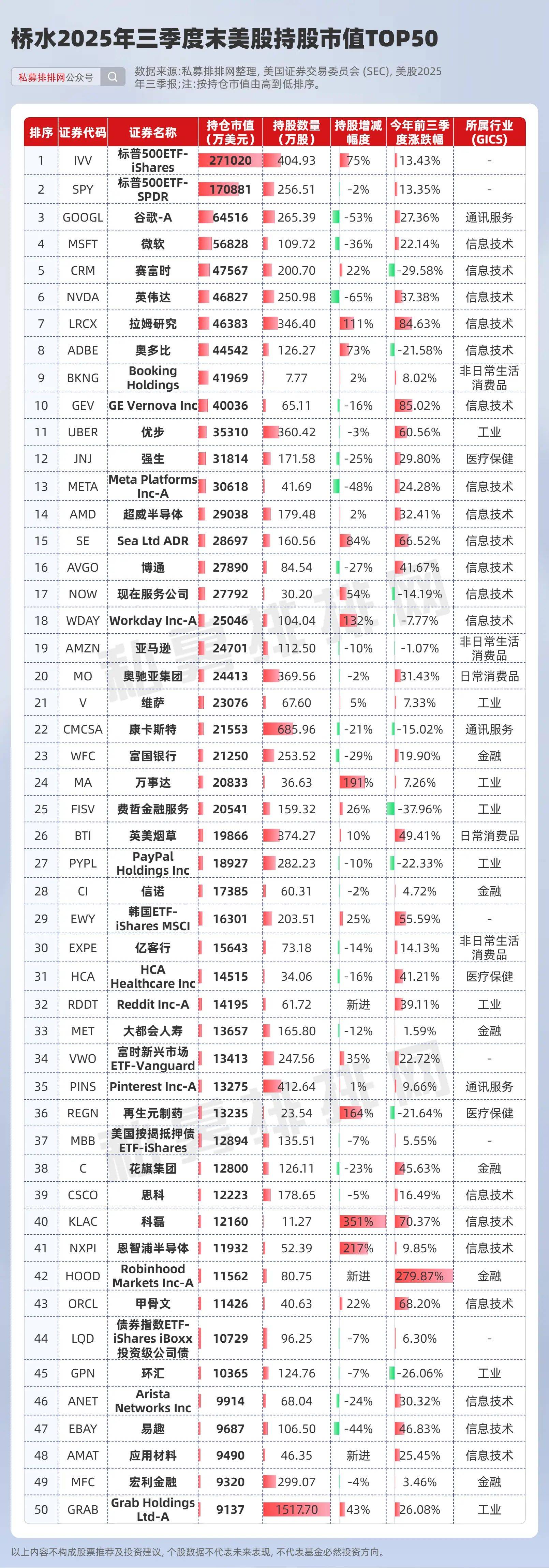
近日,华尔街多家金融机构披露了2025年三季度的13F文件,它们在AI投资上的巨大分歧引起了众多投资者的关注。 从持仓来看,桥水大幅减持英伟达、谷歌等美股科技巨头,大空头Michael Burry则清仓了所持全部英伟达股票。与之相反,巴菲特旗下伯克希尔却首次建仓 谷歌,景顺本季度依旧加仓英伟达等科技巨头。 从最新美股市场表现来看,在美联储官员集体"放鹰"的背景下,华尔街机构的"多空对决"直接放大了美股科技巨头的波动率和分化表现。在三季报披露后的 两个交易日(11月17-18日),美股科技股连续两天受挫,其中英伟达两日累跌逾4%,微软累跌逾3%,Meta累跌近2%。与此同时,谷歌两日累涨近3%。 那么,这些华尔街知名金融机构具体的调仓动向是怎样的?它们又如何看待接下来的AI行情呢? 看空派 桥水砍仓65%英伟达 在看空阵营中,全球最大的对冲基金桥水的操作格外受关注。截至2025年三季度末,桥水对英伟达的持股数量大幅削减65%至251万股,英伟达也由二季度 的第三大重仓股退居第六大重仓股。值得注意的是,桥水在二季度刚对英伟达大幅加仓约154%。此外,桥水还减持了谷歌、微软等科技巨头。 他还指出,由于货币政策宽松( ...