自动驾驶

Search documents
一笔Pre-IPO轮融资完成:11.77亿
Sou Hu Cai Jing· 2026-01-29 00:47
Group 1 - DeepWay has completed a Pre-IPO financing round, raising a total of 1.177 billion yuan [2] - The financing was led by PwC Capital, with participation from various investors including ABC Impact and Lenovo Ventures [2] - The funds will be primarily used for the operation and development of the company's core business in the smart new energy heavy truck sector [2] Group 2 - DeepWay, founded in 2020 by Baidu and Lionbridge Group, specializes in smart new energy heavy trucks and intelligent road freight solutions [2] - The company has completed a total of five financing rounds since its inception, with notable venture capital and private equity investors [2][3] - Cumulatively, DeepWay has raised over 3.157 billion yuan across these financing rounds, making it one of the notable players in China's autonomous driving sector [3] Group 3 - As of June 2025, DeepWay has delivered approximately 6,400 new energy heavy trucks [3] - The company set a record in August 2022 for the largest financing in the smart new energy truck sector with a 460 million yuan A-round [3] - The A+ round in March 2023 raised 770 million yuan, led by Weiqiao Group and SoftBank China Capital [3]

汽车早报|小米SU7 Ultra将正式入驻GT7 蔚来世界模型NWM新版本正式推送
Xin Lang Cai Jing· 2026-01-29 00:37
Group 1: Automotive Industry Developments - The first mandatory national standard for automotive driving assistance systems, titled "Technical Requirements and Testing Methods for Light Vehicle Automatic Emergency Braking Systems" (GB 39901—2025), will be implemented on January 1, 2028 [1] - Lantu Automotive has received approval from the China Securities Regulatory Commission for its introduction listing on the Hong Kong Stock Exchange [1] - NIO has officially launched a new version of its "NIO World Model" (NWM), which includes a city navigation battery swap feature, supporting over 2,000 battery swap stations nationwide [1] - Xiaomi's SU7 Ultra will officially enter the game "Gran Turismo 7" on January 29, marking the first Chinese brand model to be featured in the game [1] Group 2: Company Financials and Performance - Tesla reported fourth-quarter revenue of $24.9 billion, a year-on-year decrease of 3.1%, with operating profit at $1.41 billion, down 11%, and free cash flow at $1.42 billion, down 30% [5] - Kia Motors reported a fourth-quarter operating profit of 1.84 trillion KRW, net profit of 1.47 trillion KRW, and sales of 28.09 trillion KRW, all below market expectations [7] - Volvo Group's fourth-quarter adjusted operating profit was 12.77 billion SEK, with net sales of 123.8 billion SEK and an adjusted operating profit margin of 10.3% [7] Group 3: Strategic Initiatives and Collaborations - WeRide has launched its self-developed general simulation model, WeRide GENESIS, to accelerate the development and commercialization of autonomous vehicles [3] - Pony.ai and Aitb have formed a business partnership to build a fully autonomous driving service fleet, with the first batch of autonomous vehicles obtaining L4-level testing and demonstration application licenses [4] - Tesla plans to invest approximately $2 billion in xAI to deepen their collaborative relationship [6] - Tesla's CEO Elon Musk announced plans for significant capital expenditures in 2026, including the construction of a "Terafab" giant chip factory to address potential capacity bottlenecks [7] Group 4: Employment and Management Changes - German automotive supplier OMO has announced plans to lay off up to 4,000 employees globally, affecting operations in India, Singapore, Romania, Serbia, Germany, and Mexico [8] - Porsche announced that Tobias Sühlmann will succeed Michael Mauer as design director starting February 1, following Mauer's departure after over 20 years in the role [8]


特斯拉(TSLA.US)Q4利润大降61% 马斯克用“科技宏图”撑起信仰:20亿美元押注xAI 太空算力与机器人掀起赛博狂欢
智通财经网· 2026-01-29 00:36
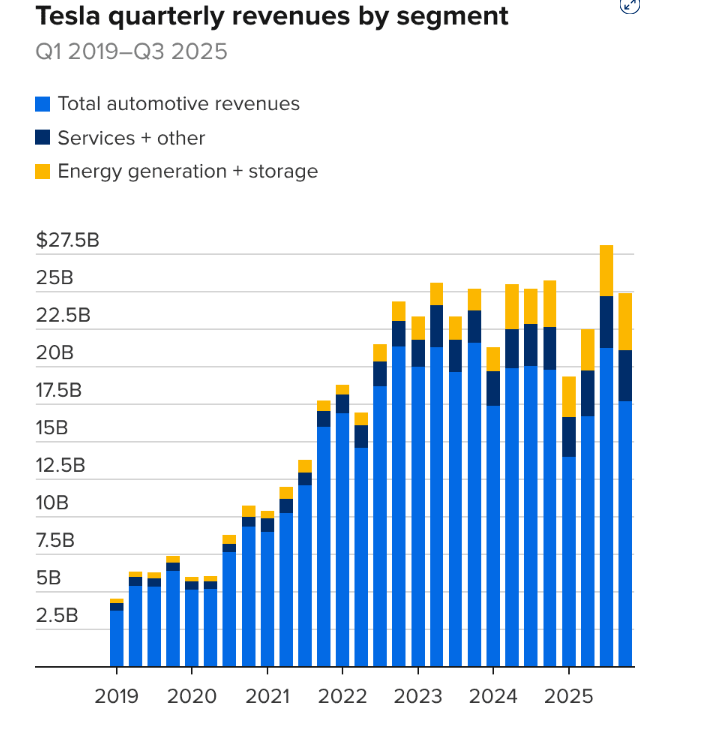
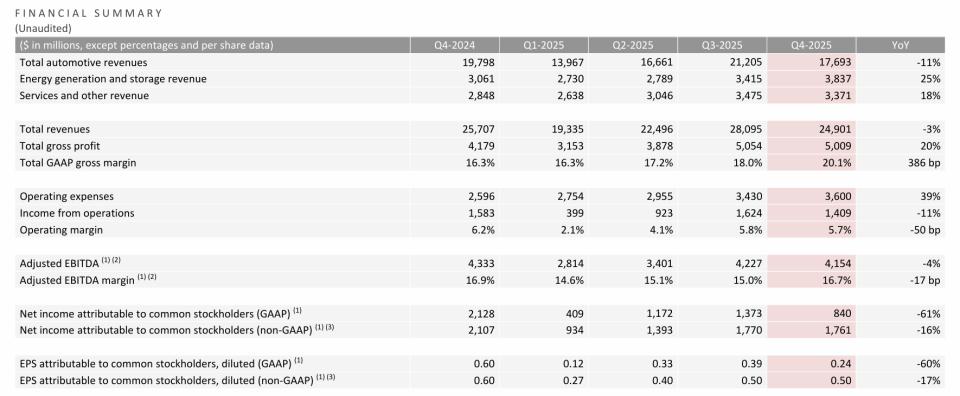
Core Insights - Tesla reported better-than-expected Q4 earnings, with record energy deployment, but faced a 3% decline in annual revenue for the first time in its history, and a significant 61% drop in Q4 net profit [1][5][12] - Despite the disappointing financials, CEO Elon Musk's optimistic outlook on AI, autonomous driving, and robotics has led to a post-earnings stock price increase of over 4% [2][13] - The company's automotive revenue fell by 11% year-over-year, while energy and storage revenue grew by 25%, indicating a shift in focus [5][15] Financial Performance - Q4 total revenue was approximately $24.9 billion, slightly above Wall Street's expectation of $24.79 billion, but down 3% year-over-year [2][5] - Adjusted earnings per share for Q4 were about $0.50, exceeding the expected $0.45 [2] - Tesla's gross margin for Q4 was approximately 20.1%, higher than the anticipated 17.1%, but net profit under GAAP standards saw a 61% year-over-year decline due to a 39% increase in operating expenses [5][12] Business Segments - The automotive segment, which has historically been the largest revenue contributor, saw a significant decline, dropping from approximately $19.8 billion to $17.7 billion year-over-year [5][12] - Energy generation and storage revenue reached about $3.84 billion, growing 25% year-over-year, which helped mitigate the decline in automotive revenue [15][18] - Tesla plans to invest $20 billion in xAI, a competitor to OpenAI, to enhance its AI capabilities [16][17] Strategic Initiatives - Tesla is transitioning its production lines to focus on the upcoming Optimus humanoid robot and plans to scale production significantly by 2026 [15][18] - The company is also expanding its Robotaxi service, with plans to roll out in several major U.S. cities [14][15] - Tesla's collaboration with SpaceX is expected to bolster its long-term growth narrative, as both companies are intertwined in Musk's broader vision for technology and infrastructure [19][20] Market Dynamics - Tesla faces increasing competition, particularly from BYD in the Chinese market, which has impacted its vehicle sales [2][9] - The decline in vehicle deliveries by 16% in Q4 and 8.6% for the year highlights ongoing challenges in the automotive sector [9][11] - Investors are increasingly viewing Tesla not just as an automotive company but as part of a larger ecosystem that includes SpaceX and AI technologies, which may support its valuation despite current struggles [2][19]

被比亚迪打到负增长,特斯拉20亿投资xAI,加速押注未来?
3 6 Ke· 2026-01-29 00:36
Core Insights - Tesla reported a slight revenue decline of 3% year-over-year for Q4 2025, with total revenue reaching $24.9 billion, slightly above market expectations. Adjusted earnings per share (EPS) were $0.50, exceeding analyst forecasts [1][5] - The core automotive business faced significant challenges, with revenues dropping 11% year-over-year to $17.7 billion, and net profit plummeting 61% to $840 million [1][3][7] - For the full year 2025, Tesla's total revenue was $94.8 billion, marking the first annual revenue decline in the company's history, with total vehicle deliveries down 8.6% to 1.64 million units [3][5] Financial Performance - Q4 2025 total automotive revenues were $17.7 billion, down from $19.8 billion in Q4 2024, while total revenues for the year were $94.8 billion, a decrease from $97.7 billion in 2024 [2][4] - The total gross profit for Q4 2025 was $5.0 billion, with a gross margin of 20.1%, reflecting a year-over-year increase of 386 basis points [2][4] - Operating expenses surged by 39% year-over-year to $3.6 billion in Q4 2025, contributing to an operating margin decline to 5.7% [2][4][15] Automotive Business Challenges - The automotive segment's revenue decline is attributed to increased market competition, particularly from Chinese competitor BYD, and the expiration of U.S. federal EV tax credits [7][9] - Tesla's global vehicle deliveries fell by 16% year-over-year in Q4 2025, with total deliveries for the year also declining [7][9] - The company has adjusted pricing strategies, reducing the starting price of Model 3 and Model Y to $37,000, but this has negatively impacted profit margins [9] Autonomous Driving and Robotics - The Full Self-Driving (FSD) subscription model has seen a doubling in monthly subscriptions, reaching approximately 1.1 million users by year-end [10] - Tesla is transitioning to a monthly subscription model for FSD, aiming for a more sustainable software revenue stream [10] - Progress has been made in the Robotaxi initiative, with plans to expand operations in several U.S. cities by mid-2026 [11] Energy Business Growth - The energy segment reported a 25% year-over-year revenue increase in Q4 2025, reaching $3.84 billion, and a total of $12.77 billion for the year, marking a 27% growth [13][14] - The gross profit from the energy business reached a record $1.1 billion in Q4 2025, driven by increased demand for energy storage products [14] Strategic Investments - Tesla's operational expenses increased significantly, reflecting a strategic focus on long-term growth through investments in AI, new production lines, and global infrastructure [15][16] - The company announced a $2 billion investment in AI startup xAI to bolster its technology narrative [6][16] - Despite a decline in operating profit margin to 4.6% for the year, Tesla maintains a strong cash position with $44.1 billion in cash and investments at the end of Q4 2025 [16]

特斯拉:将推出第三代人形机器人
财联社· 2026-01-29 00:26
以下文章来源于科创板日报 ,作者刘蕊 科创板日报 . 专注科创板和科技创新,上海报业集团主管主办,界面财联社出品。 美东时间周三盘后,特斯拉公布了好于预期的第四季度财报业绩,推动该公司股价盘后上涨3%。不过,特斯拉全年的营收同比下降了3%, 这是该公司有史以来首次出现年度营收下滑的情况。 以下是该公司的表现情况,与LSEG调查的分析师的预期相比: 每股收益:50美分(调整后),而预期为45美分 营收:249亿美元,同比下滑3%,预期为247.9亿美元 特斯拉全年营收从2024年的977亿美元降至948亿美元。特斯拉在财报中写道,营收下降的部分原因是"车辆交付量减少"以及"监管补贴收 入降低"。 本月早些时候,特斯拉公布第四季度车辆交付量同比下降了16%,全年交付量下降了8.6%。 今年上半年推广Robotaxi业务 尽管特斯拉的核心汽车业务一直面临困境,但特斯拉CEO马斯克近几个季度来一直试图将投资者的注意力转移到其他方面——例如他一直大 力宣传的新兴自动驾驶出租车业务以及尚未上市的Optimus人形机器人。 2025年,特斯拉推出了名为"Robotaxi"的叫车应用程序,并且已在美国得克萨斯州奥斯汀市开展了 ...

马云最新发声:谈AI和教育;软银拟向OpenAI追加投资300亿美元;英伟达员工晒年会最牛年终奖:黄仁勋亲笔签名皮衣丨邦早报
Sou Hu Cai Jing· 2026-01-29 00:25
Group 1: AI and Education - Jack Ma emphasizes that in the AI era, the focus should be on teaching children how to effectively use AI rather than debating its necessity. He believes curiosity, imagination, creativity, judgment, and collaboration are the key skills needed [1] - The Ma Yun Rural Teacher Program aims to enhance the quality of rural education through funding and professional training, providing support to 100 teachers annually [1] Group 2: Market Performance and IPOs - Hunan Mingming Henbang, a leading snack and beverage retailer, saw its stock surge by 88.08% upon listing on the Hong Kong Stock Exchange, closing with a market cap of 862.04 billion HKD [3] - SoftBank is reportedly negotiating to invest an additional 30 billion USD in OpenAI, which is seeking up to 100 billion USD in new funding, potentially valuing the company at 830 billion USD [9] - Tesla plans to cease production of Model S and Model X vehicles to transition towards a fully autonomous future, utilizing its "Optimus" robot factory [7] Group 3: Financial Results - Meta reported Q4 revenue of 59.89 billion USD, a 24% year-over-year increase, with advertising revenue also up by 24% [10] - Li Auto is restructuring its R&D framework, splitting the autonomous driving team into three distinct groups to enhance efficiency [9] - Oriental Selection reported a net profit of 239 million CNY for the first half of the 2026 fiscal year, reversing a loss from the previous year [11][12] Group 4: Corporate Developments - Amazon announced layoffs affecting nearly 16,000 jobs while continuing to invest in strategic areas [16] - The German automotive supplier, OMO, plans to cut up to 4,000 jobs globally due to challenging market conditions [16] - Longting Technology completed a new round of financing totaling 500 million CNY, with investments from various funds [17]






马云最新发声:谈AI和教育;软银拟向OpenAI追加投资300亿美元;英伟达员工晒年会最牛年终奖:黄仁勋亲笔签名皮衣丨邦早报
创业邦· 2026-01-29 00:08
Group 1 - Jack Ma emphasizes the importance of teaching children how to effectively use AI rather than debating its necessity, highlighting curiosity, imagination, and creativity as key skills for the AI era [2] - The Ma Yun Rural Teacher Program, initiated by the Jack Ma Foundation in 2015, aims to enhance rural education quality through funding and professional training, selecting 100 teachers annually for support [2] Group 2 - Hunan Mingming Henbang, China's largest snack and beverage retail chain, saw its stock surge by 88.08% upon listing on the Hong Kong Stock Exchange, closing with a market cap of HKD 86.204 billion [4] - The company issued 14.101 million H shares, with a subscription rate exceeding 1500 times, and anticipates net proceeds of over HKD 3 billion from the offering [4] Group 3 - Tesla plans to cease production of Model S and Model X vehicles to transition towards a fully autonomous future, utilizing the "Optimus" robot factory for production [8] - Elon Musk stated that this change is part of Tesla's overall shift towards automation, although support for existing Model S and Model X vehicles will continue [8] Group 4 - SoftBank is reportedly negotiating to invest up to $30 billion in OpenAI, which is seeking to raise up to $100 billion in new funding, potentially valuing the company at $830 billion [10] - OpenAI's largest shareholder, SoftBank, previously invested $22.5 billion in December, increasing its stake to approximately 11% [10] Group 5 - Meta reported Q4 revenue of $59.89 billion, a 24% year-over-year increase, with advertising revenue also rising by 24% to $58.14 billion [11] - The company expects Q1 sales to range between $53.5 billion and $56.5 billion, with a post-earnings stock increase of over 4% [11] Group 6 - Ideal Auto is restructuring its R&D framework, splitting the autonomous driving team into three main groups, with a focus on software and hardware integration [10] - The restructuring aims to enhance the efficiency of the development process and align with the company's strategic goals [10] Group 7 - Amazon announced a reduction of nearly 16,000 jobs as part of an organizational restructuring while continuing to invest in strategic areas [17] - The company aims to balance workforce adjustments with ongoing recruitment in critical functions [17] Group 8 - Longting Technology completed a new round of financing totaling 500 million yuan, with investors including national and local AI industry funds [18] - The funds will be used to accelerate product development and enhance the company's market position [18]



Meta第四季度营收同比增24%,盘后一度涨超11%;特斯拉Q4盈利高于预期,投资xAI 20亿美元;微软云业务增速放缓,资本支出创历史新高,盘后跌超7...
Mei Ri Jing Ji Xin Wen· 2026-01-29 00:08
当地时间1月28日,据媒体援引知情人士称,马斯克正计划将SpaceX的IPO时间安排在6月中旬——正值 罕见的行星连珠现象与他的生日期间。SpaceX计划融资规模高达500亿美元,估值约1.5万亿美元,将打 破沙特阿美2019年创下的290亿美元IPO纪录。有分析称,SpaceX公司将IPO日期放在6月份的原因之 一,或许就是马斯克的生日在6月28日,这在一定程度上凸显了马斯克对SpaceX公司的个人影响。另据 知情人士透露,该公司瞄准6月中旬上市,届时木星和金星将出现三年多来首次近距离相合。 点评:SpaceX拟于六月启动巨额IPO,潜在估值创历史新高,将引发全球资本市场高度关注。 NO.3Meta第四季度营收同比增24%,盘后一度涨超11% Meta周三盘后公布财报显示,公司第四季度营收598.9亿美元,同比增长24%,预估584.2亿美元;第四 季度广告收入581.4亿美元,同比增长24%,预估567.9亿美元;第四季度每股收益8.88美元,上年同期 8.02美元;第四季度经营利润247.5亿美元,同比增长5.9%。Meta称全年资本支出将达1150亿美元至 1350亿美元,超过分析师平均预期的1106 ...
马斯克:特斯拉将停产Model S和Model X,全力投入Optimus研发
Jin Rong Jie· 2026-01-29 00:04
Core Viewpoint - Tesla's CEO Elon Musk announced the discontinuation of Model S and Model X production in the upcoming quarter, emphasizing a shift towards a future centered on autonomous driving [1] Group 1: Production Changes - The production lines for Model S and Model X at Tesla's Fremont factory will be replaced with the Optimus production line [1] - The long-term goal for the Optimus production line is to achieve an annual production capacity of one million robots [1]
日本汽车生死时刻,丰田社长开出“七张药方”
汽车商业评论· 2026-01-28 23:06
Core Viewpoint - The Japanese automotive industry is at a critical juncture, facing systemic challenges that require a strategic response to maintain competitiveness and productivity [4][10][13]. Group 1: Strategic Challenges - The new president of JAMA, Sato Akira, is tasked with leading the development of a crucial action plan for 2026 to address the industry's challenges [6][11]. - Seven key issues have been identified, focusing on enhancing productivity and international competitiveness [15][16]. Group 2: Key Issues - **Ensuring Stable Procurement of Key Resources and Components**: Japan's reliance on imports for essential materials like rare earth elements and lithium poses a risk to supply chain resilience [18]. - **Implementing Diverse Carbon Neutrality Paths**: Japanese automakers are exploring multiple technology routes, including hybrid systems, to adapt to fluctuating electric vehicle demand [19][20]. - **Building a Circular Economy**: A complex network for data interconnectivity and component traceability is needed to create a sustainable manufacturing ecosystem [21]. - **Strengthening Human Resource Foundations**: The industry faces challenges in cultivating local talent for software and chip development, which are critical for future growth [22][23]. - **Creating Integrated Autonomous Driving Systems**: Japan is cautious in commercializing fully autonomous driving, lagging behind competitors like China and Silicon Valley [24][25]. - **Reforming Automotive Taxation**: The complex tax system hinders domestic sales, with JAMA prioritizing tax burden reduction to stimulate the local market [26][28]. - **Enhancing Supply Chain Competitiveness**: Standardization and modular design are essential for cost reduction, especially highlighted by recent chip shortages [29][30]. Group 3: Urgency and Collaboration - Sato Akira emphasized the immediate need to address the procurement of key resources as the most pressing challenge [33]. - Industry leaders recognize the necessity of collaboration to achieve scale and improve competitiveness, particularly in semiconductor standardization [35][36]. - JAMA is actively developing a chip database to enhance supply chain transparency and mitigate shortages [40]. Group 4: Economic Impact - The automotive industry accounts for approximately 10% of Japan's GDP and 20% of manufacturing GDP, with a trade surplus of about 20 trillion yen [44]. - The sector directly supports around 5.5 million jobs, expanding to 8.5 million when including related industries, highlighting its significant economic influence [45].