
服务消费

Search documents
锐财经|2025年服贸会将在京开启 激发服务贸易与消费新活力
Ren Min Ri Bao Hai Wai Ban· 2025-08-29 03:44
Core Viewpoint - The 2025 China International Service Trade Fair (CIFTIS) will be held in Beijing from September 10 to 14, focusing on the theme "Digital Intelligence Leading, Service Trade Renewed," highlighting the characteristics of service trade [1][3]. Service Trade Growth - In the first half of this year, China's service import and export total reached 3.9 trillion yuan, a year-on-year increase of 8%, marking a historical high for the same period [1]. - Service exports accounted for 11.5% of total exports, an increase of 0.7 percentage points compared to the same period last year [1]. - The transportation service export reached 418.5 billion yuan, growing by 23.9%, while travel service exports reached 174.87 billion yuan, growing by 68.7%, indicating strong growth in both traditional and emerging service sectors [2][3]. Policy Support - The development of service trade is expected to benefit from global growth, with the WTO projecting a 4.0% increase in global service exports by 2025 [5]. - The Chinese government plans to introduce new policies to support service exports, focusing on financial, regulatory, and market expansion measures [6]. - The Ministry of Commerce is tracking the implementation of the negative list for cross-border service trade and aims to enhance the liberalization and facilitation of service trade [6]. Service Consumption Potential - From January to July, national service retail sales increased by 5.2%, with service consumption becoming a significant driver for service trade growth [7]. - The CIFTIS will feature over 40 supporting activities to integrate service consumption, trade, and investment, promoting new service consumption models [7][8]. - The government will focus on policy promotion, expanding service supply, and innovating service consumption scenarios to stimulate consumption potential [8].

本周累计"吸金"超7500万元,食品饮料ETF天弘(159736)涨超2%,扩大服务消费的若干政策措施将于下月出台
2 1 Shi Ji Jing Ji Bao Dao· 2025-08-29 02:33
Group 1 - The liquor sector experienced a strong performance on August 29, with the Tianhong Food and Beverage ETF (159736) rising by 2.16% and reaching an intraday high of 2.70%, with a trading volume exceeding 13 million yuan [1] - Key stocks in the sector included Kweichow Moutai, Yili, and Wuliangye, with Kweichow Moutai hitting the daily limit [2] - The Tianhong Food and Beverage ETF has seen a net inflow of over 75 million yuan during the week of August 25 to August 28, indicating strong investor interest [2] Group 2 - Ping An Securities noted that the liquor sector is stabilizing at a fundamental level, with mid-year reports addressing historical inventory issues and dividend yields supporting stock prices [3] - Hualong Securities highlighted that the current mid-year reporting period is seeing concentrated performance pressure in the liquor sector, while new consumer brands are experiencing rapid growth [3] - The upcoming Mid-Autumn Festival and National Day are expected to catalyze consumption in the liquor sector [3]






激发服务贸易与消费新活力
Sou Hu Cai Jing· 2025-08-29 01:48
Core Viewpoint - The 2025 China International Service Trade Fair (CIFT) will be held from September 10 to 14 in Beijing, focusing on the theme "Digital Intelligence Leading, Service Trade Renewed," highlighting the characteristics of service trade [2][3]. Group 1: Service Trade Growth - In the first half of the year, China's service import and export total reached 3.9 trillion yuan, a year-on-year increase of 8%, marking a historical high for the same period [3]. - The share of service exports in total foreign trade exports reached 11.5%, an increase of 0.7 percentage points compared to the same period last year [3]. - Transportation service exports amounted to 418.5 billion yuan, growing by 23.9%, while travel service exports reached 174.87 billion yuan, with a remarkable growth of 68.7% [4]. Group 2: Policy Support and Future Outlook - The service trade sector is expected to benefit from increased policy support, with the WTO projecting a 4.0% growth in global service exports by 2025 [5]. - The Ministry of Commerce plans to introduce new policies to promote service exports, focusing on financial, regulatory, and international market development [6]. - The service retail sector saw a year-on-year growth of 5.2% from January to July, indicating a shift towards balanced consumption between goods and services [7]. Group 3: Innovation and Consumer Potential - The CIFT will feature over 40 diverse supporting activities, integrating service consumption, trade, and investment [7]. - The Ministry of Commerce aims to enhance service consumption by implementing policies that promote quality and expansion in key areas such as home services and health consumption [8]. - There will be a focus on supporting new business models and consumption scenarios, promoting the integration of commerce, tourism, culture, and sports [8].
激发服务贸易与消费新活力(锐财经)
Ren Min Ri Bao Hai Wai Ban· 2025-08-28 22:55
Core Viewpoint - The 2025 China International Service Trade Fair will be held from September 10 to 14 in Beijing, focusing on the theme "Digital Intelligence Leading, Service Trade Renewed," highlighting the characteristics of service trade [2] Group 1: Service Trade Growth - In the first half of the year, China's service import and export total reached 3.9 trillion yuan, a year-on-year increase of 8%, marking a historical high for the same period [2] - Service exports accounted for 11.5% of total foreign trade exports, an increase of 0.7 percentage points compared to the same period last year [2] - Transportation service exports reached 418.5 billion yuan, growing by 23.9%, while travel service exports reached 174.87 billion yuan, growing by 68.7%, making travel the fastest-growing sector [3] Group 2: Policy Support - The development of service trade is expected to benefit from global growth, with the WTO projecting a 4.0% increase in global service exports by 2025 [4] - The Chinese government plans to introduce new policies to support service exports, including financial and regulatory measures [5] - The Ministry of Commerce is focusing on enhancing the role of service trade in the economy, with significant investments in key areas [5] Group 3: Consumer Potential - From January to July, national service retail sales increased by 5.2%, indicating a rising share of service consumption [6] - The upcoming service trade fair will feature over 40 supporting activities, integrating service consumption, trade, and investment [6] - The Ministry of Commerce aims to stimulate service consumption by implementing policies that enhance service quality and expand service offerings [6][7]
新政组合拳9月出台,撬动服务消费新增量
Bei Jing Shang Bao· 2025-08-28 13:55
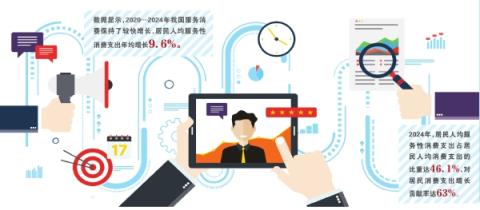
Core Viewpoint - China's consumption pattern is shifting towards a balanced stage of goods and service consumption, with a significant emphasis on service consumption as a reflection of consumption upgrading [1][3][4]. Group 1: Service Consumption Growth - From January to July this year, service retail sales increased by 5.2% year-on-year, indicating a continuous rise in the proportion of service consumption [3]. - Between 2020 and 2024, China's service consumption is expected to grow rapidly, with per capita service consumption expenditure projected to increase by an average of 9.6% annually [3]. - By 2024, per capita service consumption expenditure is anticipated to account for 46.1% of total per capita consumption expenditure, contributing 63% to the growth of resident consumption expenditure [3]. Group 2: Importance of Service Consumption - Service consumption is crucial for economic development and improving people's livelihoods, as it can stimulate both life services and productive services, leading to structural optimization and an increase in the value added by the service sector [4]. - The service sector is projected to account for 48.8% of total employment by 2024, with significant growth in sectors such as catering, accommodation, and cultural entertainment [4]. Group 3: Policy Measures to Enhance Service Consumption - The Ministry of Commerce plans to introduce several policy measures in September to expand service consumption, focusing on enhancing the supply of high-quality services through both domestic and foreign openings [5][6]. - More service consumption sectors will be included in the "Encouraged Foreign Investment Industry Directory," which is expected to enhance the quality of service supply and stimulate market vitality [6]. Group 4: Innovation in Service Consumption - High-quality, diversified, and composite innovative scenarios are identified as key drivers for enhancing and expanding service consumption [7]. - The Ministry of Commerce will support the development of new consumption formats and models, promoting activities that integrate commerce, tourism, culture, and sports [7]. Group 5: Upcoming Events and Initiatives - The 2025 China International Fair for Trade in Services (CIFTIS) will take place from September 10 to 14 in Beijing, showcasing over 190 key achievements in service trade [8]. - The event will feature various activities aimed at fostering new growth points in service consumption, including cultural markets, gourmet food, and exciting performances [8].
冠通期货早盘速递-20250828
Guan Tong Qi Huo· 2025-08-28 10:17
Group 1: Hot News - Next month, the Ministry of Commerce will introduce several policies and measures to expand service consumption, using fiscal and financial means to optimize and enhance service supply capacity and stimulate new service consumption volume. The Ministry of Commerce and relevant departments have jointly formulated "Several Policy Measures to Promote Service Exports", and relevant documents will be publicly issued soon [2] - Shanghai has issued an implementation opinion on accelerating the renovation of urban villages, prioritizing the renovation of villages with urgent public needs and many urban safety and social governance hidden dangers. The renovation of urban villages should solicit the opinions of villagers, and the initial shareholding ratio of the town collective economic organization in the cooperative renovation should generally not be less than 10% [2] - In July, the profits of industrial enterprises above designated size decreased by 1.5% year-on-year, with the decline narrowing by 2.8 percentage points compared to June and narrowing for two consecutive months. Among them, the profits of high-tech manufacturing increased by 18.9% from a 0.9% decline in June, driving the profit growth rate of all industrial enterprises above designated size to accelerate by 2.9 percentage points compared to June, showing a significant leading role [2] - As of August 27, among 89 blast furnaces of 23 sample steel enterprises surveyed, 2 new blast furnaces were under maintenance, with a newly added maintenance volume of 4340m³ and a daily average impact on hot metal production of about 10,300 tons. Currently, a total of 16 blast furnaces of steel enterprises in Tangshan are under maintenance, with a daily average impact on hot metal of about 47,400 tons, and the capacity utilization rate is 88.83%. Steel mills will gradually shut down and maintain blast furnaces at the end of the month as required. It is expected that 16 new blast furnaces will be under maintenance, with a daily average impact on hot metal production of about 116,600 tons (including previously maintained blast furnaces). The capacity utilization rate will drop to 78.13%, a decrease of 10.7% compared to the current level (August 27) and a decrease of 6.84% compared to the same period last year [3] - Goldman Sachs expects the oil surplus to intensify, with an average daily surplus of 1.8 million barrels from the fourth quarter of 2025 to the fourth quarter of 2026. By the end of 2026, global oil inventories will increase by nearly 800 million barrels. It is expected that the Brent crude oil price will fall to just over $50 by the end of 2026 [3] Group 2: Key Focus - Key commodities to focus on are urea, polysilicon, PVC, Shanghai copper, and plastic [4] Group 3: Night Session Performance - Night session performance by sector: Non-metallic building materials 2.81%, precious metals 27.04%, oilseeds 12.20%, non-ferrous metals 21.32%, soft commodities 2.52%, coal, coke, and steel ore 14.43%, energy 3.18%, chemicals 12.11%, grains 1.22%, and agricultural and sideline products 3.17% [4] Group 4: Large Asset Performance - Equity: The Shanghai Composite Index had a daily decline of 1.76%, a monthly increase of 6.36%, and an annual increase of 13.38%. The S&P 500 had a daily increase of 0.24%, a monthly increase of 2.24%, and an annual increase of 10.20%. Other indices also had their respective performance [7] - Fixed income: The 10-year treasury bond futures had a daily increase of 0.08%, a monthly decrease of 0.43%, and an annual decrease of 0.83%. Other treasury bond futures also had corresponding performance [7] - Commodities: The CRB commodity index had a daily increase of 0.76%, a monthly increase of 0.32%, and an annual increase of 1.35%. WTI crude oil had a daily increase of 0.96%, a monthly decrease of 7.74%, and an annual decrease of 11.21%. Other commodities also showed different trends [7] - Others: The US dollar index had a daily decrease of 0.05%, a monthly decrease of 1.86%, and an annual decrease of 9.48%. The CBOE volatility index had no daily change, a monthly decrease of 12.56%, and an annual decrease of 15.73% [7]
商务部 9 月将出台扩大服务消费的若干政策
Dong Zheng Qi Huo· 2025-08-28 08:56
1. Report Industry Investment Ratings - The report does not provide overall industry investment ratings 2. Core Views of the Report - The dollar index is expected to move in a volatile manner due to EU sanctions on Russia and political events in France and Ukraine [14][15] - The upward trend of US stocks remains intact, and investors can buy on dips after short - term corrections, supported by tech giants' AI capital expenditure and interest - rate cut expectations [18][19] - For stock index futures, it is recommended to allocate evenly among various stock indices, considering policies to expand service consumption and industrial profit data [20][22] - In the bond market, unilateral long positions should be taken with caution. Investors with stock positions can consider long bonds to hedge potential stock price corrections [24][25] - For commodities, different investment suggestions are provided for each category based on their specific supply - demand fundamentals and market conditions 3. Summary by Directory 3.1 Financial News and Reviews 3.1.1 Macro Strategy (Foreign Exchange Futures - US Dollar Index) - Ukraine and the US will hold a meeting on the 29th to discuss security guarantees for Ukraine. France's Prime Minister will meet with the opposition to avoid a trust vote. The EU is considering secondary sanctions on Russia [12][13][14] - The dollar index is expected to move in a volatile manner due to these events [15] 3.1.2 Macro Strategy (US Stock Index Futures) - NVIDIA's data center revenue in the last fiscal quarter was lackluster, and the revenue guidance was not impressive. Fed official Williams hinted at a possible adjustment in interest - rate policy [16][17] - The short - term adjustment of US stocks is to release valuation pressure, and the upward trend remains intact. Investors can buy on dips [18][19] 3.1.3 Macro Strategy (Stock Index Futures) - The Ministry of Commerce will introduce policies to expand service consumption in September, and jointly formulate measures to promote service exports with relevant departments [20] - In July, the year - on - year decline in industrial enterprise profits narrowed. It is recommended to allocate evenly among various stock indices [21][22] 3.1.4 Macro Strategy (Treasury Bond Futures) - From January to July, the profit growth rate of industrial enterprises above designated size decreased by 1.7% year - on - year. The central bank conducted a 3799 - billion - yuan 7 - day reverse repurchase operation, with a net withdrawal of 2361 billion yuan [23][24] - Unless the stock market continues to adjust or the central bank's monetary policy turns unexpectedly loose, treasury bonds lack the opportunity for continuous growth. Unilateral long positions should be taken with caution [24][25] 3.2 Commodity News and Reviews 3.2.1 Agricultural Products (Soybean Meal) - In September, the estimated arrival of imported soybeans at domestic oil mills is about 10.3025 million tons, and the estimated arrivals in October and November are 9 million tons and 7.5 million tons respectively [26] - The USDA will release its export sales report. Sino - US relations are the most important uncertain factor affecting the price trend. The price of soybean meal is expected to move in a volatile manner [27] 3.2.2 Agricultural Products (Soybean Oil/Rapeseed Oil/Palm Oil) - From August 1 - 25, Malaysia's palm oil exports increased by 36.41% month - on - month. Malaysia has formulated an emergency plan for agricultural exports according to EU regulations [28][29] - The short - term trend of the oil market is expected to be volatile, waiting for more data [30] 3.2.3 Agricultural Products (Cotton) - New cotton picking in Xinjiang is expected to be advanced. Brazil's cotton harvesting progress is 60.3%, and the growth progress of US cotton is slow but the quality is high [31][32][33] - Before the new cotton is listed, the supply is tight, which will support the price in the short term. Zheng cotton is expected to move in a volatile manner [34] 3.2.4 Black Metals (Rebar/Hot - Rolled Coil) - From January to July, 19,800 old urban residential areas were newly started for renovation. In July, transportation fixed - asset investment was 306.1 billion yuan. In August, the retail and wholesale of passenger cars increased year - on - year [35][37][38] - Steel prices are expected to move in a volatile manner, and a short - term volatile trading strategy is recommended [38][39] 3.2.5 Black Metals (Coking Coal/Coke) - The price of coking coal in the southwest market is stable. The coking coal futures price is expected to adjust in the short term but has strong support below [40][42] 3.2.6 Agricultural Products (Corn Starch) - From August 21 - 27, the开机率 of the corn starch industry decreased slightly, and the inventory also decreased slightly. The current inventory is at a high level, and the seasonal de - stocking inflection point may be postponed [43] - The price difference between corn starch and corn has fallen to a low level, and investors can pay attention to the opportunity to widen it [44] 3.2.7 Agricultural Products (Corn) - As of August 22, the inventory of corn in the northern port continued to decline, and the grain inventory in the southern port increased slightly month - on - month [45] - Short positions can be held for a while, and attention should be paid to factors affecting supply and demand [45] 3.2.8 Agricultural Products (Pigs) - In the first half of 2025, Muyuan Co., Ltd. had significant growth in revenue and net profit. The short - term trend of pig futures is expected to be volatile and weak, and investors can pay attention to the reverse - spread opportunity [47][48] 3.2.9 Black Metals (Steam Coal) - In July, the coal import volume of the Philippines decreased. The price of steam coal is expected to continue its seasonal weakness [49][50] 3.2.10 Black Metals (Iron Ore) - Fortescue's iron ore shipments in FY25 reached 198.4 million tons, and its cost decreased. The iron ore price is expected to move in a volatile manner, and the iron - making volume is expected to decline next week and then rebound [51][52] 3.2.11 Agricultural Products (Red Dates) - The main producing areas of red dates in Xinjiang have entered the sugar - increasing period. The price of red date futures is expected to move in a narrow range around 11,400 yuan/ton, and investors are advised to wait and see [54][55] 3.2.12 Non - ferrous Metals (Lead) - On August 26, the LME0 - 3 lead was at a discount of $38.74/ton. The US may list lead as a critical mineral, and the regeneration rate in September may decline [56] - It is recommended to wait and see in the short term [57] 3.2.13 Non - ferrous Metals (Zinc) - On August 26, the LME0 - 3 zinc was at a discount of $4.61/ton. Zijin Mining's zinc production increased. The stock market decline affected zinc prices, and the domestic supply is loosening [58][59] - It is recommended to wait and see for unilateral trading and pay attention to medium - term positive - spread opportunities [60] 3.2.14 Non - ferrous Metals (Lithium Carbonate) - The phosphoric acid iron - lithium industry proposed to resist price competition and strengthen capacity self - discipline. The Bougouni lithium mine in Mali was attacked [61][62] - It is recommended to pay attention to the opportunity of buying on dips and positive - spread trading [63] 3.2.15 Non - ferrous Metals (Copper) - The second - stage pumping operation of the Kakula mine is about to start. Canada is researching a financing plan for key mineral projects [64][65] - The copper price is expected to remain high and volatile, and it is recommended to buy on dips [67] 3.2.16 Non - ferrous Metals (Nickel) - Eramet plans to increase its nickel ore production to 42 million tons this year. The price of nickel ore is expected to decline in September - October, and the nickel price is expected to have short - term band - trading opportunities and medium - term short - selling opportunities [69][71] 3.2.17 Energy Chemicals (Crude Oil) - From August 16 - 22, US EIA commercial crude oil and refined product inventories decreased. The oil price is expected to move in a volatile manner in the short term, and attention should be paid to the seasonal inventory accumulation in the fourth quarter [72][73] 3.2.18 Energy Chemicals (Caustic Soda) - On August 27, the price of liquid caustic soda in Shandong increased slightly. The supply is sufficient, and the demand is stable. The price of low - concentration liquid caustic soda is expected to remain stable in the near future [74][75] - Investors should be cautious when chasing high prices [76] 3.2.19 Energy Chemicals (Pulp) - The price of imported wood pulp decreased. The pulp market is expected to move in a weak and volatile manner [77][78] 3.2.20 Energy Chemicals (PVC) - The price of PVC powder decreased. The PVC futures price is expected to move in a volatile manner [79][81] 3.2.21 Energy Chemicals (Styrene) - From August 20 - 27, the inventory of styrene in East China ports increased. The styrene market in September is expected to improve marginally, but there may be inventory accumulation pressure in the fourth quarter [82][83] 3.2.22 Energy Chemicals (Bottle Chips) - The export quotes of bottle - chip factories are mostly stable, with individual slight decreases. The inventory of bottle chips is accelerating to decline, and attention should be paid to the pressure on processing fees from plant restart and new capacity in September [84][86] 3.2.23 Shipping Index (Container Freight Rate) - Portugal plans to invest 3.97 billion euros to upgrade its ports. The spot freight rate is weakening, and the demand is decreasing. The freight rate is expected to continue to decline [87][88][89]
国新证券每日晨报-20250828
Guoxin Securities Co., Ltd· 2025-08-28 08:39
Domestic Market Overview - The domestic market experienced a pullback after an initial rise, with the Shanghai Composite Index closing at 3800.35 points, down 1.76% [4][9] - The Shenzhen Component Index closed at 12295.07 points, down 1.43%, while the ChiNext Index fell by 0.69% [4][9] - The total trading volume of the A-share market reached 31,978 billion yuan, showing an increase compared to the previous day [4][9] - Among 30 sectors, 29 saw declines, with real estate, comprehensive finance, and textile and apparel sectors showing the largest gains, while only the communication sector recorded an increase [4][9] Overseas Market Overview - The three major U.S. stock indices saw slight gains, with the Dow Jones up 0.32% and the S&P 500 reaching a new historical high with a 0.24% increase [2][4] - The Nasdaq rose by 0.21%, with notable gains from companies like Salesforce and Chevron [2][4] - Chinese concept stocks generally declined, with Tiger Brokers dropping nearly 10% and Canadian Solar falling over 9% [2][4] Key News - The Shanghai government is accelerating the renovation of urban villages, implementing various measures for overall project transformation [11][12] - The Ministry of Industry and Information Technology issued guidelines to optimize business access and promote the satellite communication industry, aiming for significant growth by 2030 [13][14] - The National Bureau of Statistics reported a 1.7% decline in profits for large-scale industrial enterprises from January to July, with state-owned enterprises seeing a 7.5% drop [14][15] - The Ministry of Commerce plans to introduce several policy measures next month to expand service consumption [19][20]
商务部将出台扩大服务消费 若干政策措施 激发服务消费新增量
Jin Rong Shi Bao· 2025-08-28 02:31
Group 1: Service Trade Development - The 2025 Service Trade Fair will focus on the theme "Digital Intelligence Leading, Service Trade Renewed," featuring six types of activities including global summits, exhibitions, forums, and promotional events [1] - In the first half of the year, China's service trade import and export totaled 3.9 trillion yuan, a year-on-year increase of 8%, with service exports reaching 1.7 trillion yuan, up 15% [2] - The proportion of service exports in total foreign trade exports reached 11.5%, an increase of 0.7 percentage points compared to the same period last year [2] Group 2: Policy Support and Future Outlook - The Ministry of Commerce will enhance policy support for service trade, implementing measures from the State Council's opinions on promoting high-quality service trade development [3] - A series of policies to promote service exports will be introduced, focusing on fiscal, financial, and facilitation aspects to optimize the policy environment [3] - Overall, service trade is expected to continue growing throughout the year, with an ongoing optimization of trade structure [4] Group 3: Service Consumption Initiatives - The Service Trade Fair serves as a significant platform for expanding service consumption, with over 50 countries and 20 international organizations participating [5] - The Ministry of Commerce plans to implement a consumption action plan, introducing policies to enhance service consumption and improve service supply capabilities [5][6] - There will be a focus on increasing high-quality service supply through opening up key sectors such as telecommunications, healthcare, and education [6]
2025年服贸会将启,激发服务贸易投资与消费新活力
Xin Hua Cai Jing· 2025-08-28 00:15
Group 1 - The 2025 China International Service Trade Fair will be held in Beijing from September 10 to 14, focusing on "Digital Intelligence Leading, Service Trade Renewed" as its annual theme [1] - The fair aims to enhance its role as a platform for expanding openness, deepening cooperation, and leading innovation in service trade [1][2] - Nearly 2,000 enterprises are expected to participate, including around 500 Fortune 500 companies, covering 27 of the top 30 service trade countries and regions [2] Group 2 - The fair will feature six types of activities, including a global service trade summit, exhibitions, forums, and promotional events, emphasizing international participation and the value of an open platform [2][3] - The event will showcase over 190 new products and achievements, including groundbreaking technologies such as a 3D-printed vascular stent and a professional quantum computer [3] Group 3 - China's service trade is projected to continue growing, with the total import and export value reaching a historical high in the first half of the year [4] - The World Trade Organization forecasts a 4.0% increase in global service exports by 2025, with China's travel service import and export scale exceeding 1 trillion yuan, growing at 12.3% [4] Group 4 - The fair will play a significant role in expanding service consumption, with policies aimed at enhancing service supply capabilities and stimulating new service consumption growth [6] - The event will also focus on technology empowerment and investment promotion, showcasing new digital and intelligent consumption scenarios [6]