高端化

Search documents
研判2025!中国智能电表继电器行业政策、产业链、发展现状、竞争格局及发展趋势分析:招标增量与新兴场景共振,智能电表继电器前景可期[图]
Chan Ye Xin Xi Wang· 2025-08-04 03:19
Core Viewpoint - The low-voltage cable industry in China is experiencing robust growth, driven by increasing demand for electricity due to urbanization and technological advancements, with market size projected to reach 223.21 billion yuan by 2025, growing at a compound annual growth rate (CAGR) of 9.18% from 2020 to 2024 [1][19][20]. Industry Overview - Low-voltage cables are essential for power transmission in various sectors, including residential, commercial, and industrial applications, characterized by their moderate voltage levels and high transmission efficiency [1][19]. - The market size of China's low-voltage cable industry grew from 146.75 billion yuan in 2020 to an estimated 208.56 billion yuan in 2024 [1][19]. Industry Development History - The low-voltage cable industry in China has evolved through four key stages: the embryonic stage before 1949, the foundational stage from 1949 to 1978, the transformation stage from 1978 to 2000, and the rapid growth stage from 2000 to the present [9]. Industry Chain - The upstream of the low-voltage cable industry includes raw materials such as copper, aluminum, rubber, and plastics, while the midstream involves the manufacturing of low-voltage cables, and the downstream encompasses applications in power, transportation, construction, and communication sectors [12]. Market Demand and Investment - Investment in power engineering in China is projected to grow from 270 billion yuan in 2017 to 608.3 billion yuan in 2024, with a CAGR of 12.3%, while investment in grid engineering is expected to rise from 531.5 billion yuan to 1,168.7 billion yuan in the same period [16]. - The demand for low-voltage cables is supported by the continuous expansion of power supply infrastructure and smart grid initiatives [16]. Competitive Landscape - The low-voltage cable industry in China is characterized by a large number of small-scale enterprises, with major players including Hengtong Optic-Electric, Baosheng Technology, and Zhongtian Technology, among others [22][24]. - The industry faces challenges such as product homogeneity and intense competition, but leading companies are achieving advanced technological capabilities and international competitiveness [22]. Future Trends - The low-voltage cable industry is moving towards smart technology integration, with the development of intelligent cables that can monitor operational data and predict failures [29]. - Environmental regulations are driving the industry towards greener practices, including the use of halogen-free and biodegradable materials [30]. - There is a focus on high-end special cables for demanding applications in aerospace and marine engineering, with advancements in materials enhancing performance [31].


机械工业上半年利润增长9.4%,战新产业带动作用增强
Di Yi Cai Jing Zi Xun· 2025-08-04 03:13
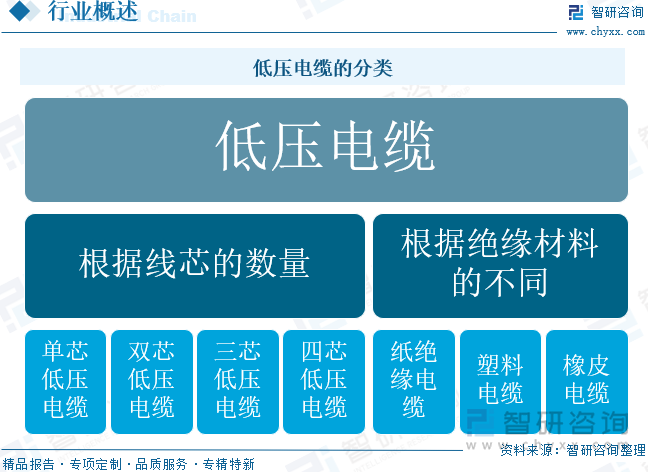
Core Viewpoint - The mechanical industry in China showed stable growth in the first half of the year, with key economic indicators such as value-added output, revenue, and profit all experiencing positive year-on-year growth, despite facing challenges like insufficient effective demand and external trade pressures [1][2][6]. Economic Performance - In the first half of the year, the value-added output of large-scale mechanical enterprises grew by 9.0% year-on-year, with total revenue reaching 15.3 trillion yuan, a 7.8% increase [1][2]. - Total profit amounted to 791.21 billion yuan, reflecting a 9.4% year-on-year growth, which is 11.2 percentage points higher than the national industrial average [1][2]. - The operating profit margin was 5.2%, slightly above the national industrial average [2]. Sector Growth - The automotive and electrical machinery sectors led the growth with increases of 11.3% and 12.2%, respectively, while general equipment, specialized equipment, and instruments also saw growth rates of 8.3%, 3.8%, and 7.6% [2]. - Among 122 monitored products, 84 saw year-on-year production increases, representing 68.9% of the total, which is an improvement of 7.4 percentage points from the previous year [2]. Strategic Emerging Industries - Strategic emerging industries continue to drive growth in the mechanical sector, with revenue and profit growth rates for these industries exceeding the overall mechanical industry by 1.3 and 5.4 percentage points, respectively [3]. Challenges and Risks - Over 60% of enterprises reported insufficient orders, with challenges including market fluctuations, insufficient effective demand, and pressure from external trade [5][6]. - The impact of U.S. tariff policies has led to increased caution among foreign buyers, resulting in a slowdown in order growth, particularly in sectors like petrochemical machinery and agricultural machinery [6]. - The price index for mechanical products has been declining, with a consistent drop of around 2% year-on-year for 29 consecutive months, further compressing profit margins [6]. Future Outlook - The mechanical industry is expected to maintain a stable growth trajectory in the second half of the year, with a projected annual growth rate of around 5.5% for major economic indicators [1][7]. - Continued emphasis on technological innovation, industrial upgrading, and the cultivation of new productive forces is anticipated to enhance the resilience and safety of the supply chain [7].

比亚迪(002594):巴西工厂投产 出海稳步推进
Xin Lang Cai Jing· 2025-08-04 00:33
Core Viewpoint - The company reported its July production and sales figures, indicating a slight year-on-year increase in wholesale sales of new energy vehicles, while facing a month-on-month decline due to seasonal factors and inventory adjustments [1][2]. Group 1: Sales Performance - In July, the company sold 344,000 new energy vehicles, a year-on-year increase of 0.6% but a month-on-month decrease of 10.0% [1]. - The wholesale sales of new energy passenger vehicles reached 341,000 units in July, reflecting a year-on-year increase of 0.1% and a month-on-month decrease of 9.7% [1]. - Cumulative wholesale sales from January to July reached 2.454 million units, representing a year-on-year growth of 26.0% [1]. Group 2: Export Growth - The company achieved 81,000 units in new energy vehicle exports in July, marking a significant year-on-year increase of 169.0%, although it experienced a month-on-month decline of 10.3% [2]. - The decline in month-on-month exports was attributed to increased import tariffs in Brazil, which took effect on July 1 [2]. - The company plans to enhance its overseas market presence, with new factories being established in Brazil, Uzbekistan, Hungary, Turkey, and Indonesia [2]. Group 3: Technological Advancements and Product Strategy - The company is focusing on high-end product development, with flagship models like Han L and Tang L already launched, featuring advanced charging technology [3]. - The upcoming Fangchengbao Titanium 7 SUV is designed to meet family needs with spaciousness and advanced technology, expected to launch in Q4 2025 [3]. - Revenue projections for 2025-2027 are estimated at 990.81 billion, 1,188.97 billion, and 1,397.04 billion yuan, with net profits of 55.20 billion, 65.81 billion, and 75.33 billion yuan respectively [3].

中国一汽累计突破关键核心技术1559项 自主攻关 向上向新(创新故事)
Ren Min Ri Bao· 2025-08-03 21:53
Core Insights - China FAW Group is showcasing its innovative achievements at the 2025 Technology Conference, emphasizing the importance of mastering key core technologies and enhancing national automotive brands to drive high-quality development in the automotive manufacturing industry [1][5] - Over the past five years, China FAW has made significant strides in innovation, achieving breakthroughs in 1,559 key core technologies and obtaining 12,728 patent authorizations [1][3] - The production efficiency at the Hongqi manufacturing center is notable, with a complete vehicle assembly time of just 54 seconds and an automation rate of 71.4% in the stamping production line [2][5] Innovation and Technology - China FAW has transitioned from manual production to a highly automated and intelligent manufacturing process, with 100% automation in the welding production line using 739 robots [2][3] - The company has successfully developed domestic air springs, reducing the cost from approximately 15,000 yuan to about 2,000 yuan per vehicle, breaking the foreign monopoly [3][4] - The development of low-temperature battery cells addresses the challenges of battery performance in cold climates, ensuring that the vehicles maintain their power and performance in low temperatures [4][5] Market Performance - In the first half of the year, China FAW's total vehicle sales reached approximately 1.57 million units, representing a year-on-year increase of 6.2% [5] - The sales of its self-owned brands exceeded 450,000 units, with an 8.5% increase, while the sales of new energy vehicles surged by 95.5% to over 145,000 units [5]

又一超大直径盾构机在郑下线 巨无霸姊妹花出海闯世界
He Nan Ri Bao· 2025-08-01 23:15
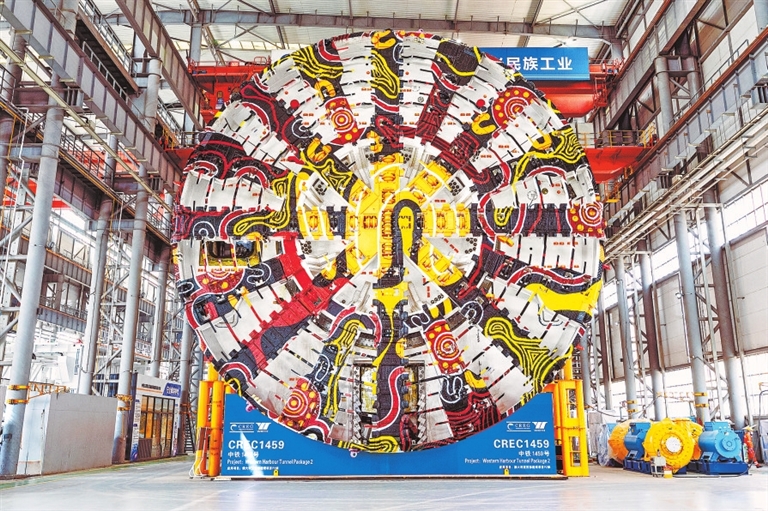
Group 1 - The largest diameter shield machines exported by China are "Patigalang" and "Barangaroo," which are designed for the Sydney Western Harbour project in Australia [3][6] - "Barangaroo" was successfully launched on July 30 at the Zhengzhou National TBM Industrialization Center, while "Patigalang" was launched in April [3][6] - The Sydney Western Harbour project features a dual-tunnel design with a maximum depth of 52 meters below sea level and complex geological conditions, including sandstone and clay layers [3] Group 2 - Both shield machines have a diameter of 15.7 meters, a length of approximately 113 meters, and weigh over 4,300 tons, incorporating multiple intelligent technologies to enhance construction efficiency [6] - The successful acquisition of the project order in Australia is attributed to the advanced and targeted technical solutions provided by the company [6] - The company has been actively integrating into the global market, exporting tunnel boring machines to over 30 countries and regions, maintaining the world's highest production and sales for eight consecutive years [6]
百威亚太(01876.HK)2025年中报点评:延续去库 务实调整
Ge Long Hui· 2025-08-01 19:21
Core Viewpoint - The company reported a decline in revenue and profitability for the first half of 2025, with a total revenue of $3.14 billion, a normalized EBITDA of $980 million, and a normalized net profit of $470 million, reflecting year-on-year decreases of 7.7%, 10.6%, and 14.1% respectively [1] Group 1: Financial Performance - In Q2 2025, the company achieved a revenue of $1.68 billion, with a year-on-year decline of 4.6% in reported terms and 3.9% in organic terms [1] - The normalized EBITDA for Q2 2025 was $500 million, showing a year-on-year decrease of 5.7% in reported terms and 4.5% in organic terms [1] - The normalized net profit for Q2 2025 was $240 million, reflecting a year-on-year decline of 6.3% [1] Group 2: Regional Performance - In the Asia-Pacific West region, revenue declined by 2.7% year-on-year in Q2 2025, while normalized EBITDA showed a 1.4% organic growth due to a low base effect [1] - The China region continued to experience inventory reduction, with a revenue decline of 6.4% year-on-year in Q2 2025, driven by policy impacts and a focus on inventory reduction [1] - The Indian market showed strong growth in high-end and ultra-high-end products, offsetting the weak demand in China, contributing to a more stable performance in the Asia-Pacific West region [1] Group 3: Future Outlook - The company expects to continue its inventory adjustment in Q3 2025, with a potential return to normal growth in Q4 2025 due to low base effects [3] - The non-current drinking channel in China is being expanded, with high-end and ultra-high-end products gaining a larger share compared to current drinking channels [3] - The Indian region is anticipated to maintain its growth momentum, with double-digit growth in high-end and ultra-high-end products [3]

2023年中国筋膜枪行业调研简报-20250801
Tou Bao Yan Jiu Yuan· 2025-08-01 13:31
Investment Rating - The report does not explicitly state an investment rating for the industry Core Insights - The Chinese fascia gun industry is experiencing significant growth driven by government policies that promote market standardization and technological upgrades, leading to a shift towards smart and high-end products [3][4] - The market is characterized by a clear segmentation of consumer groups, with fitness enthusiasts, office workers, and the elderly representing 35%, 45%, and 15% of the market respectively [20][24] - The industry faces challenges such as a lack of unified standards, intense price competition, and high supply chain costs, which hinder the development of high-end products [28] Summary by Sections Government Policies and Market Regulation - The industry has been regulated through policies like the Medical Device Supervision and Administration Regulations, which classify fascia guns as Class II medical devices, raising market entry barriers and ensuring product safety [3] - Tax reductions and R&D subsidies are encouraging companies to innovate and develop high-end, smart products [4] Competitive Landscape - International brands dominate the high-end market due to superior core performance, while Chinese brands are focusing on differentiation through smart features and appealing designs to attract younger consumers [10][11] - Chinese brands leverage local supply chain advantages to build efficient sales networks, reducing production costs by 10%-15% [12] Market Segmentation and Brand Strategies - The market is divided into high-end, mid-range, and entry-level segments, with leading brands focusing on the mid to high-end market by combining cost-effectiveness with smart technology [16][18] - Brands are adopting a "scene-based + modular" product strategy to cater to different consumer needs, enhancing brand loyalty through targeted marketing efforts [21] Future Trends and Challenges - The industry is expected to evolve towards smart and personalized solutions, integrating with wearable technology to create a comprehensive health management ecosystem [22][29] - The ongoing push for standardization is likely to eliminate low-quality products and concentrate market share among leading companies [30]
创世纪(300083):3C设备龙头 消费电子周期复苏、新领域拓展促增长
Xin Lang Cai Jing· 2025-08-01 12:35
Group 1: Company Overview - The company, Genesis, focuses on the research, production, sales, and service of high-end intelligent equipment, with key products including drilling and milling machining centers for the consumer electronics industry, as well as vertical, horizontal, and gantry machining centers for automotive manufacturing and hardware molds [1] - In 2024, the company's revenue is projected to be approximately 4.605 billion yuan, representing a year-on-year growth of 31%, while the net profit attributable to shareholders is expected to be around 237 million yuan, reflecting a year-on-year increase of about 22% [1] Group 2: Industry Trends - The global machine tool market is expected to reach approximately 120.2 billion USD in 2024, with a projected CAGR of 7.5% from 2025 to 2033, growing to 230.42 billion USD by 2033 [2] - The machine tool industry is anticipated to benefit from a replacement cycle and a manufacturing recovery, with the replacement cycle estimated at 7-10 years and signs of improvement in manufacturing sentiment indicated by a PMI of 49.7% in June 2025 [2][3] Group 3: Emerging Opportunities - The consumer electronics sector is entering a new innovation cycle, which is expected to drive demand for upstream equipment beyond expectations, with Apple likely to lead this growth [4] - New fields such as humanoid robots and low-altitude economy are projected to experience significant growth, with the humanoid robot market in China expected to reach 75 billion yuan by 2029 and the low-altitude economy's core industry scale reaching 580 billion yuan in 2024 [5] - The company is well-positioned to benefit from the recovery in the 3C cycle and the rapid development of emerging fields from 0 to 1, leveraging its competitive advantages in research and scale [6] Group 4: Financial Projections - The company's net profit attributable to shareholders is forecasted to be approximately 400 million yuan, 550 million yuan, and 660 million yuan for the years 2025 to 2027, representing year-on-year growth rates of 70%, 36%, and 20% respectively [7] - The corresponding price-to-earnings ratios for August 1 are projected to be approximately 34x, 25x, and 21x for the years 2025 to 2027 [7]

下半年,联合利华需要在中国打一场“反弹之战”
FBeauty未来迹· 2025-08-01 11:13
Core Viewpoint - Unilever's financial performance in the first half of 2025 shows a decline in overall revenue but indicates a positive trend in strategic transformation and market focus, particularly in the Chinese market [2][4][30]. Financial Performance - Total revenue for the first half of 2025 was €3.01 billion (approximately ¥24.76 billion), a year-on-year decrease of 3.2%, primarily due to currency fluctuations (-4.0%) and business adjustments (-2.5%), while underlying sales grew by 3.4% [2]. - Operating profit was €530 million (approximately ¥4.37 billion), reflecting a significant year-on-year drop of 10.6% [2]. Strategic Focus - CEO Fernando Fernandez emphasized the importance of "focus" and "agility" in driving growth, highlighting the company's strategic correctness in both developed and emerging markets [4]. - Unilever is undergoing a profound transformation, with plans to spin off its ice cream business and leverage influencer marketing as a new growth engine [4][12]. China Market Insights - In China, Unilever's underlying sales saw a slight decline in the first half, but improvements were noted in the second quarter, suggesting that recent adjustments are beginning to yield results [6][26]. - The company is accelerating premiumization and localized innovation, exemplified by the launch of the Vaseline Water Radiance Body Essence series tailored for Chinese consumers [8][27]. Regional Performance - Revenue contributions from developed markets (44%) and emerging markets (56%) showed growth rates of 4.3% and 2.8%, respectively, indicating that the Chinese market is crucial for the group's return to positive growth [10][30]. - The beauty and personal care segments generated €650 million (approximately ¥5.35 billion) in revenue, with underlying sales growth of 3.7% and 4.8% [10]. Business Restructuring - Unilever is actively engaged in mergers and acquisitions, focusing on high-end beauty and personal care brands, while divesting non-core assets to optimize its business portfolio [13][16]. - The company has made several acquisitions, including a 90.5% stake in the high-end beauty brand Minimalist and the purchase of the UK-based eco-friendly personal care brand Wild [16][17]. Marketing Strategy - Unilever is shifting towards a "influencer-first" strategy, planning to increase social media spending from 30% to 50% of its total advertising budget and expand collaborations with influencers [18][19]. - This strategy aims to enhance brand relevance and connection with younger consumers, particularly in the beauty sector [20]. Future Directions - Unilever's three core development directions include enhancing beauty and health, increasing investments in the U.S. and Indian markets, and deepening high-end and digital transformation [22][23][24]. - The company anticipates a rebound in the Chinese market, supported by regional growth and strategic adjustments, with expectations of a sales growth rate between 3% and 5% for the full year [30][29].

新华视点丨特色产业“小切口”撬动地方经济“大发展”
Xin Hua She· 2025-08-01 08:09
Group 1: Durian Industry in Sanya - The Sanya Yucai Ecological Zone has successfully developed a durian industry with over 13,000 acres of large-scale cultivation, producing "tree-ripened" durians with a market price exceeding 60 yuan per pound [5][6] - The application of advanced technologies, such as water and fertilizer integration and a 160-point data control system, has significantly reduced the fruit-bearing period from 8 years to 4 years, enhancing survival rates and fruit quality [5] - A multi-crop planting model involving durians, bananas, betel nuts, and pineapples has alleviated the initial 4-year income pressure from durian cultivation [6] Group 2: Economic Impact and Employment - The Yucai Ecological Zone has leveraged 1.18 billion yuan in fiscal funds to attract 4.5 billion yuan in social investment, creating a five-link mechanism that promotes land transfer, labor employment, technical services, profit sharing, and industrial development [9] - This initiative has generated employment for 4,052 individuals across 10 villages, with labor wages amounting to 7.5484 million yuan [9] Group 3: Aluminum Industry in Guizhou - Guizhou's Qingzhen City, rich in bauxite resources with over 300 million tons, is focusing on high-end, green, and intelligent development of the aluminum industry [8][18] - The city is attracting deep processing aluminum enterprises to shift from resource selling to product manufacturing, enhancing the local economy [11][14] - The China Aluminum Guizhou branch has been mining bauxite since 2017, continuously improving mining technology for better safety and resource utilization [12]