
关税

Search documents
全球央行年会前市场进入避险模式,纳指跌近1.5%,英特尔逆势收涨近7%
Feng Huang Wang· 2025-08-19 22:18
Market Overview - US stock indices closed mixed as investors await Fed Chair Powell's speech at the Jackson Hole conference, looking for signals on interest rate direction [1] - Rate futures indicate the Fed is expected to cut rates twice this year, each by 25 basis points, with the first cut anticipated in September [1] - Concerns arise as some investors rotate out of tech stocks into high-growth sectors, influenced by the significant weight of tech giants in major indices [1][2] Consumer Behavior - Consumers are currently cautious in their spending, observing the impact of tariffs on holiday consumption [2] - Major retailers like Lowe's, Walmart, and Target are set to release earnings reports, which will provide insights into the health of American consumers [1][2] Sector Performance - The S&P 500's sectors showed declines in technology (-1.88%), telecommunications (-1.16%), and consumer discretionary, while real estate gained 1.80% [3] - Semiconductor ETFs fell by 2.02%, and various tech sector ETFs declined between 1.34% and 1.89% [2] Notable Stock Movements - Major tech stocks experienced declines, with Nvidia down 3.50% and Meta down 2.07%, while Intel surged approximately 7% after SoftBank announced a $2 billion investment [4][5] - Home Depot's stock rose 3.2% despite second-quarter earnings missing market expectations, as the company maintained its full-year guidance [5] Company News - The US government is negotiating with Intel to acquire equity in exchange for subsidies under the CHIPS Act, emphasizing a non-voting stake [7] - Meta is restructuring its AI team into four independent groups to enhance its focus on achieving "superintelligence" [7] - Ford is seeking external customers for its joint battery plant with SK On due to a slowdown in electric vehicle demand [8] AI Developments - OpenAI's CEO Sam Altman announced that GPT-6 is in development, promising more personalized interactions through memory capabilities [9]

美国典当行火了
Guo Ji Jin Rong Bao· 2025-08-19 16:21
Group 1 - American families are planning to spend about 2% less on back-to-school shopping this year compared to last year, leading to increased visits to pawn shops for essential items [1] - Pawn shops offer a wide range of back-to-school supplies, including sneakers, laptops, instruments, and mini-fridges, often at prices significantly lower than large retail stores [1] - The rise in tariffs on imported clothing and footwear, with some reaching up to 30%, has contributed to higher prices for essential back-to-school items, with shoe prices increasing by 1.4% and clothing prices by 0.1% in July [1] Group 2 - EZPawn, a chain with 500 locations, reports that prices at pawn shops can be up to 50% cheaper than large retail stores, with a 4% increase in sales last quarter, particularly in categories like footwear and electronics [2] - Approximately 98% of items sold at pawn shops are second-hand, making them exempt from tariffs, which is an attractive feature for budget-conscious consumers [2] Group 3 - There has been a significant increase in the number of families pawning gold and jewelry to obtain extra cash for school supplies, indicating a growing financial strain on households [3] - The National Pawnbrokers Association notes that customers who can access loans may be heavily indebted, while many regular pawn shop customers struggle to obtain traditional credit [3] - The busy nature of pawn shops may signal worsening economic conditions, as many customers are facing severe financial difficulties [3]
关税与通胀后续走势如何?仍难预料
财富FORTUNE· 2025-08-19 14:03
Core Viewpoint - The article discusses the impact of tariffs on inflation and consumer prices in the U.S., highlighting that the expected transmission of tariff costs to consumer prices has not been as severe as anticipated, with companies absorbing costs to maintain profit margins [2][4][6]. Group 1: Inflation and Tariffs - The Consumer Price Index (CPI) has shown a slight increase, but remains below expectations, while the Producer Price Index (PPI) unexpectedly rose [2]. - Some industries severely affected by tariffs have seen price surges, yet July data indicates a relief in price pressures for certain goods, while service sectors are experiencing increased price pressures [2]. - JPMorgan's report suggests that companies are absorbing tariff costs at the expense of profit margins, with current profit margins at historical highs allowing for cost absorption without damaging capital or operational budgets [2][4]. Group 2: Tariff Rates and Consumer Impact - Barclays reports that the actual weighted average tariff rate in May was only 9%, lower than the previously estimated 12%, indicating that the impact of tariffs may be less than expected [2][4]. - The article notes that over half of U.S. imported goods benefited from tax exemptions, which has shifted demand away from high-tariff countries [3]. - Citi Research has not found significant evidence of widespread price pressure from tariffs, attributing recent service price increases to one-time factors [5]. Group 3: Future Projections and Economic Implications - Despite potential future tariff increases, Citi's chief economist predicts that consumers will not face significant price hikes due to weakening demand, which limits companies' ability to pass on costs [6]. - Goldman Sachs forecasts that consumers will bear a larger share of tariff costs, with the proportion expected to rise from 22% to 67% if current trade policies continue [6]. - The article emphasizes the importance of understanding the extent of tariff impacts on inflation for the Federal Reserve, as persistent inflation above the 2% target complicates monetary policy decisions [7].



Amer Sports(AS) - 2025 Q2 - Earnings Call Transcript
2025-08-19 13:00
Financial Data and Key Metrics Changes - Amur Sports reported a 23% sales growth in Q2 2025, or 22% excluding currency impact, with an adjusted operating margin increase of 260 basis points [6][31][34] - Adjusted net income for Q2 was $36 million, compared to $25 million in the prior year, with adjusted diluted earnings per share rising to $0.06 from $0.05 [35][36] Business Line Data and Key Metrics Changes - Technical Apparel revenues increased by 23% to $509 million, driven by a 31% expansion in direct-to-consumer (D2C) sales [36][37] - Outdoor Performance segment saw revenues rise by 35% to $414 million, with D2C growing 63% [39] - Ball and Racket segment revenue increased by 11% to $314 million, supported by strong performance in racket sports and soft goods [42] Market Data and Key Metrics Changes - Asia Pacific region led growth with a 45% increase, followed by China at 42%, EMEA at 18%, and The Americas at 6% [32] - The Americas' growth deceleration was attributed to normalizing growth in the ball and racket segment and a tougher comparison due to shipment shifts [32] Company Strategy and Development Direction - The company aims to optimize its retail footprint in Greater China, focusing on high-quality locations rather than rapid expansion [13][14] - Amur Sports is confident in its ability to manage through tariff scenarios due to its premium brands and pricing power [7][29] - The company plans to open approximately 25 net new stores globally in 2025, with a focus on North America [13] Management's Comments on Operating Environment and Future Outlook - Management expressed confidence in the company's growth trajectory, citing strong brand momentum and a unique portfolio of premium brands [5][8] - The company raised its full-year revenue growth guidance from 15%-17% to 20%-21%, reflecting strong Q2 performance and ongoing momentum [49][50] Other Important Information - The company received $19 million in government grants, benefiting its adjusted operating margin by approximately 150 basis points in Q2 [34] - Amur Sports ended the quarter with $640 million in net debt, maintaining a healthy balance sheet to navigate external uncertainties [45] Q&A Session Summary Question: Can you elaborate on the momentum in the third quarter and the growth drivers for Solomon? - Management noted strong Q2 results and continued momentum into Q3, particularly for Solomon footwear, driven by new product introductions and a unique outdoor sneaker category [56][57] Question: What are the next growth levers for the Solomon brand? - Management highlighted the strong growth pattern in Solomon, particularly in China and Asia Pacific, and plans to open additional stores in the U.S. [62][63] Question: What type of price increases are being implemented to mitigate tariffs? - Management indicated that while Wilson has seen approximately 10% price increases, Solomon and Arcterix have not yet needed to raise prices due to their pricing flexibility [69][70] Question: How are full-price stores performing compared to outlet stores? - Full-price stores are performing robustly, with a mid-single-digit drag from outlet sales declines, indicating a shift towards a healthier full-price business [73][74] Question: What is the outlook for the women's business at Arcterix? - The women's business saw over 30% revenue growth in Q2, with specific models performing exceptionally well, indicating a strong product strategy [84][85]

关税与高利率压制消费需求 家得宝(HD.US)Q2同店销售额不及预期
智通财经网· 2025-08-19 12:13
Core Insights - Home Depot reported Q2 financial results with non-GAAP EPS of $4.68, slightly below expectations by $0.01, while revenue reached $45.28 billion, reflecting a 4.8% year-over-year growth, meeting forecasts [1] - Key sales metrics showed underperformance, indicating a reduction in consumer spending on big-ticket items amid high interest rates and inflation uncertainty, with same-store sales growth at 1%, below the expected 1.4% [1][2] - The company noted a decline in same-store customer transactions by 0.4% year-over-year, while the average transaction amount increased by 1.4% [1] Financial Performance - Home Depot's total customer transactions decreased by 0.9% to 446.8 million, with the average transaction amount rising by 1.2% to $90.01 [1] - The company expects total sales to grow by 2.8% for the fiscal year, with same-store sales projected to increase by approximately 1% after excluding one-time factors [2] Consumer Behavior - Consumers are increasingly engaging in smaller projects, with 12 out of 16 sales departments reporting year-over-year sales growth [2] - The trend of postponing large projects persists due to high interest rates and economic instability, although customers are not canceling these projects [2][3] Pricing Strategy - Home Depot has maintained its pricing levels as most imported goods arrived before new tariffs were implemented, although price increases are anticipated later in the year [2][3] - The company is studying customer sensitivity to price increases and expanding procurement channels [3] Market Positioning - Home Depot is focusing on professional contractors, with a significant portion of sales coming from this segment, which typically spends more than DIY customers [4][6] - The company has made strategic acquisitions, including SRS Distribution for $18.25 billion and plans to acquire GMS for approximately $4.3 billion, enhancing its professional product distribution [6] Competitive Landscape - Home Depot's competitors, such as Floor & Decor, have noted minimal impact from recent price adjustments but anticipate further measures later in the year [3] - The company has not altered its pricing strategy despite changes in U.S. tariff policies, with a customer base that generally has better financial stability than the average consumer [7]

每日投行/机构观点梳理(2025-08-19)
Jin Shi Shu Ju· 2025-08-19 12:01
Group 1: Gold Price Forecast - UBS has raised its gold price target by $100 to $3,600 per ounce by the end of March 2026, and by $200 to $3,700 per ounce by the end of June 2026, maintaining the same forecast for September 2026 [1] Group 2: Federal Reserve Interest Rate Expectations - Russell Investments suggests that the upcoming Jackson Hole meeting may temper expectations for Federal Reserve rate cuts, with a possibility of a 25 basis point cut in September rather than 50 basis points [1] - CICC indicates that the Federal Reserve will remain cautious in its rate cut decisions, with internal divisions and external pressures suggesting that significant cuts are unlikely due to concerns over "stagflation" [4] Group 3: Impact of Tariffs on Inflation and Currency - Deutsche Bank warns that U.S. tariffs may increase inflation and weaken the dollar, as companies might pass on tariff costs to consumers, potentially leading to reduced consumer spending [2] - Canadian Imperial Bank of Commerce reports that U.S. tariffs on European and UK goods have caused government bond yield curves to steepen, as investors demand higher compensation for holding long-term bonds [1] Group 4: Economic Growth Risks - Fitch Ratings states that higher U.S. tariffs could threaten India's projected economic growth of 6.5% for the fiscal year, particularly affecting sectors like IT services and construction if tariffs remain elevated [3] - CICC notes that the overall valuation of A-shares is reasonable and not overvalued, with the Shanghai Composite Index's dynamic P/E ratio at around 12.2 times, indicating a moderate valuation compared to global markets [6] Group 5: Financial Market Trends - CITIC Securities reports a significant increase in bank wealth management products, with a growth of approximately 2 trillion yuan to 32.67 trillion yuan by the end of July 2025, driven by high-interest deposits maturing [8] - CITIC Securities also highlights that the price of rare earths is expected to stabilize and potentially increase, supported by strong demand from sectors like electric vehicles and consumer electronics [9]
吃饭又砸锅?欧洲可不干!美国财长威胁对华加税200%,G7无人响应
Sou Hu Cai Jing· 2025-08-19 09:16
Group 1 - The core viewpoint of the articles revolves around the increasing tensions between the U.S. and its allies regarding tariffs on countries purchasing Russian energy, with U.S. Treasury Secretary Besant threatening higher tariffs as a negotiation tactic [1][2] - The silence from G7 leaders during Besant's proposal for a 200% tariff on China indicates their reluctance to support U.S. measures that could jeopardize their own economic interests, particularly in relation to their trade ties with China [2][3] - The articles highlight a shift in global economic dynamics, where countries are less reliant on the U.S. and more focused on their own interests and relationships with China, reflecting a decline in U.S. influence within the G7 [3][6] Group 2 - The U.S. strategy of imposing tariffs to suppress China's economic growth is seen as a way to deflect attention from domestic economic issues, such as job shortages and industrial decline [2][4] - The potential for retaliatory measures from China could pose significant risks to U.S. companies that depend on the Chinese market, suggesting that U.S. policies may backfire and harm its own economy [4][6] - The articles argue for a return to principles of free and fair trade, emphasizing that unilateral actions by the U.S. could disrupt global supply chains and lead to increased costs for consumers [3][6]

美媒:近三分之一美国企业计划半年内涨价
Xin Hua Wang· 2025-08-19 07:46
Core Insights - Nearly one-third of U.S. businesses plan to raise prices within six months, indicating a trend of passing higher input and import costs onto consumers [1] - 50.7% of businesses expect costs to rise in the coming months, reflecting pressures from increasing supplier costs and an uncertain tariff environment [1] - The sentiment among business owners regarding the U.S. economic outlook is increasingly pessimistic, as noted by experts [1] Group 1: Economic Pressures - Businesses are facing two main pressures: rising costs from suppliers and an uncertain tariff environment [1] - The impact of high tariffs is being transmitted through the supply chain, leading to a chain reaction of cost increases [1] Group 2: Price Increase Implications - A significant increase in prices may exacerbate inflation, affecting household budgets and influencing the monetary policy of the U.S. Federal Reserve [1] - Analysts and executives indicate that government policies that raise global prices compel businesses to adjust their pricing strategies accordingly [1]
8.19黄金逆涨35美金大跌 多空鏖战
Sou Hu Cai Jing· 2025-08-19 07:28
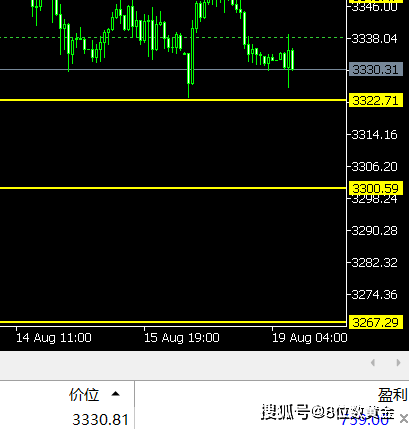
Group 1 - Gold experienced a significant price fluctuation, initially rising by $35 before a substantial pullback, indicating ongoing market volatility and a tug-of-war between bulls and bears [1][4] - The current trading range for gold is around $3339, with potential resistance at $3348 and $3375, while support levels are identified at $3322 and $3300 [6][8][9] - After four months of consecutive gains, gold has entered a period of consolidation, with a high volatility pattern around the $3300 mark, suggesting a potential breakout in either direction [9] Group 2 - Recent market movements were influenced by geopolitical events, including Trump's renewed focus on tariffs affecting steel and chips, which may heighten global supply chain concerns and benefit gold prices [10] - The Federal Reserve's recent dovish stance and internal divisions regarding interest rate cuts are critical for global markets, impacting both the dollar and gold prices [11] - The global stock market is showing resilience, with projections indicating a record scale by 2025, as major economies experience simultaneous growth, suggesting a shift towards a high-inflation environment [12]
杰克逊霍尔全球央行年会前瞻
Nan Hua Qi Huo· 2025-08-19 06:12
Report Industry Investment Rating - No information provided in the report Core Viewpoints of the Report - The Jackson Hole Global Central Bank Annual Meeting will be a "watershed" for the Fed's policy direction. The market should focus on three key signals: labor market judgment, inflation risk statements, and emphasis on policy flexibility [2][36] - Powell's speech at the meeting is likely to maintain a "neutral to hawkish" stance, emphasizing "inflation resilience" and "policy flexibility" to guide the market to reduce bets on "consecutive rate cuts" [3] - The Fed's core goal of "balancing inflation and growth" remains unchanged. The game between the lagged impact of tariffs and economic downside risks will be the main line of future monetary policy [3] Summary by Directory Introduction: Policy Weathervane Significance of the Jackson Hole Annual Meeting - The Jackson Hole Annual Meeting is a key platform for the Fed to release major policy signals. The policy statements at this meeting often set the tone for subsequent monetary policies [4][7] Current Economic Background and Complexity of the Fed's Policy Environment Macro - economic and Policy Pressure Intertwined - The US economy shows multiple contradictory features. Inflation pressure is structurally differentiated, with core CPI showing more resilience. The labor market is cooling but still has some strength, and external policy pressure has increased significantly [8][11][13] - As of August 19, the market's probability of a 25 - basis - point rate cut in September has reached 90%, and some institutions have even raised the probability of a 50 - basis - point rate cut [13] Fed's Internal Disagreement - The dovish camp is concerned about economic downside risks and employment market slowdown, advocating for near - term rate cuts. The hawkish camp emphasizes labor market resilience and inflation rebound risks, advocating maintaining high interest rates [14] Key Economic Data Analysis July US CPI Data - July CPI showed "overall stability and strong core." Energy prices declined, food prices were stable, while core services inflation was strong. Different commodity items were affected differently by tariffs and demand [15] July US PPI Data - July PPI showed an unexpected increase, mainly driven by services. The increase in PPI may not fully reflect fundamental inflation pressure, but it indicates potential upward risks for future CPI [22][23] Root Causes of the July CPI and PPI Divergence - The divergence between CPI and PPI reflects the complexity of inflation transmission, including a 1 - 3 - month time lag in cost transfer and possible statistical differences [25] Possible Scenarios of Powell's Speech and Policy Signal Analysis - Scenario 1: Absence from the meeting. This is a "passive neutral" strategy to avoid market volatility and leave policy decisions to economic data before the September meeting [27] - Scenario 2: Deliver a "non - substantial" speech. This is to maintain policy options' openness and postpone the final decision to the September meeting [28] - Scenario 3: Moderately release rate - cut signals. This requires further deterioration of employment data and significant escalation of external pressure from the Trump administration [28] Market Expectations and Future Monetary Policy Outlook Short - term Market Expectations and Risks - Market expectations of the number of rate cuts this year are around 3 times, but this is at risk of adjustment. US economic downside risks are accumulating, making short - term policy expectations more complex [34] Medium - to - Long - term Monetary Policy Path - The lagged impact of tariffs will be a key constraint on the Fed's policy in the next 1 - 2 years. In Q4 2025, inflation pressure may intensify, and in 2026, inflation is likely to fall, opening up room for significant rate cuts [34] Conclusion: Core Observation Points of the Jackson Hole Annual Meeting - The meeting will be a "watershed" for the Fed's policy. The market should focus on labor market judgment, inflation risk statements, and policy flexibility [36]