
新消费

Search documents
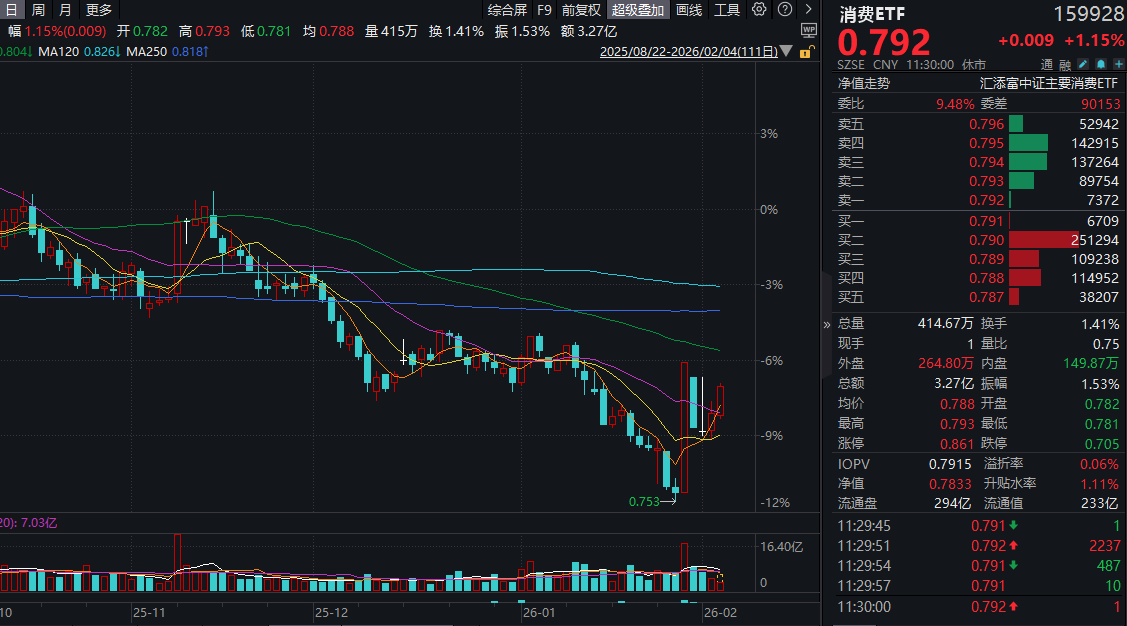
中央一号文件发布,锚定农业农村现代化!贵州茅台涨超2%重回1500上方,消费ETF(159928)涨超1%冲击两连阳!
Xin Lang Cai Jing· 2026-02-04 05:05
Group 1 - The core viewpoint of the news highlights the strong performance of the consumption sector, particularly the consumption ETF (159928), which has seen significant inflows and trading activity [1][3] - The consumption ETF (159928) has recorded a net inflow of over 2.35 billion yuan in the last 20 days, with its latest scale exceeding 23 billion yuan, leading its peers [1][3] - Major stocks within the consumption ETF, such as Kweichow Moutai, Wuliangye, and Yili, have shown positive price movements, indicating a robust market sentiment [3][4] Group 2 - The first central document of the year emphasizes the modernization of agriculture and rural areas, aiming to enhance living conditions and increase farmers' wealth [7][8] - The document sets a hard target for grain production to stabilize at around 1.4 trillion jin, underscoring the importance of food security [7] - The focus on expanding rural consumption is seen as a key economic task, with strategies to improve both infrastructure and quality of life in rural areas [8] Group 3 - The food and beverage sector is expected to see a recovery, with positive sales growth in various categories, particularly frozen foods and hot pot ingredients [9][10] - The dairy market is experiencing a stabilization in raw milk prices, which is projected to positively impact the meat and dairy pricing cycle in 2026 [10] - The white liquor market is showing signs of bottoming out, with Kweichow Moutai expected to maintain its pricing power during the upcoming festive season [10]


从智能家居看新消费出圈三重力
Xin Lang Cai Jing· 2026-02-03 23:53
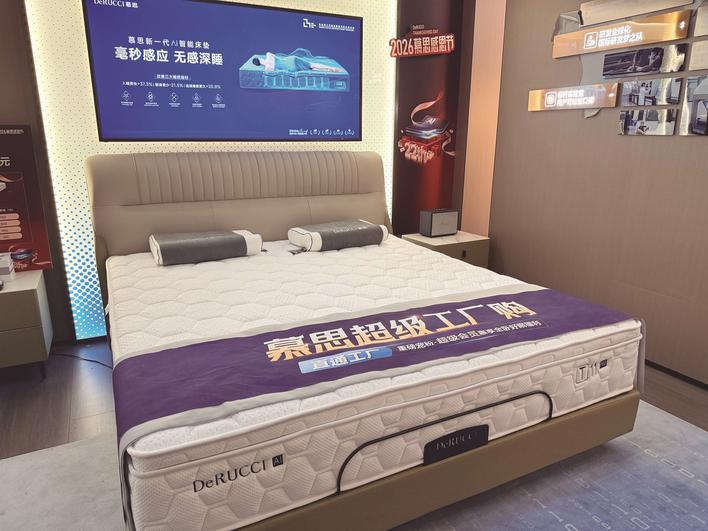
Core Viewpoint - The article emphasizes the importance of expanding domestic demand as a key strategy for economic recovery, highlighting the proactive role of Jiaxing in implementing national strategies through local practices [3]. Group 1: Company Overview - Jiaxing Mu Si Smart Home Co., Ltd. operates in a highly automated environment, showcasing a shift from traditional furniture manufacturing to smart sleep solutions, reflecting the company's resilience since its listing in 2022 [3]. - The company reported a cumulative revenue of 3.761 billion yuan for the first three quarters of 2025 [3]. Group 2: Product Innovation - The AI smart mattress developed by the company can monitor heart rate and adjust firmness automatically, providing real-time health data to users [5]. - The evolution of the smart sleep product line has progressed to its eleventh generation, utilizing self-developed sensors and AI algorithms to enhance sleep quality [5]. Group 3: Consumer Experience - The transition from traditional sales methods to immersive experience-driven sales is highlighted, where consumers engage in self-exploration and direct interaction with products [6]. - This shift reflects a broader change in consumer behavior, where individuals are willing to pay for experiences that resonate with their personal needs and emotional connections [6]. Group 4: Technological Advancement - The company allocates 60% of its R&D budget to smart sleep systems, indicating a commitment to long-term innovation rather than short-term marketing strategies [6]. - Technological breakthroughs in materials and AI applications are establishing a solid competitive advantage for the company [6]. Group 5: Industry Ecosystem - The establishment of the "Mu Si Gold Steward" service system signifies a shift from one-time product delivery to ongoing experiential delivery, transforming the brand's role from manufacturer to solution provider [7]. - The company is also developing a Mu Si Sleep Museum to integrate manufacturing with cultural and tourism experiences, creating a new industrial tourism landmark [7].
新消费C位丨从“隐形冠军”到“标准定义者”:一枚蛋挞的供应链革命
第一财经· 2026-02-03 10:16
Core Viewpoint - The rise of Zhongbei Egg Tart exemplifies the transformation of China's new consumption supply chain from "behind-the-scenes support" to "value leadership," highlighting the importance of precise consumer insights, rigorous industry standards, and deep ecosystem construction in today's competitive landscape [19][20]. Group 1: Company Achievements - Zhongbei, a supply chain enterprise, won the prestigious "Seven Star Award" in the food health sector, showcasing its significant impact in the industry [1]. - The founder, Yang Xiaoqing, has over 30 years of experience in the baking industry and developed a new category of baking raw materials in 2011, leading to a 20% compound annual growth rate for Portuguese egg tarts in China [2]. Group 2: Consumer Insights - Consumer demands have evolved, with new products having shorter life cycles, and consumers now seek emotional value and diverse consumption scenarios in addition to taste [5]. - The company has adapted to these changes by focusing on enhancing the consumer experience alongside product development [5]. Group 3: Technological Innovations - Zhongbei's 64-layer puff pastry technology is not merely about stacking layers but involves precise control of dough and butter ratios, temperature, and rolling precision to ensure each layer is distinct and maintains crispness for over 8 hours [6]. - The company invested significantly in technology to ensure that egg tarts remain crispy whether served hot or cold, addressing the evolving consumption scenarios [7]. Group 4: Market Expansion and Challenges - The expansion into different markets, such as supermarkets and hotels, has tested Zhongbei's supply chain capabilities, requiring adaptability to various consumer needs [12]. - The transition from a supplier to a growth partner involves balancing personalized customer service with maintaining a strong brand identity and core competencies [15][16]. Group 5: Future Trends and Philosophy - The concept of "clean labels" is becoming essential, with consumers preferring simple, natural ingredients, indicating a shift towards healthier food options [13]. - The company's approach emphasizes collaboration with partners to innovate and define products, which has led to increased market capacity and consumer interest in egg tarts [14][17].

《2025年香港IPO及二级市场白皮书》发布:港股强势复苏,硬科技与生物医药成新引擎
Sou Hu Cai Jing· 2026-02-03 10:12
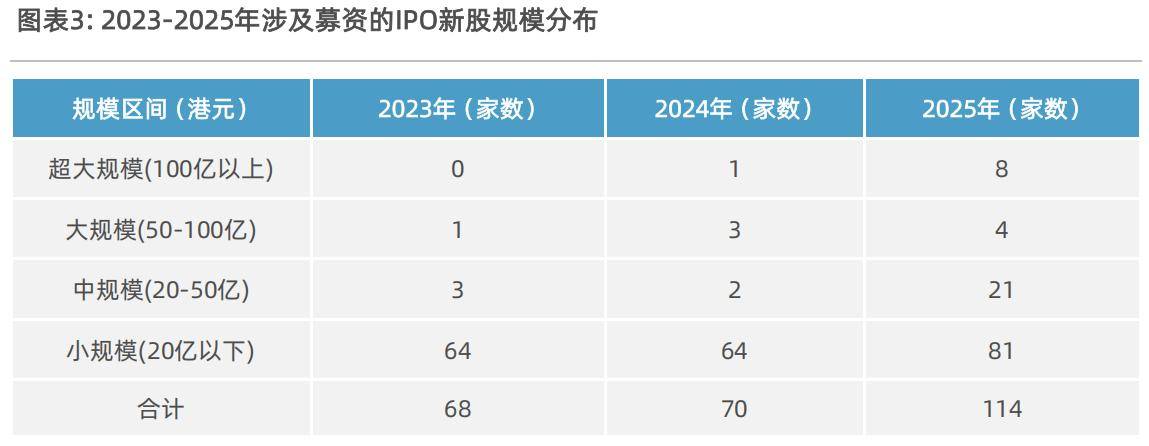
Group 1: IPO Market Performance - In 2025, the Hong Kong IPO market raised HKD 286.7 billion, a significant increase of 225.9% year-on-year, reclaiming the top position globally for fundraising [2] - A total of 114 companies went public in 2025, marking a 62.9% increase compared to 2024 [2] - The number of mega IPOs (raising over HKD 10 billion) reached 8, a sevenfold increase from 2024 [2][3] Group 2: Industry and Regional Insights - The healthcare sector led the IPO market with 28 listings, reflecting a 133.3% year-on-year growth, indicating strong investor interest in biotech companies [5] - Mainland companies dominated the Hong Kong IPO market, with Shanghai surpassing Guangdong as the city with the most IPOs, totaling 18 [5] Group 3: Market Sentiment and Performance - The IPO subscription market saw unprecedented enthusiasm, with 14 million subscriptions, a more than 12-fold increase from the previous year, and an average oversubscription rate of 1,684 times [9] - 90.28% of new stocks were issued at a premium, showcasing strong market confidence [9] - The first-day drop rate for new stocks fell below 30%, with an average first-day increase of 36.95% [11] Group 4: Secondary Market Dynamics - The Hong Kong secondary market outperformed globally, with the Hang Seng Index rising by 27.77% in 2025, leading major global indices [12] - Daily trading volume averaged approximately HKD 248.9 billion, an 88.7% increase year-on-year [12] Group 5: Capital Flow and Structural Changes - Southbound capital became a key source of liquidity for Hong Kong stocks, with total transactions reaching HKD 28.7 trillion and net purchases exceeding HKD 1.4 trillion, both setting historical records [14] - The Hong Kong Stock Exchange implemented reforms to lower barriers for tech companies, facilitating a shift towards hard tech, biotech, and new consumption sectors [15]
房地产行业第5周周报:受去年同期为春节的影响,楼市成交同比正增长,首批商业不动产REITs已申报至交易所-20260203
Bank of China Securities· 2026-02-03 09:31
政策 ◼ 1)根据上交所官网,1 月 29 日-30 日,已有 8 只商业不动产 REITs 申报至交易 所(分别为华安锦江商业、中金唯品会商业、汇添富上海地产商业、国泰海通砂 之船商业、华安陆家嘴商业、华夏凯德商业、华夏银泰百货商业、华夏保利发展 商业不动产 REITs),预计募集总额 314.7 亿元,涵盖酒店、写字楼与配套商业、 奥特莱斯、购物中心、服务式公寓等多种商业业态,原始权益人有保利发展、上 海地产、陆家嘴、凯德投资、银泰百货、锦江国际、唯品会、砂之船(西安)。 2)根据财联社报道,多家房企目前已经不被监管部分要求每月上报"三条红线"指 标,不过部分出险房企被要求向总部所在城市专班组定期汇报资产负债率等财务 指标。2020 年 8 月,监管部门为控制房企有息负债规模,对房企设置了融资"三条 红线",不过近几年基本已经不被提及。 投资建议 房地产行业 | 证券研究报告 — 行业周报 2026 年 2 月 3 日 房地产行业第 5 周周报(2026 年 1 月 24 日-2026 年 1 月 30 日) 受去年同期为春节的影响,楼市成交同比正增长;首批 商业不动产 REITs 已申报至交易所 新房成 ...
烟火气拉满,江苏消费“上新”了
Xin Hua Ri Bao· 2026-02-02 23:33
□ 本报记者 王梦然 陈珺璐 消费是畅通经济循环的关键环节,是增进民生福祉的重要载体。围绕省"十五五"规划纲要中"全方位扩 大内需"的具体部署,代表委员们纷纷建言献策,从政策引导、企业实践、产业融合等多个维度,勾勒 出江苏以"新消费"点亮美好生活的生动图景。 "人民商场的核心竞争力,不只是商品本身,还有那沉淀了90多年的情感链接和信任基石。"省人大代 表、苏州人民商场女装部副经理沈黎萍介绍,为打破传统零售边界,商场加速数字化转型,通过微商 城、会员体系直播带货,将线下服务延伸至线上场景。新的一年,商场将着力把首店做成"恒店",让网 红焕发"长红"活力。她表示,将继续创新服务路径,将苏式文化元素融入现代消费场景,让购物与社 交、文化体验深度融合,在首发经济、旅游经济、银发经济、美丽经济、宠物经济等"新赛道"上发 掘"新增长",扩大优质商品和服务供给,满足不同年龄段的个性化消费期待。 在省政协委员,扬州瘦西湖旅游度假投资管理集团董事长,江苏扬城一味餐饮管理有限公司董事长、总 经理陈万庆看来,文旅行业特别是住宿餐饮业,既是拉动消费的重要领域,也是实现产业联动、畅通经 济循环的重要纽带,在推动消费结构升级、促进内需持 ...
当代快评|“新消费”赛道,重庆如何落子
Sou Hu Cai Jing· 2026-02-01 22:43
Core Insights - Chongqing is actively cultivating new consumption models to address challenges, seize opportunities, and enhance urban capabilities, aiming to transform from a grand blueprint into a vibrant reality [1] Group 1: Consumption Growth - In 2025, Chongqing's total retail sales of consumer goods exceeded 1.66 trillion yuan, marking a year-on-year growth of 3.1%, reflecting the city's consumption vitality and a shift in development logic towards a cycle of "new demand" defining "new supply" [3] - The 2026 government work report emphasizes the importance of leading new supply with new demand and expanding consumption through innovative consumption scenarios and models [3] Group 2: New Consumption Models - The "silver economy" is being industrialized in response to the aging population, with policies introduced in 2025 to provide subsidies for elderly care services and home modifications, aiming to stimulate demand for smart health care and related new industries [4] - The "first launch economy" and "ticket root economy" are innovative mechanisms designed to enhance consumption levels and promote interconnected consumption, with the former focusing on attracting international brands and the latter creating a chain of consumption from a single outing [5] Group 3: Emotional Economy - The "emotional economy" represents a unique advantage for Chongqing, focusing on reimagining urban physical and cultural spaces to create new consumption scenarios that resonate emotionally with consumers, particularly the youth [5] Group 4: Strategic Development - Chongqing recognizes the need to improve its high-end commercial elements and consumption quality compared to other first-tier cities, indicating that reliance on traditional consumption expansion is insufficient [6] - The city is undergoing a profound transformation from functional satisfaction to emotional fulfillment in consumption, aiming to reshape urban competitiveness through a focus on new consumption [6] Group 5: Policy and Ecosystem - Policies need to be more precisely targeted at pilot projects for new industries, models, and scenarios, encouraging enterprises to innovate based on genuine consumer insights [6] - A collaborative ecosystem is essential, transitioning from isolated breakthroughs to systemic symbiosis, with government or industry associations leading cross-sector cooperation [6] - The success of new consumption relies on a friendly, convenient, and safe environment, necessitating improvements in international payment services and consumer rights protection [6]

一周新消费NO.346|泡泡玛特推出甜品品牌「POP BAKERY」;MLB官宣章若楠出任潮流品牌全新代言人
新消费智库· 2026-02-01 13:03
New Product Launches - Heinz has launched a new "nutritional noodles" product, available in original, pork liver spinach, and beef tomato flavors, made from Canadian wheat and free from added salt, sugar, and preservatives [4] - Pop Mart has introduced a new dessert brand "POP BAKERY," featuring products like ice cream and cookies [4] - Master Kong has released two new noodle products, braised beef noodles and Sichuan beef noodles, using large cuts of meat and fresh ingredients [4] - McDonald's China has launched several new limited-time products for the Spring Festival, available in over 7,700 restaurants [6] - Danone's Alpro has introduced "Alpro Meal To Go," a plant-based meal replacement drink containing 20g of plant protein [5] - Yili has partnered with JD Health to launch "Milk Oat Bird's Nest Porridge," featuring 400mg of traceable bird's nest [6] - Wanglaoji has released a limited edition diamond gem set priced at 18.28 million, featuring 18K gold and 18,202 natural gems [7] - Mengniu has launched "Lutein Blueberry Milk," enriched with DHA and vitamins [7] - Hengshun has introduced "Vinegar Cola," combining traditional vinegar with a fizzy drink [9] Industry Events - MLB has announced actress Zhang Ruonan as its new brand ambassador, focusing on street culture and self-expression [11] - KFC has adjusted its delivery product prices, with an average increase of 0.8 yuan [11] - Douyin e-commerce has upgraded its after-sales mechanism to improve operational efficiency for merchants [11] - Crocs has partnered with LEGO to launch a new collaborative series [11] Financing and Acquisitions - Muxin Intelligent has completed a B-round financing of over 100 million yuan [18] - Anta Sports has reached an agreement to acquire a 29.06% stake in Puma for 1.5 billion euros (approximately 12.4 billion yuan) [20] - Puratos has acquired American nut supplier Vör Foods to enhance its innovation in baked goods [20] - Fen Chuan Ji has completed a 100 million yuan A-round financing for supply chain upgrades and digital management [20] - Nowwa Coffee has completed a multi-hundred million yuan C-round financing [22] - WH Group's subsidiary Smithfield Foods has signed an agreement to acquire Nathan's Famous for approximately 450 million USD [25] Food Industry Developments - Koko Manfen has launched a new drink featuring plum and three beans [27] - Woji Fresh has introduced a gift box of pure milk dessert soups [27] - Luckin Coffee has opened a co-branded store with the Australian Open [27] - Tea Xiaokai has launched "Magic Frozen Tea" with seaweed pearls [27] - Tetra Pak is investing 600 million euros (approximately 5 billion yuan) to build a new factory in Sweden [31]

新股专题:节后情绪过热或已埋下休整伏笔,但预计不改新股活跃周期继续演绎
Huajin Securities· 2026-02-01 12:24
Investment Rating - The report maintains a positive outlook on the new stock market, suggesting continued active cycles despite recent corrections [1][13]. Core Insights - The new stock market has shown signs of correction after a period of rapid growth, with the average increase of new stocks since 2025 dropping to -4.0%, and only 13.8% of stocks achieving positive returns [1][30]. - The report emphasizes the importance of focusing on value and thematic investments, indicating that the market remains active with high trading volumes and potential for upward movement [2][13]. - Specific sectors such as technology, AI, robotics, and commercial aerospace are highlighted as areas of continued interest, with a recommendation to seek stocks with strong performance support [3][13]. Summary by Sections New Stock Performance - Last week, three new stocks were available for online subscription, with an average issuance price-earnings ratio of 37.7X [5][23]. - The average first-day increase for newly listed stocks was approximately 212.2%, indicating stable trading sentiment, while the average increase in the secondary market was -0.1% [5][28]. - Since 2025, the average increase for new stocks listed on the Shanghai and Shenzhen exchanges has been -4.0%, with only 13.8% showing gains [30][31]. Upcoming New Stocks - Four new stocks are set to complete subscriptions this week, with two from the Sci-Tech Innovation Board and two from the main board, and their expected issuance price-earnings ratios are 48.8X and 16.9X respectively [7][35]. - The report suggests that the current subscription environment remains profitable, encouraging active participation [36]. Recommended Stocks - The report identifies several stocks for potential investment, including emerging industry leaders and those with favorable valuations, such as Tongyu New Materials and Fengbei Biological [9][45]. - For mid-term investments, stocks like Jun Ding Da and Si Kan Technology are recommended for their potential opportunities [9][45].
西部证券新兴产业周报-20260201
Western Securities· 2026-02-01 11:26
Investment Rating - The report recommends an "Overweight" rating for solid-state batteries, innovative drugs, and new consumption sectors, while suggesting a "Neutral+" rating for humanoid robots and AI applications [5][10][21]. Core Insights - The report highlights a focus on solid-state batteries, innovative drugs, and new consumption as key investment themes, indicating a positive outlook for these sectors [5][10]. - The report notes that the overall emerging industry is showing a strong fundamental outlook with a neutral technical perspective, suggesting potential for growth despite recent fluctuations [16]. Summary by Relevant Sections Investment Themes - **Solid-State Batteries**: Rated "Overweight" with a strong technical outlook, indicating a recovery from a low position. The industry is moving towards commercialization with significant developments from companies like Geely [5][10]. - **Innovative Drugs**: Also rated "Overweight", with a stable outlook as the National Medical Products Administration has approved multiple innovative drugs, enhancing market confidence [5][10]. - **New Consumption**: Rated "Overweight", with initiatives in Beijing to promote new consumption landmarks, indicating a supportive environment for growth [5][10]. - **Humanoid Robots**: Rated "Neutral+", with a moderate technical outlook. The sector is experiencing a transition from prototypes to mass production, which could enhance market opportunities [5][10]. - **AI Applications**: Rated "Neutral+", with signs of recovery. The commercialization of AI applications is seen as a turning point, with significant investments from major companies [5][10]. Market Trends - The report indicates that the overall emerging industry has returned to below the mean plus two standard deviations, with moderate rotation intensity and average crowding levels, suggesting a potential for rebound in profitability expectations [16][18]. - Recent events, such as the launch of new products and approvals in the innovative drug sector, are expected to drive growth and investor interest [10][11].