
消费品以旧换新政策

Search documents
私营企业利润增速加快 多地加力支持民营经济发展壮大
Di Yi Cai Jing· 2025-08-28 16:40
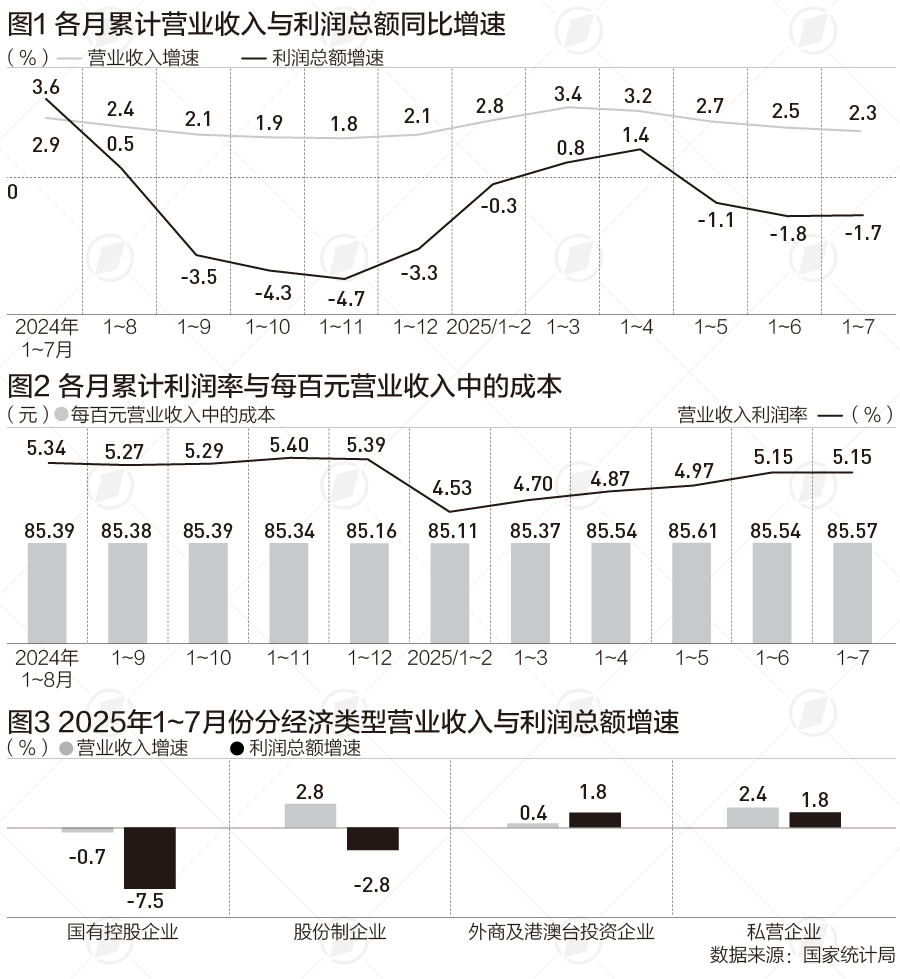
Core Insights - The profitability of industrial enterprises has shown positive improvement due to the implementation of various policies aimed at promoting the private economy and countering "involution" [1][5] Group 1: Industrial Profitability - In July, profits of industrial enterprises above designated size decreased by 1.5% year-on-year, a reduction in the decline by 2.8 percentage points compared to June 2025 [1] - From January to July, cumulative profits of industrial enterprises fell by 1.7%, with a slight narrowing of the decline by 0.1 percentage points compared to the first half of the year [1] - Medium and small-sized enterprises saw a turnaround in profits in July, with increases of 1.8% and 0.5% respectively, compared to declines of 7.8% and 9.7% in June [1] Group 2: Revenue and Cost Dynamics - Industrial enterprise revenue grew by 1.1% year-on-year in July, although this represented a decline of 0.5 percentage points from the previous month [2] - The Producer Price Index (PPI) remained unchanged at -3.6% year-on-year, while the industrial added value decreased by 1.1 percentage points compared to the previous month [2] - Industrial costs increased by 1.2% year-on-year in July, a decrease of 0.8 percentage points from the previous month [2] Group 3: Sector-Specific Performance - Manufacturing and public utilities saw profit growth in July, with manufacturing profits increasing by 6.6% year-on-year, a rise of 5.2 percentage points from June [2] - The mining sector experienced a significant profit decline of 39.2%, worsening by 3.0 percentage points compared to the previous month [2] - High-tech manufacturing profits rose by 18.9%, contributing 2.9 percentage points to the overall improvement in industrial profits [3] Group 4: Private Enterprises - From January to July, private enterprises achieved a total profit of 111.837 billion yuan, growing by 1.8%, with July profits increasing by 2.6%, surpassing the average growth of all industrial enterprises by 4.1 percentage points [5] - Recent policies aimed at enhancing the business environment and providing financial support have positively impacted the profitability of private enterprises [5] - Various local governments have introduced measures to promote the high-quality development of the private economy, signaling a commitment to improving the business environment and stimulating market vitality [5][6]

私营企业利润增速加快,多地加力支持民营经济发展壮大
Di Yi Cai Jing Zi Xun· 2025-08-28 11:48
Group 1 - The core viewpoint is that industrial enterprises' profitability is showing positive improvement due to the implementation of various policies aimed at promoting the private economy and countering "involution" [1][7] - In July, profits of industrial enterprises above designated size decreased by 1.5% year-on-year, but the decline narrowed by 2.8 percentage points compared to June 2025 [1] - From January to July, cumulative profits of industrial enterprises fell by 1.7%, with a slight improvement in the decline rate compared to the first half of the year [1] Group 2 - In July, the revenue of industrial enterprises grew by 1.1% year-on-year, although the growth rate decreased by 0.5 percentage points compared to the previous month [2] - The Producer Price Index (PPI) remained unchanged at -3.6% year-on-year, while the cost of industrial enterprises increased by 1.2%, a decrease of 0.8 percentage points from the previous month [2] - The manufacturing and public utility sectors saw a rebound in profit growth, with manufacturing profits increasing by 6.6% year-on-year, while mining profits fell by 39.2% [2] Group 3 - In the manufacturing sector, profits in raw materials and high-tech manufacturing showed significant improvement, with raw materials manufacturing profits rebounding to a growth of 36.9% year-on-year [3] - High-tech manufacturing profits turned from a decline of 0.9% in June to a growth of 18.9% in July, contributing 2.9 percentage points to the overall profit improvement of industrial enterprises [3] - Specific industries such as electronic and electrical machinery manufacturing saw profits grow by 87.9% and 15.3% respectively, driven by large-scale equipment updates [3] Group 4 - Private enterprises achieved a total profit of 1,118.37 billion yuan from January to July, with a growth of 1.8%, which is 0.1 percentage points faster than the first half of the year [7] - In July, private enterprises' profits grew by 2.6%, exceeding the average growth rate of all industrial enterprises by 4.1 percentage points [7] - Recent policies aimed at improving the business environment and supporting private enterprises have shown positive results, enhancing their operational conditions and profitability [7] Group 5 - Various local governments have introduced measures to promote the development of the private economy, signaling a strong commitment to optimizing the business environment and stimulating market vitality [8] - Specific initiatives include supporting private enterprises in participating in key industrial chains and addressing challenges faced by the private sector [8] - The establishment of local regulations, such as those in Hainan, aims to create a fair competitive environment for private enterprises [8]
7月规模以上工业生产保持稳定增长 高技术制造业利润同比增长18.9%
Zhong Guo Zheng Quan Bao· 2025-08-27 22:17
Core Insights - In July, the profits of industrial enterprises above designated size in China decreased by 1.5% year-on-year, but the decline narrowed by 2.8 percentage points compared to June, marking a continuous two-month contraction [1][2] - High-tech manufacturing profits turned from a 0.9% decline in June to an 18.9% increase in July, significantly contributing to the overall profit growth of industrial enterprises [1][4] - The recovery of corporate profitability is supported by a 0.9% year-on-year increase in operating revenue for industrial enterprises in July, with a cumulative growth of 2.3% from January to July [2] Industry Performance - Manufacturing profits grew by 6.8% year-on-year in July, accelerating by 5.4 percentage points from June, contributing to a 3.6 percentage point increase in overall industrial profits [4] - The raw materials manufacturing sector saw profits shift from a 5.0% decline in June to a 36.9% increase in July, with notable recoveries in the steel and petroleum processing industries [4] - High-tech manufacturing sectors, such as aerospace and semiconductor industries, reported substantial profit increases of 40.9% and 176.1% respectively, showcasing their leading role in profit recovery [4][5] Small and Medium Enterprises - Profits for medium and small-sized industrial enterprises improved significantly, with July profits turning from declines of 7.8% and 9.7% in June to increases of 1.8% and 0.5% respectively [2] - Private enterprises experienced a 2.6% profit increase in July, outperforming the average profit growth of all industrial enterprises by 4.1 percentage points [2] Policy Impact - The implementation of policies aimed at supporting small and medium enterprises has yielded positive results, improving their operational environment and profitability [2][5] - The "two new" policies have led to rapid profit growth in related industries, with specific sectors like electronic equipment manufacturing seeing profit increases of 87.9% [5] Future Outlook - The chief economist of China Minsheng Bank anticipates a continued moderate recovery in profits for industrial enterprises, driven by the normalization of supply and demand dynamics and supportive policies [3][6]
国家统计局:“两新”政策成效显著 持续带动行业利润增长
Sou Hu Cai Jing· 2025-08-27 03:14
Core Insights - The implementation of the "Two New" policies has significantly boosted profit growth in related industries, particularly in July [1] Industry Performance - In July, driven by large-scale equipment renewal policies, the profit growth in the manufacturing of electronic and electrical machinery specialized equipment, general components, and specialized equipment for food, beverage, tobacco, and feed production increased by 87.9%, 15.3%, and 11.3% respectively [1] - The "old for new" consumption policy has led to remarkable profit increases in the manufacturing of complete computers, intelligent unmanned aerial vehicles, and household cleaning appliances, with profits rising by 124.2%, 100.0%, and 29.7% respectively [1] - Related industries in the supply chain, such as computer peripheral equipment manufacturing and sensitive components and sensors manufacturing, also saw profit increases of 57.0% and 51.9% respectively [1]
智荟周刊 | 消费品“焕新”掀热潮 消费潜力持续释放
Sou Hu Cai Jing· 2025-08-27 02:50
Group 1 - The core viewpoint of the article emphasizes the effectiveness of the "old-for-new" consumption policy in stimulating consumer spending and promoting environmental sustainability [1][3] - The third batch of funding for the "old-for-new" policy, amounting to 69 billion yuan, has been allocated, with a fourth batch of the same scale expected to follow in October [3][6] - The policy has led to significant sales growth in various sectors, with related product sales exceeding 1.9 trillion yuan, accounting for 7.5% of retail sales in the first seven months of the year [6][7] Group 2 - The "old-for-new" policy has resulted in a nearly 100% sales increase in online smart lock products during the first quarter of the year, driven by government subsidies [6][7] - Data from the Ministry of Commerce indicates that the average daily sales driven by the policy have stabilized between 10 billion to 11 billion yuan since May [7][8] - The policy has particularly boosted the sales of energy-efficient appliances, with subsidies for first and second-level energy-efficient products being significantly higher [7][9] Group 3 - Companies are innovating service models to capitalize on the consumption opportunities created by the policy, with JD.com offering integrated delivery and installation services [8][9] - There are calls for simplifying the subsidy application process and addressing issues such as low valuation of old products and insufficient product categories for subsidies [8][9] - Future recommendations include enhancing the recycling network for large appliances and expanding the range of supported products to include health and wellness items [9]

以旧换新补助监管再加码 严防政策套利漏洞
Zhong Guo Jing Ying Bao· 2025-08-25 07:12
Group 1 - The Ministry of Commerce emphasized the need to strengthen regulation and prevent risks in the nationwide consumer goods replacement policy, ensuring the safety of funds and optimizing policies to stimulate consumption growth [2] - The National Development and Reform Commission (NDRC) reported that over half of the 300 billion yuan allocated for the consumer goods replacement program has been disbursed, with strict measures against fraudulent practices being implemented [2] - The NDRC announced that the third batch of 69 billion yuan in special bonds for consumer goods replacement has been fully allocated, with a fourth batch planned for October, aiming for a total of 300 billion yuan by year-end [2] Group 2 - The consumer goods replacement policy has significantly boosted sales, with over 1.7 trillion yuan in sales generated this year, and retail sales of major appliances and communication devices increasing by 30.7% and 24.1% respectively [3] - The demand for steel in manufacturing sectors such as automotive, home appliances, and shipbuilding has shown strong resilience due to the policy [3] - The "Two Major" construction projects have received 800 billion yuan in funding, with 735 billion yuan from the central budget also being allocated, indicating a strong push for infrastructure development [3]

中证报头版:强化财税金融支持 以旧换新政策加力可期
Sou Hu Cai Jing· 2025-08-24 23:27
Group 1 - The State Council's recent meeting and the national teleconference on the promotion of the old-for-new consumption policy signal increased policy support for consumer goods [1] - Experts suggest that future adjustments to the old-for-new policy may include raising financial support and expanding the range of eligible products [1] - There will be a focus on enhancing policy coordination and technological empowerment to ensure that policy benefits reach consumers directly, effectively boosting domestic demand and consumption [1]
强化财税金融支持 以旧换新政策加力可期
Zhong Guo Zheng Quan Bao· 2025-08-24 20:10
Core Viewpoint - The recent meetings by the State Council and the national conference on the promotion of the old-for-new consumption policy signal increased policy support for expanding consumption and stimulating demand in the market [1][3]. Policy Effects - The old-for-new policy has shown significant effects this year, with retail sales in various categories such as home appliances and communication equipment growing at rates of 28.7%, 13.8%, 20.6%, and 14.9% year-on-year in July, outpacing overall retail sales growth [1]. - The policy has also positively impacted the automotive sector, with new energy vehicle sales expected to grow by 81.7% from April 2024 to July 2025 [1]. - The Ministry of Finance has allocated 300 billion yuan in special long-term bonds to support the old-for-new consumption policy [1]. Funding and Support Measures - The Ministry of Finance has announced the distribution of 69 billion yuan in the third batch of special long-term bonds to support local governments in implementing the old-for-new policy [2]. - Various regions are enhancing subsidy measures, such as Heilongjiang increasing subsidies for electric vehicles and Chongqing allocating an additional 300 million yuan for vehicle replacement subsidies [2][3]. - Adjustments in subsidy distribution methods have been made to improve accessibility for consumers, such as changing from daily limited vouchers to centralized distribution [2]. Policy Optimization - Local governments are addressing supply-demand imbalances in subsidy vouchers and enhancing fund utilization efficiency [3]. - Adjustments to the old-for-new policy are being made based on the availability of national funding, with a focus on ensuring the effective release of consumer potential [3][4]. - The central government has reiterated its commitment to support the old-for-new policy, emphasizing its role in stabilizing investment and expanding consumption [3][4]. Future Expectations - There is an expectation for further expansion of the old-for-new policy into service consumption and public consumption sectors to maximize overall consumer potential [4]. - Analysts predict that the scale of funding for the old-for-new policy may be increased, with potential adjustments to the types of products eligible for subsidies [5]. - The Ministry of Finance is implementing a monitoring mechanism to ensure effective use of subsidy funds and prevent misuse [5].
7月宏观数据点评:多重扰动背景下经济有所放缓
Yintai Securities· 2025-08-18 08:11
Economic Overview - In July, the industrial added value for large-scale enterprises grew by 5.7% year-on-year, a slowdown of 1.1 percentage points from the previous month[2] - The total retail sales of consumer goods increased by 3.7% year-on-year in July, marking a new low for the year, and down 1.1 percentage points from the previous month[18] - Fixed asset investment (excluding rural households) grew by 1.6% year-on-year from January to July, continuing a decline for four consecutive months[24] Industrial Production - The growth rate of industrial added value for the first seven months was 6.3% year-on-year[8] - High-tech manufacturing and equipment manufacturing maintained high growth rates, with increases of 9.3% and 8.4% respectively in July[8] - Export delivery value growth slowed to 0.8% in July, down 3.2 percentage points from the previous month[8] Consumer Market - The retail sales of goods in July grew by 4.0%, while catering services increased by only 1.1%[18] - The "old-for-new" policy pause in some regions led to a significant drop in related goods sales growth[18] - Sales of household appliances and audio-visual equipment grew by 28.7%, down from 32.4% in the previous month[18] Fixed Asset Investment - Manufacturing investment grew by 6.2%, a slowdown of 1.3 percentage points from the previous month[24] - Infrastructure investment growth was 7.3%, down 1.6 percentage points from the previous month[26] - Private investment growth fell to -6.3% in July, indicating a significant decline in private sector confidence[26] Real Estate Market - Real estate development investment decreased by 12.0% year-on-year from January to July, with the decline widening by 0.8 percentage points from the previous month[33] - New housing construction area fell by 19.4%, while the sales area of new commercial housing dropped by 4.0%[34] - The price index for new residential buildings in 70 large and medium-sized cities fell by 0.3% month-on-month in July[34]
国家统计局解读!核心CPI同比涨幅连续扩大
Zheng Quan Ri Bao Wang· 2025-08-15 04:05
Group 1 - In July, the Consumer Price Index (CPI) showed positive changes, with a month-on-month increase of 0.4%, reversing the previous month's decline of 0.1% [1] - The rise in CPI was primarily driven by increases in service and industrial consumer goods prices, with significant price hikes in transportation-related services due to the summer travel season [1][2] - The core CPI, which excludes food and energy prices, increased by 0.8% year-on-year, marking a 0.1 percentage point increase from the previous month, indicating a steady upward trend [2][3] Group 2 - The increase in core CPI is attributed to effective implementation of consumption-boosting policies and gradual release of consumption potential, alongside the establishment of a unified domestic market [3] - Prices of industrial consumer goods, excluding energy, rose by 1.2% year-on-year, with household appliances seeing a 2.8% increase, reflecting a positive impact on CPI [3] - Service prices also experienced a year-on-year increase of 0.5%, with notable rises in household and educational services, contributing to the overall CPI growth [3][4] Group 3 - Overall, the CPI in July remained stable, with positive changes continuing to emerge, although the market still faces a situation of strong supply and weak demand [4] - Future policies aimed at expanding domestic demand and furthering the construction of a unified national market are expected to continue yielding positive effects on price levels [4]