
能源强国

Search documents
从四个维度看建设能源强国的底气和信心
Xin Lang Cai Jing· 2025-12-15 14:05
登录新浪财经APP 搜索【信披】查看更多考评等级 世界百年变局加速演进,科技革命与大国博弈相互交织,建设能源强国的底气何在?锚定2035年建设目 标,以能源强国建设托举中国式现代化的信心何来? 答案,写在"十四五"的非凡实践中:2026年全国能源工作会议披露的数据显示,我国能源体量规模稳居 世界第一,非化石能源消费比重超额完成"十四五"目标任务,能源发展质量效益大幅跃升。 这份厚重提气的答卷深刻表明,我国能源事业实现历史性跃升,在从量变到质变的跨越中,不仅积蓄了 抵御风浪的雄厚硬实力,更锻造了面向未来、引领发展的战略主动权。 炒股就看金麒麟分析师研报,权威,专业,及时,全面,助您挖掘潜力主题机会! 来源:中国电力报能源筑梦 强国扬帆 ——从四个维度看建设能源强国的底气和信心 2021—2025。 乘着新时代新征程的浩荡东风,中国能源事业以前所未有的姿态奔涌向前—— 四年前,习近平总书记首次提出"加快建设能源强国"的战略构想,犹如将一粒蕴含无限生机的种子,播 撒在中国能源事业的沃土之中。 四年后,"加快建设新型能源体系""建设能源强国"的宏伟目标正式写入"十五五"规划建议,矗立起引领 能源未来的清晰航标。 看供 ...
中央经济工作会议解读:能源强国引航,告别内卷拥抱创新
Yin He Zheng Quan· 2025-12-15 13:05
Investment Rating - The report suggests a positive outlook for the electric power equipment industry, indicating potential investment opportunities in sectors such as renewable energy, AI-driven technologies, and energy storage [4]. Core Insights - The Central Economic Work Conference highlighted the establishment of a national energy strategy, marking a shift from energy security to energy leadership, which is expected to drive growth in the energy sector [4]. - Key areas of focus include the promotion of new energy sources, green transformation, and the integration of AI technologies into energy systems [4]. - The report anticipates a recovery in profitability for wind, solar, and lithium battery sectors due to policy support aimed at reducing excessive competition [4]. - The demand for AI and energy-efficient technologies is expected to rise, with significant investments in infrastructure to support these advancements [4][5]. Summary by Sections Energy Strategy - The conference proposed a national energy strategy to enhance energy security and promote leadership in energy development, emphasizing the importance of renewable energy and green technologies [4]. Renewable Energy - The report forecasts an annual increase of 120 GW in new wind installations and 230-250 GW in solar installations by 2026, driven by domestic demand and supportive policies [4]. - The lithium battery sector is expected to see a resurgence in demand and profitability as market conditions stabilize [4]. AI and Infrastructure - The integration of AI in energy systems is projected to create high demand for advanced power distribution systems, with a shift towards high-voltage direct current (HVDC) technologies [4]. - The report highlights the need for modernized infrastructure to support the growing energy demands associated with AI applications [4]. Storage Solutions - The energy storage market is transitioning from policy-driven growth to market-driven profitability, with a projected compound annual growth rate of 30% during the 14th Five-Year Plan [5]. - The report identifies significant growth potential in both domestic and international energy storage markets, particularly in commercial and industrial sectors [5]. Innovation and Future Technologies - The report emphasizes the importance of innovation in driving future growth, particularly in areas such as embodied intelligence, hydrogen energy, and controlled nuclear fusion [5]. - The development of hydrogen energy is being accelerated by government policies, with a focus on green hydrogen and ammonia production [5].




公用事业行业跟踪周报:中央经济工作会议召开,双碳地位提升、建设能源强国-20251215
Soochow Securities· 2025-12-15 12:40
Investment Rating - The report maintains an "Overweight" rating for the utility sector [1] Core Insights - The Central Economic Work Conference has elevated the status of dual carbon goals and the construction of an energy powerhouse, emphasizing the need for comprehensive green transformation and energy system upgrades [4] - Key industry data shows a stable increase in electricity consumption and generation, with a notable rise in renewable energy capacity [4][13][21] Industry Data Summary Electricity Consumption - Total electricity consumption from January to October 2025 reached 8.62 trillion kWh, a year-on-year increase of 5.1%, with growth rates for various sectors: primary industry +10.5%, secondary industry +3.7%, tertiary industry +8.4%, and urban-rural residential +6.9% [13][14] Power Generation - Cumulative power generation from January to October 2025 was 8.06 trillion kWh, reflecting a year-on-year increase of 2.3%. The breakdown includes: thermal power -0.4%, hydropower +1.6%, nuclear power +8.7%, wind power +7.6%, and solar power +23.2% [21][22] Electricity Prices - The average electricity purchase price in November 2025 was 401 RMB/MWh, down 2% year-on-year but up 2.8% month-on-month [36][41] Coal Prices - As of December 12, 2025, the price of thermal coal at Qinhuangdao port was 745 RMB/ton, a decrease of 6.17% year-on-year and 5.10% week-on-week [44][47] Hydropower Conditions - As of December 12, 2025, the water level at the Three Gorges Reservoir was 172.03 meters, with inflow and outflow rates showing a year-on-year decrease of 7.7% and 7.56%, respectively [52][58] Installed Capacity - New installed capacity from January to September 2025 included: thermal power +5,668 MW (up 69.5%), hydropower +716 MW (down 10.1%), nuclear power +153 MW, wind power +6,109 MW (up 56.2%), and solar power +24,027 MW (up 49.3%) [4][45] Investment Recommendations - Focus on green electricity, with recommendations for companies such as Longyuan Power, Zhongmin Energy, and Three Gorges Energy. Emphasis on the transformation of thermal power and the potential of hydropower and nuclear power for stable returns [4]
环保行业跟踪周报:中央经济工作会议强化双碳转型,优质运营资产迎市场化改革、国际化拓展-20251215
Soochow Securities· 2025-12-15 11:04
Investment Rating - The report maintains an "Accumulate" rating for the environmental protection industry [1] Core Viewpoints - The Central Economic Work Conference emphasizes a comprehensive green transition and energy independence, with expectations for market-oriented reforms and international expansion in the environmental sector [9][10] - The environmental industry is set to benefit from debt resolution and market-oriented pricing reforms, which are expected to enhance cash flow and return on equity (ROE) [10][12] - The report highlights the importance of green trade and international expansion, particularly in Southeast Asia and Central Asia, where opportunities in waste incineration and wastewater treatment are significant [10][11] Summary by Relevant Sections Industry Trends - Key recommendations include companies such as Hanlan Environment, Longjing Environmental Protection, and High Energy Environment, among others [4] - The report tracks policies from the Central Economic Work Conference that guide the development of the environmental industry, including a focus on carbon market construction and solid waste management [10][11] - The report notes a significant increase in sales of new energy sanitation vehicles, with a 61.32% year-on-year growth and a penetration rate increase to 18.02% [24] Investment Suggestions - The report suggests focusing on clean energy and recycling resources, recommending companies like Longjing Environmental Protection and High Energy Environment for hazardous waste resource recovery [12][13] - It emphasizes the potential for cash flow improvement in the water sector, with companies like Yuehai Investment and Xingrong Environment highlighted for their growth prospects [18] - The report also points to opportunities for overseas expansion in waste incineration, recommending companies such as Weiming Environmental Protection and Sanfeng Environment [13] Market Performance - The environmental industry is expected to see a resonance of value and growth driven by the dual carbon goals, with a focus on optimizing operational efficiency and marketization [16][20] - The report indicates that the solid waste sector is likely to see enhanced dividend capabilities and improved cash flow due to national subsidies and market reforms [17] - The water sector is projected to experience a significant increase in free cash flow, with market pricing reforms expected to drive growth and valuation improvements [18]
能源强国战略再深化,旺能环境以综合能源站转型锚定发展新方向
Quan Jing Wang· 2025-12-15 08:13
Core Viewpoint - The Central Economic Work Conference emphasizes the construction of an energy powerhouse, accelerating the establishment of a new energy system and expanding green electricity applications, indicating a significant shift in China's energy development strategy [1] Group 1: Company Strategy and Transformation - Wangneng Environment is transitioning from a single waste incineration model to a "comprehensive environmental energy station" model, integrating various waste disposal and resource recycling functions to enhance efficiency and maximize resource recovery [1] - The company has established a diversified business matrix for waste disposal, including household and kitchen waste, with a total designed disposal capacity of 23,170 tons/day for incineration projects and 3,720 tons/day for kitchen waste projects across multiple regions [2] - Wangneng Environment is actively extending its industrial chain to include resource recovery from ash and plastics, aiming to enhance collaborative benefits [2] Group 2: Market Expansion and Internationalization - The company has signed a principle contract with the Vietnamese government to invest in a modern waste incineration plant with a daily processing capacity of at least 600 tons, marking a key step in technology export and international expansion [3] - Wangneng Environment is exploring international markets, focusing on countries like Vietnam, Malaysia, Thailand, and Saudi Arabia, with 15 overseas projects currently tracked [3] Group 3: Green Electricity Development - The company is expanding its energy value conversion paths, with a project in Huzhou that will supply green electricity directly to high-energy-consuming users, supported by recent policy changes [4] - The "zero-carbon intelligent computing center" project is expected to leverage the stable processing capacity of 2,150 tons/day to provide reliable green electricity, transitioning the company's supply model from government to direct enterprise supply [4]

每日报告精选-20251215
GUOTAI HAITONG SECURITIES· 2025-12-15 08:10
Economic Overview - Domestic consumption remains weak, with overall commodity consumption showing poor performance and automotive sales cooling down[4] - Infrastructure investment continues to slow, with new housing transactions marginally declining[4] - M1 growth rate fell to 4.9% in November, down from 6.2% in the previous month, indicating a tightening liquidity environment[11] Market Trends - Global risk appetite is cooling, with precious metals outperforming other asset classes; gold prices increased by 2.2%[5] - Emerging market stocks rose by 1.0%, while developed market stocks saw a slight decline of 0.3%[5] - The Shanghai Composite Index rose by 0.3%, while the Hang Seng Index increased by 0.2%[5] Sector Insights - The automotive sector is expected to see heavy truck sales reach 720,000 units in 2026, with overall wholesale sales projected at 1.09 million units, a year-on-year decrease of 3%[39] - Steel production decreased to 8.06 million tons, down 2.83% week-on-week, while total inventory fell by 33.5% to 13.32 million tons[41] Policy and Strategy - The central government emphasizes the need for proactive fiscal policies to stabilize investment and consumption, with a focus on boosting domestic demand[30] - The upcoming economic policies are expected to support sectors like technology, energy, and consumption, with a particular focus on AI applications and green energy initiatives[19]
公用环保 202512 第 2 期:“十五五”规划建议首提“能源强国”,关注氢能和聚变能未来产业发展
Guoxin Securities· 2025-12-15 05:24
Investment Rating - The report maintains an "Outperform" rating for the public utilities and environmental protection sectors [5][7]. Core Views - The "14th Five-Year Plan" emphasizes the construction of an "Energy Power" and the development of hydrogen and fusion energy industries [3][18]. - The central economic work conference highlighted the need for a comprehensive green transition and the establishment of a new energy system [2][16]. Summary by Sections Market Review - The Shanghai Composite Index fell by 0.08%, while the public utilities index decreased by 0.09% and the environmental index dropped by 0.61% [1][15]. - In the electricity sector, thermal power increased by 0.22%, while hydropower decreased by 0.26%, and renewable energy generation rose by 0.93% [1][28]. Important Events - The central economic work conference took place on December 10-11, focusing on energy security and the establishment of a carbon trading market [2][16]. - Yunnan province announced an increase in coal power capacity pricing to 330 RMB per kilowatt per year starting in 2026 [17]. Investment Strategy - Public Utilities: Recommendations include major thermal power companies like Huadian International and Shanghai Electric, as well as leading renewable energy firms such as Longyuan Power and Three Gorges Energy [4][25]. - Environmental Protection: Focus on mature sectors like water and waste incineration, with recommendations for companies like China Everbright Environment and Zhongshan Public Utilities [26]. Key Company Earnings Forecasts - The report provides earnings forecasts for various companies, maintaining an "Outperform" rating for firms such as China Nuclear Power and China General Nuclear Power [7][8]. Industry Dynamics - The report discusses the transition from an "energy power" to an "energy strong country," emphasizing supply security, ecological low-carbon initiatives, and technological innovation [3][19][22].




公用环保202512第2期:“十五五”规划建议首提“能源强国”,关注氢能和聚变能未来产业发展
Guoxin Securities· 2025-12-15 05:08
Investment Rating - The report maintains an "Outperform" rating for the public utilities and environmental protection sectors [5][7]. Core Views - The "14th Five-Year Plan" emphasizes the construction of an "Energy Powerhouse," focusing on the development of hydrogen and fusion energy industries [3][18]. - The central economic work conference highlighted the need for a comprehensive green transition and the establishment of a new energy system [2][16]. - The report suggests that the energy system in China is transitioning from an "energy power" to an "energy powerhouse," with increased demands for supply security, ecological sustainability, technological innovation, and modern governance [3][19][21]. Summary by Sections Market Review - The Shanghai Composite Index fell by 0.08%, while the public utilities index decreased by 0.09% and the environmental index dropped by 0.61% [1][15]. - In the electricity sector, thermal power increased by 0.22%, while hydropower decreased by 0.26%, and renewable energy generation rose by 0.93% [1][15]. Important Events - The central economic work conference took place on December 10-11, focusing on energy security and the establishment of a carbon trading market [2][16]. - Yunnan province announced an increase in coal power capacity pricing to 330 RMB per kilowatt per year starting in 2026 [17]. Investment Strategy - Recommendations include major thermal power companies like Huadian International and Shanghai Electric, as well as leading renewable energy firms such as Longyuan Power and Three Gorges Energy [4][25]. - The report also highlights opportunities in the water and waste incineration sectors, suggesting investments in companies like China Everbright Environment and Zhongshan Public Utilities [26]. Key Company Earnings Forecasts - The report provides earnings forecasts for various companies, indicating a stable outlook for nuclear power operators like China Nuclear Power and China General Nuclear Power [4][25]. - It also emphasizes the defensive attributes of hydropower stocks in a global interest rate decline environment, recommending companies like Yangtze Power [4][25]. Industry Key Data Overview - In October, the industrial electricity production increased by 7.9% year-on-year, with total electricity consumption reaching 774.2 billion kilowatt-hours, a 4.3% increase [49][55]. - The cumulative installed power generation capacity reached 3.75 billion kilowatts, with solar power capacity growing by 43.8% year-on-year [73].
国泰海通:跨年攻势已经开始,看好科技、券商与消费
Ge Long Hui· 2025-12-15 00:47
本文来自格隆汇专栏:国泰海通策略方奕,作者:方奕、张逸飞、陶前陈、苏徽 摘要 在较长时间的横盘震荡后,中国"转型牛"将重振旗鼓,拾级而上。11月24日上证指数跌至3800点悲观之际,国泰海通策略团队判断"关键位置:进入击球 区,布出先手棋",近两周以来创业板指已基本收复失地。对于后市,国泰海通比市场共识更乐观:部分投资者以"跨周期"解读政策不积极存在谬误, 2025年超常规是相较以2024年尾部风险暴露。面向2026年,中央经济工作会议明确"巩固拓展经济稳中向好势头",并要求财政政策"更加积极"与"内需主 导",首次提出"推动投资止跌回稳"(2025年负增长),并时隔十年重提房地产"去库存";中财办副主任韩文秀表示将根据形势变化出台实施增量政策, 继续实施"国补"与靠前实施"十五五"重点项目,隐含了实现"十五五"良好开局的开门红重要性。考虑近期经济活动转淡与房地产销售面积下滑加快,政策 预期有望上修。在人民币稳定的前提下,2026年初中国央行降息预期有望提高。在交易层面,保收益降仓位已经步入尾声,岁末年初的再配置与机构资金 回流有望改善市场流动性和活跃成交,跨年攻势已经开始了。 春季行情规律:大盘搭台小盘唱戏 ...


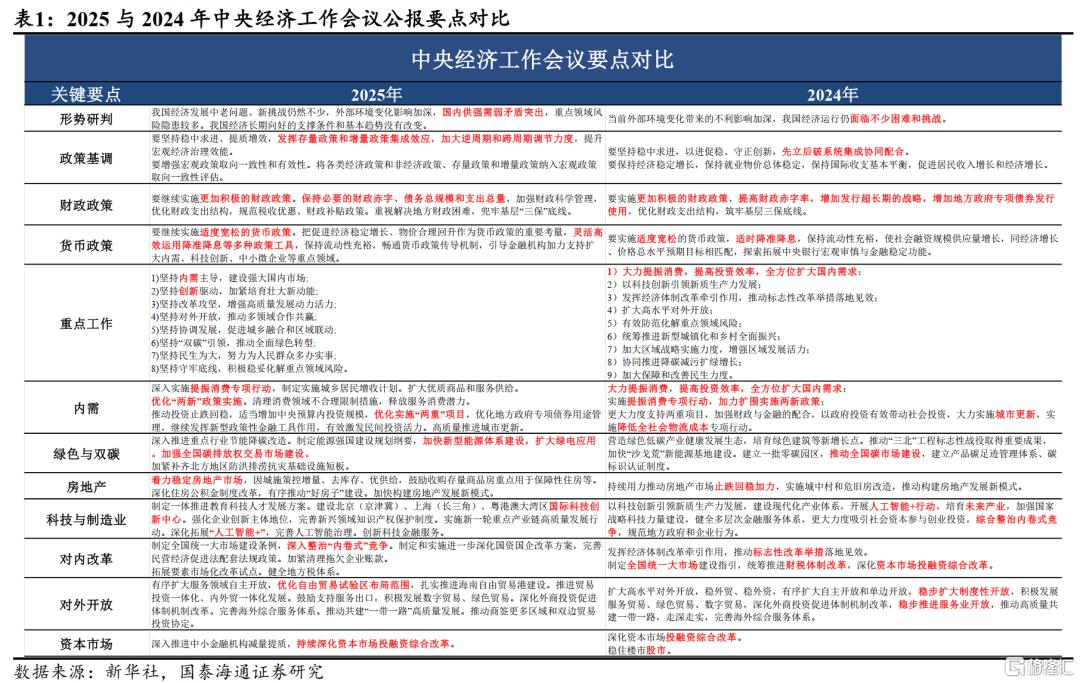
国泰海通:跨年攻势已经开始 看好科技、券商及消费
智通财经网· 2025-12-14 23:43
行业比较:步出先手棋后,进入跨年攻势:看好科技、券商与消费。中央经济工作会议延续积极的宏观 政策立场,重视短期的扩大内需和中长期的"内功"修炼,组合增加进攻性。看好:1)科技成长:AI模 型和应用进展加快,国内算力基础设施短缺。推荐:港股互联网/传媒/计算机/算力,以及具备全球竞争 优势的制造业出海:电力设备/机械设备。2)大金融:资本市场改革纵深有望重振风偏,推荐:券商/ 保险。3)顺周期:调整三年后,估值与持仓处于低位,消费板块景气线索增多,推荐低股价、低库 存、景气改善的消费股:食品饮料/农林牧渔/酒店/旅游服务;周期看好有色/化工。 主题推荐:1、商业航天:长征十二甲火箭发射在即与星座组网加速,看好液体火箭/卫星载荷/发射 场。2、能源强国:扩大绿电应用成为能源战略重点,看好智能电网/新型储能/核聚变能。3、AI应用: 中央提出深化拓展人工智能+,看好港股互联网/数据中心电力。4、内需消费:建设强大国内市场,看 好新兴消费/赛事经济/冰雪旅游。 风险提示:海外经济衰退超预期,全球地缘政治的不确定性。 智通财经APP获悉,国泰海通证券发布研报称,考虑近期经济活动转淡与房地产销售面积下滑加快,政 策预期有 ...