贸易关税

Search documents
商务部:坚决反对美对华半导体产品加征301关税,已提出严正交涉。(新华社)
Hua Er Jie Jian Wen· 2025-12-25 07:11
商务部:坚决反对美对华半导体产品加征301关税,已提出严正交涉。(新华社) 风险提示及免责条款 市场有风险,投资需谨慎。本文不构成个人投资建议,也未考虑到个别用户特殊的投资目标、财务状况或需要。用户应考虑本文中的任何 意见、观点或结论是否符合其特定状况。据此投资,责任自负。 ...
12月25日你需要知道的隔夜全球要闻
Sou Hu Cai Jing· 2025-12-24 23:26
Group 1 - The US government announced on the 23rd that it will impose tariffs on Chinese chips by 2027, concluding the previous Biden administration's trade investigation into Chinese chips, with no additional tariffs for at least 18 months [1] - Nvidia clarified that it is not acquiring Groq but obtaining a technology license to integrate Groq products into future offerings [2] - Intel's stock fell by 0.52% following reports that Nvidia has paused testing its 18A process technology [5] Group 2 - Nike's stock rose by 3%, with Apple CEO Tim Cook investing approximately $2.95 million to purchase 50,000 shares of Nike [6] - Denali Therapeutics saw a 38% increase, marking its largest rise in four years, due to Sanofi's $2.2 billion acquisition of Denali [7] - The US Energy Information Administration postponed the release of crude oil and natural gas inventory data to December 29 and December 30, respectively [8] Group 3 - The Baltic Dry Index achieved its best annual performance since 2016, with an 88.3% increase this year [13] - The three major US stock indices all rose, with the Dow Jones up 0.6%, the S&P 500 up 0.32% reaching new closing highs, and the Nasdaq up 0.22% [15] - WTI February crude futures closed at $58.35 per barrel, while Brent February crude futures closed at $62.24 per barrel; COMEX gold futures fell by 1.24% to $3,768.5 per ounce, and COMEX silver futures fell by 1.11% to $44.115 per ounce [16]


今年8-11月巴西对美国出口下降
Shang Wu Bu Wang Zhan· 2025-12-23 16:46
Core Insights - Brazilian exports to the United States are projected to decline significantly due to increased tariffs imposed by the U.S. government, with an estimated total decrease of approximately $1.5 billion from August to November 2025 [1] Industry Impact - A total of 21 industries in Brazil are expected to experience a year-on-year decline in exports to the U.S. during the specified period [1] - The most affected sectors include food, plastics and rubber, wood, metals, and transportation equipment, indicating a broad impact across various industries [1]
US to impose tariffs on chips from China
Reuters· 2025-12-23 14:20
Core Viewpoint - The United States plans to impose new tariffs on China's semiconductor industry, effective June 23, 2027, targeting chips that currently have 0% duties [1] Group 1 - The U.S. Trade Representative announced the upcoming tariffs on Chinese semiconductor products [1]


美联储官员保尔森:关税推高2025年通胀 明年有望回落
Xin Hua Cai Jing· 2025-12-12 15:17
Group 1 - The core viewpoint expressed by Anna Paulson, President of the Federal Reserve Bank of Philadelphia, is her concern regarding the risks in the labor market, emphasizing that she is more worried about labor market weakness than inflationary pressures [1] - Paulson indicated that the recent interest rate cut by the Federal Reserve provides "some assurance" against further deterioration in the job market, highlighting a proactive approach to economic risks [1] - She described the current federal funds rate range of 3.5% to 3.75% as "slightly tight," suggesting that the cumulative effects of previous tightening policies should be sufficient to continue suppressing inflationary pressures [1] Group 2 - Paulson holds a relatively optimistic view on inflation prospects, suggesting that high inflation in 2025 will be largely driven by trade tariffs, with a likelihood of inflation decreasing in 2026 as these effects diminish [1] - The current state of the labor market is characterized as "bending but not broken," indicating a cautious outlook while awaiting more information from the Federal Open Market Committee (FOMC) meeting in January 2026 to better assess economic prospects and policy risks [1] - The dual logic in the Federal Reserve's current decision-making is highlighted, where preventive interest rate cuts are aimed at addressing potential economic and employment downturn risks, while maintaining a tight policy stance to uphold anti-inflation credibility [2]
加央行鹰派立场成加元核心支撑
Jin Tou Wang· 2025-12-12 02:51
Core Viewpoint - The Canadian dollar (CAD) is experiencing a low-level fluctuation against the US dollar (USD), primarily due to the divergence in monetary policy between the Bank of Canada (BoC) and the Federal Reserve (Fed), alongside the resilience of the Canadian economy and support from rebounding oil prices [1][2]. Group 1: Monetary Policy and Economic Indicators - The Bank of Canada maintained its policy interest rate at 2.25% during the monetary policy meeting on December 10, indicating that the current rate is suitable for supporting structural economic transformation, marking the end of the rate-cutting cycle [1]. - Canada's GDP grew by 2.6% in Q3, significantly exceeding market expectations, and the unemployment rate fell to 6.5% in November, indicating improvements in the job market [1]. - The inflation rate in Canada was stable at 2.2% in October, remaining close to the 2% target, with core inflation between 2.5% and 3%, suggesting manageable inflationary pressures [2]. Group 2: US Monetary Policy and Market Impact - The Federal Reserve completed its third rate cut of the year on December 11, lowering the federal funds rate target range to 3.50%-3.75%, with internal dissent among officials indicating significant divisions [2]. - Fed Chairman Jerome Powell's comments on the downside risks to the US labor market have heightened expectations for further easing, contributing to a decline in the USD index below 99, which diminishes the dollar's attractiveness [2]. Group 3: Technical Analysis and Market Focus - The technical outlook for USD/CAD shows a bearish trend, with the price consistently trading below the five-day moving average and a lack of rebound momentum [3]. - Key support levels are identified at 1.3740 and 1.3680, with potential for further decline towards 1.3600 if these levels are breached [3]. - Market attention is expected to focus on statements from BoC and Fed officials, trade-related data, and international oil price movements, which are crucial for CAD as a commodity currency [3].
美国明年起对尼加拉瓜所有未纳入现有贸易协定进口商品征收关税
Yang Shi Xin Wen Ke Hu Duan· 2025-12-10 22:26
Core Viewpoint - The U.S. will impose tariffs on all Nicaraguan imports not covered by existing trade agreements starting January 1, 2026, with a phased implementation over two years [1] Group 1 - The tariffs will apply to all Nicaraguan goods that are not included in current trade agreements [1] - The implementation of these tariffs will occur in stages over a two-year period [1]
Dollar Does Not Deserve Its 'Very Rich Valuation,' Goldman Strategist Says
Youtube· 2025-12-03 16:34
Labor Market Concerns - There is a growing concern regarding the labor market, with indications that the layoff rate is beginning to pick up, despite previous stability in hiring and firing rates [2][3] - Upcoming reports are anticipated to confirm whether the tentative signals of increased layoffs are substantiated by comprehensive payroll and household survey data [3] Dollar Valuation and Economic Outlook - The US dollar is experiencing weakness due to a perception that the US economy is less exceptional than in the past, leading to a decline in its valuation [4][5] - The Federal Reserve is expected to ease policy further, which may contribute to continued dollar weakness [5][6] Bank of Japan (BOJ) Policy Considerations - The BOJ is considering a potential interest rate hike in December, influenced by the US economic performance and early signs of self-sustaining wage growth in Japan [10][11][12] - There is a concern regarding excessive yen weakening, prompting potential pushback from both the administration and the BOJ [12][13] Currency Trends and Investment Opportunities - The Chinese renminbi (CNY) is expected to appreciate gradually due to improved trade relations and significant growth in Chinese exports, which are seen as undervalued [16][17] - There are positive outlooks for the Chinese domestic equity market, particularly in high-tech industries, suggesting further growth potential [18][19] - Emerging markets, particularly Brazil, present investment opportunities in equities and bond markets as rate cuts are anticipated [21]

特朗普与巴西总统讨论合作打击有组织犯罪等议题
Xin Hua Wang· 2025-12-03 04:18
Core Viewpoint - The communication between U.S. President Trump and Brazilian President Lula emphasizes the importance of cooperation in combating organized crime, trade, and tariffs, indicating a potential strengthening of U.S.-Brazil relations [1] Group 1: Cooperation on Organized Crime - Trump and Lula discussed the urgency of enhancing cooperation to combat international organized crime, highlighting its impact on Brazil [1] - Both leaders expressed a commitment to work together in addressing organized crime issues [1] Group 2: Trade and Tariffs - Lula welcomed the U.S. decision to remove the 40% tariffs on Brazilian products such as meat, coffee, and fruits, while indicating that further discussions on tariffs for other products are necessary [1] - The U.S. had imposed a 40% tariff on Brazilian imports since August, citing political reasons related to former President Bolsonaro [1]
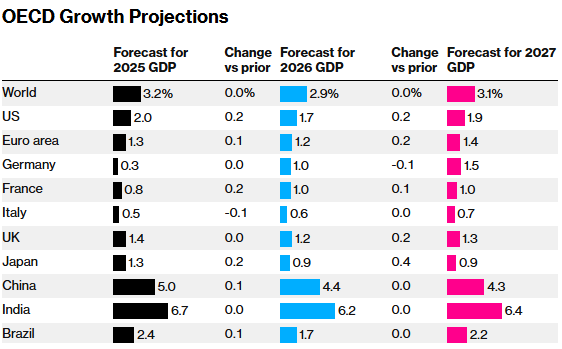
OECD上调主要经济体增长预期:全球贸易顶住关税冲击,AI投资成“减震器”
智通财经网· 2025-12-02 13:55
Group 1 - The OECD reports that the global economy has shown unexpected resilience to trade tariffs, primarily due to significant growth in AI-related investments and companies' efforts to import goods before tariffs take effect [1][4] - The OECD has revised upward its growth forecasts for the US and Eurozone for this year and next, while making slight adjustments to other major economies [1][4] - The global economic growth rate is projected to decline to 2.9% in 2026 from 3.2% in 2025, as the full impact of tariffs has yet to be realized [1][4] Group 2 - The OECD Secretary-General Mathias Cormann noted that despite concerns over economic slowdown due to increased trade barriers, the global economy has demonstrated strong resilience this year [4] - The OECD highlighted that the tech sector's prosperity has supported global trade flows, with production growth in technology outpacing other industries [4][5] - The OECD estimates that without significant AI investments, the US economy would have contracted by 0.1% in the first half of the year due to slowing household consumption and reduced government procurement [4] Group 3 - The OECD's Director of the Economic Research Department, Luiz de Mello, stated that investments in equipment necessary for businesses to thrive in the new tech era have stimulated economic activity, partially offsetting the negative impacts of policy uncertainty and tariffs [5] - The OECD warns that the rapid expansion of the tech sector and optimistic expectations regarding AI could lead to sudden market corrections and forced asset sales due to currently high valuations [8] - The OECD indicates that the current situation is "unstable," and its forecasts carry "significant risks" due to concerns over rapid changes in trade measures [8]