PPI

Search documents
3月通胀点评:低通胀:冲击后或迎转机
CMS· 2025-04-10 13:35
Inflation Analysis - March CPI year-on-year decreased by 0.1%, improving by 0.6 percentage points from the previous month[5] - Core CPI, excluding food and energy, rose to 0.5% in March from -0.1% in February, indicating a recovery in consumer demand[10] - Food CPI year-on-year was -1.4%, but the decline narrowed by 1.9 percentage points compared to the previous month[9] PPI Trends - March PPI year-on-year fell by 2.5%, with production materials down by 2.8%, marking an increase in the decline by 0.3 percentage points from the previous month[16] - The coal mining and oil extraction sectors experienced the largest declines, with coal mining PPI down by 14.9% year-on-year[18] - Manufacturing and construction sectors showed seasonal demand expansion, but overall industrial demand remains weak, impacting PPI negatively[23] Future Outlook - April CPI is expected to see a slight year-on-year increase, primarily driven by food and service sectors, but seasonal factors may lead to a decline in food prices[22] - PPI is anticipated to remain under pressure due to ongoing trade tensions and weak domestic demand, with potential policy adjustments to stimulate growth[23]
核心CPI显著回升——3月物价数据解读【财通宏观•陈兴团队】
陈兴宏观研究· 2025-04-10 09:21
Core Viewpoint - The article discusses the recent trends in Consumer Price Index (CPI) and Producer Price Index (PPI), highlighting a recovery in CPI year-on-year growth and an expansion in the year-on-year decline of PPI, influenced by various seasonal and input factors [1][2][4]. CPI Analysis - In March, the CPI year-on-year decline narrowed to -0.1%, a decrease of 0.6 percentage points from the previous month, while the core CPI significantly rebounded to 0.5% [1][4]. - The main drag on the CPI was food prices, which fell by 1.4% month-on-month, contributing approximately 60% to the total CPI decline [6][4]. - Seasonal factors, such as warmer weather leading to increased fresh food supply, and a tourism off-season causing a drop in travel-related prices, were significant contributors to the CPI's month-on-month decline [1][6]. - Excluding food and energy, the core CPI showed improvement, with a year-on-year increase of 0.5%, indicating a potential positive impact from consumption-boosting policies [1][4]. PPI Analysis - The PPI year-on-year decline expanded to -2.5% in March, an increase of 0.3 percentage points from the previous month, with production materials experiencing a decline of -2.8% [9][10]. - Input factors, including falling international oil prices and weakened domestic demand, significantly influenced the PPI's month-on-month and year-on-year performance [2][10]. - Specific industries, such as coal mining and oil extraction, saw notable price declines, with coal mining prices dropping by 14.9% [9][10]. - Despite the overall decline, some high-tech industries showed price improvements, with educational and pharmaceutical equipment prices increasing by 7.6% and 6.1%, respectively [9][10].


关税反制,对国内通胀有多大影响?
一瑜中的· 2025-04-07 14:34
Core Viewpoint - The article discusses the impact of China's tariff retaliation against the U.S. on domestic inflation, particularly focusing on the effects on the Consumer Price Index (CPI) and Producer Price Index (PPI) [2][12]. Group 1: Import Structure from the U.S. - In 2024, China's total imports from the U.S. are projected to be $163.6 billion, accounting for 6.3% of total imports, a slight decrease from 6.4% in the previous year [4][13]. - The import structure consists of approximately 34% capital goods, 34% industrial supplies, and 31% consumer goods, with significant changes observed since 2018, particularly a decrease in automobile imports and an increase in food imports [4][13]. - An analysis of specific HS4 categories reveals two types of imports: those that are low in volume but highly dependent on the U.S. (e.g., high-protein sorghum) and those that are high in volume but have low dependency on the U.S. (e.g., crude oil) [4][13]. Group 2: Impact on CPI - Using the structural decomposition method, it is estimated that the 34% tariff could increase the CPI by approximately 0.09 percentage points if fully passed through [5][6][19]. - The cost transmission method suggests that the tariff could lead to a 2.2% increase in the import price index, which would translate to a CPI increase of about 0.19 percentage points [7][8][22]. - Historical experience indicates that similar tariffs in 2018 resulted in an average CPI increase of 0.11 percentage points, leading to an estimated increase of 0.28 percentage points for the current tariff scenario [10][25]. Group 3: Methodology for CPI Impact Assessment - The assessment of CPI impact involved three methods: structural decomposition, cost transmission, and historical experience, each yielding different estimates for the potential increase in CPI due to the tariffs [5][22][25]. - The structural decomposition method involved selecting significant import categories and matching them to CPI components, while the cost transmission method relied on historical correlations between import price indices and CPI [17][22]. - The historical experience method extrapolated from past tariff impacts, adjusting for the differences in the composition of goods affected by the tariffs [10][25].

宏观经济宏观周报:高频指标表现弱于季节性,但投资景气继续上升-2025-04-06
Guoxin Securities· 2025-04-06 04:12
Economic Growth Indicators - The Guosen High-frequency Macro Diffusion Index A turned negative, while Index B slightly declined, indicating a weak trend[1] - Investment sector sentiment continues to rise, while the real estate sector shows a decline[1] - Seasonal comparison shows Index B typically rises by an average of 0.17 weekly post-Spring Festival, but this week it fell by 0.14, underperforming historical averages[1] Asset Price Predictions - Current domestic interest rates are low, while the Shanghai Composite Index is high, suggesting a potential downward adjustment[1] - The predicted ten-year government bond yield for the week of April 11, 2025, is expected to rise, while the Shanghai Composite Index is anticipated to decline[1] - The deviation between predicted and actual ten-year government bond yields reached a historical high of 85 basis points, indicating significant divergence from the macroeconomic fundamentals[18] Price Tracking - Food and non-food prices both increased this week, with March CPI food prices expected to decline by approximately 1.5% month-on-month[2] - The overall CPI is projected to decrease by about 0.5% month-on-month, with a year-on-year recovery to -0.1%[2] - March PPI is expected to show a month-on-month decline of about 0.1%, remaining flat year-on-year at -2.2%[11]
经济飘红,考验仍在——3月经济数据前瞻
一瑜中的· 2025-04-02 10:37
Core Viewpoint - The economy is expected to achieve a "good start" in Q1, with GDP growth projected around 5.1%, exceeding the annual target growth rate [2][4]. Economic Outlook for Q1 - Q1 GDP growth is anticipated to be approximately 5.1%, slightly lower than the 5.4% in Q4 of the previous year [9]. - Industrial growth is expected to be strong at around 5.7%, driven by the "new economy," export incentives, and advancements in "hard technology" [4][9]. - Financial sector growth is projected to be below 6.5%, influenced by lower stock trading volumes and insurance premium income [4][9]. - Real estate growth is forecasted at 1%, down from 2% in Q4, primarily due to negative growth in new housing sales [4][9]. - Information technology, leasing, and business services are expected to maintain high growth rates [4][9]. Key Economic Data for March - CPI is expected to rebound from -0.7% to around -0.2%, while PPI is projected at -2.3% [5][12][13]. - Retail sales growth is anticipated to rise to 4.8%, driven by a surge in "trade-in" activities [5][20]. - Exports are projected to grow by 2.5%, while imports may decline by 5.5%, influenced by increased tariffs [5][15][16]. - Fixed asset investment growth is expected at 4.2%, with real estate investment declining by 10% [5][17]. - Industrial production growth is forecasted at 5.5%, supported by strong PMI indices [5][14]. Sector-Specific Insights - Retail sales are expected to benefit from accelerated "trade-in" programs, with significant increases in automotive and home appliance sales [20][21]. - Financial sector growth is projected to remain stable, with new social financing expected at 4.8 trillion, reflecting a year-on-year increase [22].

宏观经济宏观周报:国内经济增长动能稳健提升
Guoxin Securities· 2025-03-23 07:14
Economic Growth - The domestic economic growth momentum is steadily improving, with the Guosen High-Frequency Macro Diffusion Index A remaining positive and Index B continuing to rise[1] - Investment sector sentiment is improving, while consumer and real estate sectors show little change; investment performance is relatively strong[1] - Seasonal comparison indicates that Index B typically rises by an average of 0.17 weekly after the Spring Festival, with this week's standardized increase at 0.14, aligning with historical averages[1] Asset Prices and Predictions - Current domestic interest rates are low, while the Shanghai Composite Index is high; a mean reversion suggests that the ten-year government bond yield is expected to rise and the Shanghai Composite Index to fall in the upcoming week[1] - The predicted ten-year government bond yield for the week of March 21, 2025, is 2.47%, while the actual yield is 1.87%, indicating a deviation of 61 basis points[18] - The predicted Shanghai Composite Index for the same week is 3,174.98, lower than the actual value of 3,411.22[19] Price Trends - Food and non-food prices have both slightly decreased, with March CPI food expected to be -1.0%, non-food at -0.1%, and overall CPI at -0.3%[2] - The domestic Producer Price Index (PPI) is expected to remain flat month-on-month, with a slight year-on-year increase to -2.1%[2]
信贷不足VS财政拐点?——2月金融数据点评
赵伟宏观探索· 2025-03-16 16:22
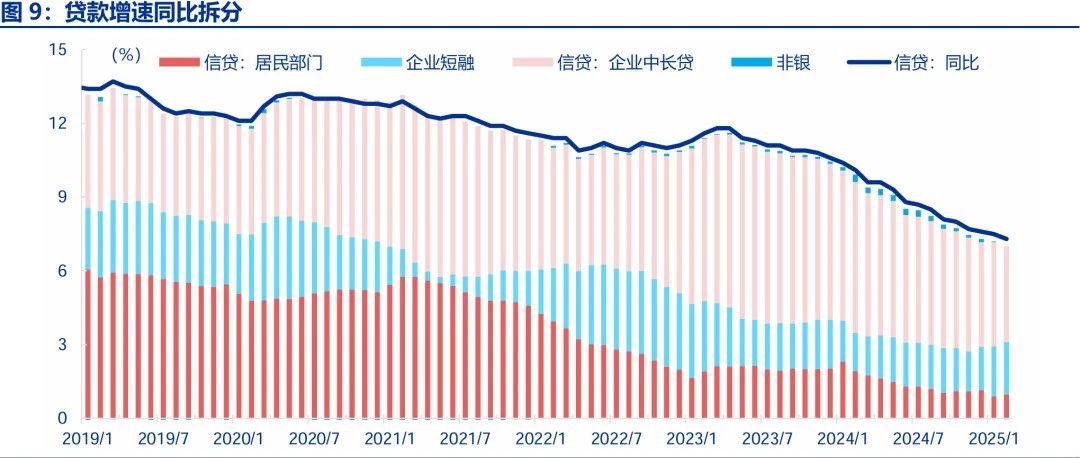
Core Viewpoint - A more proactive fiscal policy may break the current weak expectation cycle, as the decline in M2 year-on-year is primarily due to weak growth in household demand deposits rather than insufficient corporate activity, indicating a shift in household asset allocation towards equity markets [2][9] Financial Data Summary - In February, new credit amounted to 10,100 billion, a year-on-year decrease of 4,400 billion, mainly dragged down by corporate medium and long-term loans. Household loans decreased by 3,891 billion, a year-on-year reduction of 2,016 billion, with short-term loans down by 2,741 billion and medium and long-term loans down by 1,150 billion [4][22] - The total social financing (社融) in February was 22,375 billion, a year-on-year increase of 7,416 billion, supported by a significant increase in government bond financing while loans decreased. New RMB loans were 6,528 billion, a year-on-year decrease of 3,245 billion [5][23] - The M2 year-on-year growth remained stable at 7.0%, with the new M2 year-on-year growth rate declining by 0.3 percentage points to 0.1%. In terms of deposit structure, household deposits increased by 6,100 billion, a year-on-year decrease of 25,900 billion, while corporate deposits decreased by 8,940 billion [5][28] Economic Outlook - The increase in social financing in February was supported by fiscal financing, but the delayed arrival of debt repayment funds and weak credit demand indicate that the recovery foundation is still not solid. A more proactive fiscal policy is expected to effectively break the current weak expectation cycle, with increased spending intensity and accelerated expenditure expected to stabilize social financing [3][21]
欧元区3月投资者信心指数大幅回升——海外周报第82期
一瑜中的· 2025-03-16 14:40
Core Viewpoints - The article discusses recent economic data from the US, Eurozone, and Japan, highlighting trends in inflation, employment, and financial conditions [2][4][10]. Group 1: Important Data Review - In February, the US PPI increased by 3.2% year-on-year, lower than the expected 3.3% and previous 3.5%, with a month-on-month change of 0% against an expected increase of 0.3% [9]. - The US CPI for February grew by 2.8% year-on-year, below the expected 2.9% and previous 3%, with a month-on-month increase of 0.2% [9]. - The Eurozone's Sentix investor confidence index for March rose to -2.9, significantly above the expected -8.4 and previous -12.7 [10]. - Germany's January exports fell by 2.5% month-on-month, contrary to the expected growth of 0.5% [10]. - Japan's 2024 Q4 real GDP annualized quarter-on-quarter growth was revised down to 2.2%, below the expected 2.8% [10]. Group 2: Weekly Economic Activity Index - The US WEI index increased to 2.65% for the week of March 8, up from 2.24% the previous week [13]. - The German WAI index rose to 0.51% for the week of March 9, compared to 0.24% the previous week [13]. Group 3: Demand - The US Redbook retail sales year-on-year growth rate decreased to 5.7% for the week of March 8, down from 6.6% the previous week [14]. - The US mortgage application numbers increased, with the MBA market composite index rising to 269.3, an 11.2% week-on-week increase [15]. Group 4: Employment - Initial jobless claims in the US fell to 220,000 for the week of March 8, down from 222,000 the previous week [16]. - Continuing claims also decreased to 1.87 million, compared to 1.90 million the previous week [16]. Group 5: Prices - The RJ/CRB commodity price index was 302.67 on March 14, a 0.1% decrease from the previous week [17]. - The US gasoline retail price was $2.95 per gallon on March 10, down 0.1% from the previous week [17]. Group 6: Financial Conditions - The Bloomberg financial conditions index for the US was 0.20 on March 14, down from 0.27 the previous week [18]. - The Eurozone's Bloomberg financial conditions index increased to 1.30, up from 1.17 the previous week [18]. - Offshore dollar liquidity showed deterioration, with the yen and euro swap basis against the dollar decreasing [19]. Group 7: Bond Yield Spread - The 10-year bond yield spread between the US and Eurozone narrowed, with the US-EU spread at 135.6 basis points, down from 144.7 basis points the previous week [21].

海外周报第82期:欧元区3月投资者信心指数大幅回升-2025-03-16
Huachuang Securities· 2025-03-16 14:15
Investment Rating - The industry investment rating is "Recommended," indicating an expected increase in the industry index by more than 5% over the next 3-6 months compared to the benchmark index [51]. Core Insights - The Eurozone's investor confidence index saw a significant rebound in March, with the Sentix index rising to -2.9, surpassing expectations of -8.4 and the previous value of -12.7 [8]. - In the U.S., the Producer Price Index (PPI) for February was lower than expected, while the Consumer Price Index (CPI) showed an unexpected decline [7][9]. - The U.S. financial conditions are tightening, while the Eurozone is experiencing a loosening of financial conditions, as indicated by the Bloomberg financial conditions index [28]. Summary by Sections 1. Important Data Review - U.S. February PPI increased by 3.2% year-on-year, below the expected 3.3% and previous 3.5% [7]. - Eurozone's investor confidence index rebounded significantly in March [8]. - Japan's GDP for Q4 2024 was slightly revised down [7]. 2. Weekly Economic Activity Index - The U.S. WEI index rose to 2.65% for the week of March 8, up from 2.24% the previous week [14]. - Germany's WAI index increased to 0.51% for the week of March 9, compared to 0.24% the previous week [14]. 3. Demand - U.S. retail sales growth, as measured by the Redbook index, decreased to 5.7% year-on-year from 6.6% the previous week [17]. - Mortgage rates in the U.S. rose slightly to 6.65%, while mortgage applications increased by 11.2% [20]. 4. Employment - Initial jobless claims in the U.S. fell to 220,000, down from 222,000 the previous week [22]. 5. Prices - The RJ/CRB commodity price index was 302.67, showing a 0.1% decline from the previous week [25]. - U.S. gasoline prices decreased to $2.95 per gallon, down 0.1% from the previous week [25]. 6. Financial Conditions - The Bloomberg financial conditions index for the U.S. was 0.20, down from 0.27 the previous week, indicating tightening conditions [28]. - Offshore dollar liquidity has worsened, with the yen and euro swap basis against the dollar showing declines [28]. 7. Bond Yield Spread - The 10-year bond yield spread between Germany and Portugal narrowed, with spreads of -49.3bp and -106.0bp respectively [33].
投资,要寻找定价预期差
雪球· 2025-03-16 02:36
Core Viewpoint - The article emphasizes the importance of identifying mispricing in asset prices across different economic cycles to find investment opportunities and risks [2]. Group 1: Economic Cycles and Investment Timing - The Kondratiev cycle lasts approximately 50-60 years and involves technological revolutions, while the Juglar cycle is about 10 years and relates to equipment investment [3]. - The current economic situation indicates that after experiencing a downturn in the real estate sector and high inventory levels in 2022, a recovery phase is expected to begin in the second half of 2024, coinciding with a global inventory cycle bottoming out [4]. - Historical data shows that when the M1-M2 growth rate drops below 10%, it typically signals a market bottom, with a recovery expected after September 2024 [5]. Group 2: Price and Profit Relationships - Price movements generally lead inventory changes by 1-3 quarters, while corporate profits follow inventory changes by 2-4 quarters, indicating a sequential relationship in the economic cycle [6]. - The consumer electronics sector has experienced a peak in revenue growth since Q1 2021, followed by a decline, entering a destocking phase until 2024, when a recovery is anticipated due to AI technology and policy support [6]. Group 3: Valuation and Identifying Opportunities - During earnings season, companies that exceed performance expectations should be closely monitored to assess the reasons behind their outperformance and determine their position in the economic cycle [7]. - The focus should be on two types of companies: undervalued growth stocks, particularly in technology, and companies facing pessimistic pricing due to cyclical downturns, which may rebound as conditions improve [8][9]. - A thorough data validation process is necessary to assess the sustainability of the identified valuation discrepancies, including monitoring high-frequency data such as inventory levels and gross margins [9]. Group 4: Investment Strategy - A combination of top-down macroeconomic analysis and bottom-up company performance evaluation is recommended for selecting stocks, allowing for both short-term and long-term investment opportunities [10].