
数字化

Search documents
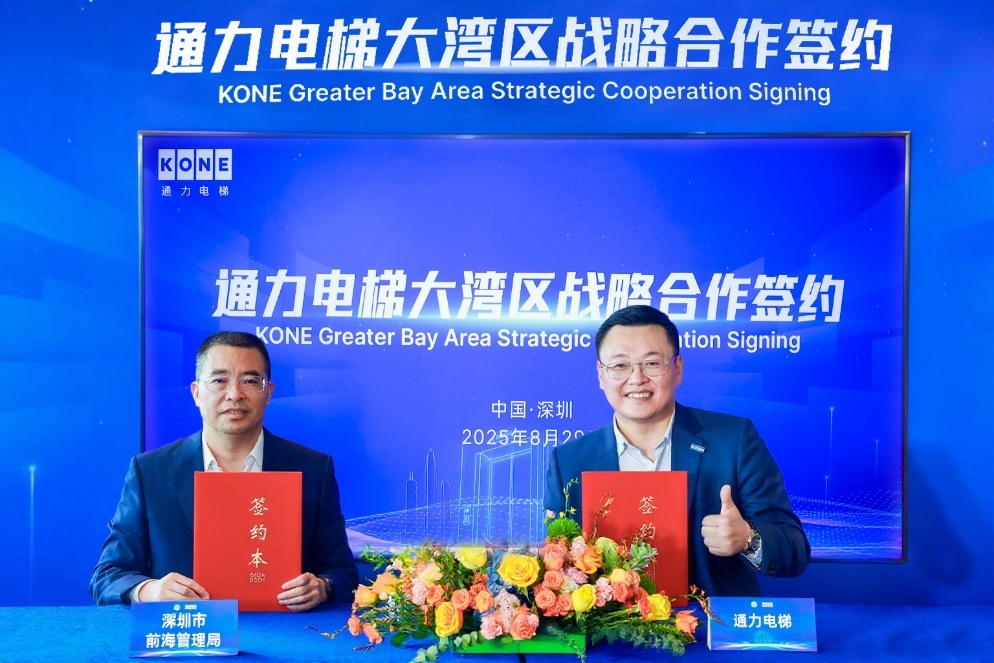
通力电梯加码在华投资,将在深圳设立南方总部 面对行业新机遇,国产电梯能否扳回一局?
Mei Ri Jing Ji Xin Wen· 2025-09-01 13:32
Group 1 - Kone Elevator announced a significant investment plan in the Guangdong-Hong Kong-Macao Greater Bay Area, including the establishment of a southern headquarters, R&D center, and smart logistics and assembly center in Shenzhen, focusing on modernization and digital maintenance services [1][11] - The Chinese elevator market has the largest elevator ownership globally, with international brands like Kone and Otis holding about 70% market share, while domestic brands account for only around 30% [2][5] - The elevator industry has faced revenue declines due to a slowdown in real estate demand, leading to increased competition and price wars among companies [2][4] Group 2 - In the first half of 2025, 10 out of 12 listed elevator companies in China reported revenue declines, with Shanghai Mechanical and Guangri shares experiencing decreases of 6.41% and 3.05%, respectively [3][4] - The total revenue of 12 A-share elevator companies in the first half of 2025 was 18.125 billion yuan, marking a five-year low compared to over 22 billion yuan in the same period in 2021 [3][4] - The demand for elevator maintenance and modernization is expected to grow, with over 1.2 million elevators in use and more than 1 million old elevators exceeding 15 years of service [9][10] Group 3 - Domestic brands are increasingly focusing on digitalization and smart technology to enhance competitiveness, with significant investments in R&D for IoT and AI applications [5][6] - Companies like Kone and Guangri are implementing smart elevator cloud service platforms and optimizing business structures to improve profitability [6][9] - The Chinese government is supporting the modernization of old elevators through special long-term bonds, with 6.2 billion yuan allocated for updating over 41,000 residential elevators [10][11]





中国电信与阿里携手,开启云和AI合作新纪元
Sou Hu Cai Jing· 2025-09-01 12:49
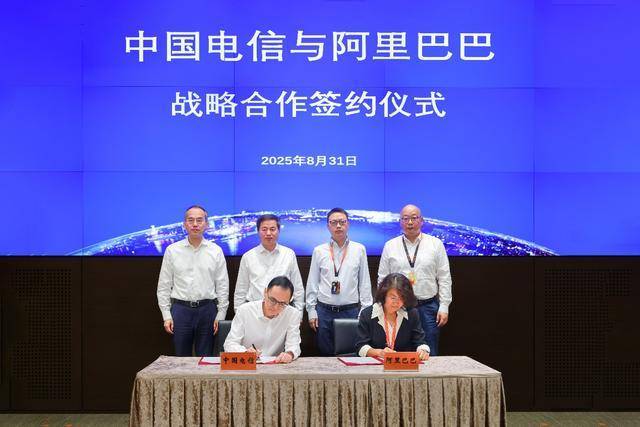
Core Insights - A strategic cooperation agreement has been signed between China Telecom and Alibaba, marking a significant collaboration in the digital era [1][3] - The partnership aims to enhance cooperation in key areas such as cloud and AI infrastructure, e-commerce development, and social value innovation [3] Group 1: Strategic Collaboration - The signing ceremony was attended by high-level executives from both companies, indicating the importance of this partnership [1] - The agreement includes a comprehensive plan to leverage each company's technological and market strengths to create integrated solutions for digitalization and AI applications [3] Group 2: Future Prospects - The collaboration is expected to boost the core competitiveness of both companies and provide strong momentum for the international development of Chinese enterprises [3] - Both companies are committed to driving innovation in digital and intelligent technologies, aiming to create greater social value [3] - This partnership is seen as a strategic move that injects new vitality and momentum into the development of China's digital economy [3]


首旅酒店(600258):25H1业绩表现较为稳健,盈利能力同比提升
EBSCN· 2025-09-01 08:13
Investment Rating - The report maintains an "Accumulate" rating for the company [1] Core Views - The company achieved a stable performance in H1 2025, with a year-on-year improvement in profitability. Revenue for H1 2025 was CNY 3.661 billion, down 1.93% year-on-year, while net profit attributable to shareholders was CNY 397 million, up 11.08% year-on-year [5][7] - The hotel business saw a slight decline in revenue, while the scenic area revenue remained stable. The hotel business generated revenue and profit of CNY 3.365 billion and CNY 395 million, respectively, with a year-on-year decrease of 2.09% in revenue but an increase of 20.53% in profit [5][6] - The company opened 664 new hotels in H1 2025, a year-on-year increase of 17.1%, with a focus on optimizing the store structure [6][8] Summary by Sections Financial Performance - In H1 2025, the overall gross margin was 38.33%, an increase of 0.76 percentage points year-on-year. The net profit margin for H1 2025 was 10.85%, up 1.27 percentage points year-on-year [7][12] - The company’s revenue growth rate is projected to be -0.94% for 2025, with net profit expected to grow by 12.86% [9][10] Revenue Breakdown - The hotel business revenue decreased by 7.85% due to the closure of underperforming stores and a decline in RevPAR, while the hotel management business revenue increased by 11.70% due to the expansion of franchise stores [5][6] - The RevPAR for all hotels, excluding light management hotels, was CNY 153, down 4.3% year-on-year [6] Store Expansion and Structure - The company continues to optimize its store structure, focusing on standard management hotels. As of H1 2025, the total number of hotels reached 7,268, with the proportion of mid-to-high-end hotels increasing to 29.3% [6][8] Profitability and Cost Control - The company has effectively controlled costs, with a decrease in the expense ratio to 24.02%, down 0.79 percentage points year-on-year. The sales expense ratio increased due to higher OTA commissions, while management expenses decreased due to improved cost control [7][12] Future Outlook - The company’s mid-to-high-end brand layout is becoming more complete, and the report expresses optimism about the company's future development prospects, maintaining the "Accumulate" rating [8][9]

首旅酒店(600258):25H1业绩表现较为稳健 盈利能力同比提升
Xin Lang Cai Jing· 2025-09-01 06:26
Core Viewpoint - The company reported a slight decline in revenue for the first half of 2025, but net profit increased, indicating improved profitability despite challenges in the hotel business [1][3]. Revenue and Profit Summary - In H1 2025, the company achieved revenue of 3.661 billion yuan, a year-on-year decrease of 1.93%, while net profit attributable to shareholders was 397 million yuan, an increase of 11.08% [1]. - In Q2 2025, revenue reached 1.896 billion yuan, a year-on-year increase of 0.42%, with net profit of 254 million yuan, up 7.37% [1]. Business Segment Performance - Hotel business revenue in H1 2025 was 3.365 billion yuan, down 2.09%, but profit increased by 20.53% to 395 million yuan. The decline in revenue was attributed to the closure of underperforming stores and a decrease in RevPAR [1][2]. - The management business benefited from the expansion of franchise stores, with revenue increasing by 11.70% [1]. - Scenic area revenue in H1 2025 was 296 million yuan, with profit totaling 153 million yuan, showing a slight decrease of 0.09% in revenue but a marginal increase in profit of 0.16% [2]. RevPAR and Hotel Operations - The RevPAR for all hotels, excluding light management hotels, was 153 yuan in H1 2025, down 4.3% year-on-year, with Q2 showing a smaller decline of 4.1% compared to Q1 [2]. - The average room rate in Q2 2025 was 242 yuan, down 2.0%, with an occupancy rate of 68.2%, a decrease of 1.5 percentage points [2]. - The company opened 664 new hotels in H1 2025, a year-on-year increase of 17.1%, with a focus on standard management hotels [2]. Profitability and Cost Control - The overall gross margin for H1 2025 was 38.33%, an increase of 0.76 percentage points, driven by a higher proportion of high-margin hotel management revenue [3]. - The company’s expense ratio was 24.02%, down 0.79 percentage points, with notable improvements in management expenses due to enhanced cost control [3]. - The net profit margin for H1 2025 was 10.85%, up 1.27 percentage points year-on-year, indicating effective cost management [3]. Future Outlook and Valuation - The company has slightly adjusted its net profit forecasts for 2025-2027 to 910 million, 1.092 billion, and 1.319 billion yuan, reflecting a cautious outlook on business travel demand recovery [4]. - The company maintains a positive view on its future development prospects, supported by an increasingly complete mid-to-high-end brand layout [4].
捷达品牌将成立新公司 计划2028年前推出5款全新商品
Zhong Guo Zhi Liang Xin Wen Wang· 2025-09-01 04:47
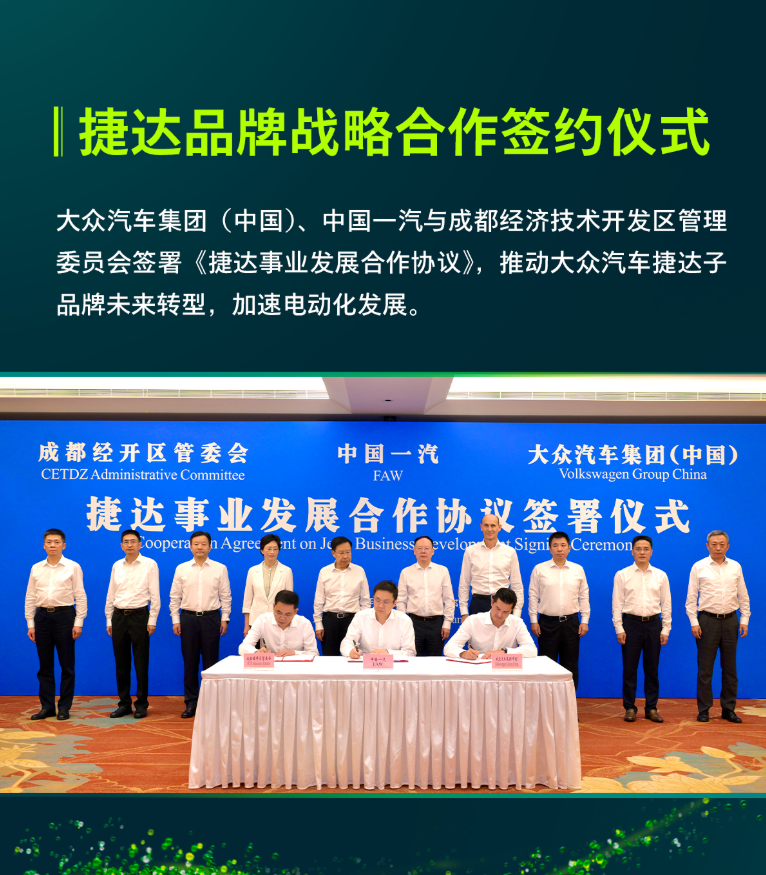
Core Points - A cooperation agreement has been signed between China FAW, Volkswagen Group (China), and Chengdu Economic and Technological Development Zone Management Committee to establish a new company for the Jetta brand, with plans to launch five new models by 2028, including four electric vehicles, the first of which is expected to be released in 2026 [1][3] Group 1 - The new company will fully integrate existing Jetta resources and introduce local capital as new investors, allowing Jetta to continue operating as a sub-brand of Volkswagen while maximizing synergies with Volkswagen Group and FAW-Volkswagen [3] - By 2028, Jetta aims to launch four electric models targeting the entry-level market, featuring competitive electrification, digitalization, and advanced driver-assistance systems (ADAS) [3] - The establishment of the new company aims to leverage regional industrial synergies to accelerate Jetta's electrification process and enhance operational efficiency [5] Group 2 - The cooperation agreement outlines a significant transformation in both the development path of the Jetta brand and the joint venture model [5] - By 2030, the goal for the new Jetta company is to create a trillion-level industrial value chain encompassing research and development, production, supply, and sales, thereby increasing Jetta's market influence in the Sichuan automotive industry [5]
高压一二次设备持续增长,多品种出口迭创新高——电网2025年1-7月招标总结
2025-09-01 02:01
Summary of Conference Call Records Industry Overview - The conference call focuses on the power grid industry, specifically high-voltage equipment and infrastructure investment in China for the first half of 2025. Key Points and Arguments Electricity Consumption and Growth - National electricity consumption increased by 3.7% year-on-year in the first half of 2025, with July surpassing 4%, and an annual growth target of 5% is expected to be achieved [3][2][1]. High-Voltage Equipment and Bidding Performance - In the first half of 2025, the State Grid's bidding for ultra-high voltage equipment reached 10.715 billion yuan, a year-on-year increase of approximately 5%. Bidding for ultra-high voltage materials reached 17.87 billion yuan, with a year-on-year increase of about four times [6][5]. - The bidding for transmission and transformation equipment grew by 25%, while digital equipment saw a growth of 30.5% [1][6]. Infrastructure Investment - The total investment in power grid infrastructure in the first half of 2025 was 291.1 billion yuan, reflecting a year-on-year increase of 14.6%. Although the growth rate exceeded 20% at the beginning of the year, it gradually settled around 10% [2]. Key Projects and Developments - Major projects initiated in the first half of 2025 include direct current ultra-high voltage lines from Inner Mongolia to Jiangxi and from Songliao to North China, as well as several back-to-back direct current projects [10][11]. - The approval and commencement of ultra-high voltage flexible direct current projects are expected in the second half of the year, indicating strong demand for equipment [12]. Market Performance of High-Voltage Equipment - The high-voltage transmission and transformation equipment market showed robust growth, with the bidding capacity for transformers above 220kV increasing by 16.5% year-on-year [13]. - Demand for secondary equipment grew by 37.2%, with significant increases in various categories of equipment [13]. Export Performance - Transformer exports reached 26.958 billion yuan, a year-on-year increase of 37.35%, with liquid transformers growing by 50.71% [27][28]. - The export of low-voltage switchgear increased by 22.2%, while power cable exports grew by nearly 42% [27][32]. Company Performance - Key companies in the bidding process included Shandong Electric, China XD Electric, Pinggao Electric, and TBEA, with Shandong Electric leading in the ultra-high voltage project bids [7][14]. - In the materials sector, Hongsheng Huayuan and Zhongtian Technology excelled in the tower and grounding wire segments, with demand for towers reaching 8.12 billion yuan [8]. Digitalization and AI Integration - The digital equipment sector saw a total bidding amount of 3.314 billion yuan, reflecting a year-on-year growth of 30% [20]. - The integration of AI in the power grid is expected to drive further growth, with upcoming specialized AI bidding announcements from the State Grid [36]. Recommendations for Future Development - The conference highlighted three main investment themes: ultra-high voltage, digitalization, and international expansion, all of which are expected to perform well in the current market environment [36]. Additional Important Information - The penetration rate of amorphous transformers reached 29.8%, indicating increasing adoption of advanced technologies in the power grid [22]. - The joint procurement in the distribution network reached 137.3 billion yuan, accounting for over half of the total bidding amount, with significant contributions from provinces like Shandong and Jiangsu [21][23].
卓然股份(688121):反内卷有望驱动炼化老旧设备更新
Xin Lang Cai Jing· 2025-09-01 00:36
Core Viewpoint - The company reported a significant decline in revenue and net profit for the first half of 2025, indicating challenges in its operational performance and market conditions [1] Financial Performance - In the first half of 2025, the company achieved operating revenue of 966 million yuan, a year-on-year decrease of 28.92% [1] - The net profit attributable to shareholders was -21.90 thousand yuan, a year-on-year decline of 100.62% [1] - The net profit excluding non-recurring items was 1.71 million yuan, down 95.30% year-on-year [1] - In Q2 2025, operating revenue was 797 million yuan, a year-on-year decrease of 39.00% but a quarter-on-quarter increase of 373.60% [1] - The net profit attributable to shareholders in Q2 was 8.11 million yuan, down 89.29% year-on-year but up 197.37% quarter-on-quarter [1] - The net profit excluding non-recurring items in Q2 was 9.36 million yuan, down 87.85% year-on-year but up 222.31% quarter-on-quarter [1] Order and Revenue Structure - The sales revenue from refining equipment accounted for 2.02% of the main business revenue, while petrochemical equipment sales accounted for 2.40% [2] - Engineering general contracting services made up 12.57% of the main business revenue, with other products and services contributing 83.00% [2] - The company has a total of 5.868 billion yuan in orders above 20 million yuan, which will gradually confirm revenue from 2025 to 2026, likely increasing the proportion of engineering general contracting services [2] Industry Trends - The Ministry of Industry and Information Technology announced a new round of policies aimed at stabilizing growth in key industries, including petrochemicals, which will drive the replacement of outdated equipment [3] - The "Implementation Plan for the Innovative Development of the Fine Chemical Industry (2024-2027)" emphasizes the importance of fine chemicals and new chemical materials for high-quality development in the petrochemical sector [3] - The industry is expected to increase investment in new technologies and processes, promoting technological advancement and industrial upgrading towards green and low-carbon development [3] Company Strategy - The company is actively investing in green and low-carbon technologies, aligning with national strategies for sustainable development [4] - It is focusing on clean energy, low-carbon processes, and green products, while exploring high-end, intelligent, and green implementation paths in the petrochemical sector [4] - The company aims to expand its market presence in petrochemical equipment, refining equipment, EPC general contracting services, and related products, while also extending its business into new materials and new energy [4] - The projected net profit for the company from 2025 to 2027 is estimated at 130 million yuan, 150 million yuan, and 200 million yuan, with corresponding PE ratios of 27.4X, 24.0X, and 17.5X based on the closing price on August 29, 2025 [4]

5552亿元!沪市公司中期分红再创新高!
Zheng Quan Ri Bao Wang· 2025-08-31 13:48
Core Insights - The performance of listed companies in the Shanghai market shows a clear growth momentum driven by consumption and technology, indicating a transition towards high-quality development [1] Group 1: Financial Performance - In the first half of 2025, total operating revenue for Shanghai-listed companies reached 24.68 trillion yuan, a slight decrease of 1.3% year-on-year; net profit was 2.39 trillion yuan, an increase of 1.1% year-on-year [2] - The number of companies participating in mid-term dividends reached a record high, with 408 companies announcing mid-term dividends, a 12% increase year-on-year; total cash dividends amounted to 555.2 billion yuan, up 5% [2] - Manufacturing sector showed stability with operating revenue and net profit increasing by 3.9% and 7.1% year-on-year, respectively, contributing 78% and 50% to the overall growth excluding non-bank financials [2] Group 2: Industry Trends - Emerging industries such as electronics, communications, biomedicine, and rail transit equipment saw revenue and net profit growth rates of 7.5% and 6.5%, respectively; the share of emerging industries in manufacturing revenue rose from 39% to 49% over five years [2] - Traditional industries are undergoing transformation, with steel and machinery sectors achieving net profit growth of 235% and 21% year-on-year, respectively [3] - Digital and intelligent transformation is advancing, with companies like Zhongchuang Zhiling and SANY Heavy Industry implementing automation and digital manufacturing solutions to enhance efficiency [3] Group 3: Export and International Performance - Over 830 manufacturing companies in the Shanghai market achieved overseas revenue of 1.1 trillion yuan, a year-on-year increase of 5%; private enterprises contributed nearly 70% of this revenue [4] Group 4: Investment Trends - The scale of ETFs in the Shanghai market exceeded 3.7 trillion yuan, with net inflows of over 350 billion yuan this year; significant growth in ETF products indicates increasing institutional investment [5] - The number of asset restructuring cases in the Shanghai market increased by 23% year-on-year, with major asset restructurings rising by 224%, totaling over 160 billion yuan in transaction value [6]
科锐国际(300662):收入增速亮眼 AI驱动提质增效
Xin Lang Cai Jing· 2025-08-31 12:46
Core Insights - The company reported strong revenue growth in 1H2025, achieving revenue of 7.075 billion yuan, a year-on-year increase of 27.67%, and a net profit attributable to shareholders of 127 million yuan, up 46.96% year-on-year [1] - The second quarter of 2025 showed impressive revenue growth, with revenue reaching 3.772 billion yuan, a year-on-year increase of 29.99%, and a net profit of 69 million yuan, up 51.26% year-on-year [1] - The company's gross margin decreased due to product mix effects, with a gross margin of 5.53% in 2Q2025, down 1.52 percentage points year-on-year [1] Revenue Breakdown - In 1H2025, the company's revenue from flexible staffing, headhunting, recruitment outsourcing, and technical services was 6.736 billion, 196 million, 45 million, and 38 million yuan, respectively, with year-on-year growth rates of 29.31%, -1.18%, 26.84%, and 48.23% [2] - The gross margins for these segments were 4.49%, 29.12%, 38.67%, and 18.47%, showing year-on-year changes of -1.23, +1.03, +15.45, and +0.59 percentage points, respectively [2] Regional Performance - The overseas revenue and gross margin showed an upward trend in 1H2025, with revenue increasing by 5.1% and gross margin improving by 1.4 percentage points year-on-year [2] Operational Efficiency - The company is enhancing operational efficiency through AI-driven initiatives, focusing on internal information technology and digital product development [2] - Continuous training and adjustment of AI models for recruitment matching are improving matching efficiency and accuracy [2] Investment Outlook - The company is projected to achieve revenues of 14.842 billion, 18.001 billion, and 21.140 billion yuan for 2025-2027, with net profits of 308 million, 412 million, and 537 million yuan, respectively [3] - The company has completed internal adjustments, and both outsourcing and headhunting businesses are expected to grow positively, supported by AI applications for quality improvement and efficiency [3]

七大看点!沪市半年报“交卷”
Zheng Quan Shi Bao· 2025-08-31 12:29
Financial Performance - In the first half of the year, Shanghai Stock Exchange listed companies achieved a total operating revenue of 24.68 trillion yuan, a slight decrease of 1.3% year-on-year; net profit reached 2.39 trillion yuan, an increase of 1.1% year-on-year; and net profit after deducting non-recurring items was 2.29 trillion yuan, up 0.7% year-on-year [1] - In Q2, operating revenue and net profit increased by 6.1% and 0.1% quarter-on-quarter, respectively [1] - The manufacturing sector showed stability with operating revenue and net profit growing by 3.9% and 7.1% year-on-year, contributing 78% and 50% to the overall growth after excluding non-bank financials [1] Emerging Industries - The integrated circuit and biomedicine sectors are becoming new growth engines, with integrated circuit companies reporting a total operating revenue of 246.68 billion yuan and net profit of 18.94 billion yuan, representing year-on-year growth of 14% and 57%, respectively [3] - The biomedicine sector achieved total revenue of 251.11 billion yuan and net profit of 31.86 billion yuan, with year-on-year growth of 1% and 14% [3] Consumer Sector - The consumer sector, including food and beverage and home appliances, saw operating revenue and net profit grow by 12% and 2% year-on-year, respectively [4] - The automotive industry experienced a 6% increase in operating revenue, while the home appliance sector's net profit grew by 10% [4] Traditional Industries - Traditional industries such as steel and machinery are innovating to escape "involution," with net profit growth of 235% and 21% year-on-year, respectively [6] - Companies are advancing digital and intelligent transformations, with significant improvements in production efficiency and revenue growth in digital logistics and supply chain solutions [6] Export Performance - Over 830 manufacturing companies achieved overseas revenue of 1.1 trillion yuan, a year-on-year increase of 5%, with private enterprises contributing nearly 70% of this revenue [7] - Companies like China Railway Engineering Corporation and King Long Motor achieved significant export growth in various international markets [7] ETF Market - The total scale of ETFs in the Shanghai market exceeded 3.7 trillion yuan, with significant net inflows and a growing number of new ETF products launched [8] - The introduction of new indices and products in the STAR Market has attracted long-term investment, with substantial increases in the scale of STAR Market ETFs [8] Mergers and Acquisitions - The number of asset restructuring cases increased significantly, with 378 new cases in the first half of the year, a year-on-year growth of 23% [9] - The implementation of policies aimed at supporting technology companies has led to a rise in IPO applications and significant asset restructuring activities [9]