绿色低碳转型

Search documents
前三季度四川经济运行平稳,体现“稳”“新”“好”三个特点
Sou Hu Cai Jing· 2025-10-21 10:57
Core Viewpoint - Sichuan's economy has shown stable growth in the first three quarters of 2023, with a GDP of 49,322.2 billion yuan, reflecting a year-on-year increase of 5.5% [3] Economic Performance - The economic foundation is solid, with stable production and supply, expanding market demand, and improving livelihood guarantees [3] - Agricultural output increased by 3.5%, while social retail sales grew by 5.8% [3] - Industrial output maintained a growth rate of over 7%, with high-tech manufacturing value added increasing by 11.6% [6][8] Investment and Consumption - Investment in the primary and secondary industries grew by 13.1% and 6.9% respectively [4] - Retail sales of essential goods increased, with food retail up by 12.4% and luxury goods like jewelry and cosmetics rising by 24.5% and 9.1% respectively [4] Employment and Income - Urban employment remained stable, with over 800,000 new jobs created and an average urban unemployment rate of 5.3% [4] - Per capita disposable income for urban and rural residents grew by 4.5% and 5.5%, respectively, indicating a narrowing income gap [4] New Growth Drivers - New production capabilities are being cultivated, with significant growth in high-tech manufacturing and green industries [6] - The internet sector saw a revenue increase of 20.5% from January to August [6] Policy and Market Dynamics - The effectiveness of policies aimed at stimulating demand and production is becoming evident, with significant growth in equipment investment and consumer goods sales [8] - The business environment is improving, with industrial profits rising by 5.8% year-on-year, surpassing the national average [8] Infrastructure and Financial Support - Infrastructure development is being accelerated, enhancing resource allocation and economic operation [9] - Financial services are robust, with a double-digit growth in loans supporting the real economy [9]

超20位重磅嘉宾热议“全球变革中的上海行动与多元协同”
新浪财经· 2025-10-21 10:01
Core Viewpoint - The 2025 Sustainable Global Leaders Conference aims to explore new paths for sustainable development, emphasizing collaboration and innovation in Shanghai's industrial upgrade and sustainable practices [2][3][4]. Group 1: Conference Overview - The conference is co-hosted by the World Green Design Organization and Sina Group, with support from the Shanghai Huangpu District Government [2]. - The parallel forum on October 17 focused on "Shanghai Actions and Multidimensional Collaboration in Global Transformation" [2]. Group 2: Key Themes and Discussions - Discussions included topics such as "Creating a Sustainable Development Model in the East" and "Decoding Sustainable Drivers for Shanghai's Industrial Upgrade" [3]. - The importance of sustainable development as a universal aspiration was highlighted, with a focus on green development as a foundation for high-quality growth [4]. Group 3: Leadership Insights - Leaders from various organizations emphasized the role of ESG principles in driving high-quality development and the integration of these principles into corporate strategies [10][20]. - The need for a robust capital market to support long-term investments in sustainable initiatives was discussed, with a call for more patient capital [12]. Group 4: Industry Innovations - The significance of green electricity as a strategic resource for national development was underscored, with a notable decrease in costs for wind, solar, and hydrogen energy over the past decade [16]. - Companies like Fosun Pharma are investing heavily in R&D, with approximately 5 billion RMB allocated annually, representing nearly 17% of their pharmaceutical revenue [20]. Group 5: Standardization and Global Competitiveness - The need for a balanced approach in developing ESG standards that align international norms with local practices was emphasized [24]. - Companies are encouraged to leverage cultural connections in international communications to enhance global competitiveness [25].

能源保供坚实有力!前三季度能源统计报告发布
Da Zhong Ri Bao· 2025-10-21 08:59
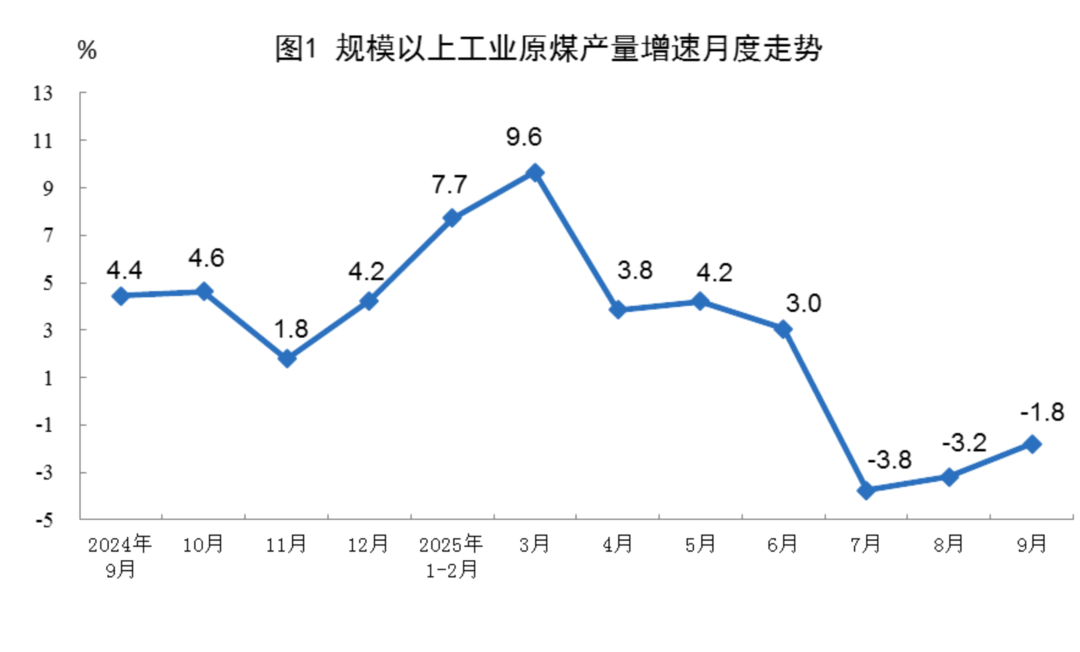
10月20日,国家统计局在其官网发布今年1-9月能源统计数据,国家统计局能源统计司司长胡汉舟表示,今年前三季度,我国经济稳定增长,能源消费增 速保持平稳。能源行业运行整体向好,各类能源先进产能积极有序释放,新能源快速发展,能源供应保障能力继续提升;能源消费结构优化转型加速推 进,非化石能源消费比重持续提高。 能源生产稳步增长 前三季度,能源生产稳步增长,规模以上工业煤油气电等主要能源产品生产均保持增长。 原煤生产保持平稳。煤炭行业积极推动先进产能有序释放,煤炭供应保持平稳,煤炭"压舱石"作用充分彰显。前三季度,规模以上工业原煤产量35.7亿 吨,同比增长2.0%。 油气生产稳中有增。前三季度,规模以上工业原油产量1.6亿吨,同比增长1.7%;规模以上工业天然气产量1949亿立方米,创历史同期新高,同比增长 6.4%。 电力生产保障有力。前三季度,规模以上工业发电量7.3万亿千瓦时,同比增长1.6%。其中,规模以上工业火电、水电分别下降1.2%、1.1%,规模以上工 业核电、风电和太阳能发电分别增长9.2%、10.1%、24.2%。 供给保障有力有效 受国产煤供应较为充分等有利因素影响,今年以来我国能源进口整体 ...
中国建筑兴业(0830.HK)三季度:业绩企稳信号显现,多维布局锚定长期增长空间
Ge Long Hui· 2025-10-21 06:36
Core Viewpoint - China State Construction International Holdings Limited (0830.HK) reported a third-quarter revenue of HKD 1.341 billion and an operating profit of HKD 121 million, indicating a positive trend towards stabilization in performance amidst the current market environment [1] Business Performance - The company has shown improvements in revenue and operating profit compared to the first half of the year, signaling a potential bottoming out of performance [1] - The company has made significant strides in its curtain wall business across Hong Kong, mainland China, and Singapore, achieving notable project wins and expanding its market presence [3][4] Market Outlook - The recovery in the Hong Kong real estate market is expected to bolster demand for curtain wall services, supported by rising private residential rents and a stable volume of property transactions [4] - Various institutions have optimistic forecasts for the Hong Kong property market, predicting a stabilization and potential growth in transaction volumes and prices in the coming years [4] Competitive Advantages - The company is focusing on high-end market segments, enhancing profit margins by securing contracts with premium clients such as Apple and Nike, which prioritize quality over price [7][8] - The company has successfully penetrated the Singapore market, obtaining government contracts that will provide a foundation for future projects in various sectors [9] BIPV Business Growth - The BIPV (Building-Integrated Photovoltaics) segment is experiencing rapid growth due to favorable policies and technological advancements, with the company securing multiple projects that validate its technical capabilities [12][14] - The company is well-positioned to benefit from the increasing demand for BIPV solutions, driven by government initiatives promoting green energy and sustainable construction practices [15] Strategic Vision - The company aims to solidify its leadership in the curtain wall industry while expanding its footprint in the green energy sector, particularly through its BIPV initiatives [17] - The rebranding of its subsidiary to emphasize its commitment to green energy solutions reflects the company's strategic focus on capturing opportunities in the low-carbon transition [17]

透过“三季报”看中国经济稳步前行
Ren Min Ri Bao· 2025-10-21 06:28
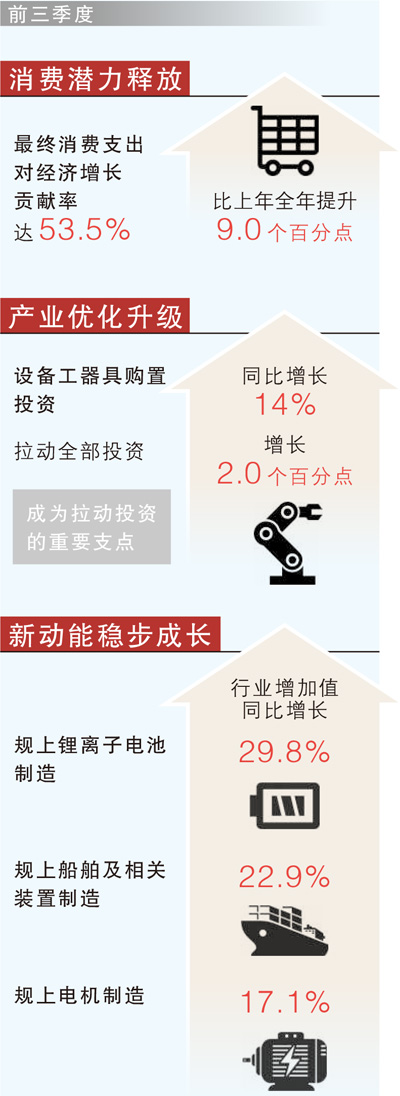
Economic Overview - The GDP growth for the first three quarters is 5.2%, with a third-quarter growth of 4.8%, indicating a stable economic performance [3][4][9] - The economic increment reached 39,679 billion, which is an increase of 1,368 billion year-on-year [4] - The average urban unemployment rate for the first three quarters is 5.2%, remaining stable compared to the first half of the year [4][10] Consumption and Investment - Final consumption expenditure contributed 53.5% to economic growth, an increase of 9.0 percentage points compared to the previous year [6][7] - Investment in equipment and tools increased by 14%, contributing 2.0 percentage points to overall investment growth [7][8] Industry Performance - The added value of the lithium-ion battery manufacturing industry grew by 29.8%, while shipbuilding and related equipment manufacturing increased by 22.9%, and motor manufacturing rose by 17.1% [8] - The proportion of added value from equipment manufacturing and high-tech manufacturing reached 35.9% and 16.7% respectively [5] Trade and International Relations - The total import and export volume increased by 6.0% year-on-year, with foreign exchange reserves maintaining above 3.3 trillion USD [10] - The resilience of foreign trade is highlighted by the historical high in goods import and export scale [4][10] Policy Impact - Macro policies have been effectively implemented to stabilize the economy and support long-term development [6][11] - The government has issued 300 billion yuan in special bonds to stimulate consumer demand through trade-in programs [6][7]
新思想引领新征程丨绿色低碳转型步伐稳健,美丽中国铺展新画卷
Yang Guang Wang· 2025-10-21 05:36
Core Points - The Chinese government emphasizes the importance of ecological environment protection and green development during the "14th Five-Year Plan" period, aiming for harmonious coexistence between humans and nature [1][2][3] - Significant improvements in ecological quality have been reported, with a 16.3% reduction in PM2.5 concentration in cities by 2024 compared to 2020, and over 90% of surface water quality meeting good standards [3] - The renewable energy sector has rapidly expanded, with one-third of the national electricity consumption coming from clean renewable sources, supporting carbon peak and neutrality goals [4][5] Group 1 - The "14th Five-Year Plan" focuses on ecological priority and green development, promoting a transition to a green economy [1][2] - The Yangtze River's ecological environment has been prioritized, with measures taken to improve water quality and ecosystem stability [2] - The construction of sports facilities in Jiangsu integrates ecological restoration with public services, showcasing effective environmental governance [1] Group 2 - Nationwide efforts have led to the completion of ultra-low emissions upgrades for 11.2 billion kilowatts of coal power and 9.5 billion tons of crude steel capacity [3] - The establishment of the largest and fastest-growing renewable energy system globally, with significant projects like the Kubuqi Desert wind and solar base [4] - China's renewable energy exports have contributed to a reduction of approximately 4.1 billion tons of carbon emissions globally [5]
陕西省委书记赵一德在秦岭生态环境保护工作推进会上强调 健全常态化长效化保护体制机制
Zhong Guo Huan Jing Bao· 2025-10-21 04:49
Core Points - The meeting focused on the ecological protection of the Qinling Mountains, emphasizing the need for a systematic and sustainable approach to environmental management [1][2] - The importance of learning from past mistakes, particularly regarding illegal constructions, was highlighted to enhance political awareness and execution in ecological protection [1] - A call for strengthening biodiversity protection and the establishment of national parks and botanical gardens was made to create a comprehensive wildlife resource protection network [1] Summary by Sections - **Ecological Protection Strategies** - Emphasis on regulations to protect mountains, planning to control mountain development, and the use of technology for management [1] - A commitment to improving the ecological environment quality of the Qinling region through a long-term protection mechanism [1] - **Biodiversity and Wildlife Protection** - Initiatives to enhance the protection of wild birds and to combat illegal activities affecting wildlife [1] - Plans to increase the supply of high-quality and safe alternative products to reduce ecological damage [1] - **Regulatory and Management Framework** - The need for strict enforcement of regulations against illegal exploration and adventure activities in core protection areas [1][2] - Development of a comprehensive monitoring and regulatory system integrating various technologies [2] - **Community Engagement and Responsibility** - Encouragement for local governments and departments to take responsibility for ecological protection and to engage the community in conservation efforts [2] - A focus on enhancing public awareness and collective action towards the protection of the Qinling Mountains [2]
前三季度关键数据出炉 读懂中国经济“秋季报”背后的信心和底气
Yang Shi Wang· 2025-10-21 04:20
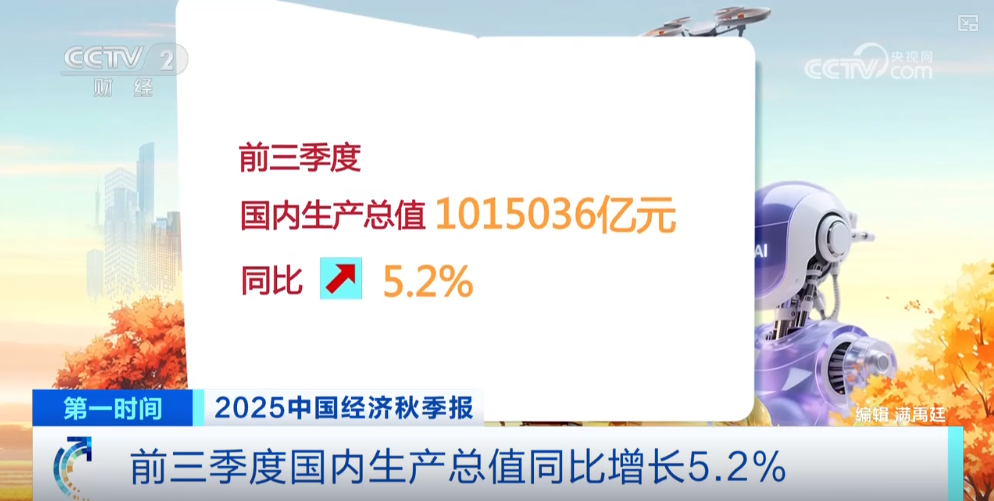
Economic Growth - China's GDP for the first three quarters of the year reached 10,150.36 billion yuan, with a year-on-year growth of 5.2%, accelerating by 0.4 percentage points compared to the same period last year [3] - The economic increment amounted to 396.79 billion yuan, with an increase of 136.8 billion yuan year-on-year [3] Industrial Performance - The industrial added value above designated size grew by 6.2% year-on-year, with the manufacturing sector increasing by 6.8% [3] - The proportion of added value from equipment manufacturing and high-tech manufacturing reached 35.9% and 16.7%, respectively [5] Consumer Market - The total retail sales of consumer goods reached 3,658.77 billion yuan, reflecting a year-on-year growth of 4.5%, with service retail sales growing by 5.2% [3][16] - Final consumption expenditure contributed 53.5% to economic growth, indicating that consumption remains the main engine of economic growth [5] Investment Trends - Manufacturing investment grew by 4.0% year-on-year in the first three quarters [3] - Investment in the automotive manufacturing sector maintained double-digit growth, driven by policies promoting the replacement of old vehicles [6][9] Employment and Prices - The urban survey unemployment rate remained stable compared to the first half of the year [3] - Core CPI inflation has expanded for five consecutive months, reflecting the effectiveness of policies aimed at expanding domestic demand and promoting consumption [3] International Trade - The total value of goods trade reached 3.361 trillion yuan, with a year-on-year growth of 4% [3] - The resilience of China's foreign trade has been highlighted, with a focus on upgrading export structures and expanding market reach [16] Technological Innovation - High-tech manufacturing added value grew by 9.6% year-on-year, with significant increases in the production of industrial and service robots [8][9] - The integration of technology and industry has led to a transformation of innovative potential into economic momentum, with substantial growth in renewable energy products [9][10] Energy Consumption - The total electricity consumption in the third quarter exceeded 1 trillion kilowatt-hours, with industrial electricity consumption showing rapid growth [12] - In Jiangsu, electricity consumption in advanced manufacturing increased significantly, particularly in the photovoltaic equipment sector [12]
国泰海通晨会早报-20251021
GUOTAI HAITONG SECURITIES· 2025-10-21 03:30
Group 1: Policy Research - The "14th Five-Year Plan" period is a critical phase for China to achieve its 2035 vision, focusing on high-quality development driven by new productive forces through technological innovation and industrial upgrades [2][4] - The core development line during the "15th Five-Year Plan" period emphasizes high-quality development driven by new productive forces, with a focus on advanced fields such as artificial intelligence, quantum technology, and low-altitude economy [4][5] - The report outlines a strategic goal system for the "15th Five-Year Plan," aiming for an average annual economic growth of approximately 4.73% to double the economy or per capita income by 2035 [5][6] Group 2: Overseas Technology Research - OpenAI has signed a 10GW computing power order with Broadcom, focusing on building foundational hardware capabilities [7][8] - OpenAI plans to deploy a total of 26GW of computing power through partnerships with NVIDIA and AMD, indicating a significant investment in AI accelerator technology [8][9] - OpenAI is exploring new business models, including integrating shopping features into ChatGPT and launching consumer hardware products, aiming to support a $1 trillion capital investment over five years [9][10] Group 3: Industry Insights - TSMC has reported stronger-than-expected AI demand, with Q4 revenue guidance exceeding market expectations, indicating a positive outlook for the AI sector [10] - The semiconductor market is experiencing significant price increases, with DRAM prices rising by 91% since early September and 510% since March 2025, benefiting semiconductor material demand [19] - The steel industry is witnessing a recovery in demand post-holiday, with inventory levels decreasing, suggesting a potential stabilization in the market [31][34]
图说经济丨如何评价前三季度经济运行总体表现?
中汽协会数据· 2025-10-21 02:13
Economic Stability - The overall economic stability of China remains unchanged, with a GDP growth of 5.2% year-on-year in the first three quarters, an increase of 0.2 and 0.4 percentage points compared to the previous year and the same period last year, respectively. The economic increment reached 39,679 billion yuan, an increase of 1,368 billion yuan year-on-year [5][6]. Employment and Prices - The average urban survey unemployment rate for the first three quarters was 5.2%, consistent with the first half of the year. The core CPI, excluding food and energy, rose by 0.6% year-on-year, with a 1.0% increase in September, marking a continuous expansion in growth for five months [6]. International Trade - The scale of goods import and export reached a historical high for the same period, with growth rates rebounding quarterly. As of the end of September, foreign exchange reserves remained above 3.3 trillion USD [7]. Industrial Performance - In the first three quarters, the industrial power generation of enterprises above designated size increased by 1.6% year-on-year. The volume of goods turnover and passenger turnover grew by 4.8% and 4.4%, respectively [8]. Economic Structure Optimization - The economic structure continues to optimize, with the added value of equipment manufacturing and high-tech manufacturing industries accounting for 35.9% and 16.7% of the total added value of industries above designated size, respectively [9]. Green Transition - Progress in green and low-carbon transformation is evident, with the proportion of non-fossil energy consumption in total energy consumption increasing by approximately 1.7 percentage points year-on-year [10]. Foreign Trade Growth - New driving forces in foreign trade are growing, with diversified markets providing strong support for export growth. The export of "new three samples" products saw double-digit growth in the first three quarters [11]. Income and Living Standards - The per capita disposable income of residents grew in line with economic growth, and the income gap between urban and rural residents continued to narrow [12][13]. Economic Resilience - Achieving a 5.2% economic growth rate demonstrates China's strong resilience and adaptability in the face of instability and uncertainty. This growth rate ranks among the top in major economies, highlighting China's role as a stable and reliable source of global economic growth [14].