
去美元化

Search documents
金价大涨映射了三大宏观不确定性
Di Yi Cai Jing· 2026-01-29 03:12
Core Viewpoint - The recent surge in gold prices, breaking historical records, reflects a significant shift in market perception regarding gold as a safe-haven asset amidst rising geopolitical tensions and economic uncertainties [3][4][10]. Geopolitical Risk - Gold's safe-haven attribute is rooted in its independence from government and corporate credit, making it a preferred asset during macroeconomic turmoil [4]. - Recent geopolitical events, including military actions and trade tensions, have catalyzed a spike in gold prices, transforming short-term trading demand into long-term investment demand [5][6]. - The ongoing fragmentation of the global geopolitical landscape has led to a persistent state of uncertainty, altering traditional gold pricing dynamics [6][9]. Monetary Credit Risk - The weakening of the dollar-based global monetary system has amplified gold's appeal as a non-sovereign asset, unaffected by any single country's monetary policy [10]. - The U.S. national debt is projected to exceed $38 trillion by 2025, raising concerns about the sustainability of the dollar's value and prompting central banks to increase gold reserves [10][11]. - The acceleration of "de-dollarization" trends is positioning gold as a strategic asset in the evolving global monetary landscape [12]. Macroeconomic Uncertainty - Global economic growth is under pressure, with forecasts indicating a slowdown in trade and investment due to rising tariffs and geopolitical risks [13]. - The expectation of stagflation has heightened gold's appeal as a hedge against inflation and economic stagnation, reinforcing its role as a critical asset in investment portfolios [13][14]. - The uncertainty surrounding global economic recovery continues to bolster gold's long-term investment rationale, as investors seek to mitigate systemic risks [15]. Conclusion - The rise in gold prices serves as a warning signal regarding global geopolitical, economic, and monetary challenges, necessitating vigilance from investors, policymakers, and businesses [16][17]. - The future trajectory of gold prices will be closely tied to the resolution of underlying global risks and the stabilization of economic and political orders [17].

建信基金:多重积极因素共振 看好黄金资产长期配置价值
Zhong Zheng Wang· 2026-01-29 03:09
Group 1 - The core viewpoint of the articles highlights the strong performance of gold prices, which have reached historical highs, with overseas London gold prices exceeding $5000 per ounce and domestic Shanghai gold prices surpassing 1100 yuan per gram, reflecting cumulative increases of 97.41% and 85.61% respectively since 2025 [1][2] - The long-term support for gold remains solid due to its multiple attributes as a traditional store of value, especially in the context of ongoing international uncertainties [1] - Gold prices are negatively correlated with U.S. real interest rates, and with the Federal Reserve entering a rate-cutting cycle, this is expected to benefit gold performance. Historically, during the last six Fed rate-cutting cycles, the average increase in London gold prices was 24.55% [1] Group 2 - Gold is an essential part of global central bank reserves, and the ongoing "de-dollarization" process, coupled with high U.S. Treasury yields and diminishing dollar credit, has led to increased gold allocations by central banks, acting as marginal price setters for gold [2] - As of the end of Q3 2025, the global official gold reserves accounted for 28.9% of total official reserves, the highest since records began in 2000 [2] - From an asset allocation perspective, gold's low correlation with traditional asset classes like stocks and bonds can help diversify portfolio risks and improve the risk-return profile [2]
建信基金:打造一站式全流程资产配置方案
Zhong Zheng Wang· 2026-01-29 03:03
Group 1 - The public fund industry is undergoing profound changes driven by asset price rotation, product structure transformation, and increasing demand for wealth management from residents [1] - Jianxin Fund's FOF investment and advisory head, Sun Yuemeng, shared investment strategies for FOFs in 2026, highlighting their unique advantages in multi-asset allocation and risk diversification [1] - Jianxin Fund launched the Longying Plan in early 2026, offering customized FOFs to provide one-stop asset allocation services for investors [1] Group 2 - Jianxin Fund's FOF team employs a four-layer selection process focusing on macro asset allocation, industry rotation, fund selection, and absolute return strategies, aiming to enhance portfolio returns [2] - The Jianxin Fuze Antai FOF is one of the first FOF products in the industry, with a strategic equity asset allocation midpoint of 20%, adjustable to 0% in extreme market conditions to control maximum drawdown [2] - The Jianxin Hongtai Multi-Asset 3-Month Holding FOF has a strategic equity asset allocation midpoint of 10% and covers various markets, recently achieving early fundraising success within just three trading days [2]
超级铜周期
2026-01-29 02:43
Summary of Conference Call on Copper Market Dynamics Industry Overview - The discussion centers around the copper market and its dynamics in relation to macroeconomic factors and technological advancements, particularly the impact of the AI revolution on copper demand [2][4][7]. Key Points and Arguments 1. **Copper Price and Macroeconomic Correlation** - Traditionally, copper prices have shown a positive correlation with macroeconomic conditions, but this relationship has diverged since 2023, indicating that new factors, such as the AI technology revolution, are significantly influencing copper demand [2][4]. 2. **Emerging Markets and Currency Correlation** - The positive correlation between emerging market currencies and copper prices has been disrupted since 2020, primarily due to developed countries employing fiscal and monetary policies (MMT) to extend economic growth, which has increased copper demand in these regions [2][5][6]. 3. **AI Era and Electricity Demand** - The AI era is driving a surge in electricity demand, with significant copper usage in electrical equipment construction, positioning copper as the "oil of the AI era" [2][7]. 4. **Investment in Electrical Infrastructure** - Developed and developing countries are simultaneously advancing electrification efforts. For instance, China plans to increase its grid investment by 40% during its "15th Five-Year Plan," totaling approximately 4 trillion RMB [2][8]. 5. **Basic Metals Demand from AI Supply Chain** - The entire AI supply chain requires substantial amounts of basic metals, including aluminum and copper, for data centers, chip manufacturing, and electrical infrastructure [2][9]. 6. **Global Economic Trends and Inequality** - The K-shaped recovery in the global economy is exacerbating wealth inequality, with a notable increase in the wealth concentration among the top 1% in the U.S., which could lead to rising geopolitical risks and populism [2][10]. 7. **Impact of Fiscal and Monetary Policies on Copper Prices** - Developed countries' fiscal and monetary policies have prevented economic downturns, thereby boosting demand for basic metals, including copper. For example, despite a significant price drop in 2023 due to U.S. interest rate hikes, copper prices rebounded following the introduction of multiple fiscal measures [2][11]. 8. **Global Monetary Order and Copper Prices** - The erosion of fiscal discipline is initiating a new global monetary order (Bretton Woods 3.0), challenging the dollar's status as an endogenous currency and accelerating de-dollarization, which is driving up prices of commodities like gold and copper [2][12]. 9. **Geopolitical Risks and Strategic Reserves** - Increasing geopolitical risks are prompting countries to bolster their strategic reserves, with significant growth in imports of copper and rare earths, indicating strong future demand in technology and metals sectors [2][13]. 10. **Resource Nationalism and Supply Constraints** - Resource nationalism is slowing the release of supply, intensifying the supply-demand imbalance in the copper market. Countries like Peru are implementing measures that could restrict copper exports, potentially leading to higher prices [2][14]. 11. **Future Expectations for Copper Market** - The confluence of the AI revolution and significant global changes is expected to usher in a new super cycle for copper. The current price levels, while high, are not yet at the peaks of previous cycles when adjusted for inflation, suggesting a potential increase of around 20% in copper prices within the year [2][15][16]. Additional Important Insights - The discussion highlights the critical role of copper in the context of technological advancements and economic policies, emphasizing its dual nature as both a commodity and a financial asset in the evolving global landscape [2][15].
美联储暂停降息引爆反弹强 美元表态强化上行动能
Jin Tou Wang· 2026-01-29 02:39
Group 1 - The core catalyst for the dollar's rebound is the Federal Reserve's decision to maintain the federal funds rate at 3.50%-3.75%, ending a series of rate cuts since September 2025, which aligns with market expectations [2] - The Federal Reserve's statement upgraded the description of economic activity from "slowing expansion" to "steady expansion" and removed the phrase about increasing risks to employment, reinforcing the dollar's strength [2] - U.S. Treasury Secretary's reaffirmation of a strong dollar policy and the emphasis on fundamental support for this policy have bolstered market confidence in the dollar, leading to a stronger dollar against the yen [2] Group 2 - Geopolitical and policy uncertainties are indirectly benefiting the dollar, as rising geopolitical risks, such as threats against Iran, are driving safe-haven flows into dollar assets [3] - The competition for the Federal Reserve Chair position is intensifying, with clear policy divergence among candidates, which is causing market concerns about policy stability and prompting a shift towards dollar safety [3] - The technical outlook for the dollar index shows strong short-term rebound momentum, with key resistance levels identified at 96.80 and potential targets at 97.00-97.20 [3] Group 3 - Short-term dollar movements will focus on three core factors: U.S. economic data, progress on the Federal Reserve Chair candidates, and geopolitical dynamics, all of which will influence market sentiment and policy expectations [4] - The ongoing global trend of de-dollarization and the policy directions of major central banks will determine the dollar's medium to long-term trajectory [4]
西南期货早间评论-20260129
Xi Nan Qi Huo· 2026-01-29 02:22
重庆市江北区金沙门路 32 号 23 层; 023-67071029 上海市浦东新区世纪大道 210 号 10 楼 1001; 021-61101854 地址: 电话: 1 市场有风险 投资需谨慎 2026 年 1 月 29 日星期四 国债: 上一交易日,国债期货收盘全线上涨,30 年期主力合约涨 0.07%报 112.090 元, 10 年期主力合约涨 0.05%报 108.210 元,5 年期主力合约涨 0.06%报 105.870 元,2 年 期主力合约涨 0.01%报 102.394 元。 公开市场方面,央行公告称,1 月 28 日以固定利率、数量招标方式开展了 3775 亿 元 7 天期逆回购操作,操作利率 1.40%,投标量 3775 亿元,中标量 3775 亿元。Wind 数据显示,当日 3635 亿元逆回购到期,据此计算,单日净投放 140 亿元。 住房城乡建设部透露,2025 年 1-12 月份,全国新开工改造城镇老旧小区 2.71 万 个、499 万户,共完成投资 1332 亿元。据了解,2025 年,全国计划新开工改造城镇老 旧小区 2.5 万个。 美联储维持基准利率在 3.50%-3. ...
一夜大涨百元!金饰克价首次站上1700元
Xin Lang Cai Jing· 2026-01-29 02:14
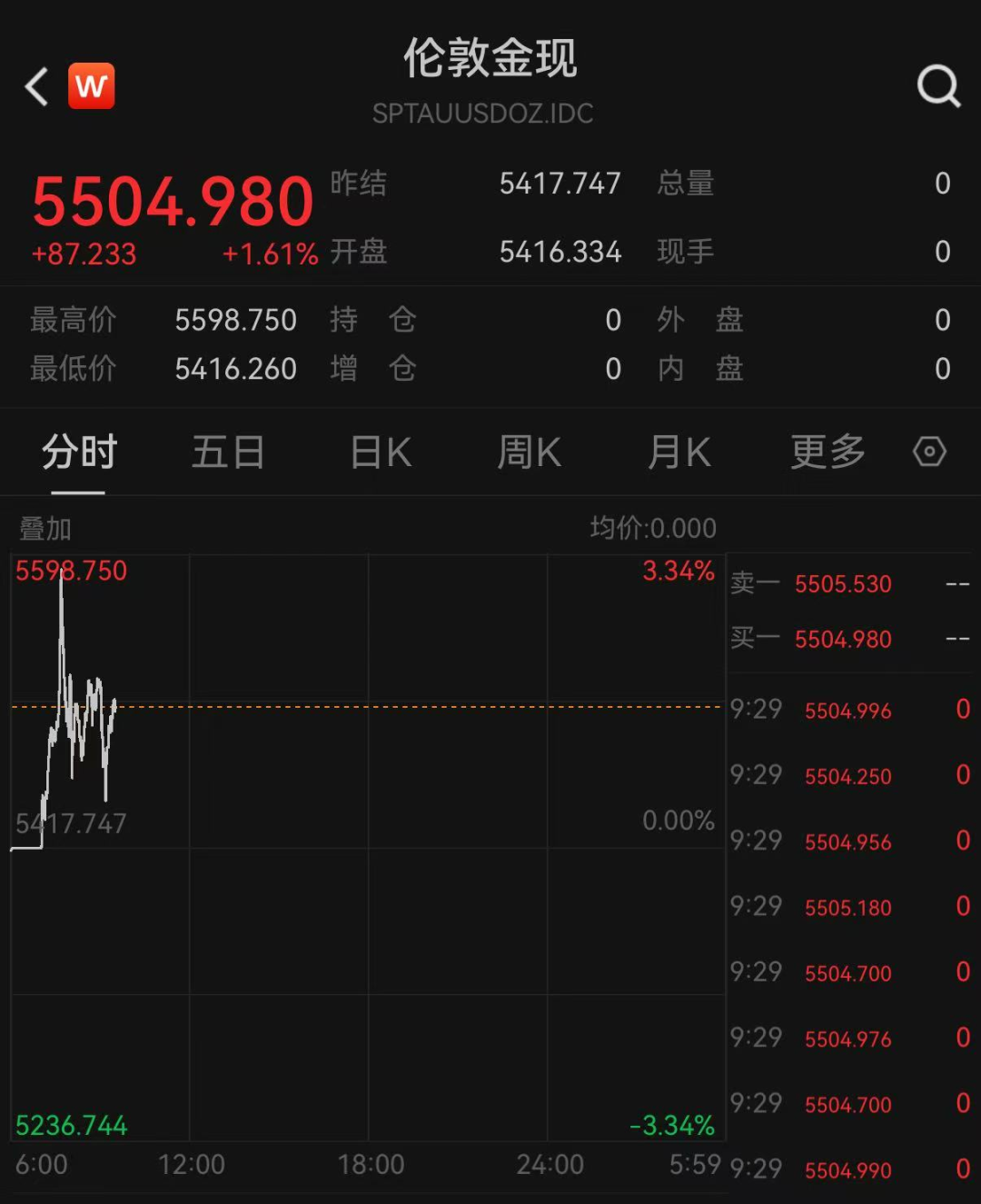
Group 1 - The core point of the news is the significant increase in spot gold prices, which surged over $500 within a week and approached $5600 before retracting slightly [1][2][9] - As of January 29, spot gold was reported at $5504.980 per ounce, reflecting a 1.61% increase [1][2] - The highest price reached during the trading session was $5598.750 per ounce, while the lowest was $5416.260 [2] Group 2 - Domestic gold jewelry prices have also hit historical highs, with brands like Laomiao and Chow Sang Sang seeing daily increases of around 100 RMB per gram [3][5] - Laomiao's gold price was reported at 1722 RMB per gram, an increase of 104 RMB, while Chow Sang Sang was at 1708 RMB per gram, up by 94 RMB [3] - The total scale of gold-themed funds in the A-share market has approached 380 billion RMB, with a growth of nearly 100 billion RMB since the end of last year, marking a 35.7% increase [9]
美联储加息下黄金为何反涨
Jin Tou Wang· 2026-01-29 02:13
Group 1 - The core logic of gold's rise during the Federal Reserve's interest rate hike cycle has shifted from being "interest rate driven" to "credit driven" [1] - Despite nominal interest rates increasing, market expectations indicate that future real interest rates will decline, with the 10-year TIPS yield dropping below 0.8% [1] - Global central banks have purchased over 1,000 tons of gold for seven consecutive years, with countries like China and Russia accelerating their diversification of reserves, positioning gold as a key vehicle for de-dollarization [1] Group 2 - There is a strong market expectation for a rate cut cycle in 2025-2026, with over 70% probability indicated by federal funds futures, creating a consensus on the nearing end of the rate hike cycle [2] - Historical data shows that gold has averaged a 15% increase within six months following the end of the last three rate hike cycles [2] - The ongoing global geopolitical conflicts and the U.S. national debt exceeding $37 trillion have led to a withdrawal from risk assets, resulting in a 23% increase in gold ETF holdings, reaching the highest level since 2021 [2] Group 3 - Central banks have net purchased gold for 15 consecutive years, with a total increase of 3,177 tons from 2022 to 2024, and emerging markets accounting for over 70% of this increase [3] - The People's Bank of China increased its gold reserves by 42 tons in 2024, raising the gold reserve ratio to 4.3%, which supports the internationalization of the renminbi [3] - Gold's share in global reserves has risen to 28.9%, while the dollar's share has fallen below 60%, indicating that gold is evolving from a safe-haven asset to a strategic anchor in the restructuring of the global monetary system [3]
中信建投工业品日报1.29
Xin Lang Cai Jing· 2026-01-29 01:21
Group 1: Copper Market - The main copper futures in Shanghai rose to 102,430 CNY, while London copper fluctuated around 13,112 USD [4][17] - The macroeconomic outlook is neutral to bearish, with the Federal Reserve maintaining interest rates and Powell's statements cooling rate cut expectations, alongside escalating tensions in Iran creating risk-averse sentiment [5][17] - The inventory of copper on the Shanghai Futures Exchange increased by 3,130 tons to 148,000 tons, while LME copper stocks rose by 1,575 tons to 173,900 tons, indicating a negative feedback on demand due to high prices [5][17] - Despite downstream purchasing at lower prices, the pressure on spot prices remains, and the market is expected to maintain a wide range of fluctuations in the short term, with a reference range of 99,800 - 103,000 CNY per ton for the main copper futures [5][17] Group 2: Nickel and Stainless Steel - The nickel and stainless steel market continues to react to Indonesian policy developments, with prices expected to remain high in the short term due to tight policy expectations [6][18] - The supply of nickel from the Philippines is hindered by weather conditions, while Indonesian wet method nickel is relatively abundant, but the supply of fire method nickel is tight [6][18] - The operational range for nickel futures is set at 140,000 - 160,000 CNY per ton, and for stainless steel at 14,000 - 15,500 CNY per ton [6][18] Group 3: Polysilicon Market - The polysilicon market is experiencing weak transaction volumes, with some companies lowering prices and downstream purchasing intentions remaining low due to demand being pulled forward [19] - The silicon industry association forecasts a 15% quarter-on-quarter decrease in polysilicon production for January, with further reductions expected in February to 82,000 - 85,000 tons [19] Group 4: Aluminum Market - The aluminum market saw a slight rebound in alumina prices, with current supply reductions expected to support short-term price increases [20][21] - A major alumina producer in Guizhou has reduced production, leading to a tighter supply in the Southwest region, while logistics are expected to tighten as the Spring Festival approaches [20][21] - The operational range for aluminum futures is set at 24,800 - 26,000 CNY per ton, with a recommendation to hold existing long positions [21] Group 5: Zinc and Lead Markets - Zinc prices are experiencing strong fluctuations, with the macroeconomic environment being mixed following the Federal Reserve's decision to pause rate cuts [23] - Supply-side issues are noted, with production expected to decrease by over 50,000 tons due to maintenance and natural days off in February [23] - The operational range for zinc futures is set at 24,500 - 26,000 CNY per ton, while lead futures are expected to operate within 16,800 - 17,800 CNY per ton [23]


3大风险信号,黄金赚麻了,我却担心得睡不着觉
3 6 Ke· 2026-01-29 00:17
Core Viewpoint - The recent surge in international gold prices, breaking historical thresholds, reflects a significant shift in market perception regarding gold's value as a safe-haven asset amid rising geopolitical tensions and macroeconomic uncertainties [1][2][16]. Geopolitical Risks - Gold's status as a safe-haven asset is rooted in its independence from government and corporate credit, making it a reliable store of value during macroeconomic turmoil [2][3]. - Recent geopolitical events, including military actions and trade tensions, have intensified short-term demand for gold, transitioning it from a temporary hedge to a long-term strategic asset [3][4]. Monetary Credit Risks - The weakening of the dollar-based global monetary system has amplified gold's appeal as a non-sovereign asset, unaffected by any single country's monetary policy [7][8]. - The U.S. national debt has surpassed $38 trillion, raising concerns about the sustainability of the dollar and prompting central banks to increase their gold reserves [8][9]. - The uncertainty surrounding Federal Reserve policies has further enhanced gold's attractiveness, as lower interest rates reduce the opportunity cost of holding gold [9][10]. Macroeconomic Uncertainty - Global economic conditions are increasingly precarious, with low investment and rising tariffs contributing to a slowdown in trade growth [11][12]. - The expectation of stagflation has emerged, with gold being recognized for its dual role as an inflation hedge and a safe asset during economic downturns [12][13]. - The current "asset scarcity" environment, characterized by high equity valuations and declining interest in alternative assets, has shifted investor focus towards gold as a risk diversification tool [13][14]. Conclusion and Outlook - The rise in gold prices serves as a warning signal regarding global macroeconomic instability, reflecting both immediate geopolitical tensions and long-term uncertainties [15][16]. - Future gold price movements will likely depend on the resolution of geopolitical conflicts, effective management of debt risks, and the overall strength of economic recovery [16].