光伏产业调整

Search documents
产能出清加速 多家光伏产业链上市公司近期宣布终止、出售相关项目
Mei Ri Jing Ji Xin Wen· 2026-02-24 14:40
Core Viewpoint - The photovoltaic industry is facing significant losses in 2025, with major companies reporting worsening financial forecasts and adjusting or halting projects due to declining product prices and operational cost concerns [1][2]. Group 1: Financial Forecasts - JinkoSolar is expected to report a net loss of 5.9 billion to 6.9 billion yuan for 2025 [1] - Trina Solar anticipates a net loss of 6.5 billion to 7.5 billion yuan for 2025 [1] - Tongwei Co. predicts a net loss of 9 billion to 10 billion yuan for 2025 [1] Group 2: Project Adjustments - Trina Solar announced the termination of the second phase of its 35GW monocrystalline silicon wafer project, reallocating 1.7 billion yuan of remaining funds to distributed smart photovoltaic power station projects [2] - TCL Zhonghuan plans to sell its Malaysian photovoltaic factory for 51 million USD [2] - Mingguan New Materials intends to terminate a 5 billion yuan solar backsheet production project and shift production to a new facility in Jiangxi Yichun, with an investment of 290 million yuan [2] Group 3: Industry Challenges - Mingguan New Materials reported a projected net loss of 125 million to 160 million yuan for 2025, with losses expected to increase by 86.35% to 138.53% year-on-year [3] - The company cited reduced demand for backsheet products and intensified competition leading to price declines in the encapsulation materials sector [3] - The shift in market preference towards bifacial modules is impacting the sales of single-glass components, prompting the company to adjust its product focus [3]

8个月内三换董事长,跨界电池片上市公司管理层“大换血”
Sou Hu Cai Jing· 2026-02-10 11:30
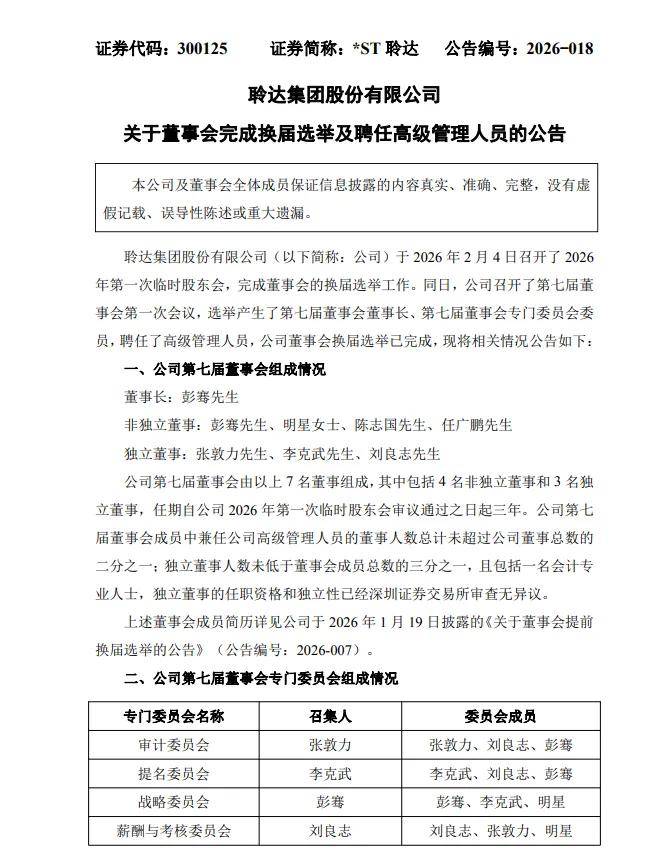
Core Viewpoint - The management reshuffle at *ST Lingda (300125) continues, marking significant changes in leadership as the company faces challenges in the photovoltaic industry, including a temporary suspension of battery production [1][10]. Group 1: Management Changes - *ST Lingda announced the completion of its board restructuring and the appointment of new senior management on February 4, with many new faces in the newly formed seventh board [1]. - The new chairman, Peng Qian, replaces the former chairman Jin Yongfeng, who has stepped down after only eight months in the role [6][7]. - The restructuring saw the departure of seven board members, including five directors and two independent directors, while new appointments include Peng Qian, Mingxing, Chen Zhiguo, and Ren Guangpeng [7][8]. Group 2: Company Background and Challenges - *ST Lingda entered the battery segment in 2021 by acquiring 100% of Jinzhai Jiayue, but soon faced difficulties as the photovoltaic industry adjusted [8][10]. - The company announced a temporary production halt for its subsidiary Jinzhai Jiayue, becoming the first listed company in the photovoltaic sector to do so [10]. - The company has been struggling with debt issues, leading to pre-restructuring applications from creditors [10]. Group 3: Future Outlook - Following the management changes, *ST Lingda is expected to divest its photovoltaic assets and shift its main business focus, as previous expansion plans for battery production have been terminated [11]. - The company had previously planned significant investments in battery production capacity, including a 15GW TOPCon and 5GW HJT expansion, which are now deemed unfeasible [11].


棒杰股份光伏项目暴雷: 1.4亿补贴遭追讨,公司银行账户已被冻结
Xin Lang Zheng Quan· 2026-01-23 03:08
Core Insights - The lawsuit initiated by the local government against the company for the return of 140 million yuan in subsidies highlights the strained relationship between enterprises and local governments during the adjustment period of the photovoltaic industry [2][5] - The freezing of the company's main bank accounts signals a critical pressure on its cash flow and operational capabilities, potentially affecting daily operations, supplier payments, and employee salaries [2][4] Project Background - The Huai'an photovoltaic project was a key part of the company's strategic transition from traditional industries to the renewable energy sector, with a total investment exceeding 1 billion yuan [3] - The project received comprehensive support from the local government, including land, tax incentives, and direct financial subsidies, with the disputed 140 million yuan being a significant component of this support [3] Company Situation - The company is facing dual challenges of transformation pains and financial pressure, having aggressively entered the photovoltaic sector in search of a new growth trajectory after stagnation in its traditional business [4] - The freezing of bank accounts poses a severe threat to the company's operations, potentially leading to supplier payment issues and financial institution withdrawal, which could trigger further financial distress [4][7] Industry Context - The company's predicament reflects a broader issue faced by many traditional companies entering the photovoltaic sector, particularly as the industry enters a deep adjustment phase with overcapacity and declining prices [5][6] - The reliance on government subsidies tied to project progress and investment metrics has led to widespread disputes as market conditions change, exemplified by the company's situation [5] Legal and Financial Implications - If the company loses the lawsuit, it will not only have to repay the 140 million yuan but also face potential interest payments, severely impacting its cash flow [7] - The freezing of bank accounts is viewed as a high-risk signal by financial institutions, which may lead to reduced loan limits and increased financing costs, further straining the company's financial health [7] Response Strategies - The company may seek to negotiate with the local government for a revised project timeline or alternative repayment arrangements to address the subsidy return issue [8] - Exploring asset disposals or strategic partnerships could provide necessary funding, although these options may be challenging in the current market environment [8] - Long-term, the company needs to reassess its competitive position in the photovoltaic sector and consider focusing on core strengths or collaborating with industry leaders to mitigate risks [8]

棒杰股份光伏项目暴雷:1.4亿补贴遭追讨,公司银行账户已被冻结
Xin Lang Zheng Quan· 2026-01-22 10:04
Core Viewpoint - The lawsuit initiated by the local government against Bangjie Co., demanding the return of 140 million yuan in subsidies, highlights the strained relationship between companies and local governments during the adjustment period of the photovoltaic industry [2][3]. Event Summary - The lawsuit stems from the failure of the Huai'an photovoltaic project to progress as agreed, leading to the demand for the return of subsidies [2]. - The freezing of the company's main bank accounts signals a critical pressure on its cash flow and operational capabilities [2][4]. Project Background - The Huai'an photovoltaic project was a key part of Bangjie Co.'s strategic shift towards the renewable energy sector, with a total investment exceeding 1 billion yuan [3]. - The project received comprehensive support from the local government, including the controversial 140 million yuan in subsidies [3]. - The project's stagnation is attributed to a global market shift, resulting in significant price drops and project delays across the industry [3]. Company Situation - Bangjie Co. faces dual challenges of transformation pains and financial pressure as it attempts to pivot from its traditional clothing business to the photovoltaic sector [4]. - The freezing of bank accounts poses a severe threat to the company's daily operations, potentially leading to supplier payment issues and employee salary delays [4]. Industry Context - The difficulties faced by Bangjie Co. reflect a broader trend among traditional companies entering the photovoltaic market, many of which are experiencing project delays and investment impairments [5]. - The reliance on government subsidies tied to project performance creates a precarious situation for companies when market conditions change [5]. Lawsuit Impact - If Bangjie Co. loses the lawsuit, it will face not only the return of the 140 million yuan but also potentially millions in interest, severely impacting its cash flow [7]. - The freezing of bank accounts is viewed as a high-risk signal by financial institutions, which may lead to reduced loan limits and increased financing costs [7]. Response Strategies - Bangjie Co. may seek to negotiate with the local government for a revised project timeline or alternative repayment arrangements [8]. - The company could explore asset sales or targeted capital increases, although these options may be challenging in the current market [8]. - Long-term, the company needs to reassess its competitive position in the photovoltaic sector and consider partnerships with industry leaders to mitigate risks [8].
综合晨报-20260112
Guo Tou Qi Huo· 2026-01-12 03:09
Report Industry Investment Ratings - Not provided in the given content Core Views - The report analyzes the market conditions of various commodities and financial products, including energy, metals, chemicals, agricultural products, and financial derivatives. It provides insights into supply - demand dynamics, price trends, and investment suggestions for each category [2][3][4] Summary by Categories Energy - **Crude Oil**: Tensions in the Iranian geopolitical situation and the US seizure of Venezuelan oil tankers have increased short - term upward pressure on oil prices, but inventory pressure and supply surplus limit the upside [2] - **Fuel Oil & Low - Sulfur Fuel Oil**: Geopolitical factors have led to wide - range fluctuations in fuel oil prices. High - sulfur fuel oil may see increased demand, while low - sulfur fuel oil faces supply - side pressure [22] - **Bitumen**: Oil price rebounds have not been fully followed by bitumen. Venezuelan oil supply disruptions may impact bitumen raw materials in the future [23] Metals - **Precious Metals**: With mixed US employment data and ongoing global geopolitical unrest, precious metals are challenging previous highs [3] - **Base Metals**: - **Copper**: Prices are affected by US employment data, geopolitical situations, and domestic production and inventory. An option strategy has been proposed [4] - **Aluminum**: Short - term price movements are driven by funds, and there is a divergence from fundamentals. High profits may prompt aluminum plants to sell for hedging [5] - **Zinc**: Consumption is expected to be front - loaded in 2026, but the market may range - bound due to cost support and supply - side factors [8] - **Lead**: The market is range - bound, and attention should be paid to cost - related support [9] - **Nickel & Stainless Steel**: The market is in a state of shock, with inventory changes and policy sentiment influencing prices [10] - **Tin**: LME tin prices have risen, and domestic prices are supported. Attention is on inventory changes [11] - **Lithium Carbonate**: Prices are oscillating at a high level, with supply - demand factors driving the market [12] - **Industrial Silicon**: The market is expected to be weak due to supply - demand imbalances [13] - **Polysilicon**: A new policy has changed the trading logic, and prices may seek cost support [14] Ferrous Metals - **Steel (Rebar & Hot - Rolled Coil)**: Steel prices are oscillating, with demand and inventory showing different trends. Steel mill profits are improving, and iron - water production is rising [15] - **Iron Ore**: The market has rebounded, but there are risks of high - level volatility due to supply - demand and geopolitical factors [16] - **Coke & Coking Coal**: Both are expected to have a relatively strong and oscillating trend, with considerations for supply - demand and policy factors [17][18] - **Silicomanganese & Ferrosilicon**: For both, it is recommended to buy on dips, considering supply - demand and policy impacts [19][20] Chemicals - **Urea**: The market is expected to oscillate strongly within a range as spring agricultural demand approaches [24] - **Methanol**: Import expectations are reduced, but high coastal inventories and downstream feedback may suppress the market [25] - **Pure Benzene**: The short - term market is expected to oscillate, and a positive spread strategy may be considered in the medium - term [26] - **Styrene**: The market is in a state of consolidation due to cost and inventory factors [27] - **Polypropylene, Plastic, & Propylene**: Market sentiment varies, with supply - demand factors influencing prices [28] - **PVC & Caustic Soda**: PVC may have short - term trading opportunities and long - term price increases. Caustic soda is oscillating, with supply - demand and profit factors at play [29] - **PX & PTA**: Demand will decline during the Spring Festival, but cost support from oil prices exists. PX has a strong medium - term outlook [30] - **Ethylene Glycol**: The market will be under pressure in the short - term and may improve in the second quarter, but long - term pressure remains [31] Agricultural Products - **Soybeans & Soybean Meal**: The market is waiting for the USDA report. South American production expectations and weather are key factors, and prices may be weak [36] - **Edible Oils (Soybean Oil & Palm Oil)**: The market is expected to oscillate, with attention on palm oil export tax policies and inventory [37] - **Canola & Canola Oil**: The market is expected to oscillate weakly, with the focus on the impact of the Canadian Prime Minister's visit to China [38] - **Soybean No. 1**: The futures contract is in a downward trend, and attention should be paid to policies and market guidance [39] - **Corn**: The futures market is expected to oscillate widely, with attention on sales progress and auctions [40] - **Livestock & Poultry**: - **Pigs**: Short - term price support may come from secondary fattening, but long - term supply pressure exists [41] - **Eggs**: The market is expected to be strong in the short - term, and a long - position strategy is recommended [42] - **Cotton**: The market is expected to adjust, with attention on supply - demand and policy factors [43] - **Sugar**: The market is oscillating, with differences in international and domestic production progress [44] - **Apples**: The futures price has rebounded, and attention should be paid to demand and inventory removal [45] - **Wood**: The price is at a low level, and the market is recommended to be observed [46] - **Pulp**: The market is oscillating, and short - term upward potential is limited [47] Financial Derivatives - **Container Shipping Index (European Line)**: A new policy may push up short - term freight rates, but the long - term impact is uncertain [21] Financial Markets - **Stock Index**: The A - share market is expected to oscillate strongly, with growth and cyclical styles potentially outperforming [48] - **Treasury Bonds**: The market is slightly down, and attention should be paid to the flattening of the yield curve [49]
“光伏仍处于关键调整期”!相关部门和企业代表这样展望行业后续发展
Di Yi Cai Jing· 2025-12-18 11:31
Core Viewpoint - The Chinese photovoltaic industry is at a critical adjustment period, facing both opportunities and challenges, with a focus on self-discipline and innovation to combat irrational competition and enhance resilience [2][3]. Industry Challenges and Adjustments - The photovoltaic industry is experiencing a downward trend that is nearing its bottom, with companies gradually reducing losses, but future domestic and international market demand remains uncertain [2]. - The industry is undergoing a profound cyclical adjustment, facing challenges related to capacity, pricing, and intense competition, necessitating collective efforts for innovation and market expansion [2][3]. - The Ministry of Industry and Information Technology (MIIT) plans to strengthen capacity regulation and promote the orderly exit of backward production capacity while enhancing market monitoring mechanisms to combat illegal pricing and promote quality [3][4]. Market Dynamics and Performance - From January to October 2025, the national photovoltaic power generation utilization rate was 94.9%, a decrease of 2.2 percentage points year-on-year, indicating increasing pressure on power system absorption [3][4]. - The production of polysilicon reached approximately 1.113 million tons, a year-on-year decline of 29.6%, while wafer production was about 567 GW, down 6.7% year-on-year, marking the first decline in years [5]. - The cumulative installed capacity of photovoltaic power in China reached 1.14 billion kilowatts by the end of October 2025, with the proportion of photovoltaic power generation in total installed capacity increasing from 12% at the end of 2020 to 30% [5]. Financial Performance and Industry Outlook - The photovoltaic industry's profitability is gradually improving, with losses in the first three quarters of 2025 amounting to 31.039 billion yuan, and the third quarter losses narrowing by nearly 50% compared to the second quarter [5]. - The average bidding price for photovoltaic components has been steadily recovering, indicating a shift from disorderly expansion to rational competition within the industry [5].
光伏行业处于关键调整期!工信部、国家能源局划重点,企业这样破局
Zhong Guo Zheng Quan Bao· 2025-12-18 08:39
Core Viewpoint - The photovoltaic industry in China is currently at a critical adjustment period characterized by both opportunities and challenges, with issues such as "involution" competition, overcapacity, and consumption pressure being prominent [1][3]. Supply and Demand Challenges - The supply side is facing "involution" competition that erodes industry profits and squeezes technological innovation space, while key technological barriers need to be strengthened [3]. - On the demand side, the high proportion of photovoltaic integration is leading to significant challenges in efficient consumption, with the national photovoltaic power generation utilization rate at 94.9% for January to October 2025, down 2.2 percentage points year-on-year [3]. Government Regulatory Measures - The Ministry of Industry and Information Technology (MIIT) plans to implement capacity regulation and curb low-price competition by 2026, focusing on the orderly exit of backward production capacity and enhancing market monitoring mechanisms [3]. - The MIIT will also strengthen product quality supervision and promote self-discipline within the industry [3]. Development Suggestions - The Deputy Director of the National Energy Administration, Gui Xiaoyang, proposed three key suggestions: 1. Maintain confidence in development, leveraging national strategies that indicate a need for an additional 200 million kilowatts of wind and solar installations annually over the next decade [4]. 2. Deepen industry cooperation to eliminate irrational competition that sacrifices quality and long-term value, promoting a focus on technological innovation and service optimization [4]. 3. Shift the focus of photovoltaic development from merely generating electricity to optimizing the timing, location, and value of electricity generation through innovations like energy storage and intelligent control [4]. Industry Outlook and Positioning - Analysts predict that the "anti-involution" policies in 2026 may accelerate the exit of backward production capacity, potentially leading to improved profitability across the industry [6]. - The China Photovoltaic Industry Association indicates that while the industry is at a critical adjustment phase, the downward trend is nearing its bottom, with losses gradually narrowing, although uncertainties in domestic and international market demand remain [6]. - Leading companies like Longi Green Energy emphasize the importance of self-discipline and innovation, advocating for a robust supply chain and the integration of photovoltaic technology with energy storage and smart grids [7].
光伏产业仍处深度调整期--产业链价格短期企稳 四季度供需博弈加剧
Zhong Guo Chan Ye Jing Ji Xin Xi Wang· 2025-11-06 00:14
Core Insights - The photovoltaic industry in China is undergoing a deep adjustment period due to the dual pressures of capacity expansion and slowing terminal demand, with no fundamental change in the overall supply-demand pattern [1] - Despite some price recovery in certain segments of the industry chain, the overall market demand has not formed a strong support [1] - The fourth quarter is expected to see price fluctuations in photovoltaic products, with potential stabilization in some segments due to production cuts and policy support [1] Summary by Sections Polysilicon Market - Polysilicon is facing challenges of oversupply and high inventory, with social inventory expected to reach 440,000-450,000 tons in September [2] - Despite some companies planning production cuts, overall output remains high due to new capacity ramp-up and the resumption of production by second and third-tier manufacturers [2] - The average transaction price for n-type polysilicon is stable at 53,200 yuan/ton, with overall production expected to reach a peak in October [2][3] Silicon Wafer and Cell Prices - Silicon wafer manufacturers have attempted price increases since September, with some sizes turning profitable, while others are covering cash costs [4] - The production of silicon wafers increased by 5.37% month-on-month, but price increases have not fully transmitted to the downstream cell segment [4] - The cell segment is experiencing pressure from the module side, leading to a planned production adjustment in October [4] Module Demand and Production - Module demand has declined, with orders decreasing and production expected to drop by 3.19% month-on-month in October [5] - Mainstream module prices remain stable, but high-power models have seen price increases due to better supply-demand dynamics [5] - The overall industry chain is still under price pressure due to high inventory and insufficient terminal demand, with expectations of continued downward price risks [6]
合盛硅业(603260):主营产品景气承压,静待产业链回暖
Huaan Securities· 2025-09-05 06:40
Investment Rating - The investment rating for the company is "Buy" (maintained) [1] Core Views - The company's main products are under pressure, and it is waiting for a recovery in the industry chain [1] - In the first half of 2025, the company reported a revenue of 9.776 billion yuan, a year-on-year decrease of 26.34%, and a net profit attributable to shareholders of -397 million yuan, a decline of 140.60% year-on-year [4][5] - The second quarter saw a revenue of 4.548 billion yuan, with a year-on-year and quarter-on-quarter decrease of 42.11% and 13.02%, respectively [4] - The company experienced a significant drop in sales volume and prices for its main products, including industrial silicon, silicone rubber, and silicone oil [5] - The report indicates that the company is expected to benefit from potential price recovery as the industry undergoes restructuring and capacity consolidation [6] Financial Summary - The company is projected to achieve net profits attributable to shareholders of 2.014 billion, 2.840 billion, and 3.773 billion yuan for the years 2025, 2026, and 2027, respectively, with corresponding P/E ratios of 30.06X, 21.31X, and 16.04X [7] - Key financial indicators for 2025E include revenue of 28.709 billion yuan, a year-on-year growth of 7.6%, and a net profit margin of 7.0% [10] - The gross profit margin is expected to be 18.8% in 2025, with a projected return on equity (ROE) of 5.8% [10]

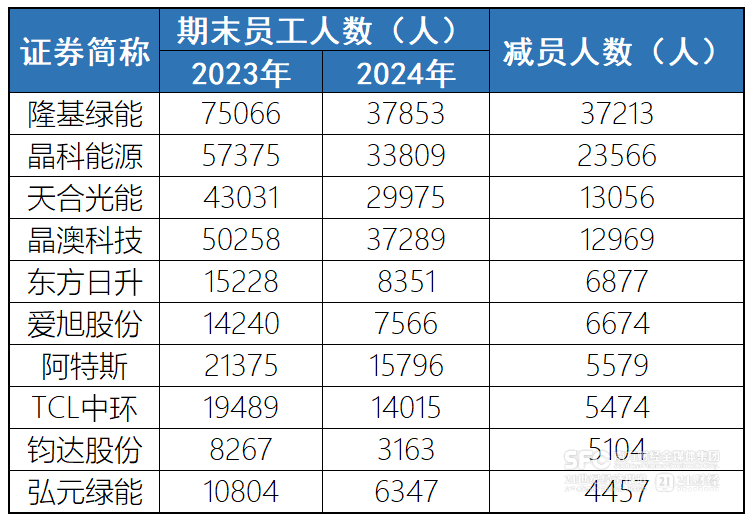
21新能说丨14万光伏从业人员撤出阵地:哪家在减员,哪家又在扩人?
2 1 Shi Ji Jing Ji Bao Dao· 2025-05-08 12:22
Core Insights - The photovoltaic industry is undergoing significant adjustments due to supply-demand mismatches, leading to workforce reductions across many companies [1][2] Group 1: Workforce Changes - The total number of employees in 109 A-share photovoltaic companies is projected to be 638,700 in 2024, down from 782,600 in 2023, indicating a reduction of over 140,000 employees [1] - The workforce increased from 617,700 in 2022 to 782,600 in 2023, reflecting a booming industry performance with record revenues and profits [1] - Major companies like Longi Green Energy, Jinko Solar, Trina Solar, and JA Solar have seen reductions of over 10,000 employees each, with Longi and Jinko losing more than 20,000 employees [3] Group 2: Financial Performance - In 2023, the 109 A-share photovoltaic companies achieved a total revenue of 1.65 trillion yuan and a net profit of 147.095 billion yuan, both setting historical highs [1] - However, in 2024, the industry is expected to face a downturn, with total revenue dropping to 1.38 trillion yuan and a net loss of 0.06 billion yuan [1] Group 3: Hiring Trends - Despite the overall trend of workforce reduction, some companies are hiring, such as North Huachuang, which increased its workforce by 4,344, and Sungrow Power, which added 3,608 employees [4][5] - Companies in the inverter and auxiliary materials sectors, such as Sungrow Power, DeYuan, and Airo Energy, have also reported increases in their workforce due to profitable performance [5]