外卖业务

Search documents
海底捞(06862):主品牌经营逐步企稳,副牌及外卖快速成长
GF SECURITIES· 2026-03-25 15:25
Investment Rating - The investment rating for the company is "Buy" with a current price of HKD 14.22 and a fair value of HKD 19.86 [5]. Core Insights - The main brand's operations are stabilizing, while the sub-brands and takeout services are experiencing rapid growth [3]. - The company reported a revenue of RMB 432.3 billion for the full year 2025, reflecting a year-on-year growth of 1.1%, while the net profit attributable to shareholders was RMB 40.5 billion, down 14.0% year-on-year [10]. - The average customer spending and table turnover rates for the main brand have stabilized, with a table turnover rate of 3.9 times and an average customer spending of RMB 97.7 in 2025 [10]. - The company is cautiously expanding its main brand while focusing on the growth of sub-brands, with a net decrease of 51 direct stores in 2025 [10]. - The company maintains a high dividend level, proposing a total dividend of approximately RMB 35 billion, which accounts for 86% of the net profit attributable to shareholders [10]. - The profit forecast for 2026-2028 estimates net profits of RMB 44 billion, RMB 48 billion, and RMB 51 billion respectively, with a target price based on a 22x PE ratio for 2026 [10]. Financial Summary - Revenue projections (in RMB million) for 2024A to 2028E are as follows: 42,755 (2024A), 43,225 (2025A), 47,565 (2026E), 50,498 (2027E), and 53,368 (2028E) with growth rates of 3.1%, 1.1%, 10.0%, 6.2%, and 5.7% respectively [4]. - EBITDA is projected to be 9,074 (2024A), 5,779 (2025A), 8,772 (2026E), 9,128 (2027E), and 9,554 (2028E) [4]. - The net profit attributable to shareholders is expected to be 4,708 (2024A), 4,050 (2025A), 4,429 (2026E), 4,768 (2027E), and 5,122 (2028E) [4]. - The company’s return on equity (ROE) is projected to be 45.1% (2024A), 40.4% (2025A), 42.2% (2026E), 43.2% (2027E), and 44.4% (2028E) [4].

绿茶集团(06831):2025年报业绩点评:经营表现稳健,外卖收入高增
GUOTAI HAITONG SECURITIES· 2026-03-25 06:58
Investment Rating - The investment rating for the company is "Buy" [6][10] Core Insights - The company has shown robust operational performance with significant growth in takeaway revenue, achieving a total revenue of 4.763 billion RMB in 2025, representing a year-on-year increase of 24.1% [10] - The adjusted net profit for 2025 reached 5.09 billion RMB, reflecting a 41.0% increase year-on-year, with a net profit margin of 10.7%, up by 1.3 percentage points [10] - The company is expanding its online and offline channels, enhancing brand influence and operational efficiency [2] Financial Summary - Total revenue projections for the company are as follows: - 2024A: 3.838 billion RMB - 2025A: 4.763 billion RMB - 2026E: 5.969 billion RMB - 2027E: 7.454 billion RMB - 2028E: 9.224 billion RMB - The projected growth rates for total revenue are 6.9% for 2024A, 24.1% for 2025A, 25.3% for 2026E, 24.9% for 2027E, and 23.7% for 2028E [4] - Gross profit for 2025 is estimated at 3.570 billion RMB, with a gross margin of 68.3%, an increase of 1.9 percentage points year-on-year [10] - The company plans to maintain a net profit growth trajectory, with forecasts of 631 million RMB for 2026, 801 million RMB for 2027, and 992 million RMB for 2028, reflecting year-on-year growth rates of 30%, 27%, and 24% respectively [10] Operational Metrics - The company reported a restaurant operating income of 3.541 billion RMB in 2025, a 14% increase year-on-year, while takeaway revenue reached 1.204 billion RMB, growing by 67% [10] - The number of stores increased to 609 by the end of 2025, marking a net addition of 144 stores, with same-store sales showing a slight decline of 0.8% [10] - The average customer spending was 54.6 RMB in 2025, a decrease of 3% year-on-year, with dine-in spending remaining stable [10]
外卖占比近五成、副牌收缩,百胜中国要剑指2万家店
Guo Ji Jin Rong Bao· 2026-02-06 03:04
Group 1 - The core viewpoint of the article highlights Yum China’s financial performance for the fourth quarter and full year of 2025, showing a total revenue growth of 4% to $11.8 billion and an operating profit of $1.3 billion, which is an 11% increase year-on-year [1] - Store expansion is identified as a key driver of Yum China's revenue growth, with a net addition of 1,706 stores in 2025, bringing the total to 18,101 stores by year-end [1] - The two main brands, KFC and Pizza Hut, experienced a store growth rate of approximately 12% in 2025, with KFC increasing from 11,648 to 12,997 stores and Pizza Hut from 3,724 to 4,168 stores [1] Group 2 - The article notes that the total number of new stores for the two main brands in the previous year was 1,793, which exceeds Yum China's total new store count of 1,706 for 2025, indicating a reduction in the number of secondary brands [3] - Yum China aims to accelerate its store expansion, targeting 20,000 stores by 2026 and 30,000 by 2030, requiring a net addition of approximately 1,900 stores in 2026, averaging over 5 new stores per day [3] - The franchise model is crucial for scaling growth, with the proportion of franchise stores increasing for both KFC and Pizza Hut from 15% to 37% and 2% to 31% respectively from 2023 to 2025 [3] Group 3 - The takeaway business has significantly impacted Yum China's performance, with a 25% year-on-year growth in delivery sales, which now account for 48% of restaurant revenue, up from 39% in 2024 [5] - In the fourth quarter, the delivery sales proportion for KFC and Pizza Hut reached 53% and 54% respectively, indicating a growing reliance on delivery services [5] - To address rising costs associated with delivery, Yum China announced a price increase for delivery products by an average of 0.8 yuan, while maintaining dine-in prices [5]

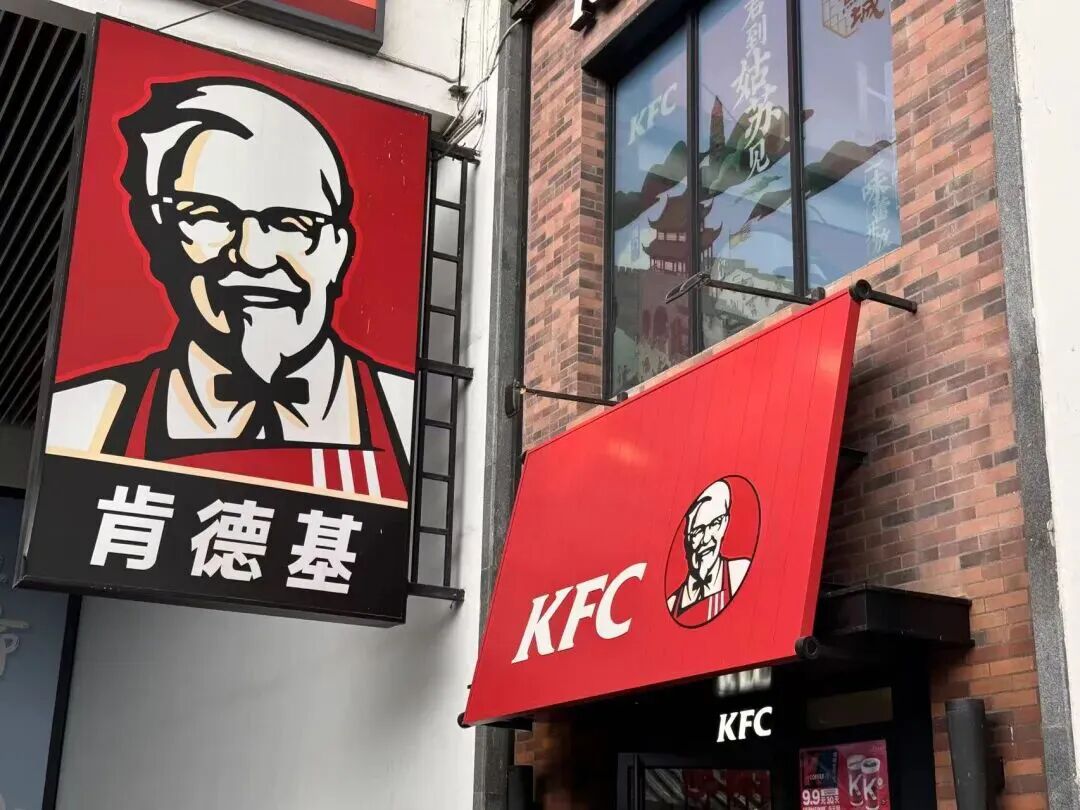
百胜中国去年营收增长4%:外卖业务占比近五成
Xin Lang Cai Jing· 2026-02-05 09:34
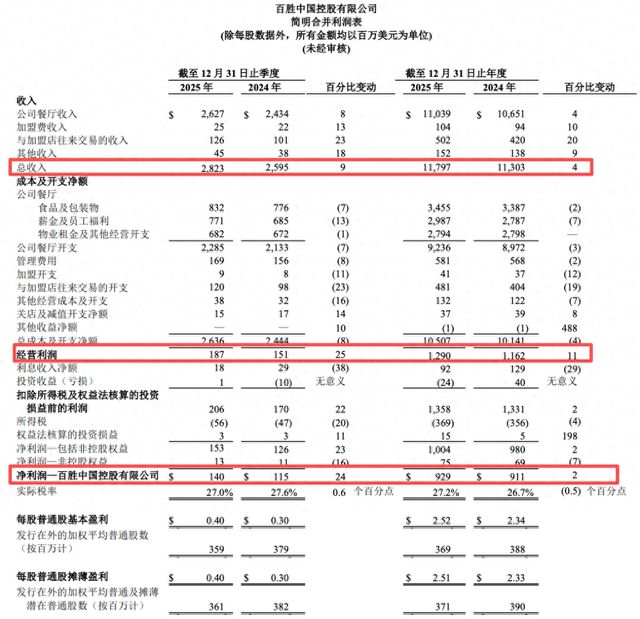
Core Viewpoint - Yum China reported a profit margin increase despite fierce competition in the food delivery sector, with management indicating that the share of delivery business will continue to rise [1][7]. Financial Performance - In Q4 2025, Yum China's total revenue grew by 9% year-on-year to $2.823 billion, with operating profit reaching $187 million, up 25% [1][9]. - For the full year 2025, total revenue increased by 4% to $11.797 billion, and operating profit was $1.29 billion, reflecting an 11% growth [1][9]. - The net profit for Q4 was $140 million, a 24% increase, while the annual net profit was $929 million, up 2% [1][9]. Same-Store Sales and Transactions - Same-store sales increased for the third consecutive quarter, with a 3% growth in Q4 and a total of 20 billion transactions for the year, an 8% increase [8][13]. - The company has achieved a continuous increase in same-store transaction volume for 12 consecutive quarters [8][13]. Delivery Business Growth - Delivery sales grew by 25% year-on-year, accounting for 48% of restaurant revenue, up from 39% the previous year [7][8]. - The share of delivery sales rose from 42% in Q1 to 53% in Q4 of the previous year [7]. Profitability Metrics - The operating profit margin for 2025 was 10.9%, an increase of 0.6 percentage points year-on-year, while restaurant profit margin was 16.3%, also up by 0.6 basis points [8][11]. - KFC's operating profit margin was 14.5%, and Pizza Hut's was 7.9%, marking the highest level since Yum China's listing in 2016 [11]. Store Expansion and Strategy - Yum China added 1,706 new stores in 2025, with a total store count reaching 18,101 [15]. - The company plans to exceed 20,000 stores by 2026, focusing on both self-operated and franchised models [16]. Future Outlook - Management expects system sales to grow in the high single digits in 2026, with slight improvements in restaurant and operating profit margins [16].
KFC的外卖贡献过半后,涨价开始了
Hua Er Jie Jian Wen· 2026-01-26 05:58
Group 1 - KFC has initiated a new round of price adjustments for delivery products, effective January 26, with an average increase of 0.8 yuan, while dine-in prices remain unchanged [1] - The price adjustment is aimed at better addressing operational cost changes and maintaining stable and healthy operations, reflecting a common practice among fast-food chains to adjust prices in response to market cost fluctuations [2] - In Q3, KFC's delivery sales grew by 33% year-on-year, increasing the proportion of total restaurant revenue from 40% to 51% compared to the same period last year [3] Group 2 - The company has implemented various strategies to cope with rising delivery costs and the impact on profit margins, including enhancing dine-in efficiency and reducing reliance on third-party platforms through its extensive membership system and self-delivery team [3] - KFC's parent company, Yum China, aims to exceed 25,000 stores by 2028, with a target operating profit margin of no less than 11.5%, while KFC's restaurant profit margin is expected to remain above 17.3% by 2025 [4] - The external environment and internal structure are subject to change, necessitating continuous recalibration of Yum China's economic strategies [5]

1年1亿单,老乡鸡近半收入靠外卖
阿尔法工场研究院· 2026-01-22 00:08
Core Viewpoint - The article discusses the significant role of food delivery in the revenue model of Lao Xiang Ji, a leading Chinese fast-food chain, highlighting the financial implications of delivery service fees and the company's growth trajectory in the market [2][6]. Revenue and Growth - Lao Xiang Ji has seen a continuous increase in restaurant numbers, reaching 1,658 by August 2025, with a notable concentration in Anhui Province [7]. - The total revenue for Lao Xiang Ji from 2022 to 2025 is reported as follows: 4.528 billion RMB, 5.651 billion RMB, 6.288 billion RMB, and 4.578 billion RMB for the first eight months of 2025, with a significant portion coming from direct store sales [7]. - The number of takeaway orders surged from approximately 60 million in 2022 to over 107 million in 2024, contributing to nearly half of the company's revenue [8]. Delivery Fees and Costs - Lao Xiang Ji's delivery revenue from 2022 to 2024 was 1.994 billion RMB, 2.574 billion RMB, and 3.047 billion RMB, with a further increase to 2.66 billion RMB in the first eight months of 2025, representing over 58.1% of total revenue [8]. - The company pays substantial service fees to delivery platforms, amounting to 286 million RMB, 387 million RMB, 419 million RMB, and 287 million RMB during the respective periods, which constitutes about 6.3% to 6.8% of total revenue [11][8]. Comparison with Industry Peers - Compared to other Chinese fast-food companies, Lao Xiang Ji's delivery revenue share is significantly higher, with competitors like Big Pizza and Yu Jian Xiao Mian reporting much lower percentages of delivery revenue [9][14]. Franchise and Quality Control - Lao Xiang Ji is expanding its franchise network, with franchise stores increasing from 118 to 733, while the gross margin for franchise stores has declined from 28.9% in 2022 to 20.1% in 2024 [18]. - The average customer spending at franchise stores has also decreased, contrasting with the stability seen in direct stores [18]. - The company faces challenges regarding food quality and service, as evidenced by over 1,000 complaints on consumer platforms, primarily related to food hygiene and ingredient quality [21][22]. Market Position - Lao Xiang Ji holds the top market share in the Chinese fast-food sector but ranks eighth overall in the broader fast-food industry, indicating room for improvement in market penetration and food quality standards [24].

老乡鸡招股书揭开餐饮企业痛点:近半收入依靠外卖 平台服务费率超17%
Zhong Guo Jing Ji Wang· 2026-01-20 01:13
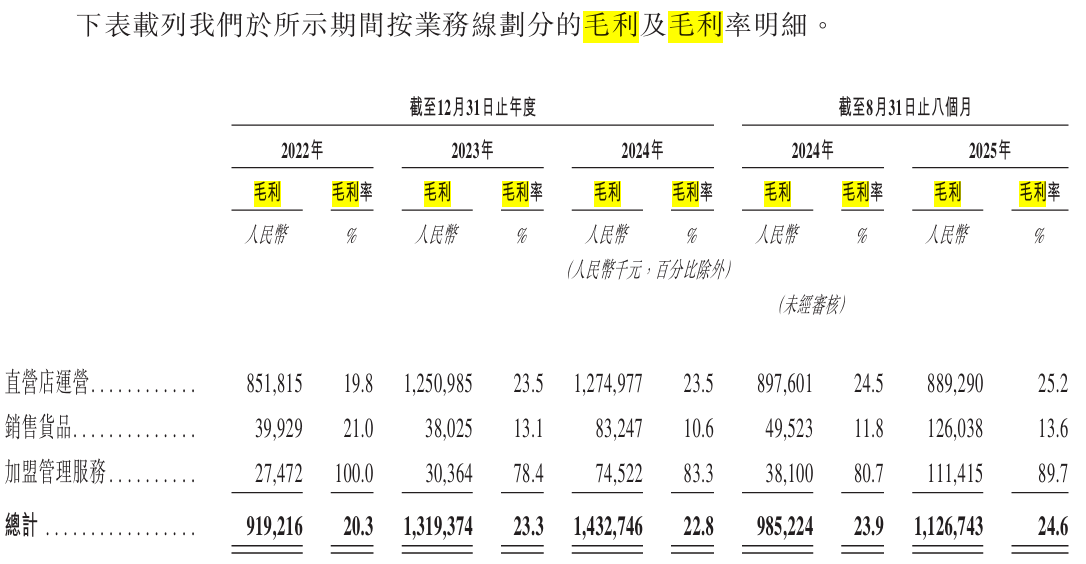
Core Viewpoint - LXJ International Holdings Limited, the parent company of "Lao Xiang Ji," is seeking to list on the Hong Kong Stock Exchange for the third time since 2025, despite facing challenges such as declining profit margins and significant social insurance and housing fund payment shortfalls for employees [1][12]. Group 1: Company Overview - "Lao Xiang Ji," originally named "Fei Xi Lao Mu Ji," was founded in 2003 by veteran farmer Shu Congxuan in Hefei, Anhui, and has grown to over 1,658 stores with a revenue of 6.288 billion RMB in 2024 [1][2]. - The founding family, including Shu Congxuan's son, daughter, and daughter-in-law, controls over 92% of the company's shares [1][4]. Group 2: Financial Performance - Revenue growth has been significant, with figures of 4.528 billion RMB in 2022, 5.651 billion RMB in 2023, and 6.288 billion RMB in 2024, reflecting year-on-year increases of 58.38%, 24.8%, and 11.3% respectively [5]. - The compound annual growth rate (CAGR) for revenue from franchise stores is 102.9%, with the number of franchise stores increasing from 118 in 2022 to 733 by the first eight months of 2025 [5][6]. Group 3: Profitability Challenges - Despite revenue growth, the overall gross profit margin has declined from 20.3% in 2022 to 22.8% in 2024, with franchise store gross margins dropping from 28.9% to 20.1% during the same period [6][7]. - The company attributes the decline in gross margins to increased costs associated with supporting franchise expansion and rising raw material costs [7]. Group 4: External Dependencies - The company faces high external service fees, with over 17% of delivery revenue going to third-party platforms, impacting profitability [9][11]. - The total sales from delivery services have increased significantly, with figures of 1.994 billion RMB in 2022 and 3.047 billion RMB in 2024, showing a CAGR of 23.62% [9]. Group 5: Compliance Issues - The company has acknowledged a shortfall of over 100 million RMB in social insurance and housing fund payments for employees, which has been a persistent issue since its A-share listing attempt in 2022 [12][14]. - The shortfall in social insurance and housing fund payments has raised compliance risks, with potential penalties exceeding 2.44 billion RMB if not addressed [13].
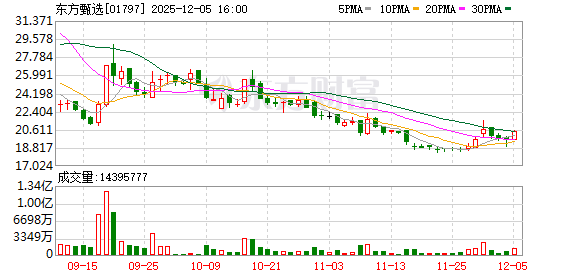
俞敏洪接管东方甄选 公司或将踏足外卖餐饮
Zhong Guo Jing Ying Bao· 2025-12-07 13:40
Core Viewpoint - The recent changes in the management structure of Dongfang Zhenxuan (Beijing) Technology Co., Ltd. have sparked speculation about the company's potential entry into the food delivery business, while its financial performance shows a significant decline in revenue and GMV. Group 1: Management Changes - Sun Dongxu has stepped down as the legal representative, executive director, and manager, with Yu Minhong taking over these roles. Yu Minhong is now the beneficial owner and actual controller of the company [2] - The company's business scope has been expanded to include restaurant management, food delivery services, and catering services [2] Group 2: Financial Performance - For the fiscal year 2025, excluding revenue from the Huixing live broadcast room, the company's continuing operations revenue decreased by 30.9% year-on-year [2] - The total gross merchandise volume (GMV) fell by 39% to 8.7 billion yuan [2] - Since launching its first self-operated product in April 2022, the company has introduced a total of 732 SKUs, with self-operated products accounting for approximately 43.8% of GMV [2] - The product range has diversified from initial offerings of fresh food and snacks to include nutritional and health products, pet food, clothing, and more [2]
瑞幸咖啡Q3净营收同比增长50%,归属普通股股东净利下降2.7%,月均交易客户首次突破1亿大关
美股IPO· 2025-11-17 14:40
Core Viewpoint - Luckin Coffee continues its rapid expansion, achieving a 50% revenue growth in Q3, with monthly active transaction customers surpassing 100 million for the first time, but profitability remains under pressure due to soaring delivery costs driven by increased orders from third-party delivery platforms [1][3][9]. Business Progress - The company added 3,008 new stores in the quarter, bringing the total to 29,214 stores (18,882 self-operated and 10,332 franchised), a quarter-on-quarter increase of 11.5% [3][5]. - Monthly active transaction customers reached 112.3 million, a year-on-year increase of 40.6%, marking a significant milestone [3][13]. - Q3 total revenue was 15.3 billion RMB (approximately 2.14 billion USD), a year-on-year increase of 50.2%, with GMV growing 48.1% to 17.3 billion RMB [3][5]. Profitability Challenges - Net profit attributable to ordinary shareholders was 1.278 billion RMB, a decrease of 2.7% year-on-year, with net profit margin dropping from 12.9% to 8.4% [3][6]. - The operating cash flow was 2.07 billion RMB, up 57.2% year-on-year, with cash and equivalents reaching 9.35 billion RMB, a 57.5% increase from the beginning of the year [3]. Cost Pressures - Delivery costs surged by 211.4% to 2.89 billion RMB, primarily due to a spike in orders from third-party delivery platforms [4][8]. - The operating expense ratio increased from 84.5% to 88.4%, eroding profit margins [4][9]. Store Performance - Same-store sales for self-operated stores grew by 14.4%, reversing the negative growth of -13.1% from the previous year [5][10]. - The profitability of self-operated stores declined, with profit margin dropping from 23.5% to 17.5%, despite an absolute profit increase of 10.2% to 1.94 billion RMB [6][10]. Franchise Business - The franchise business showed strong performance, with revenue of 3.8 billion RMB, a year-on-year increase of 62.3%, accounting for 24.9% of total revenue [7]. - Franchise revenue components included 2.02 billion RMB from material sales, 870 million RMB from delivery service fees, and 580 million RMB from profit sharing and licensing fees [7]. Customer Engagement - The average monthly active transaction customers reached 112.3 million, contributing approximately 51.3 RMB per customer for the quarter, or about 17 RMB per month [13][15]. - It is important to note that this figure includes customers from franchise stores and those using free coupons [14].

京东年活跃用户数破7亿,外卖业务投入收窄
第一财经· 2025-11-13 13:34
Core Viewpoint - JD's third-quarter financial report reflects a continuation of high investment and high growth in its takeaway business, with significant revenue growth but a notable decline in net profit due to strategic investments in new business areas [4][5][6]. Financial Performance - JD's total revenue for the third quarter increased by 14.9% year-on-year to 299.1 billion yuan, with product revenue rising by 10.5% and service revenue increasing by 30.8% [4]. - The net profit attributable to ordinary shareholders was 5.3 billion yuan, a decline of 54.7% year-on-year, primarily due to investments in new business initiatives [5]. New Business Developments - Revenue from new businesses, including JD Takeaway, JD Industrial, and overseas operations, surged by 214% year-on-year to 15.59 billion yuan [7]. - JD Takeaway has onboarded over 2 million quality restaurants, and during the Double 11 shopping festival, the average daily order volume for the top 300 restaurant brands increased 13 times compared to the first month of JD Takeaway's launch [7]. Investment and Marketing - Operating losses for JD in the third quarter amounted to 1.1 billion yuan, a significant decrease from an operating profit of 12 billion yuan in the same period last year, attributed to increased strategic investments [7]. - Marketing expenses rose by 110.5% year-on-year to 21.1 billion yuan, with marketing costs as a percentage of revenue increasing from 3.8% to 7.0% [9]. User Growth and Retail Performance - The annual active user count surpassed 700 million in October, with shopping frequency also on the rise [11]. - JD Retail's revenue, which includes JD Health and JD Industrial, reached 250.6 billion yuan, an increase of 11.4% year-on-year, with daily necessities and advertising services showing significant growth [11]. Logistics and Expansion - JD Logistics reported revenue of 55.1 billion yuan, a year-on-year increase of 24.1%, marking the highest growth rate in two years [12]. - JD Logistics is actively expanding internationally, with the opening of a new warehouse in Dubai [12].