战略关键矿产储备

Search documents
有色矿业盘中上行,矿业ETF(561330)上涨1.4%,市场关注供需格局改善
Mei Ri Jing Ji Xin Wen· 2026-02-12 04:48
Group 1 - The macro sentiment affecting industrial metals is weakening, and metals like copper and aluminum are returning to a fundamental phase [1] - The China Nonferrous Metals Industry Association has halted over 2 million tons of copper smelting projects, effectively curbing the rapid growth of copper smelting capacity [1] - The U.S. has initiated a $12 billion strategic critical mineral reserve plan to protect manufacturers from supply chain disruptions, covering various key minerals including rare earths and cobalt [1] Group 2 - The mining ETF (561330) tracks the non-ferrous mining index (931892), which includes securities related to the development of copper, aluminum, lead, zinc, and rare metals [1] - According to Wind data, the mining ETF (561330) had a year-to-date increase of 106.11% in 2025, ranking first among 10 ETFs in the non-ferrous sector [2] - The mining ETF features a higher concentration of "gold + copper + rare earths," indicating a more focused investment strategy [1]
有色金属行业报告(2026.2.2-2026.2.6):高波行情渐退,逢低布局有色板块
China Post Securities· 2026-02-09 02:12
Industry Investment Rating - The industry investment rating is maintained at "Outperform the Market" [2] Core Views - The report indicates that the volatility in precious metals has reached its peak, with gold stabilizing around 4,400 USD and domestic gold at approximately 1,000 CNY. The report suggests that the recent fluctuations in precious metals have created a potential buying opportunity for gold [5] - Copper prices have seen a decline of 3.45%, but there is positive feedback from downstream demand, indicating a potential recovery as prices stabilize around 100,000 CNY per ton [6] - Aluminum prices dropped by 5.07%, yet there are signs of improved demand from downstream sectors, suggesting a buying opportunity in the context of supply disruptions and increased storage needs [6] - Tantalum prices have risen significantly due to supply shocks, with prices reaching 3.57 million CNY per ton, reflecting a 6.57% weekly increase and a 26.6% increase year-to-date [7] - Tungsten prices have also increased, driven by supply tightness and pre-holiday stocking, with long-term prices rising significantly [8] Summary by Relevant Sections Industry Performance - The industry index for non-ferrous metals has decreased by 7.58%, ranking 32nd among sectors [17] Prices - Basic metals: LME copper decreased by 0.08%, aluminum by 0.81%, zinc increased by 0.39%, lead decreased by 1.48%, and tin decreased by 6.81% - Precious metals: COMEX gold increased by 1.65%, silver decreased by 9.06%, NYMEX palladium increased by 0.65%, and platinum decreased by 3.71% [20] Inventory - Global visible inventories for basic metals: copper increased by 22,978 tons, aluminum by 5,712 tons, zinc by 220 tons, lead by 33,662 tons, tin decreased by 1,818 tons, and nickel increased by 3,396 tons [34]
光大期货:2月5日有色金属日报
Xin Lang Cai Jing· 2026-02-05 01:09
Copper - Copper prices experienced a pullback after a rise, with domestic refined copper maintaining a reduced import loss [3] - The US ISM services PMI for January was 53.8, matching December's level and the highest since October 2024, indicating better-than-expected performance, although the new orders index showed a slowdown [3] - US ADP added 22,000 jobs in January, significantly below the expected 45,000, suggesting weakening momentum in the labor market [3] - LME copper inventory increased by 2,525 tons to 178,650 tons, while Comex inventory rose by 1,716 tons to 529,968 tons [3] - SHFE copper warehouse receipts increased by 751 tons to 159,772 tons [3] - The China Nonferrous Metals Industry Association suggested enhancing the copper resource reserve system, including expanding the national copper strategic reserve [3] - Despite a rebound in copper prices, the market faces weak fundamentals, accumulating inventory, and a demand vacuum around the Spring Festival, indicating potential price fluctuations [3] - The rigid constraints on copper mines and certainty in long-term demand suggest that any significant price drop could attract long-term investment and industrial buying [3] Nickel & Stainless Steel - LME nickel fell by 0.37% to $17,330 per ton, while SHFE nickel dropped by 0.25% to 135,600 yuan per ton [14] - LME nickel inventory increased by 786 tons to 286,314 tons, while SHFE warehouse receipts decreased by 108 tons to 48,072 tons [14] - Nickel ore and nickel pig iron prices showed strong transactions, raising concerns about tight resource supply [14] - Stainless steel inventory accumulated due to the upcoming Spring Festival, although supply-side repairs are prevalent [14][15] - Market sentiment is improving, but caution is advised regarding potential emotional resonance in the market [15] Aluminum & Alumina - Alumina prices showed a slight decline, with AO2605 settling at 2,788 yuan per ton, down 0.85% [16] - SHFE aluminum also experienced a decline, with AL2603 closing at 23,690 yuan per ton, down 0.92% [16] - Aluminum alloy prices decreased, with AD2603 at 22,215 yuan per ton, down 0.58% [16] - SMM alumina prices fell to 2,619 yuan per ton, while aluminum ingot spot discounts narrowed to 210 yuan per ton [16] - Increased repairs in various regions have led to supply disruptions, causing alumina to enter a narrow recovery phase [16] - Downstream inventory accumulation and logistics stagnation are expected to lead to a gradual decline in alumina prices [16] Industrial Silicon & Polysilicon - Industrial silicon prices showed a slight decline, with the main contract at 8,850 yuan per ton, down 0.17% [17] - Polysilicon prices increased, with the main contract at 51,195 yuan per ton, up 4.25% [17] - The supply of silicon ore is shrinking as companies enter winter maintenance, impacting overall supply [17] - The Ministry of Industry and Information Technology reiterated anti-monopoly discussions, with new orders in the silicon wafer market largely stagnant [17] Lithium Carbonate - Lithium carbonate futures rose by 1.32% to 147,220 yuan per ton [18] - Average prices for battery-grade lithium carbonate fell by 500 yuan to 153,000 yuan per ton, while industrial-grade prices also decreased by 500 yuan to 149,500 yuan per ton [18] - Weekly production of lithium decreased by 648 tons to 21,569 tons, with lithium spodumene production down by 670 tons [18] - The market sentiment is improving, but caution is warranted due to recent price declines and significant inventory levels [18]


特朗普计划启动“金库计划”
Zhong Guo Jing Ji Wang· 2026-02-04 07:47
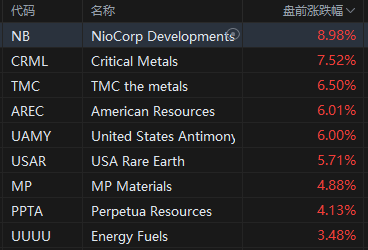
Group 1 - The rare earth sector showed significant strength in pre-market trading, with NioCorp Developments rising nearly 9% and Critical Metals increasing over 7% [1][2] - Other companies in the sector also experienced gains, including TMC the metals, American Resources, and United States Antimony, all rising over 6% [1][2] Group 2 - The U.S. government is launching a strategic critical minerals reserve project called "Project Vault," with an initial funding of $12 billion aimed at protecting manufacturers from supply shocks [3] - The project will combine $1.67 billion in private capital with a $10 billion loan from the Export-Import Bank of the United States, intended for procurement and storage of mineral resources for various industries [3] - The Export-Import Bank's board is expected to approve this record-scale loan, which is more than double the size of the bank's second-largest transaction in history [3] - The reserve will cover rare earths and other strategic elements, helping companies hedge against price volatility without needing to stockpile materials [3][4] - Over ten companies, including General Motors and Boeing, are participating in the project, which allows them to withdraw materials as needed while stabilizing market prices [4] - The project is similar to the existing strategic petroleum reserve but focuses on critical materials like gallium and cobalt, which are essential for various technologies [4]




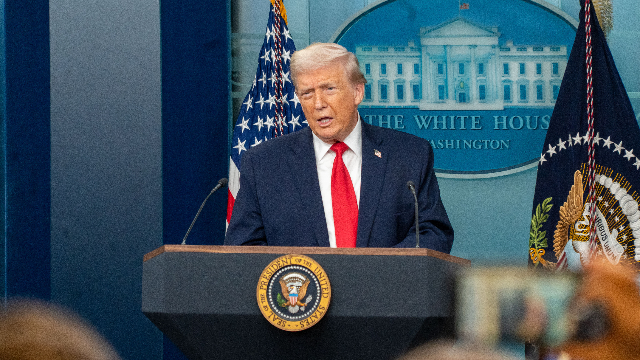
特朗普宣布120亿美元“金库计划”
第一财经· 2026-02-03 09:50
Core Viewpoint - The article discusses the launch of the "Treasury Plan" by the Trump administration, aimed at establishing a strategic reserve for critical minerals to protect U.S. manufacturers from supply shocks and stabilize the market for key raw materials [2][3]. Group 1: Treasury Plan Overview - The Treasury Plan has an initial funding of $12 billion, with $10 billion provided by the Export-Import Bank and nearly $2 billion from private capital [2]. - The plan will cover critical minerals such as rare earths, copper, and lithium, and will be managed by commodity traders including Hartree Partners, Traxys North America, and Mercuria Energy Group [2][3]. - Companies that commit to purchasing materials at designated inventory prices can submit procurement lists and access the reserve in emergencies when market purchases are difficult [3]. Group 2: Market Impact and Participation - Over ten companies, including General Motors, Stellantis, Boeing, Corning, GE Vernova, and Google, are participating in the project [4]. - Analysts suggest that the U.S. government’s direct investment in stockpiling and forming strategic partnerships aims to reduce vulnerabilities in the metal supply chain [4]. - However, some industry leaders express skepticism about the effectiveness of the $12 billion investment, citing concerns over market disruption regulations and competition for supplies from other countries [4][5]. Group 3: Broader Strategic Context - The Trump administration has prioritized critical minerals as a strategic issue, implementing various executive orders to reform domestic permitting processes and support public-private partnerships [6]. - Significant investments have been made in domestic rare earth producers, including $400 million from the Department of Defense and $2.2 billion in loans to companies like MP Materials and Lithium Americas [6][8]. - Recent initiatives also include a $160 million debt and equity investment plan by the Department of Commerce to acquire a 10% stake in a U.S. rare earth company to enhance the supply chain for rare metals and magnets [8].

特朗普宣布120亿美元“金库计划”,美国在关键矿产供应链上有哪些动作?
Di Yi Cai Jing· 2026-02-03 07:10
Group 1 - The U.S. government has launched a strategic critical minerals reserve project called the "Vault Plan," with an initial funding of $12 billion, aimed at protecting domestic manufacturers from supply shocks [1] - The project will be funded by $10 billion in loans from the Export-Import Bank of the United States and nearly $2 billion from private capital [1] - The reserve will cover critical minerals such as rare earths, copper, and lithium, and will be managed by commodity traders including Hartree Partners, Traxys North America, and Mercuria Energy Group [1] Group 2 - Companies that commit to purchasing materials at specified inventory prices can submit procurement lists to the "Vault Project," allowing them to draw from the reserve in emergencies when market procurement is difficult [4] - Over ten companies, including General Motors, Stellantis, Boeing, Corning, GE Vernova, and Google, are already participating in the project [4] - The project aims to help companies hedge against price volatility of critical raw materials without the need to stockpile inventory [4] Group 3 - Some industry leaders express skepticism about the effectiveness of the $12 billion funding, suggesting it may be limited when spread across multiple critical metals [5] - The Trump administration has been active in the critical minerals sector, signing multiple executive orders to reform domestic permitting processes and support public-private partnerships [5] - Recent investments include $400 million from the Department of Defense and $2.2 billion in loans to domestic rare earth producers [5][6]
亚太市场“黑色星期一”,贵金属市场巨震
Hua Tai Qi Huo· 2026-02-03 05:17
1. Report Industry Investment Rating - Gold: Cautiously bullish [8] - Silver: Neutral [9] - Arbitrage: Short the gold-silver ratio at high levels [9] - Options: Hold off [9] 2. Core View of the Report - The precious metals market experienced significant volatility at the end of last month and the beginning of this month. Gold, due to excessive price increases, had a "risk asset" attribute and strong callback demand. With high crowded long - positions, it was prone to a stampede effect when prices declined. However, gold remains an irreplaceable hedging asset, and investors are advised to buy on dips, though short - term further corrections are possible. Silver's situation is similar to gold, with high crowded long - positions and large floating profit positions. It is expected to remain in a low - level oscillation pattern, and investors are advised to wait and see. For the gold - silver ratio, shorting at high levels is recommended [8][9]. 3. Summary by Relevant Catalogs Market Analysis - The Asia - Pacific financial market had a "Black Monday". Uncertainty in Fed policy triggered selling. The South Korean Composite Index closed down 5.26%, the Indonesian Composite Index fell 4.88% with intraday circuit - breakers triggered, the Nikkei 225 Index dropped 1.25%, and the three major A - share and Hong Kong stock indexes all fell more than 2%. Resource stocks were severely hit, and more than 10 varieties in the domestic futures market hit the daily limit down. The Thai gold online futures trading was temporarily suspended. Iran may hold high - level nuclear negotiations with the US in the next few days, and the US and Iran are expected to meet in Istanbul on February 6. Russia will hold the next round of Ukraine issue negotiations in Abu Dhabi from February 4 - 5. US President Trump plans to launch a strategic key mineral reserve project "Project Vault" with an initial capital of $12 billion [1] Futures Quotes and Volumes - On February 2, 2026, the Shanghai gold main contract opened at 1,140.00 yuan/gram, closed at 1,008.60 yuan/gram, down 13.16% from the previous trading day. The trading volume was 41,087 lots, and the open interest was 129,725 lots. In the night session, it opened at 1,068.46 yuan/gram and closed at 1,045.00 yuan/gram, up 3.61% from the afternoon close. The Shanghai silver main contract opened at 25,960.00 yuan/kg, closed at 24,832.00 yuan/kg, down 11.13% from the previous trading day. The trading volume was 674,117 lots, and the open interest was 252,527 lots. In the night session, it opened at 22,000 yuan/kg and closed at 20,600 yuan/kg, down 17.04% from the afternoon close [2] US Treasury Yield and Spread Monitoring - On February 2, 2026, the US 10 - year Treasury yield closed at 4.271%, unchanged from the previous trading day. The 10 - year and 2 - year spread was 0.701%, also unchanged from the previous trading day [3] Changes in Positions and Volumes of Gold and Silver on the Shanghai Futures Exchange - On the Au2604 contract, long positions decreased by 13,007 lots compared to the previous day, and short positions decreased by 2,128 lots. The total trading volume of the Shanghai gold contract the previous trading day was 1,255,769 lots, up 72.24% from the previous trading day. On the Ag2604 contract, long positions decreased by 4,609 lots, and short positions decreased by 3,136 lots. The total trading volume of the silver contract the previous trading day was 1,363,351 lots, up 66.29% from the previous trading day [4] Precious Metals ETF Position Tracking - The gold ETF position was 1,087.10 tons, unchanged from the previous trading day. The silver ETF position was 15,523 tons, also unchanged from the previous trading day [5] Precious Metals Arbitrage Tracking - On February 2, 2026, the domestic gold premium was 64.87 yuan/gram, and the domestic silver premium was 5,677.97 yuan/kg. The ratio of the main gold and silver contracts on the Shanghai Futures Exchange was about 40.62, up 2.80% from the previous trading day. The overseas gold - silver ratio was 49.07, up 5.64% from the previous trading day [6] Fundamentals - On February 2, 2026, the trading volume of gold on the Shanghai Gold Exchange T + d market was 86,250 kg, up 49.15% from the previous trading day. The trading volume of silver was 211,926 kg, down 22.77% from the previous trading day. The gold delivery volume was 11,872 kg, and the silver delivery volume was 30 kg [7] Strategy - Gold: Cautiously bullish. The Au2604 contract may oscillate between 980 yuan/gram - 1,100 yuan/gram. - Silver: Neutral. The Ag2604 contract may oscillate between 19,000 yuan/kg - 22,000 yuan/kg. - Arbitrage: Short the gold - silver ratio at high levels. - Options: Hold off [8][9]
未知机构:Bloomberg独家特朗普拟启动名为金库项目的120亿美元战略关键矿-20260203
未知机构· 2026-02-03 01:55
Key Points Summary Industry Overview - The document discusses a strategic initiative in the critical minerals sector, specifically focusing on the procurement and storage of rare earth and critical minerals to support domestic manufacturing and reduce reliance on China. Core Insights and Arguments - A project named "Treasury Project" is proposed, with a total budget of $12 billion aimed at establishing a strategic reserve of critical minerals [1] - The funding structure includes $1.67 billion from private capital combined with $10 billion in loans from the U.S. Export-Import Bank [1] - The initiative aims to protect the civilian manufacturing sector from supply disruptions and price volatility [1] - The project is also intended to strengthen alternative supply chains through international cooperation, thereby reducing dependency on Chinese sources [1] Additional Important Content - The emphasis on critical minerals highlights the growing importance of these resources in the U.S. industrial landscape and the strategic shift towards self-sufficiency [1]
铜冠金源期货商品日报-20260203
Tong Guan Jin Yuan Qi Huo· 2026-02-03 01:24
1. Report Industry Investment Rating No relevant content provided. 2. Core Views of the Report - Overseas: The US ISM manufacturing index in January rebounded significantly to 52.6, the highest since February 2022, much higher than the expected 48.5. The core drivers were the simultaneous improvement in new orders and output. The employment sub - index, although at a one - year high, was still in the contraction range, indicating that demand recovery was faster than employment expansion. The price index rebounded, suggesting a resurgence in cost pressures. The US government shutdown affected the release of employment data, and precious metals showed signs of stabilization after a sharp decline [2]. - Domestic: China's RatingDog manufacturing PMI in January rose to 50.3, returning to the expansion range. New orders and employment improved simultaneously, but business confidence weakened and cost pressures increased, leading to the first increase in selling prices in 14 months. The A - share market had a volume - shrinking decline on Monday, with the Shanghai Composite Index falling 2.5% to 4015 points. The market entered a stage of rapid style rotation, with short - term volatility adjustment and mainly structural opportunities, but the medium - term trend was still positive supported by policy expectations and fundamentals [3]. - Precious Metals: After the nomination of an hawkish Fed chairman, precious metal prices continued to decline sharply. After continuous sharp drops, the selling pressure may ease, and the short - term decline may slow down, but it is still too early to say that the adjustment is over [4][5]. - Copper: The risk appetite in the market decreased, and copper prices sought support. Although the new Fed chairman nominee's stance was less dovish than expected, the Fed's existing interest - rate management mechanism relied on abundant liquidity. Trump's "Project Vault" plan and the possible resumption of operations at a Chilean mine affected the copper market. It was expected that copper prices would seek support in the short term and then gradually rebound [6][7]. - Aluminum: Due to high risk - aversion sentiment, aluminum prices adjusted. The fundamentals of aluminum did not show obvious weakening in the long - term, and the probability of continuous sharp decline was low. It was advisable to be cautious about chasing up or selling down [8][9]. - Alumina: There was supply pressure, and the cost support declined. Alumina was expected to oscillate at a low level [10]. - Cast Aluminum: The sentiment reversed, and cast aluminum continued to adjust. The cost support from scrap aluminum made the decline of cast aluminum slightly converge. The market was dominated by short - term sentiment, and the futures price was expected to continue to adjust [11]. - Zinc: There was a "stampede" of long positions, and zinc prices plunged. The supply and demand were both weak in February. The short - term market was still dominated by funds, and there was a possibility of a second decline in futures prices [12][13][14]. - Lead: Pessimistic sentiment spread, and lead prices rebounded after hitting the bottom. The supply and demand were both weak in February, and inventory accumulation put pressure on lead prices. However, the cost support from refineries was expected to ease the decline [15][16]. - Tin: The market was de - leveraged, and SHFE tin had three consecutive negative lines. The technical indicators weakened, and the fundamental support also decreased. It was difficult to say that the decline of tin prices had ended [17]. - Steel (Screw and Coil): Affected by market sentiment, steel futures oscillated and declined. The supply and demand of steel were both weak, and the market was mainly in an oscillating state. Attention should be paid to inventory trends and policy changes [18][19]. - Iron Ore: The arrival of iron ore increased slightly, and the futures price oscillated. The supply was strong and the demand was weak, and the futures price was expected to oscillate [20]. - Coking Coal and Coke: The supply shrank before the Spring Festival, and the futures prices were supported at a low level. The supply and demand were both weak, and the futures prices were expected to oscillate [21]. - Soybean and Rapeseed Meal: Brazilian soybean harvest was progressing steadily, and institutions slightly raised their production forecasts. The domestic soybean inventory of oil mills decreased, and the soybean meal inventory increased, remaining at a high level. The short - term soybean meal futures were expected to oscillate [22][23]. - Palm Oil: The market sentiment cooled down, and palm oil prices fell significantly from a high level. The short - term palm oil was expected to oscillate and adjust [24][25]. 3. Summary by Relevant Catalogs 3.1 Metal Main Varieties Yesterday's Trading Data - The report provided the closing prices, price changes, price change percentages, trading volumes, and open interest of various metal futures contracts, including copper, aluminum, zinc, lead, nickel, tin, gold, silver, etc., in both domestic and international markets [26]. 3.2 Industrial Data Perspective - It presented the price changes, inventory changes, and other data of various metals such as copper, nickel, zinc, lead, aluminum, alumina, tin, precious metals, steel, iron ore, coking coal, coke, lithium carbonate, industrial silicon, and soybean meal from February 2nd to January 30th [27][30][32].
美股异动 | 稀土概念股盘前快速拉升 Critical Metals(CRML.US)涨超8%
Zhi Tong Cai Jing· 2026-02-02 14:21
Core Viewpoint - Rare earth stocks experienced a significant pre-market surge, driven by the announcement of a $12 billion strategic critical minerals reserve plan by the U.S. government aimed at bolstering industrial security and protecting manufacturers from supply chain disruptions [1] Group 1: Stock Movements - Critical Metals (CRML.US) rose over 8% in pre-market trading [1] - NioCorp Developments (NB.US) increased by more than 6% [1] - United States Antimony (UAMY.US) saw a rise of over 5% [1] - TMC the metals (TMC.US) and USA Rare Earth (USAR.US) both increased by more than 4% [1] - MP Materials (MP.US) gained over 3% [1] Group 2: Government Initiative - The initiative, named "Project Vault," will utilize $10 billion in loans from the Export-Import Bank of the United States, along with $1.67 billion in private capital [1] - The plan aims to procure and store minerals for automotive manufacturers, technology companies, and other industrial giants [1] - This will be the first private sector reserve project of its kind in the U.S., setting a record in scale and operating similarly to the national strategic petroleum reserve [1]