入境游

Search documents
信达证券:春节超长假期刺激出游 景区、入境游表现靓丽
智通财经网· 2026-02-25 06:16
超长春节假期刺激出游需求,人均消费仍承压 26年春节假期9天,全国国内出游5.96亿人次,日均0.66亿人次、同增5.7%、恢复至19年同期的112%;国 内出游总花费8034.83亿元,日均893亿元、同增5.5%、恢复至19年同期的122%;人均消费1348元,日均 150元、同减11.3%,恢复至19年同期的84.7%。 景区:客流景气度较高 26年春节假期,景区迎来"开门红",多个景区多日达到最大承载量。从26年同比增速来看,峨眉山/三 峡大坝景区表现靓丽;从较19年增长来看,峨眉山/长白山/三峡大坝/张家界武陵源景区表现强劲。三特 索道旗下项目前8天接待游客人次同增18.2%,祥源文旅旗下目的地接待游客人次同增31.3%。 免税:海南离岛免税销售额双位数增长,三亚好于海口 在海南封关、旅游旺季叠加超长春节假期的共同催化下,日均离岛免税销售额恢复至接近24年高点的水 平。根据海口海关,26年春节假期,离岛免税购物金额27.2亿元,日均3.03亿元、同增16.5%。根据三 亚市商务局,三亚免税销售额19.6亿元、日均2.18亿、同增21%。 演艺:日均场次持平至微增 26年春节假期,宋城演艺11台《千古 ...

全球游客,突然涌向中国春节
3 6 Ke· 2026-02-09 03:05
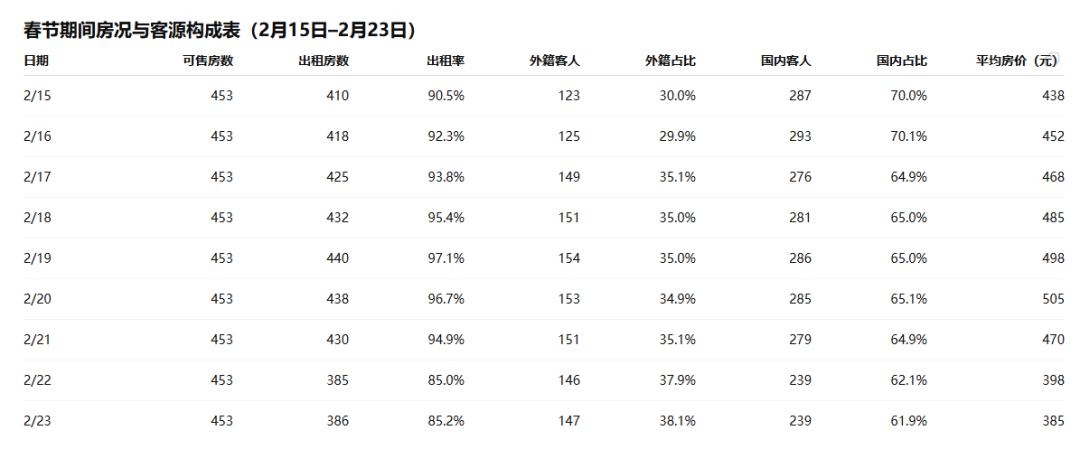
01 春节将至,国内各地外国人浓度突然高了起来。 这两天,一位在成都成华区某中端连锁酒店工作的朋友在旅界社群里晒了张截图,是他所在酒店的春节订单构成。 他说,自己本来只是想感慨一下今年春节又要满房了,结果翻了翻订单才发现,今年春节期间,每天竟然差不多有三分之一是老外。 | | 日 日本国际2017-12-19 11:21:21 10:12 10-12 11:12 11:52 11:1 | ( ( ) = ) | | | | | | | | --- | --- | --- | --- | --- | --- | --- | --- | --- | | 日期 | 可售房数 | 出租房数 | 用相率 | 外籍客人 | 外籍占比 | 国内客人 | 国内战 | 平均房价(元) | | 2/15 | 453 | 410 | 90.5% | 123 | 30.0% | 287 | 70.0% | 438 | | 2/16 | 453 | 418 | 92.3% | 125 | 29.9% | 293 | 70.1% | 452 | | 2/17 | 453 | 425 | 93.8% | 149 | 35.1% | 276 ...

2025年近7亿人次出入境——双向奔赴,开放型经济活力足
Xin Lang Cai Jing· 2026-02-07 23:56
数据背后,是入境游的热度攀升,是内地(大陆)与港澳台地区的人相近心相通,是跨境货物运输的高 效流转,体现了更具活力的高水平对外开放。 解锁入境新体验 "我们在哈尔滨玩了7天,那么大的雪、那么好看的冰雕,太震撼了。"1月26日下午,马来西亚游客佩滕 在北京首都国际机场3号航站楼准备回国,聊起此次旅行仍十分兴奋。他们一行17个人,通过免签政策 入境,冲着冰雪世界而来,满载惊喜而归。 2025年,全国移民管理机构共查验出入境人员6.97亿人次,同比上升14.2%,创历史新高;查验出入境 交通运输工具3811.6万架(列、艘、辆)次,同比上升17%。 1月26日下午,从香港西九龙站开往无锡东站的G386次列车开行。这班列车的开行,源自全国铁路新运 行图的实施。调图后,香港高铁新增南京、无锡、合肥等16个内地直达站点。调图首日,广深港高铁西 九龙站口岸出入境旅客超9.6万人次,显示出香港与内地人员往来的旺盛需求。 为保障客流顺畅,2025年,国家移民管理局扩大往来港澳人才签注政策实施范围至长三角、京津冀以及 全国所有自由贸易试验区,并为持探亲签注往来港澳地区的内地居民在港澳地区续办同类型探亲签注提 供便利。 香港大学生 ...
【招银研究|区域点评】2025年入境游数据点评:沪深领跑全国,特色业态成为“流量密码”
招商银行研究· 2026-02-04 09:05
Core Viewpoint - The inbound tourism market in China is expected to be a highlight of the consumer market by 2025, driven by the expansion of visa-free policies and the efforts of major cities to become leading destinations for inbound tourism [1] Group 1: Policy Benefits - The expansion of visa-free policies is creating a new regional landscape for inbound tourism, with the number of visa-free countries increasing to 48 and mutual visa exemptions to 29 by December 2025 [2] - In 2025, the total number of inbound and outbound foreign visitors is projected to rise to 82.04 million, with 73.1% of these being visa-free entrants [2] - The number of ports eligible for transit visa exemptions has increased to 65, and the areas for stay have expanded to 24 provinces, promoting a new pattern of "multi-point entry, cross-regional travel, and overall warming" in inbound tourism [5] Group 2: Key Cities - Major cities like Shanghai and Shenzhen are leading the way in inbound tourism, with Shanghai expected to receive 9.36 million inbound tourists in 2025, a nearly 40% increase from the previous year [6] - Shenzhen has seen a significant rise in inbound foreign visitors, surpassing traditional destinations like Beijing and Guangzhou, and is now ranked second [6] - Cities such as Chengdu and Zhangjiajie are also emerging as popular destinations, with Chengdu's inbound tourist numbers expected to grow by 54% in 2025 [6] Group 3: Inbound Tourism Trends - The inbound tourism experience is shifting from traditional sightseeing to more experiential and participatory activities, with cities adapting to these changes [6] - International flight capacity is a key factor in determining a city's inbound tourism potential, with Shanghai, Beijing, and Guangzhou leading in international passenger traffic [9] - The optimization of tax refund policies and the construction of international consumption environments are enhancing the conversion of inbound tourist flow into consumption growth [11] Group 4: New Tourism Formats - New tourism formats such as cultural experiences, tech tourism, and medical tourism are emerging, enhancing the attractiveness of major cities for inbound tourists [15] - Cities are leveraging unique cultural and technological attributes to create new highlights in inbound tourism, such as Beijing's cultural workshops and Shenzhen's tech shopping experiences [15] - Marketing strategies and content creation are helping cities like Chengdu and Zhangjiajie gain international recognition and attract more visitors [16] Group 5: Outlook - The inbound tourism sector is expected to continue its upward trajectory in 2026, supported by ongoing policy benefits and accelerated consumer conversion [17] - Major cities are likely to remain the primary destinations for inbound tourism, with new first-tier and popular cities also showing significant growth potential [17] - The trend towards diversified inbound tourism routes and experiences is anticipated to create opportunities for lesser-known destinations to gain popularity [17]

中国目的地·入境游简报011|2025成绩单陆续出炉中
Xin Lang Cai Jing· 2026-01-19 03:55
Core Insights - The inbound tourism market in China is transitioning from "traffic recovery" to "quality enhancement" driven by new policies focusing on visa facilitation and digital infrastructure improvements [1][4][5]. Policy Updates - The Ministry of Commerce and eight other departments have introduced measures to attract inbound consumption, including issuing five-year multiple-entry visas for eligible individuals and optimizing regional visa-free policies [4]. - The Ministry of Culture and Tourism and the Civil Aviation Administration have launched an action plan to enhance the convenience of inbound travel by increasing international flight routes and improving airport services [5]. - The "Meet China" platform has been launched as the first self-service consumption platform for inbound tourists, addressing shopping pain points through a comprehensive digital solution [6]. Market Trends - The inbound tourism market is showing signs of recovery, with significant increases in the number of outbound tax refund claims and inbound tourist arrivals across various provinces [2][36]. - There is a notable shift in tourist behavior, with longer stays and a preference for cultural experiences over traditional sightseeing, indicating a structural upgrade in demand [2][48]. - Emerging destinations in third and fourth-tier cities are experiencing significant growth in foreign tourist numbers, reflecting a trend of diversifying tourist attractions beyond major cities [2][49]. Data Highlights - The number of outbound tax refund claims by foreign travelers increased by 285% from January to November 2025 [36]. - Inbound tourist arrivals in Shandong increased by 41% in the first three quarters of 2025, while Anhui saw a 68% increase in the same period [44][42]. - Hainan reported a 58% increase in overnight inbound tourists compared to the previous year, surpassing pre-pandemic levels [45]. Industry Challenges - The precision of international marketing needs improvement, shifting from broad promotional strategies to more targeted approaches based on customer segmentation [50]. - There is a shortage of small language tour guides, which limits the depth of cultural exchange and service experiences for international tourists [51].
【2025中国经济印记】“游在中国”成为国际新时尚
Jing Ji Ri Bao· 2025-12-08 06:47
Core Insights - The inbound tourism market in China is experiencing significant growth due to the implementation of various facilitation measures, making travel more convenient for foreign visitors [1][2][3] Group 1: Inbound Tourism Growth - The expansion of visa-free policies and direct flights has made it easier for foreign tourists to visit China, leading to increased travel and spending [2][3] - The trend of "China Travel" and "China Shopping" has gained popularity on social media, highlighting the appeal of Chinese products and the convenience of payment options for foreign tourists [2][3] Group 2: Cultural and Experiential Tourism - There is a shift in foreign tourists' preferences from short-term visits to longer stays, with a growing interest in deep cultural experiences rather than just sightseeing [4][5] - The success of Chinese cultural IPs, such as video games and films, is driving tourism to specific locations, enhancing the cultural allure of destinations like Datong [4][5] Group 3: Economic Impact and Potential - Inbound tourism is projected to contribute approximately 0.5% to China's GDP in 2024, indicating significant room for growth compared to the 1% to 3% range seen in other major countries [6] - The "14th Five-Year Plan" emphasizes enhancing the internationalization and convenience of inbound tourism, aiming for high-quality development in the sector [7] Group 4: Strategic Development Recommendations - Experts suggest that the focus should be on developing internationalized tourism products that integrate cultural experiences, shopping, and outdoor activities to attract foreign visitors [7][8] - Building a comprehensive international tourism framework centered around major cities like Beijing, Shanghai, and Guangzhou is essential for creating a diverse and appealing tourism landscape [8]
宏观研究:“十五五”建议稿学习
China Post Securities· 2025-10-30 02:38
Group 1: Economic Outlook - The "15th Five-Year Plan" emphasizes the need for high-quality development amidst increasing external challenges and uncertainties, including geopolitical conflicts and economic protectionism[3] - The plan sets a qualitative goal for economic growth to remain within a reasonable range, with significant achievements in high-quality development[3] - Despite external pressures, China's economic foundation remains solid, with strong resilience and potential for long-term growth[9] Group 2: Policy Directions - The plan outlines 12 key tasks focusing on optimizing supply, expanding demand, ensuring safety, and balancing fairness[3] - A more proactive macroeconomic policy is highlighted, with an emphasis on developing diverse financial instruments and strengthening financial regulation[20] - The plan aims to enhance the initial income distribution mechanism, promoting a market-driven approach to compensation based on contribution[24] Group 3: Investment and Consumption - The inbound tourism market is recovering, with 15.89 million foreign visitors from January to August 2025, a 52.1% increase year-on-year, indicating a potential boost in consumer spending[17] - Infrastructure investment is expected to rise due to industrial transfers and population movements, particularly in western and northeastern regions[18] - The plan stresses the importance of consumer spending, with initiatives to cultivate international consumption centers and expand inbound consumption[17]
240小时免签下北京入境游|北京交通大学现代旅游研究院院长张辉:供需两端发力破解入境游“便利化缺损”
Bei Jing Shang Bao· 2025-10-26 09:41
Core Insights - The primary focus of China's tourism development during the 14th Five-Year Plan period will be on inbound tourism, which is expected to be a significant growth area in the upcoming 15th Five-Year Plan period [4][6] Group 1: Inbound Tourism Trends - Inbound tourism recovery has been significantly driven by demand-side policy initiatives, particularly the implementation of visa-free policies and enhanced payment convenience [4][6] - By the third quarter of this year, the number of foreign visitors entering China under visa-free policies reached 7.246 million, marking a year-on-year increase of 48.3% [4][6] - Approximately 1.35 million foreign visitors entered Beijing under visa-free and 240-hour transit visa-free policies this year, accounting for 53.4% of all inbound visitors [4][6] Group 2: Challenges in Inbound Tourism - Despite the growth, inbound tourism faces challenges related to "convenience deficits" and "product gaps," which require coordinated efforts from both demand and supply sides to address [4][6] - The need for tailored visa policies for specific markets, such as long-term stays for study tours, highlights the necessity for a more nuanced approach to visa-free policies [5][6] Group 3: Supply-Side Development - There is a pressing need to accelerate the development of world-class tourist cities, as they are essential for attracting inbound tourism [6][7] - The establishment of a comprehensive inbound study tourism system is crucial, as this market segment remains underdeveloped despite its potential [6][7] - The integration of traditional Chinese culture and health concepts into tourism offerings can create unique vacation experiences that resonate with international visitors [7] Group 4: Promotion and Marketing Strategies - The establishment of a national tourism promotion agency is recommended to enhance the global marketing of Chinese tourism products and cultural experiences [7] - Increased promotional efforts in overseas markets, particularly in niche segments like study and vacation tourism, are essential for integrating China into the global tourism network [7]

吸引海外游客,从译好“麻婆豆腐”开始
Ren Min Ri Bao· 2025-10-08 22:11
Core Insights - The newly released "Guidelines for the Construction of Inbound Tourism Demonstration Blocks in Changning District, Shanghai" aim to enhance the experience of overseas tourists by providing clear signage and standardized translations [1] Group 1: Industry Trends - There is a growing trend of young overseas tourists choosing to travel independently, leading to increased expectations for language services [1] - Tourists have expressed difficulties in understanding the translations of Chinese dishes, highlighting the need for clearer descriptions [1] Group 2: Recommendations - The guidelines suggest that restaurants should offer multilingual menus in a "Chinese + Pinyin + Foreign Language" format, including ingredient lists and cooking methods for main dishes [1]
韩国对中国团体游客免签生效
Bei Jing Shang Bao· 2025-09-29 15:41
Core Points - The South Korean government has implemented a temporary visa exemption policy for Chinese group tourists, effective from September 29 to June 30 of the following year [2][3] - The policy allows groups of three or more Chinese tourists to enter South Korea without a visa for a stay of up to 15 days, while Jeju Island continues to allow both individual and group tourists to stay for 30 days without a visa [2] - The policy is expected to enhance tourism relations between South Korea and China, with hopes of increasing the number of Chinese visitors to Incheon [2][3] Industry Impact - The tourism industry anticipates that the initial impact of the visa exemption may not be immediately significant, but it is viewed as a symbolic gesture that could lead to a gradual increase in Chinese tourists visiting South Korea [3] - It is projected that by the end of the policy period on June 30, the number of Chinese tourists visiting South Korea could reach 1 million [3] - In the first half of the year, Chinese tourists accounted for 28.6% of all foreign visitors to South Korea, indicating the importance of this market for the South Korean tourism sector [2]