石油煤炭加工

Search documents
兼论通胀预期回升的债市影响:走出低通胀的日本经验
East Money Securities· 2026-03-25 09:06
Group 1 - The report discusses the impact of rising oil prices on inflation readings, highlighting that industrial production recovery and geopolitical factors have led to significant increases in PPI, which supports inflation expectations [10][14] - The report draws parallels between Japan's experience of overcoming long-term deflation and China's current inflation dynamics, emphasizing the role of external shocks and internal economic adjustments [10][15] - Japan's CPI has shown a significant upward trend since mid-2021, with core CPI reaching 2% in April 2022 and remaining around 1.6% as of February 2026, indicating a shift from deflation to sustained inflation [19][20] Group 2 - The report identifies two core transmission obstacles for China in achieving a full price recovery: the lack of sustained price increases in the food sector and downward pressure on disposable income and employment [10][14] - Recent positive changes in China's agricultural sector, particularly regarding pig prices and income policies, suggest potential for improved inflation dynamics [10][15] - The report anticipates that the bond market may remain in a volatile state in the second quarter, with a steepening yield curve and potential trading opportunities in the long end [10][11] Group 3 - Japan's experience illustrates that external inflationary pressures can catalyze internal economic adjustments, leading to a positive feedback loop of wages, prices, and profits [24][32] - The report notes that Japan's labor market dynamics, including increased participation rates among women and older workers, have contributed to rising wage expectations and enhanced bargaining power for labor unions [33][37] - The successful transfer of rising costs to consumers in Japan has been facilitated by government support and a shift in public sentiment towards accepting price increases, which contrasts with previous deflationary mindsets [38][40]
数据显示我国经济社会绿色转型加速推进
Ke Ji Ri Bao· 2026-02-10 00:18
Group 1 - During the "14th Five-Year Plan" period, the manufacturing industries of key green products such as new energy vehicles, photovoltaic equipment, lithium-ion batteries, and solar appliances have an average annual sales growth rate of over 30% [1] - China has maintained its position as the world's largest producer and seller of new energy vehicles for ten consecutive years, with a projected year-on-year growth of 25.9% in domestic new energy vehicle sales by 2025 [1] - The sales revenue share of five high-energy-consuming industries, including petroleum, coal, and other fuel processing, has decreased from 27% at the end of the "13th Five-Year Plan" to 24.9% at the end of the "14th Five-Year Plan" [1] Group 2 - The sales revenue of green technology service industries, including new energy, energy-saving, and environmental protection, has grown at an average annual rate of 51.1%, 28.5%, and 18.2% respectively during the "14th Five-Year Plan" [1] - By 2025, the sales revenue from clean energy generation, including wind, solar, hydro, and nuclear power, is expected to account for 42.6% of total power generation sales revenue, an increase of 7.2 percentage points from the end of the "13th Five-Year Plan" [1] - The sales revenue from wind and solar power generation is projected to grow at an average annual rate of 25.4% during the "14th Five-Year Plan" [1] Group 3 - The environmental protection tax policy has released tax reduction benefits, with a cumulative implementation of 111.06 billion yuan in tax reductions since its introduction in 2018 [2] - The number of urban and rural sewage and solid waste treatment plants benefiting from environmental protection tax incentives has increased from 5,589 in 2021 to 6,415 by 2025 [2] - The revenue from environmental protection taxes on major air pollutants, such as sulfur dioxide and nitrogen oxides, is expected to decrease by 33.8% and 34.03% respectively by 2025 compared to 2020 [2] Group 4 - The water resource fee reform has shown significant results, with the amount of underground water extracted in new pilot areas decreasing by 7.1% to 5.47 billion tons by 2025 [2] - Special water usage in golf courses, ski resorts, car washes, and bathing facilities has decreased by 34.3% compared to 2024 [2] - The collaboration between policy guidance and business initiatives has led to substantial progress in green transformation, reinforcing ecological safety and promoting sustainable economic development [2]
石油煤炭加工1月价格指数迎改善;化工行业ETF易方达(516570)连续10日“吸金”合超13亿
Sou Hu Cai Jing· 2026-02-03 02:48
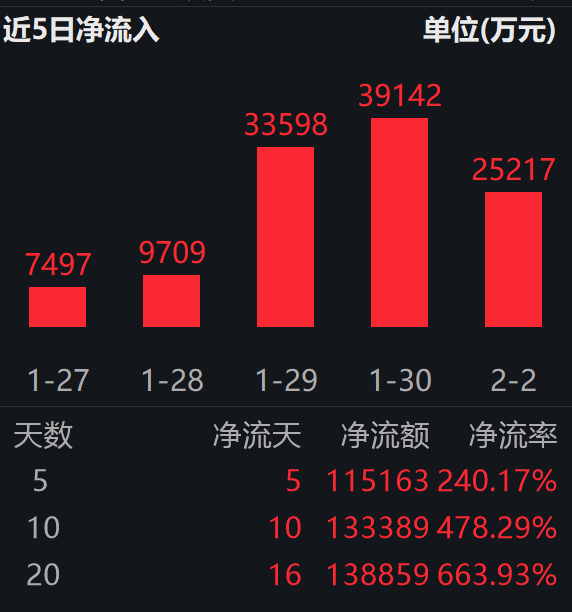
Group 1 - The China Petroleum and Chemical Industry Index (H11057) increased by 1.63%, with key stocks such as Wanhua Chemical, Yilong Co., Cangge Mining, Hualu Hengsheng, and Yuntianhua rising over 2% [1] - As of February 2, the index has risen by 41.19% over the past year [1] - The E Fund Chemical Industry ETF (516570), which tracks the index, has seen a net inflow of over 1.3 billion in the last 10 days, with its latest fund size reaching 1.537 billion [1] Group 2 - In January, the production index and new orders index for the petroleum, coal, and other fuel processing industries were both below the critical point, indicating a slowdown in market demand and a decline in production [3] - The main raw material purchase price index and the factory price index were 56.1% and 50.6%, respectively, with increases of 3.0 and 1.7 percentage points from the previous month, marking the factory price index's first rise above the critical point in nearly 20 months [3] - Guosheng Securities stated that the supply structure has improved, leading to a valuation recovery in the chemical industry, with continuous growth since the "anti-involution" trend began in July 2025 [3]



新华财经早报:2月1日
Xin Hua Cai Jing· 2026-02-01 01:15
Group 1: Manufacturing and Economic Indicators - In January, China's manufacturing Purchasing Managers' Index (PMI) was reported at 49.3%, a decrease of 0.8 percentage points from the previous month, indicating a contraction in the manufacturing sector [2] - The production index stood at 50.6%, indicating continued expansion, while the new orders index fell to 49.2%, reflecting a decline in market demand [2] - Industries such as agricultural and food processing, as well as railway, shipping, and aerospace equipment, showed production and new orders indices above 56.0%, indicating rapid release of supply and demand [2] - Conversely, industries like petroleum, coal, and automotive had indices below the critical point, signaling a slowdown in market demand and production [2] Group 2: Taxation and Regulatory Updates - The Ministry of Finance and the State Taxation Administration issued an announcement clarifying the calculation of taxable sales for value-added tax (VAT) transactions, particularly for financial products [2] - New regulations specify that the sales amount for transferred financial products is calculated based on the balance after deducting the purchase price from the selling price, with provisions for handling negative balances [2] - Additional announcements were made regarding VAT and consumption tax policies for export goods and cross-border services, providing clarity on tax exemptions and refunds [2] Group 3: Transportation and Mobility - The 2026 Spring Festival travel season will begin on February 2 and last for 40 days, with an expected cross-regional mobility of 9.5 billion people, marking a historical high [2] - Self-driving travel is anticipated to dominate, accounting for approximately 80% of the total travel, while railway and civil aviation passenger volumes are projected to reach 540 million and 95 million, respectively [2]

熊园:年度策略——2026年政策展望
Sou Hu Cai Jing· 2025-11-26 05:41
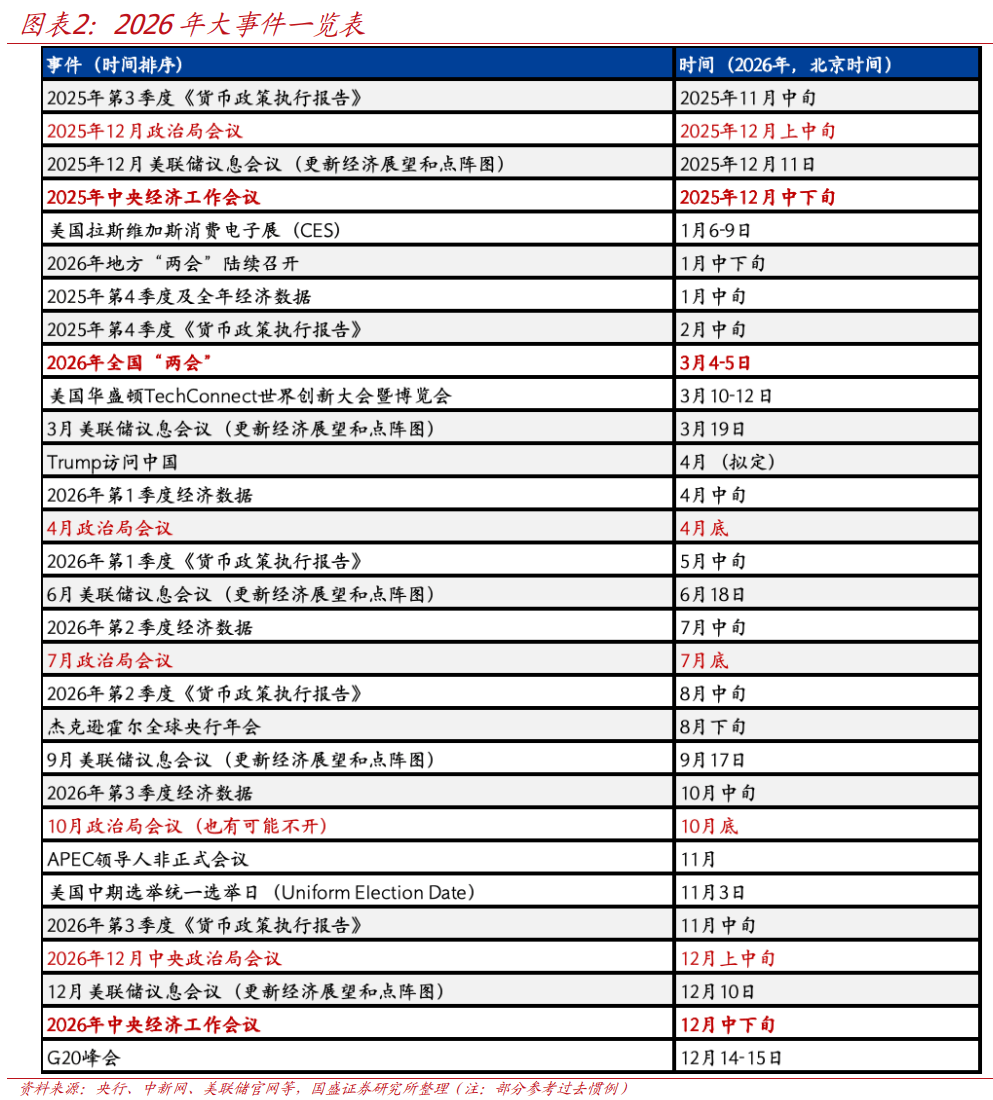
Core Viewpoint - The report outlines an optimistic economic outlook for 2026, emphasizing a proactive and expansionary policy stance to ensure a strong start to the "15th Five-Year Plan" with a GDP growth target around 5% [1][4][41] Policy Perspective - The main policy tone for 2026 is set to be positive and expansionary, with a focus on ensuring a good start to the "15th Five-Year Plan" [1][4] - Key strategies include promoting domestic demand, stabilizing real estate, and planning new major infrastructure projects [1][5] Monetary Policy - Monetary policy is expected to remain accommodative, with potential interest rate cuts and reserve requirement ratio reductions anticipated in 2026 [2][12] - It is projected that there may be 1-2 reserve requirement ratio cuts of 50-100 basis points and 1-2 interest rate cuts of 10-20 basis points [12][15] Fiscal Policy - Fiscal policy is anticipated to be proactive and expansionary, with a projected fiscal deficit rate around 4% and special bonds reaching approximately 5 trillion [2][30] - The total fiscal expenditure is expected to reach 43 trillion, reflecting an increase of 1.13 trillion year-on-year [30][29] Economic Growth Targets - The GDP growth target for 2026 is likely to remain around 5%, with quarterly growth rates projected at 5.2%, 5.0%, 5.1%, and 4.9% respectively [4][41] - Inflation is expected to remain low, with a projected annual deflation index of around 0.1% [4] Investment Focus - The focus will be on expanding domestic demand, particularly through consumer spending, real estate stabilization, and infrastructure investment [5][29] - Specific measures to boost consumption include extending the "old-for-new" policy and enhancing service consumption [5][29] Structural Reforms - Structural reforms will continue to be emphasized, particularly in enhancing the quality of life and addressing demographic challenges [8][41] - The government aims to optimize the allocation of resources towards human investment and social welfare [8][29] Key Events Timeline - A series of important economic meetings and reports are scheduled throughout 2026, including the Central Economic Work Conference and the National People's Congress [3][4]
利润修复的“起点”? ——6月工业企业效益数据点评(申万宏观·赵伟团队)
赵伟宏观探索· 2025-07-29 16:04
Core Viewpoint - The recovery in June's profit growth is primarily due to improved cost pressures and a rebound in revenue's contribution to profit year-on-year. The profit growth rate for industrial enterprises in June increased by 4.6 percentage points to -4.4% [3][8][55] - The "anti-involution" policy is expected to limit the downward space for profits, as it helps alleviate cost pressures and supports the recovery of internal demand [4][24][56] Revenue and Profit Analysis - In June, industrial enterprises' cumulative revenue year-on-year was 2.5%, slightly down from the previous value of 2.7%. Meanwhile, cumulative profit year-on-year decreased by 1.8%, compared to a previous decline of 1.1% [2][7] - The actual revenue growth rate in June saw a rebound, with the consumption manufacturing chain benefiting significantly from exports, rising by 1 percentage point to 8.8% year-on-year. However, the coal and metallurgy chain's revenue growth continued to decline, falling by 0.3 percentage points to -0.9% [4][20][56] Cost Structure and Pressure - The cost pressure for industrial enterprises eased in June, primarily due to lower costs in the petrochemical and metallurgy chains. The cost rate for industrial enterprises was 85.2%, down 32.3 basis points year-on-year [3][13][55] - The cost rate for the petrochemical chain saw a significant decline, down 37.5 basis points to -0.1%. In contrast, the downstream consumer manufacturing sector faced higher cost rates, which increased by 82.1 basis points to 83.1% [3][13][55] Inventory Trends - The nominal inventory of industrial enterprises decreased by 0.4 percentage points year-on-year to 3.1% in June. However, the actual inventory, excluding price factors, increased by 0.3 percentage points to 7.3% year-on-year [42][57] - Upstream inventory growth showed a notable increase, rising by 3.9 percentage points to 21.5% [42][57] Sector Performance - The profit growth rate for state-owned and foreign enterprises showed significant improvement in June, with year-on-year increases of 12.5 percentage points to -8.4% and 17.9 percentage points to 10.9%, respectively [36][57] - In terms of revenue, the industrial sectors such as instruments, automobiles, and petroleum coal processing experienced substantial growth, with year-on-year increases of 7.2, 4.2, and 3.6 percentage points, respectively [34][57]
利润修复的“起点”? ——6月工业企业效益数据点评(申万宏观·赵伟团队)
申万宏源宏观· 2025-07-28 15:52
Core Viewpoints - The profit growth in June is primarily attributed to improved cost pressures and a rebound in revenue's contribution to profit year-on-year. The profit margin improved as cost pressures eased, with the profit rate rising by 4.6 percentage points to -4.4% [3][8][55] - The "anti-involution" policy is expected to limit the downward space for profits, as it helps alleviate cost pressures and supports the recovery of domestic demand [4][24][56] Revenue and Profit Analysis - In June, industrial enterprises' revenue growth increased by 0.8 percentage points to 1.6% year-on-year, with significant contributions from the instrumentation, automotive, and petroleum coal processing sectors, which saw increases of 7.2, 4.2, and 3.6 percentage points respectively [5][34][57] - The actual revenue growth for the consumer manufacturing chain rose by 1 percentage point to 8.8% due to strong export support, while the coal and metallurgy chains experienced a decline in revenue growth, falling by 0.3 percentage points to -0.9% [4][20][56] Cost Structure and Inventory - The cost rate for industrial enterprises in June was 85.2%, down 32.3 basis points year-on-year, with significant reductions in the petrochemical chain's cost rate, which fell by 37.5 basis points to -0.1% [3][13][55] - Actual inventory growth saw a slight increase, with nominal inventory declining by 0.4 percentage points to 3.1% year-on-year, while actual inventory rose by 0.3 percentage points to 7.3% [42][57] Future Outlook - The ongoing "anti-involution" policy is anticipated to enhance capacity utilization and improve corporate profitability, alongside a continuous recovery in domestic demand, indicating a long-term upward trend in corporate profits [4][24][56] - Attention should be paid to the potential negative impact of "super-inflation" in upstream prices on corporate profitability, as downstream sectors face dual pressures from rigid and elastic costs [4][24][56]
上半年海南经济稳中向好、质效提升
Sou Hu Cai Jing· 2025-07-27 01:43
Economic Overview - The economy of Hainan Province showed a stable and progressive development trend in the first half of 2025, with a GDP growth of 4.2% year-on-year at constant prices [1] - The value added of primary, secondary, and tertiary industries grew by 4.7%, 5.1%, and 3.7% respectively [1] Agricultural Sector - The total output value of agriculture, forestry, animal husbandry, and fishery reached 129.185 billion yuan, marking a year-on-year increase of 5.1% [1] Industrial Sector - Industrial production accelerated, with the equipment manufacturing sector experiencing a significant increase of 72.4%, outpacing the overall industrial value added growth by 61 percentage points [1] - The processing value added in the free trade port policy showed positive effects, with petroleum, coal, and other fuel processing increasing by 35.2%, and oil and gas extraction growing by 52.8% [1] - The agricultural and sideline food processing industry saw a growth of 53.5% [1] Service Sector - The value added of the service industry (tertiary sector) increased by 3.7% year-on-year [1] - The total import and export value of services reached 34.710 billion yuan, reflecting a rapid growth of 24.7% [1] Investment and Consumption - Equipment investment grew by 5.9% due to the promotion of large-scale equipment renewal policies [2] - Infrastructure investment (excluding electricity, gas, and water supply) increased by 17.9%, exceeding the overall investment growth rate by 25.5 percentage points [2] - The total retail sales of social consumer goods reached 132.989 billion yuan, with a year-on-year growth of 11.2%, accelerating by 7 percentage points compared to the first quarter [2] Environmental and Energy Development - The air quality in Hainan was rated as good 96.8% of the time, with a 100% compliance rate for water quality in urban water sources [2] - Clean energy generation, particularly wind and hydropower, saw significant growth, with wind power increasing by 3.3 times and hydropower by 12.7% year-on-year [2] Future Outlook - The overall economic recovery trend is strengthening, with positive factors for economic transformation and high-quality development continuing to accumulate [2] - Future efforts will focus on effective investment, stabilizing foreign trade, and improving service quality [2]
广东上半年GDP同比增长4.2% 实现“半年稳”力争“全年好”
Shang Hai Zheng Quan Bao· 2025-07-18 18:23
Economic Performance - Guangdong's GDP reached 68,725.4 billion yuan in the first half of the year, with a year-on-year growth of 4.2%, an increase of 0.1 percentage points from the first quarter [3] - The province's industrial added value grew by 4%, retail sales of consumer goods increased by 3.5%, and foreign trade imports and exports rose by 4% [3] Foreign Trade - Guangdong's foreign trade imports and exports totaled 4.55 trillion yuan in the first half of the year, marking a 4% year-on-year increase, outperforming the national average by 1.1 percentage points [4] - The province accounted for 20.9% of the national foreign trade, contributing 28% to the national foreign trade growth [4] Export Products - Exports of mechanical and electrical products reached 19.6 trillion yuan, growing by 7.2% and representing 67.8% of the province's total exports [5] - High-tech product exports amounted to 505.43 billion yuan, with a growth rate of 13.3%, indicating a significant increase in the "new quality" of export products [5] Industrial Growth - The industrial added value in Guangdong increased by 4% year-on-year, with advanced manufacturing and high-tech manufacturing growing by 5.9% and 6% respectively [6] - The production of high-tech products such as new energy vehicles and industrial robots saw substantial growth, with increases of 14.7% and 34% respectively [6] Investment Trends - Industrial investment in Guangdong accounted for 38.1% of total investment, with significant growth in the automotive and petroleum industries, at 14.6% and 57.9% respectively [7] - The province aims to enhance its industrial structure by focusing on advanced manufacturing and integrating digital and green technologies into traditional industries [7]
核心CPI企稳的三个特征?——通胀数据点评(25.05)
申万宏源宏观· 2025-06-09 15:25
Core Viewpoints - The improvement in consumer demand stabilizes the core CPI, but supply-side factors significantly suppress inflation readings [2][68] Group 1: Characteristics of Core CPI Stabilization - Characteristic 1: Core commodity PPI shows a notable rebound, primarily due to improved demand and a lack of further tariff impacts. In May, the core commodity PPI increased by 0.3 percentage points to -1.4%. This is attributed to the sustained effects of consumption-boosting policies and a moderation in tariff impacts on prices [2][68] - Characteristic 2: Consumption promotion policies combined with rising gold prices lead to an increase in core commodity CPI. In May, the core commodity CPI rose by 0.1 percentage points to 0.2%, supported by increased consumer demand and a 40.1% rise in gold jewelry prices [3][18] - Characteristic 3: The increase in holiday days in May allowed for more substantial service demand release, positively impacting core service CPI, which rose by 0.2 percentage points to 0.5% [3][21] Group 2: Future Outlook - The combination of policy reinforcement and recovery in domestic demand is expected to alleviate inflationary pressures, although supply-side changes may still impose constraints on price readings [4][32] - The focus on boosting service consumption is likely to improve core service CPI further, while the ongoing "old-for-new" policy may provide significant support to core commodity CPI and PPI [4][70] Group 3: Regular Tracking - The overall CPI in May was -0.1%, slightly better than market expectations, with food supply showing a mixed performance. Fresh fruit and fish prices increased due to supply reductions, while seasonal vegetables saw a price drop [5][26] - Non-food CPI showed improvement in transportation and communication, while fuel prices for transportation saw a significant decline [50][71] - Service CPI in May reflected a recovery in demand, with core service CPI performing better than in previous years, indicating a positive trend in the service sector [58][71]