
铁路船舶航空航天

Search documents
每日市场观察-20260330
Caida Securities· 2026-03-30 03:25
Market Overview - On March 30, 2026, the market closed higher with a trading volume of 1.86 trillion, a decrease of approximately 100 billion from the previous trading day[1] - The Shanghai Composite Index fluctuated near the 5-day moving average for three consecutive days, indicating a lack of confidence despite the market rebound[1] - The rise in the innovative drug sector, which had previously seen significant declines, suggests a defensive market sentiment[1] Sector Performance - The pharmaceutical, non-ferrous metals, and chemical industries led the market gains, while utilities, banks, telecommunications, and coal sectors experienced declines[1] - The lithium battery sector showed strong upward momentum, with several stocks reaching historical highs, driven by increased demand due to high oil prices[1] Fund Flow - On March 27, 2026, net inflows into the Shanghai Stock Exchange amounted to 25.574 billion, while the Shenzhen Stock Exchange saw net inflows of 32.41 billion[3] - The top three sectors for fund inflows were chemical pharmaceuticals, energy metals, and batteries, while the top outflow sectors included electricity, commercial banks, and railways[3] Economic Indicators - The Ministry of Commerce reported that by 2025, China's digital consumer spending is expected to reach 25.3 trillion, a year-on-year increase of 8.7%[6] - The growth in digital service consumption is projected at 12.5%, becoming a key driver of overall digital consumption growth[6] Industry Insights - The China Securities Regulatory Commission (CSRC) anticipates that by 2025, the net inflow of long-term funds into the market will exceed 1 trillion, with significant contributions from social security funds and public funds[7] - In the first two months of 2026, profits in the electronics, railway, shipping, aerospace, and electrical machinery sectors increased by 203.5%, 11.4%, and 6.2% respectively[8]
透过数据看2025年中国中小企业经济运行总体平稳 展现出较强发展韧性
Yang Shi Wang· 2026-02-25 03:39
Group 1 - The overall economic operation of small and medium-sized enterprises (SMEs) in China is stable in 2025, demonstrating strong development resilience and becoming an important support for industrial economic growth [1] - The added value of industrial SMEs above designated size increased by 6.9% year-on-year, surpassing the growth rate of all industrial enterprises by 1.0 percentage points, marking three consecutive years of higher growth [1] - Revenue reached 83.8 trillion yuan, with a year-on-year growth of 2.6%, and total profits increased by 1.4%, particularly in the equipment manufacturing sector, which saw a profit growth of 11.4% [1] Group 2 - Specialized and innovative SMEs showed remarkable performance, with the added value of "little giant" enterprises increasing by 9.0% year-on-year and total profits rising by 7.0%, achieving a profit margin of 7.9% [3] - The comprehensive competitiveness of these specialized SMEs has further strengthened, outperforming the overall industrial sector [3] Group 3 - The export sector remains robust, with the SME export index at 52.4% in December 2025, indicating expansion for 21 consecutive months [5] - The export delivery value of specialized "little giant" enterprises increased by 13.3% year-on-year, exceeding the overall industrial growth by 11.1 percentage points, significantly contributing to export performance [5] Group 4 - The next steps include the formulation of the "14th Five-Year" plan to promote SME development, enhancing the cultivation system for characteristic industrial clusters, and providing targeted services in market expansion and digital empowerment [7]


2025年我国中小企业经济运行总体平稳 专精特新表现亮眼
Xin Lang Cai Jing· 2026-02-25 00:29
Core Viewpoint - The Ministry of Industry and Information Technology indicates that by 2025, China's small and medium-sized enterprises (SMEs) will show strong resilience and play a crucial role in supporting stable industrial economic growth [1] Group 1: Economic Performance of SMEs - In 2025, the added value of industrial SMEs above designated size is expected to grow by 6.9% year-on-year, surpassing the growth rate of all industrial enterprises by 1.0 percentage points, marking three consecutive years of higher growth [1] - The operating revenue of these SMEs is projected to reach 83.8 trillion yuan, reflecting a year-on-year increase of 2.6% [1] - Total profits are anticipated to grow by 1.4% year-on-year, with the equipment manufacturing sector showing a notable profit increase of 11.4% [1] Group 2: Performance of Specialized and Innovative SMEs - In 2025, the added value of specialized and innovative "little giant" enterprises is expected to grow by 9.0% year-on-year, with total profits increasing by 7.0% [1] - The revenue profit margin for these specialized SMEs is projected to reach 7.9%, which is higher than the overall industrial average, indicating enhanced competitive strength [1]
V型反弹!12月工业企业利润增速大幅回升
Jin Rong Shi Bao· 2026-01-28 03:12
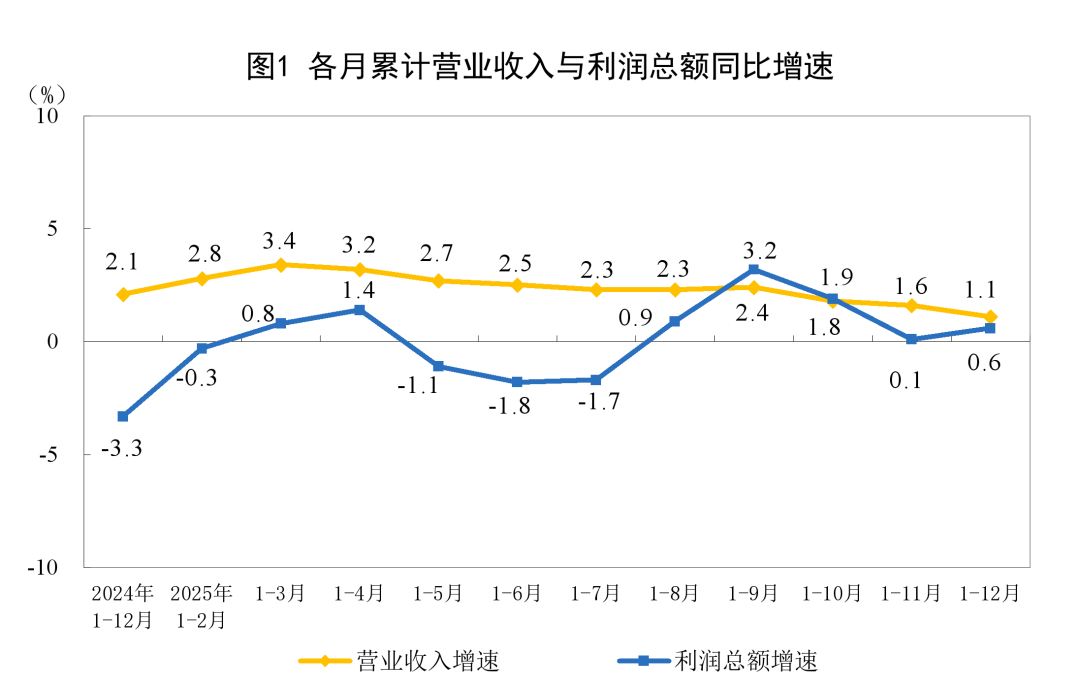
Core Insights - Overall, industrial enterprise profits are expected to show a "low first, high later, and fluctuating" trend in 2025, with a significant recovery in the medium to long term [2] - In 2026, industrial profits are anticipated to continue their recovery, transitioning from a phase of repair to moderate growth [2] Group 1: Profit Growth by Sector - Profit growth in 2025 is characterized by "two increases and one stable" among three major sectors: manufacturing is expected to grow by 5.0%, a significant rebound of 8.9 percentage points from 2024; the electricity, heat, gas, and water production and supply sector is projected to grow by 9.4%; while the mining sector is expected to decline by 26.2% [3] - Price improvements have offset the marginal decline in profit margins, allowing manufacturing profits to maintain positive growth [3] - The equipment manufacturing and high-tech manufacturing sectors are crucial for high-quality industrial development, with profits in the former expected to grow by 7.7% and in the latter by 13.3%, both exceeding the overall industrial profit growth of 12.7% [3] Group 2: Sector-Specific Profit Increases - The railway, shipbuilding, aerospace, and electronics industries are projected to see double-digit profit growth, with increases of 31.2% and 19.5% respectively; the smart electronics sector is expected to grow by 48.0% [4] - The semiconductor industry is experiencing rapid growth, with profits in integrated circuit manufacturing, semiconductor device manufacturing, electronic components, and sensors increasing by 172.6%, 128.0%, 49.1%, and 33.3% respectively [4] - In the healthcare sector, profits from genetic engineering drugs and vaccines, as well as biopharmaceuticals, are expected to rise by 72.7% and 37.1% respectively [4] Group 3: December Profit Recovery - In December 2025, profits for large-scale industrial enterprises rebounded by 5.3%, recovering from a 13.1% decline in November, indicating a "V-shaped rebound" [5] - This rebound is attributed to the combined effects of volume, price, and profit margin improvements, driven by effective growth policies and a recovery in both domestic and external demand [5] - December's industrial added value increased from 4.8% to 5.2% year-on-year, while the Producer Price Index (PPI) decline narrowed from 2.2% to 1.9%, contributing to improved revenue and profit margins [5] Group 4: Inventory and Receivables Management - By the end of December, industrial enterprise inventory growth slowed to 3.9%, and the average accounts receivable collection period decreased to 67.9 days, reflecting a proactive inventory reduction strategy amid weak demand [6] - Companies are adjusting production rhythms and focusing on order-based production to manage inventory effectively [6] Group 5: Future Outlook - Experts predict that as growth stabilization policies continue to take effect and overall demand gradually recovers, industrial enterprise profits are likely to maintain a recovery trend, supported by reduced cost pressures and optimized inventory structures [7]
21社论丨5%增速凸显中国经济向新向优
21世纪经济报道· 2026-01-20 00:24
Economic Growth - In 2025, China's GDP surpassed 140 trillion yuan, growing by 5% compared to the previous year, maintaining a leading growth rate among major global economies [1] - The contribution of final consumption expenditure to economic growth reached 52%, with retail sales of consumer goods exceeding 50 trillion yuan [1] Demand Side - Domestic demand is increasingly being released, with significant contributions from consumption driven by targeted policies [1] - The "trade-in" policy has effectively boosted retail sales of communication equipment and home appliances, achieving double-digit growth [1] - New consumption models catering to quality and personalized needs are gaining momentum, with rapid growth in sales from emerging formats like warehouse membership stores and collective stores [1] Investment Trends - Although overall investment has slowed, the structure of investment is optimizing, focusing on key areas such as infrastructure and modern industrial systems [2] - Investment in key infrastructure sectors like pipeline transportation, power generation, and water conservancy has seen double-digit growth [2] - The proportion of equipment and tool purchases in total investment has risen to 18%, enhancing supply structure and investment efficiency [2] Supply Side - The service sector has become a crucial pillar for economic growth, contributing 61.4% to economic growth and accounting for 57.7% of GDP [2] - Modern service industries, including information technology and finance, are thriving, while emerging service formats like live e-commerce are rapidly developing [2] Industrial Development - The construction of a modern industrial system is progressing, with high-tech manufacturing showing strong growth and leading industrial quality development [3] - The share of equipment manufacturing is increasing, with rapid growth in high-value industries such as aerospace and medical devices [3] - Traditional industries are also upgrading, with a steady increase in the supply of green low-carbon products [3] Challenges and Future Outlook - Despite existing challenges such as external environmental changes and structural issues, the long-term positive trend of the economy remains unchanged [4] - The government plans to implement proactive macro policies to expand domestic demand and optimize supply structure [4] - By 2026, a steady economic growth is expected, with moderate price level recovery and improved economic sentiment among businesses and residents [5]

从年度数据复盘2025年经济情况
GF SECURITIES· 2026-01-19 10:26
Economic Growth - In 2025, China's real GDP is projected to grow by 5.0% year-on-year, achieving the annual growth target and maintaining a growth rate above 5% for three consecutive years[3] - The global real GDP growth forecast for 2025 is 2.7%, with developed economies and developing countries (excluding China) expected to grow by 1.7% and 3.7%, respectively[3] - China's GDP size in 2025 is estimated at 140,187.9 billion yuan, with a per capita GDP of approximately 99,786 yuan, or about 13,970 USD[3] Income and Consumption - In 2025, the per capita disposable income is expected to increase by 5.0%, slightly lower than the growth rates of 6.3% and 5.3% in 2023 and 2024, respectively[5] - The median growth rate of disposable income is projected at 4.4%, marking the lowest point since 2021[6] - The share of spending on food, clothing, and housing is declining, while spending on daily necessities, transportation, education, and entertainment is increasing[5] Industrial Growth - Key industries with rapid growth include railways, shipbuilding, aerospace (14.0%), automobiles (11.5%), and electronics (10.6%), contributing significantly to overall industrial growth[8] - The nominal GDP growth rate for 2025 is expected to be 4.0%, lower than the previous years' rates of 4.9% in 2023 and 4.2% in 2024[8] Investment Trends - Fixed asset investment is projected to decline by 3.8% year-on-year, with a notable drop in real estate investment by 36.3%[19] - The industrial capacity utilization rate is expected to be 74.4% in 2025, slightly improving but still below the 75.0% level of 2024[10] Demographic Challenges - The natural population growth rate for 2025 is projected at -2.41‰, continuing a trend of negative growth over the past three years[12] - The proportion of the population aged 60 and above is expected to reach 23.0% in 2025, indicating ongoing aging and declining birth rates[13]
【广发宏观郭磊】从年度数据复盘2025年经济情况
郭磊宏观茶座· 2026-01-19 10:10
Core Viewpoint - The article presents an optimistic outlook for China's economy in 2025, projecting a real GDP growth of 5.0%, which aligns with the government's growth target and indicates a stable economic performance over three consecutive years with growth not falling below 5% [1][8]. Economic Growth and GDP - The projected real GDP for 2025 is approximately 140.2 trillion yuan, translating to a per capita GDP of about 13970 USD, nearing the World Bank's high-income threshold [10][11]. - The World Bank forecasts a global GDP growth of 2.7% for 2025, with developed economies and developing countries (excluding China) expected to grow at 1.7% and 3.7% respectively [1][8]. Disposable Income and Consumption - Resident per capita disposable income is expected to grow by 5.0% in 2025, slightly lower than the growth rates of 2023 and 2024, but still surpassing nominal GDP growth [2][14]. - The median growth rate of disposable income is projected at 4.4%, marking the lowest since 2021, influenced by a decline in net property income growth to 1.6% [2][14][15]. Sectoral Growth - Key sectors projected to experience significant growth in 2025 include: - Railways, shipping, and aerospace (14.0%) - Automotive (11.5%) - Computer and electronics (10.6%) - Black metal mining (9.7%) - Electrical machinery (9.2%) - General equipment (8.0%) - Chemical industry (7.8%) - Non-ferrous metals (6.8%) [2][17]. Nominal GDP and Economic Drivers - Nominal GDP growth is forecasted at 4.0% for 2025, lower than the previous years' growth rates of 4.9% in 2023 and 4.2% in 2024 [3][18]. - Economic drivers show an imbalance, with nominal growth in the secondary industry at only 1.9%, while exports are expected to grow by 5.5% and per capita consumption by 4.4% [3][20]. Industrial Capacity Utilization - Industrial capacity utilization is projected to improve gradually in the second half of 2025, with an annual average of 74.4%, still below the 75.0% level of 2024 [3][22][23]. Population Trends - The population growth rate is expected to remain negative, with a birth rate of 7.92 million in 2025, down from 9.54 million, and a natural growth rate of -2.41‰ [4][24][25]. - The proportion of the population aged 60 and above is projected to reach 23.0%, indicating ongoing trends of aging and declining birth rates [4][27]. Monthly Economic Indicators - In December, key economic indicators showed mixed results, with industrial value-added and service production indices accelerating, while retail sales and investment slowed down [4][29]. - December's industrial output growth was 5.2%, with notable increases in high-tech industries, while retail sales remained weak, particularly in categories like automobiles and home appliances [4][30][32]. Investment Trends - Fixed asset investment continued to show weakness in December, with a significant decline in real estate investment by 36.3% year-on-year [4][34][38]. - The government appears to be concentrating investment projects towards early 2026, reflecting a strategic shift in response to current economic conditions [4][40].

【权威解读】1—11月份规模以上工业企业利润保持增长
中汽协会数据· 2025-12-29 07:59
Core Viewpoint - The profit growth of industrial enterprises above designated size has continued since August, with new momentum industries like equipment manufacturing and high-tech manufacturing showing rapid growth, indicating a steady progress in industrial economic transformation and upgrading [1]. Group 1: Industrial Profit Growth - From January to November, the profit of industrial enterprises above designated size increased by 0.1% year-on-year, marking four consecutive months of growth since August. The manufacturing sector grew by 5.0%, while the electricity, heat, gas, and water production and supply sector grew by 8.4%. The mining sector saw a decline of 27.2%, but the decline was narrowed by 0.6 percentage points compared to January to October [1]. - The total operating income of industrial enterprises above designated size increased by 1.6% year-on-year [1]. Group 2: Equipment Manufacturing Sector - The profit of the equipment manufacturing sector increased by 7.7% year-on-year, contributing 2.8 percentage points to the overall profit growth of industrial enterprises above designated size. Among the eight major categories in the equipment manufacturing sector, seven achieved year-on-year profit growth, with the railway, shipbuilding, aerospace, and electronics industries experiencing double-digit growth rates of 27.8% and 15.0%, respectively. The automotive industry saw a profit increase of 7.5%, accelerating by 3.1 percentage points compared to January to October [2]. Group 3: High-Tech Manufacturing Sector - The profit growth rate of high-tech manufacturing increased to 10.0% year-on-year, accelerating by 2.0 percentage points compared to January to October, significantly higher than the average growth rate of all industrial enterprises. The "AI +" initiative has positively impacted related equipment manufacturing sectors, with profits in the electronic industrial specialized equipment manufacturing sector growing by 57.4%. Profits in semiconductor device manufacturing and electronic components manufacturing increased by 97.2% and 46.0%, respectively. The aerospace industry also saw rapid profit growth, with profits in aerospace and related equipment manufacturing increasing by 13.3%, including a 192.9% increase in aerospace-related equipment manufacturing [3]. Group 4: Raw Materials Manufacturing Sector - The profit of the raw materials manufacturing sector grew rapidly, with a year-on-year growth rate of 16.6%, contributing 2.0 percentage points to the overall profit growth of industrial enterprises. The steel industry has shown significant improvement in profitability this year, and the non-ferrous metals industry has maintained double-digit profit growth due to increased market demand and rapid revenue growth [4].

前11月中国规上工业企业利润同比增0.1%
Xin Lang Cai Jing· 2025-12-27 05:18
Group 1 - The profit of industrial enterprises above designated size in China increased by 0.1% year-on-year from January to November, maintaining growth for four consecutive months since August [1] - The equipment manufacturing and high-tech manufacturing sectors are leading the growth, indicating a steady progress in industrial economic transformation and upgrading [1] - The profit of the equipment manufacturing sector increased by 7.7% year-on-year, contributing 2.8 percentage points to the overall profit growth of industrial enterprises [1] Group 2 - The profit of high-tech manufacturing enterprises increased by 10.0% year-on-year, accelerating by 2.0 percentage points compared to the previous month, significantly higher than the average growth rate of all industrial enterprises [2] - The "Artificial Intelligence+" initiative has positively impacted related equipment manufacturing sectors, with profits in the electronic industrial specialized equipment manufacturing sector rising by 57.4% [2] - The profit of the raw materials manufacturing sector grew by 16.6% year-on-year, contributing 2.0 percentage points to the overall profit growth of industrial enterprises, driven by improved profitability in the steel industry and strong demand in the non-ferrous sector [2]
国家统计局:高技术制造业利润增速加快 原材料制造业利润较快增长
Xin Hua Cai Jing· 2025-12-27 02:34
Core Insights - The profit growth of industrial enterprises in China has shown a slight decline but continues to maintain an upward trend since August, with significant contributions from equipment manufacturing and high-tech manufacturing sectors [1][4]. Group 1: Industrial Profit Data - From January to November, the profit of large-scale industrial enterprises increased by 0.1% year-on-year, marking four consecutive months of growth since August [1]. - The manufacturing sector saw a profit increase of 5.0%, while the electricity, heat, gas, and water production and supply sector grew by 8.4%. In contrast, the mining sector experienced a decline of 27.2%, although this decline was 0.6 percentage points less than the previous month [1]. - The total operating revenue for large-scale industrial enterprises rose by 1.6% year-on-year during the same period [1]. Group 2: Equipment Manufacturing Sector - The profit of large-scale equipment manufacturing increased by 7.7% year-on-year, contributing 2.8 percentage points to the overall profit growth of large-scale industrial enterprises, making it the strongest driving sector [2]. - Among the eight major categories in the equipment manufacturing sector, seven reported year-on-year profit growth, with the railway, shipbuilding, aerospace, and electronics industries showing double-digit growth rates of 27.8% and 15.0%, respectively [2]. - The automotive industry also saw a profit increase of 7.5%, accelerating by 3.1 percentage points compared to the previous month [2]. Group 3: High-Tech Manufacturing Sector - The profit of large-scale high-tech manufacturing grew by 10.0% year-on-year, which is 9.9 percentage points higher than the average profit growth of all large-scale industrial enterprises [3]. - The "Artificial Intelligence+" initiative has positively impacted related equipment manufacturing, with profits in the electronic industrial specialized equipment sector increasing by 57.4%, and specific segments like semiconductor device manufacturing and electronic components seeing growth rates of 97.2% and 46.0%, respectively [3]. - The aerospace industry also experienced significant profit growth, with the aerospace and related equipment manufacturing sectors reporting increases of 13.3%, 192.9%, and 36.3% [3]. Group 4: Raw Materials Manufacturing Sector - The profit of large-scale raw materials manufacturing increased significantly by 16.6% year-on-year, contributing 2.0 percentage points to the overall profit growth of large-scale industrial enterprises [4]. - The steel industry has shown marked improvement in profitability this year, aided by low base factors, while the non-ferrous metals sector has maintained double-digit profit growth due to increased market demand and revenue growth [4].