
商贸零售

Search documents
主力资金|9股遭主力大幅出逃
Zheng Quan Shi Bao· 2026-01-20 10:18
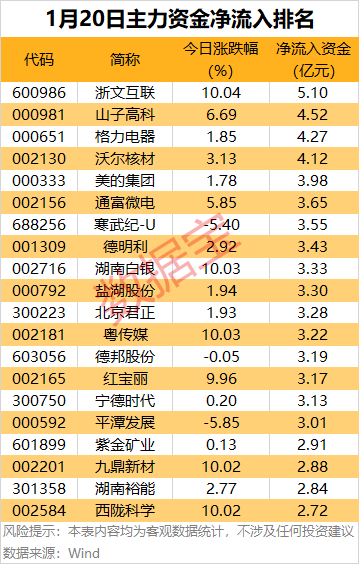
Group 1 - The A-share market showed mixed performance on January 20, with major indices diverging and most industry sectors experiencing declines, while precious metals, chemical raw materials, cement and building materials, and chemical fiber industries saw gains [1] - The net outflow of main funds from the Shanghai and Shenzhen markets reached 76.407 billion yuan, with six industries experiencing net inflows, including real estate, food and beverage, and retail, each exceeding 200 million yuan [1] - Among the 25 industries with net outflows, power equipment, electronics, and communications had the largest outflows, each exceeding 10 billion yuan [1] Group 2 - From individual stocks, 29 stocks saw net inflows exceeding 200 million yuan, with 16 stocks receiving over 300 million yuan in net inflows [2] - Zhejiang Wenlian led with a net inflow of 510 million yuan, attributed to its collaboration with ByteDance's Douyin in developing a digital marketing application [2] - Gree Electric Appliances announced a cash dividend distribution of 5.585 billion yuan to shareholders, with a payout of 10 yuan per 10 shares [3] Group 3 - The top five stocks with the highest net inflows included Zhejiang Wenlian, Shanzi High-Tech, Gree Electric Appliances, and Wolong Nuclear Materials, with inflows ranging from 412 million to 510 million yuan [4] - Conversely, nine stocks experienced net outflows exceeding 900 million yuan, with New Yisheng and Zhongji Xuchuang leading the outflows at 2.194 billion yuan and 2.122 billion yuan, respectively [5] - In the tail-end trading session, the market saw a net outflow of 6.161 billion yuan, with significant inflows in the non-ferrous metals and defense industries [6] Group 4 - Notable individual stocks with significant tail-end inflows included Xinwei Communication and Aerospace Development, each exceeding 300 million yuan [6] - The top five stocks with the highest tail-end net inflows were Xinwei Communication, Aerospace Development, and Wolong Nuclear Materials, with inflows ranging from 154 million to 395 million yuan [7] - Conversely, stocks like Shenghong Technology and TBEA experienced substantial tail-end net outflows, exceeding 300 million yuan [8]

商社美护行业周报:春节出行预定火热,潮宏基业绩预增-20260120
Guoyuan Securities· 2026-01-20 10:07
Investment Rating - The report maintains an "Overweight" rating for the industry, focusing on service consumption, beauty care, IP derivatives, and new consumption sectors such as gold and jewelry [6][27]. Core Insights - The report highlights a significant increase in consumer activity during the upcoming Spring Festival, with travel bookings and hotel reservations showing substantial year-on-year growth [4][25]. - Notable developments in the beauty care sector include the approval of a new medical device by Juzi Biotechnology and strategic partnerships between companies like Ruoyuchen and Meisidike [3][25]. - The retail sector is experiencing mixed results, with Chaohongji expected to report a net profit increase of 125% to 175% for 2025, while Chongqing Department Store anticipates a revenue decline [5][26]. Summary by Sections Market Performance - During the week of January 12-16, 2026, the performance of the commerce retail, social services, and beauty care sectors was -1.47%, +1.53%, and -0.21%, respectively, ranking them 23rd, 6th, and 14th among 31 primary industries [15][18]. Key Industry Events and News - The State Council, led by Premier Li Qiang, discussed measures to boost consumption and develop new growth points in service consumption [3][25]. - In the beauty care sector, Juzi Biotechnology's new product received regulatory approval, and several companies are pursuing strategic partnerships and IPOs [3][25]. - Travel bookings for the Spring Festival are significantly higher than last year, with a 70% increase in hotel reservations for popular cities [4][26]. - The retail sector is seeing varied performance, with Chaohongji projecting substantial profit growth while Chongqing Department Store reports a revenue decline [5][26]. Investment Recommendations - The report suggests focusing on companies such as Ruoyuchen, Maogeping, Shangmei, Pop Mart, Chaohongji, and Laopu Gold as potential investment opportunities within the highlighted sectors [6][27].

A股尾盘,多股逆势拉升封板,6股获巨额资金抢筹
Zheng Quan Shi Bao· 2026-01-20 09:39
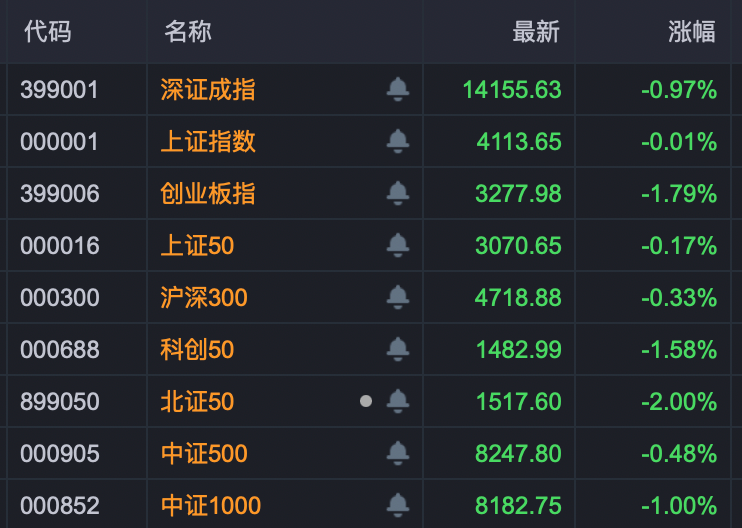
Market Overview - On January 20, the A-share market experienced fluctuations, with the Shanghai Composite Index barely holding above 4100 points and the ChiNext Index falling below 3300 points, while the Shenzhen Component, CSI 300, and CSI 500 all closed with small bearish candles. The market turnover reached 2.8 trillion yuan [1]. Index Performance - The Shenzhen Component Index closed at 14155.63, down 0.97% - The Shanghai Composite Index closed at 4113.65, down 0.01% - The ChiNext Index closed at 3277.98, down 1.79% - The CSI 300 Index closed at 4718.88, down 0.33% - The CSI 500 Index closed at 8247.80, down 0.48% [2]. Sector Performance - Chemical, precious metals, real estate, and aviation sectors showed the highest gains, while aerospace equipment, photovoltaic equipment, communication devices, and glass fiber sectors experienced the largest declines [2]. Fund Flow Analysis - The public utilities sector saw a net inflow of over 3.7 billion yuan, while the construction and decoration sector received over 3.6 billion yuan. Real estate, banking, basic chemicals, and building materials sectors each gained over 2 billion yuan in net inflows. Transportation and retail sectors also saw net inflows exceeding 1 billion yuan. Conversely, electronics, power equipment, communications, defense, and computer sectors experienced net outflows exceeding 10 billion yuan [3]. Notable Stocks - China XD Electric (601179) saw a net inflow of 1.561 billion yuan, with a price increase of 8.84% - Shanzhi High-Tech (000981) had a net inflow of 1.423 billion yuan, with a price increase of 6.69% - Zhejiang Wenhu (600986) had a net inflow of 1.318 billion yuan, with a price increase of 10.04% - China Power Construction (601669) had a net inflow of 1.305 billion yuan, with a price increase of 7.02% [4]. Market Outlook - According to Yingda Securities, the Shanghai Composite Index is expected to oscillate around the 4100-point mark, indicating a market cooling period. This does not suggest a deep correction but rather a healthy consolidation after rapid gains. Investors are advised to take profits on short-term high-flying stocks while looking for value opportunities in underperforming sectors with solid fundamentals [4]. Future Predictions - Zhongyin International predicts that by 2026, the core broad-based indices of the Chinese stock market may see an overall increase of over 40%, driven by nearly 20% profit growth and 20% valuation improvement. Key sectors expected to lead include technology manufacturing, biomedicine, national defense, and non-ferrous metals, while sectors like communications, internet, brokerage insurance, new consumption, and real estate may have potential for catch-up gains [5]. Commodity Trends - Precious metals stocks surged in the afternoon, with the sector index reversing from an early drop of over 3% to a gain of 3.5%, reaching a historical high. Notable stocks include Hunan Silver and Zhaojin Gold, which quickly hit the daily limit [5][6]. - International gold and silver prices continued to rise, with London spot gold surpassing $4700 per ounce, marking a historical high. The trend of central banks purchasing gold is expected to support gold prices amid ongoing geopolitical tensions [6]. Chemical Industry Insights - The chemical sector showed strong performance, with various sub-sectors like daily chemicals and petrochemicals experiencing significant gains. The recent global price surge in chemicals has been noted, with major companies like BASF and Dow increasing prices across multiple regions [7][9]. - Recent data indicates that chemical product prices have generally increased, with synthetic rubber seeing the highest rise of 11.7% [9].
如何从一二级市场联动寻找产业债交易信号?(行业篇)
Soochow Securities· 2026-01-20 09:28
Report Industry Investment Rating No information provided in the content. Core Viewpoints - The secondary - market trends of industrial bond sub - industries show a divergence in the correlation between primary and secondary markets. This divergence may be due to differences in supply among industries and differences in bond liquidity and trading popularity within each industry. If an industry has many issuing entities with strong willingness and ability to issue bonds and is in a good development trend, the probability of a synchronous resonance relationship between primary - market supply and secondary - market demand is relatively high, which can improve the accuracy of judging trading signals of narrowing spreads from daily net financing [1][14]. - Most industries have trading signals transmitted from primary - market supply to secondary - market demand, including comprehensive, non - ferrous metals, and others. Some industries show a stronger negative correlation between primary - market supply and secondary - market demand, such as comprehensive and non - ferrous metals. Some industries have a weak correlation between daily net financing and daily spreads, including communication and food and beverage [2][4]. Summary by Directory 1. Industrial Bond Sub - industries Show Divergence in Primary - Secondary Market Trend Correlation - **Research Method**: Classify industrial bond issuers by Shenwan primary industries, calculate the daily net financing and daily credit spreads of each sub - industry from January 1, 2025, to December 19, 2025, to observe the correlation between primary - market supply and secondary - market demand [12]. - **Divergence Performance**: Most industries have trading signals transmitted from primary - market supply to secondary - market demand, while some do not show this feature significantly [13]. - **Reasons for Divergence**: Differences in supply among industries are related to the number, size, and life - cycle stage of issuing entities. Differences in bond liquidity and trading popularity within industries are related to the scale of outstanding bonds, valuation levels, and event catalysts [14]. 1.1. Industries with Obvious Correlation - **Comprehensive Industry**: From January to March 2025, daily net financing decreased and daily spreads increased; from March to June, daily net financing increased and daily spreads decreased; from June to December, both were in a low - level oscillation [21]. - **Non - ferrous Metals Industry**: From January to July 2025, daily net financing increased and daily spreads decreased; from July to September, daily net financing decreased and daily spreads increased; from October to December, both were in a low - level oscillation [25]. - **Other Industries**: Similar analysis is conducted for industries such as pharmaceutical biology, social services, and others, with different trends in different time intervals [27][30][32]. - **Common Features**: These industries generally have a large scale of outstanding bonds and high institutional investor attention, which is conducive to the transmission of primary - market supply changes to secondary - market spread changes [3][87]. 1.2. Industries with General Correlation - **Industries Included**: Communication, food and beverage, and other industries have a weak correlation between daily net financing and daily spreads, and the linkage and transmission between primary - and secondary - market indicators are relatively weak [4][13]. - **Reasons**: These industries have low participation in the bond market, and their secondary - market trading demand is more affected by overall bond - market trends, industry risk premiums, and liquidity premiums. Different types of industries have specific reasons for the weak correlation [4][90][91].
A股尾盘,多股逆势拉升封板!6股获巨额资金抢筹!
Xin Lang Cai Jing· 2026-01-20 08:47
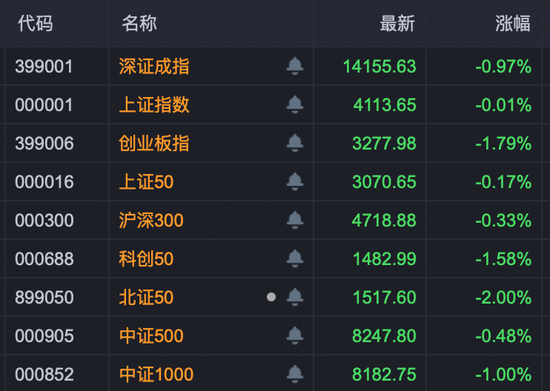
Market Overview - The A-share market experienced fluctuations with the Shanghai Composite Index barely holding above 4100 points, while the ChiNext Index fell below 3300 points. Major indices like the Shenzhen Component, CSI 300, and CSI 500 closed with small bearish candles, and the market turnover reached 2.8 trillion yuan [1][11]. Index Performance - The latest index performances are as follows: - Shenzhen Component: 14155.63 (-0.97%) - Shanghai Composite: 4113.65 (-0.01%) - ChiNext Index: 3277.98 (-1.79%) - CSI 300: 4718.88 (-0.33%) - CSI 500: 8247.80 (-0.48%) [2][12]. Sector Performance - The chemical, precious metals, real estate, and aviation sectors showed the highest gains, while aerospace equipment, photovoltaic equipment, communication devices, and glass fiber sectors faced the largest declines [2][12]. Fund Flow Analysis - The public utilities sector saw a net inflow of over 3.7 billion yuan, while the construction and decoration sector received over 3.6 billion yuan. Real estate, banking, basic chemicals, and building materials also attracted over 2 billion yuan each. In contrast, sectors like electronics, power equipment, and defense saw net outflows exceeding 10 billion yuan [3][13]. Notable Stocks - Key stocks with significant net inflows include: - China Xidian: 15.63 yuan (+8.84%) with a net inflow of 1.56 billion yuan - Shanzhi High-Tech: 5.42 yuan (+6.69%) with a net inflow of 1.42 billion yuan - Zhejiang Wenhu: 9.97 yuan (+10.04%) with a net inflow of 1.32 billion yuan [4][14]. Future Market Outlook - Yingda Securities suggests that the market is in a cooling phase, with the Shanghai Composite Index fluctuating around the 4100-point mark. This does not indicate a deep correction but rather a healthy consolidation after rapid gains. Investors are advised to take profits on overbought stocks while looking for value opportunities in underperforming sectors [5][15]. Long-term Projections - Zhongyin International forecasts that by 2026, the core broad-based index of the Chinese stock market could see an overall increase of over 40%, driven by nearly 20% profit growth and 20% valuation expansion. Key sectors expected to lead include technology manufacturing, biomedicine, and defense, while sectors like telecommunications and real estate may have potential for catch-up gains [5][15]. Precious Metals Market - The precious metals sector saw significant activity, with gold prices reaching a historical high of over 4700 USD per ounce. Domestic gold futures also surged, reflecting strong demand amid ongoing global economic uncertainties [6][16]. Chemical Industry Trends - The chemical sector is experiencing a global price surge, with major companies like BASF and Dow Chemical implementing price increases across various regions. Recent data indicates that 11 out of 16 monitored chemical products have seen price increases, with synthetic rubber rising by 11.7% [8][19]. Structural Investment Opportunities - Galaxy Securities highlights that new demand drivers are expected to accelerate a cyclical reversal in the chemical industry, suggesting a focus on structural investment opportunities as supply constraints emerge [20].
【盘中播报】沪指跌0.73% 国防军工行业跌幅最大
Zheng Quan Shi Bao Wang· 2026-01-20 03:37
Market Overview - The Shanghai Composite Index fell by 0.73% as of 10:27 AM, with a trading volume of 783.95 million shares and a transaction value of 1,378.36 billion yuan, an increase of 0.13% compared to the previous trading day [1] Industry Performance - Real estate, oil and petrochemicals, and beauty care sectors showed the highest gains, with increases of 0.86%, 0.72%, and 0.70% respectively [1] - The defense and military, comprehensive, and communication sectors experienced the largest declines, with decreases of 3.41%, 3.19%, and 3.06% respectively [1][2] Leading Stocks - In the real estate sector, Chengdu Investment Holdings led with a gain of 10.11% [1] - In the oil and petrochemical sector, Blue Flame Holdings increased by 2.86% [1] - In the beauty care sector, Yanjiang Co. rose by 9.34% [1] Detailed Industry Data - Real Estate: 0.86% increase, transaction value of 189.40 billion yuan, up 20.93% from the previous day [1] - Oil and Petrochemicals: 0.72% increase, transaction value of 80.28 billion yuan, up 26.01% from the previous day [1] - Beauty Care: 0.70% increase, transaction value of 35.84 billion yuan, up 11.01% from the previous day [1] - Defense and Military: 3.41% decrease, transaction value of 883.06 million yuan, up 45.81% from the previous day [2] - Communication: 3.06% decrease, transaction value of 754.04 million yuan, up 0.40% from the previous day [2]
资金风向标 | 两融余额较上一日减少83.62亿元 汽车行业获融资净买入额居首
Sou Hu Cai Jing· 2026-01-20 01:52
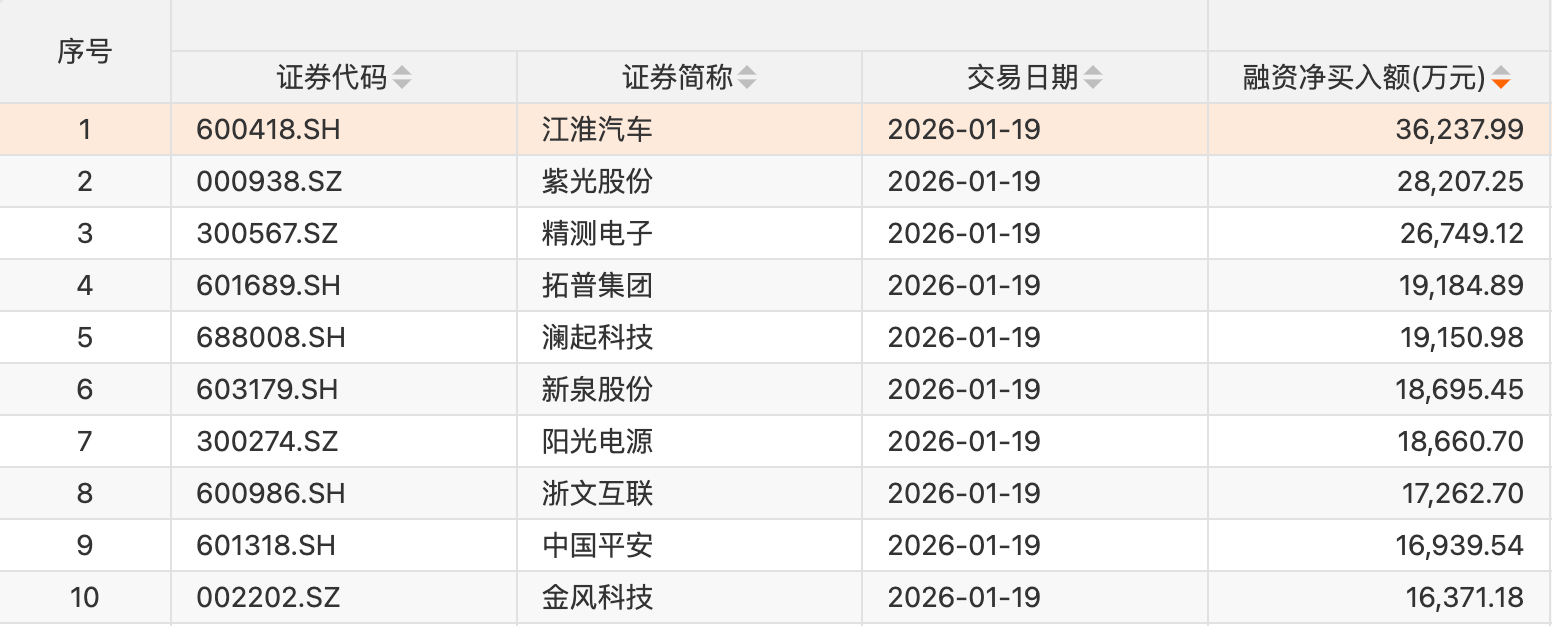
Group 1 - As of January 19, the margin trading balance of A-shares is 27,231.75 billion yuan, a decrease of 83.62 billion yuan from the previous trading day, accounting for 2.63% of the A-share circulating market value [1] - The margin trading turnover on the same day is 2,683.76 billion yuan, down by 681.14 billion yuan from the previous trading day, representing 9.82% of the A-share transaction volume [1] - Among the 31 primary industries, 10 industries received net financing inflows, with the automotive industry leading at a net inflow of 758 million yuan [1] Group 2 - A total of 33 stocks received net financing inflows exceeding 100 million yuan, with Jianghuai Automobile leading at a net inflow of 362 million yuan [1] - Other notable stocks with significant net financing inflows include Unisplendour, Jingce Electronics, Top Group, Lanke Technology, New Spring Shares, Sungrow Power Supply, Zhejiang Wenhu Interconnect, China Ping An, and Goldwind Technology [1] - According to a report from Industrial Securities, in 2026, the automotive sector is expected to undergo a value reassessment due to advancements in high-level assisted driving and breakthroughs in robotics technology [2] - The robotics sector is gradually entering a large-scale production phase, with investment opportunities shifting from divergence to convergence [2] - The report suggests focusing on two main lines: technological changes in autonomous driving and robotics, and the industrial chain opportunities arising from large-scale implementation [2]





33股获融资净买入额超1亿元 江淮汽车居首
Zheng Quan Shi Bao Wang· 2026-01-20 01:25
Industry Summary - On January 19, among the 31 primary industries tracked by Shenwan, 10 industries experienced net financing inflows, with the automotive industry leading at a net inflow of 758 million yuan [1] - Other industries with significant net financing inflows included banking, power equipment, non-bank financials, retail, and non-ferrous metals [1] Company Summary - A total of 1,619 stocks received net financing inflows on January 19, with 100 stocks having inflows exceeding 50 million yuan [1] - Notably, 33 stocks had net financing inflows exceeding 100 million yuan, with Jianghuai Automobile leading at a net inflow of 362 million yuan [1] - Other companies with significant net financing inflows included Unisoc, Jingce Electronics, Top Group, Lanke Technology, New Spring Shares, Sunshine Power, Zhejiang Wenhu Interconnection, and China Ping An [1]
1月第2周立体投资策略周:活跃资金流入,长线资金流出
Guoxin Securities· 2026-01-19 14:30
Group 1 - In the second week of January, the total net inflow of funds into the market was 7.2 billion, a significant decrease from the previous week's inflow of 71.5 billion [1][7] - The short-term sentiment indicator is at a high level since 2005, with the recent weekly turnover rate (annualized) at 682%, placing it in the 92nd percentile historically [1][13] - The long-term sentiment indicator is at a medium-low level since 2005, with the recent A-share risk premium at 2.45%, in the 46th percentile historically [2][13] Group 2 - The top three industries by transaction volume in the past week were defense and military industry (100%), semiconductors (97%), and electric power equipment (96%), while the lowest were real estate (0%), food processing (0%), and transportation (0%) [2][13] - The highest financing transaction ratio industries were electric power equipment (93%), machinery equipment (93%), and basic chemicals (92%), while the lowest were oil and petrochemicals (34%), coal (45%), and retail (46%) [2][13]
今年青海首发经济再提速
Xin Lang Cai Jing· 2026-01-17 17:41
Core Viewpoint - Qinghai Province is focusing on the "first store economy" as a key strategy to boost consumption and enhance the local commercial landscape, aiming to provide quality consumption benefits to residents and drive consumption upgrades across the province [1][2] Group 1: Policy Implementation - Since 2025, the Qinghai Provincial Department of Commerce has fully implemented the directives from the provincial investment promotion conference, establishing specialized teams and policy frameworks to promote the "first store economy" [1] - In 2026, Qinghai will expand its support for the first store economy by enhancing policy tools, including support for various retail brand first stores, new product launches, and the establishment of first store clusters [1] Group 2: Economic Integration - The initiative aims to integrate the "first store economy" with digital economy, rural revitalization, and cultural tourism industries, creating unique consumption scenarios and platforms [1] - Activities will be organized to introduce high-profile brand first stores and guide eligible first stores into the statistical system [1] Group 3: Incentive Actions - The implementation of incentive actions for first stores will focus on key areas such as Xining, Haidong, Haixi, and Yushu, leveraging commercial complexes and core business districts to encourage the opening of first stores [2] - Activities for launching new products and business models will be conducted to lay the foundation for creating first store clusters [2]