
房地产行业

Search documents
滨江集团(002244):2025年中报点评:上半年业绩大幅增长,融资成本持续下降
Dongguan Securities· 2025-08-27 05:50
Investment Rating - The report maintains an "Accumulate" rating for Binjiang Group (002244) [2] Core Insights - Binjiang Group reported significant growth in the first half of 2025, with operating revenue reaching 454.49 billion yuan, a year-on-year increase of 87.80%, and net profit attributable to shareholders of 18.53 billion yuan, up 58.87% [5][6] - The company has a robust land reserve, with 16 new projects added in the first half of 2025, totaling a construction area of 1,006,700 square meters and land payments of 33.272 billion yuan [5] - The company's debt structure has improved, with interest-bearing liabilities decreasing by nearly 4 billion yuan compared to the beginning of the year, and financing costs have continuously declined, reaching a new low of 3.1% by June 2025 [5][6] Summary by Sections Financial Performance - In the second quarter of 2025, Binjiang Group achieved operating revenue of 229.41 billion yuan, a year-on-year increase of 118.49%, and net profit attributable to shareholders of 8.77 billion yuan, up 73.19% [5] - The gross profit margin for the first half of 2025 was 12.24%, an increase of 2.67 percentage points compared to the same period last year [5] Land Reserve and Strategic Layout - As of the end of the first half of 2025, the total land reserve amounted to 9,936,300 square meters, with 73% located in Hangzhou and 17% in other second and third-tier cities in Zhejiang [5] - The company plans to implement a "1+5" development strategy, targeting sales of approximately 100 billion yuan and aiming for a ranking within the top 15 in the industry [5][6] Financial Projections - The forecast for earnings per share (EPS) for 2025 and 2026 is 0.98 yuan and 1.00 yuan, respectively, corresponding to price-to-earnings (PE) ratios of 11 times and 10.7 times based on the current stock price [6][7]

通胀将“腰斩”至接近1%?机构:楼市下跌或重塑物价动态
Jin Shi Shu Ju· 2025-08-21 07:16
Group 1 - The core viewpoint of Rosenberg Research is that the U.S. real estate market will significantly contribute to a decline in overall inflation, potentially bringing it close to 1%, well below the Federal Reserve's target of 2% [1] - The company's housing market activity index indicates a "substantial decline" in the U.S. real estate sector, with 10 out of 11 indicators showing significant downturns over the past six months [1][2] - The only indicator that did not decline was the S&P Case-Shiller 20-City Home Price Index, which increased by 0.8% over the past six months, but reduced transaction activity may pressure home prices downward [1] Group 2 - Housing-related expenditures account for approximately one-third of the Consumer Price Index (CPI) in the U.S., and the current downturn in the housing market is expected to have a lasting suppressive effect on inflation through 2026 [2] - The projected year-on-year CPI growth for the second quarter of 2026 is estimated to be between 1.2% and 1.8%, indicating a potential halving of the inflation rate compared to current levels [2] - Concerns about inflation slowing down or even deflation are emerging, with factors such as tightened immigration policies and an aging population potentially weakening consumer demand [2][3] Group 3 - Key indicators of the housing market's decline include a 23.9% decrease in housing starts, a 23.7% drop in new single-family home sales, a 16.1% decline in existing home sales, and a 14.2% reduction in the quarterly rent index for new tenants over the past two quarters [4] - The number of potential buyer visits has decreased by 7 percentage points, which is considered a critical data point in the index [4]
21社论丨破除消费堵点,释放内需潜能
21世纪经济报道· 2025-08-21 00:20
Core Viewpoint - The recent State Council meeting emphasizes strengthening domestic circulation by removing restrictive measures in the consumption sector, which is crucial for unleashing domestic demand and promoting high-quality economic development [1]. Group 1: Consumer Potential and Market Dynamics - Systematic removal of restrictive measures in the consumption sector will empower consumers with more autonomy, allowing them to make consumption decisions based on their needs and economic capabilities, thereby enhancing quality of life [1]. - The removal of restrictions will break down market barriers, attract more market participants, stimulate competition, and encourage companies to innovate, optimize products and services, reduce costs, and improve quality, leading to industry innovation and transformation [1]. Group 2: Specific Sector Policies - Optimizing automobile purchase restrictions is essential as the automotive industry is a pillar of the national economy, and normal consumption will benefit both automotive manufacturers and their supply chains, facilitating industry transformation [2]. - Adjusting real estate market policies to release improvement housing demand is critical; removing housing-related restrictions can enhance market circulation and invigorate related industries, thus boosting economic growth [2]. - Accelerating the development of service consumption and new consumption models, such as online education and shared economy, by lowering market entry barriers will better meet the public's needs for a better life and represent a significant growth potential [2]. Group 3: Implementation Principles - The process of removing consumption restrictions should follow scientific, orderly, and coordinated principles, avoiding a one-size-fits-all approach and ensuring a stable and transparent market environment [3]. - In the automotive sector, shifting from purchase management to usage management through improved transportation systems can alleviate traffic pressure and meet consumer demand [3]. - In real estate, comprehensive cancellation of purchase, sale, and price restrictions is necessary to establish a new mechanism for the interaction of housing, land, and finance, promoting reasonable circulation and moderate consumption [3]. Group 4: Service and New Consumption Areas - In the service consumption sector, breaking down hidden market entry barriers and promoting diverse high-quality services in health, elderly care, and tourism will meet the growing demands of residents and create job opportunities [4]. - For new consumption areas, creating a favorable environment for the development of digital economy and green consumption will accelerate the application of new technologies and business models, fostering new economic growth points [4]. Group 5: Market Regulation and System Construction - Strengthening market regulation and building a fair competitive environment is essential to protect consumer rights and ensure market order while promoting consumption [5]. - Different government departments should adopt a systematic approach to dismantle consumption restrictions and continuously release consumption potential, supporting steady progress in high-quality economic development [5].


破除消费堵点,释放内需潜能
2 1 Shi Ji Jing Ji Bao Dao· 2025-08-20 22:31
Group 1 - The State Council's ninth plenary session emphasizes strengthening domestic circulation by removing restrictive measures in the consumption sector to stimulate consumer potential and promote high-quality economic development [1][2] - Systematic removal of restrictions will empower consumers with more autonomy, enhance their quality of life, and stimulate demand [1][3] - Optimizing policies in the automotive sector is crucial as it is a pillar industry that supports various supply chain segments, leading to overall industry development and transformation [1][2] Group 2 - Adjusting real estate market policies is essential to release potential demand for improved housing, which is interconnected with multiple industries such as construction and furniture [2][3] - Accelerating the growth of service consumption and new consumption models, such as online education and shared economy, is necessary to meet the evolving needs of consumers [2][4] - The execution of removing consumption restrictions should follow a scientific and orderly approach, avoiding a one-size-fits-all strategy while optimizing the business environment [3][4] Group 3 - In the automotive sector, transitioning from purchase management to usage management can alleviate traffic pressure and meet consumer needs more effectively [3][4] - The real estate sector requires a comprehensive cancellation of purchase, sale, and price restrictions to promote healthy market development [3][4] - In the service consumption area, breaking down invisible market entry barriers and enhancing the supply of high-quality services can create job opportunities and drive economic growth [4]
大摩闭门会-金融, 房地产行业更新
2025-08-20 14:49
Summary of Conference Call Records Industry Overview - **Financial and Real Estate Industry Update**: The conference call primarily discusses the financial and real estate sectors, highlighting trends and performance metrics for Q2 2025 and beyond [1][2][4]. Key Points on Financial Sector - **Q2 Profit Recovery**: The financial sector saw a reversal in net profit decline from Q1, with fee and net interest income stabilizing. Asset quality remained stable, and the provision coverage ratio increased, indicating a recovery driven by fundamental improvements rather than the release of provisions [1][2]. - **Credit and Social Financing Data**: July credit and social financing data showed weakness due to seasonal factors, with a year-on-year slowdown attributed to previous excessive lending. The central bank supports reasonable pricing and lending to balance the financial system and economic relations [1][5]. - **Valuation Recovery**: The financial system's valuation rebound is supported by fundamentals, despite not being a rapid growth scenario. Low valuations and alleviated risk concerns contribute to this recovery [1][6]. - **Policy Support**: Measures such as the establishment of a 500 billion yuan development fund and urban renewal loans aim to stabilize demand and avoid excessive financial system burdens [1][6][7]. Key Points on Real Estate Sector - **Market Weakness**: The real estate market has been weakening since April, with July showing a significant year-on-year decline in new home sales volume (down 7.8%) and sales revenue (down 14.1%) [1][13][14]. - **Future Outlook**: The real estate market is expected to remain weak in Q3, with no significant improvement anticipated. The potential for new stimulus policies is low unless there is a sharp decline in housing prices [1][14][16]. - **Impact on GDP**: The contribution of real estate to GDP has decreased from over 30% to approximately 16-17%. Despite the downturn in real estate sales, overall GDP remains resilient [1][17]. Key Points on Electric Truck Industry - **Market Penetration**: The penetration rate of electric trucks has exceeded expectations, with heavy-duty trucks reaching 25% and light-duty trucks projected to reach 25% next year [1][19]. - **Economic Factors**: The economic viability of electric trucks depends on battery cycle costs rather than per kilowatt-hour costs. Leading companies like CATL maintain competitive advantages through low cycle costs and reliability [1][20][21]. - **Challenges and Opportunities**: CATL faces market share challenges in the electric truck sector but benefits from overall sales growth. The company’s profitability remains strong despite lower margins compared to passenger vehicles [1][23][24]. Additional Insights - **Insurance Sector Trends**: The insurance industry has shown significant growth in new business value and profit, particularly in Q2, with a positive outlook despite potential short-term fluctuations [8][9][10]. - **Investment Trends**: Insurance capital is expected to continue being a significant market player, with increased allocations to equities and long-term investments [11]. - **CATL's Market Position**: CATL maintains a dominant market share in the electric bus sector, attributed to its product reliability and economic efficiency [1][21][22]. - **Lithium Market Dynamics**: Rising lithium prices are beneficial for the industry, with CATL expected to gain from discounted contracts and inventory appreciation [1][31]. This summary encapsulates the essential insights from the conference call, focusing on the financial and real estate sectors, electric truck industry developments, and broader market trends.

详解7月经济数据:工业增速维持高位,服务消费增势良好
Di Yi Cai Jing· 2025-08-15 07:16
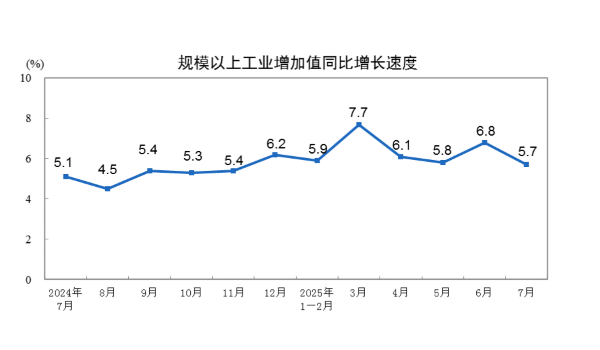
Economic Overview - China's economy showed stable operation in July, but some economic indicators experienced a decline due to external complexities and extreme weather conditions [2][4] - The industrial added value for July increased by 5.7% year-on-year, a slowdown of 1.1 percentage points compared to June [2][4] - Retail sales of consumer goods grew by 3.7% year-on-year in July, also down by 1.1 percentage points from June [2][8] Industrial Production - Industrial production growth slightly slowed in July, with the mining sector increasing by 5.0%, manufacturing by 6.2%, and electricity, heat, gas, and water production and supply by 3.3% [4][6] - The "Two New" initiatives and equipment upgrades contributed positively to industrial production, with shipbuilding and motor manufacturing seeing increases of 29.7% and 15.9%, respectively [4][6] - Despite the overall stability in industrial production, external pressures and internal competition may lead to a potential decline in growth rates [5][6] Investment Trends - From January to July, fixed asset investment (excluding rural households) reached 288.229 billion yuan, growing by 1.6% year-on-year, with infrastructure investment up by 3.2% and manufacturing investment by 6.2% [11][12] - Real estate development investment saw a significant decline of 12.0% [11] - Investment in high-tech sectors such as aerospace and computer manufacturing showed robust growth, with increases of 33.9% and 16%, respectively [12] Consumer Market - The service sector maintained stable growth, with service retail sales increasing by 5.2% from January to July, while the overall consumer market showed signs of slowing down [8][9] - Policies promoting the replacement of old consumer goods positively impacted sales, particularly in home appliances and communication devices [8][9] - The tourism and leisure sectors experienced significant growth, driven by increased consumer demand during the summer [8][9]
建筑央国企矿产资源重估价值有多大?
GOLDEN SUN SECURITIES· 2025-08-15 00:12
Group 1: Core Insights - The report emphasizes the significant profit contribution of state-owned enterprises in the construction and mineral resources sector, indicating a potential for value reassessment [5] - Key recommendations include companies with high resource contribution and untapped performance potential, such as China Metallurgical Group A (PB 0.64X) and China Metallurgical Group H (PB 0.41X) [5] - Other highlighted companies include China Railway Group A (PB 0.46X) and China Railway Group H (PB 0.30X, 25E dividend yield 4.9%), which have abundant copper and molybdenum resources [5] Group 2: Industry Performance - The report notes that the construction and mineral resources sector is poised for a reassessment of value, driven by the performance potential of untapped resources [5] - The analysis suggests that companies involved in gold business, like Shanghai Construction Group (PB 0.69X), may benefit from rising gold prices [5] - The report indicates that the overall performance of the construction and mineral resources sector is critical for the broader economic landscape, highlighting its importance in the investment strategy [5]
宏观 五个关键判断 - 张瑜旬度交流思考
2025-08-11 01:21
Summary of Key Points from Conference Call Industry or Company Involved - The discussion primarily revolves around the macroeconomic environment in China, focusing on economic cycles, monetary policy, and supply-side reforms. Core Insights and Arguments 1. **Economic Cycle Recovery**: The disparity between corporate and household deposit growth is a leading indicator of economic cycles, which has shown signs of recovery over the past 6-9 months, indicating that the worst economic period may be behind [1][2][16]. 2. **Policy Direction**: The Politburo meeting emphasized the release of existing policy effects rather than introducing new stimulus measures, suggesting a shift away from extraordinary policy reliance [1][4]. 3. **Monetary Policy Shift**: The period of the most accommodative monetary policy is over, with a focus on structural functions rather than broad easing. The large scale of precautionary savings among residents poses challenges for the central bank [1][5][17]. 4. **Impact of Household Savings**: The shift of household deposits towards financial investments has improved market liquidity, but it also presents challenges for the central bank in balancing tightening and easing measures [1][6][7]. 5. **Stock vs. Bond Market Dynamics**: Policies have significantly impacted the stock market, enhancing its attractiveness compared to bonds. Despite economic indicators not showing significant recovery, the stock market has seen an increase in its floating ratio due to policy interventions [1][8][12]. 6. **Supply-Side Reforms**: Current supply-side reforms focus on improving energy efficiency in high-energy-consuming industries and enhancing market competition through legal and market-oriented measures [3][9][10]. 7. **Anti-Competition Policies**: The anti-involution policies are aimed at optimizing market competition and addressing issues like improper scale competition and local protectionism, with a focus on legal frameworks rather than administrative measures [11][22]. 8. **Future Economic Indicators**: The next few months are critical for observing leading economic indicators, which could trigger an earlier shift from bonds to stocks if they show sustained improvement [12][19]. 9. **Consumer Policy Outlook**: Consumer policies in the second half of the year are expected to remain stable, focusing on measures to stabilize retail sales, including subsidies and financial incentives [20][21]. Other Important but Potentially Overlooked Content 1. **Investment Trends**: A decline in manufacturing investment is anticipated, which historically has led to positive outcomes for PPI, suggesting that a reduction in investment could be beneficial for the economy in the long run [19]. 2. **Household and Corporate Deposit Dynamics**: The current state of household and corporate deposit growth is crucial for understanding future economic pressures and consumer behavior, with a noted historical low in the deposit gap [16]. 3. **Long-Term Economic Adjustments**: The adjustments in monetary policy and economic strategies are expected to lead to upward revisions in economic cycles and price assessments, which could negatively impact bonds while improving equity attractiveness [14][18].
英国经济向好的一些隐藏迹象
Di Yi Cai Jing· 2025-08-10 11:18
Core Insights - The ongoing moderate decline in London housing prices is viewed positively, as it may alleviate various burdens in the UK, including labor market and social mobility barriers [1][2] - The article highlights a shift in the housing market, with current house prices at six times the average annual income, down from eight times a decade ago, indicating a significant change [1][2] Group 1: Housing Market Trends - Several factors contributing to the decline in housing prices include the introduction of the buy-to-let tax in 2015, the Brexit referendum, and the rise of remote work during the COVID-19 pandemic [2] - Unlike previous housing market crashes, the current decline in London housing prices has not led to systemic financial shocks or negative impacts on other regions, with some areas potentially benefiting from changing housing demand patterns [2][3] Group 2: Regional Economic Performance - The Greater Manchester area has shown impressive economic growth and productivity, with its absolute productivity level now only 35% lower than London, down from nearly 50% [2][3] - Other regions, such as Rotherham in South Yorkshire, have also experienced significant productivity increases, indicating a potential for broader national growth if these trends can be replicated [3] Group 3: Policy and Structural Challenges - The article discusses persistent economic absurdities, such as the "triple lock" pension system, which requires pension increases to match inflation, wage growth, or 2.5%, highlighting the need for reform [3][4] - The necessity for decisive action from elected policymakers and civil servants is emphasized, suggesting that seemingly insurmountable economic challenges may be more manageable than perceived [3][4]
持续防范化解重点领域风险
Xin Hua She· 2025-08-06 00:47
Group 1: Urban Renewal - The central government emphasizes high-quality urban renewal as a key strategy for optimizing urban structure and enhancing quality of life [3] - Urbanization in China is transitioning from rapid growth to stable development, with urbanization rate projected to rise from 53.1% in 2012 to 67% by 2024, increasing urban population from 720 million to 940 million [2] - Urban renewal is seen as a turning point for city development, focusing on improving existing urban areas rather than expanding them [3] Group 2: Local Government Debt Management - As of June 2023, local governments have issued a total of 3.8 trillion yuan in new replacement bonds, reducing average interest costs by over 2.5 percentage points [4] - The central government has implemented a series of measures to manage local government debt, effectively mitigating risks associated with hidden debts [4] - The central political bureau meeting calls for proactive and prudent measures to resolve local government debt risks and prohibits the creation of new hidden debts [4][5] Group 3: Capital Market Stability - The central political bureau meeting highlights the need to enhance the attractiveness and inclusivity of the domestic capital market, amidst a complex external environment [6] - The meeting emphasizes the importance of stabilizing the capital market, which has shown resilience and improved expectations this year [6][7] - Future reforms, including the new "National Nine Articles," aim to enhance market stability and improve the attractiveness of listed companies, contributing to a healthier market ecosystem [7]