批发和零售业

Search documents
前三季度全省经济运行总体平稳
Liao Ning Ri Bao· 2025-10-24 01:19
Economic Overview - The province's GDP for the first three quarters reached 24,283.9 billion yuan, with a year-on-year growth of 4.3% at constant prices [1] - The primary industry added value was 1,611.5 billion yuan, growing by 4.3%; the secondary industry added value was 8,367.7 billion yuan, growing by 2.1%; and the tertiary industry added value was 14,304.7 billion yuan, growing by 5.4% [1] Industry Performance - The industrial added value for large-scale enterprises increased by 2.2% year-on-year, with high-tech manufacturing growing by 6.1% [1][2] - Among 40 major industrial categories, 24 saw a year-on-year increase in added value, resulting in a growth rate of 60.0% [2] - Notable product growth included transformers, civilian steel ships, synthetic ammonia, and new energy vehicles, all showing double-digit growth [2] Service Sector - The service sector's added value grew by 5.4% year-on-year, with wholesale and retail, and accommodation and catering sectors increasing by 6.0% and 5.4%, respectively [2] - The transportation and postal sectors also showed growth, with cargo turnover increasing by 4.3% and postal business volume growing by 20.9% [2] Consumer Trends - Social retail sales totaled 7,866.0 billion yuan, with a year-on-year growth of 4.1% [3] - Urban retail sales reached 6,835.5 billion yuan, growing by 4.2%, while rural retail sales were 1,030.4 billion yuan, growing by 3.3% [3] - Significant growth in retail sales was observed in home appliances (51.0%), furniture (49.2%), and communication equipment (33.2%) [3] Investment Insights - First industry investment grew by 12.1%, while second industry investment increased by 1.6%, with manufacturing investment rising by 12.0% and high-tech manufacturing investment by 11.7% [3] Fiscal Performance - General public budget revenue reached 2,309.1 billion yuan, growing by 0.7%, while expenditure increased by 3.0% to 4,960.3 billion yuan [4] - Per capita disposable income for residents was 31,441 yuan, with urban residents at 37,493 yuan (4.5% growth) and rural residents at 18,691 yuan (5.1% growth) [4] Price Trends - Consumer prices remained stable, while industrial producer prices declined [5]
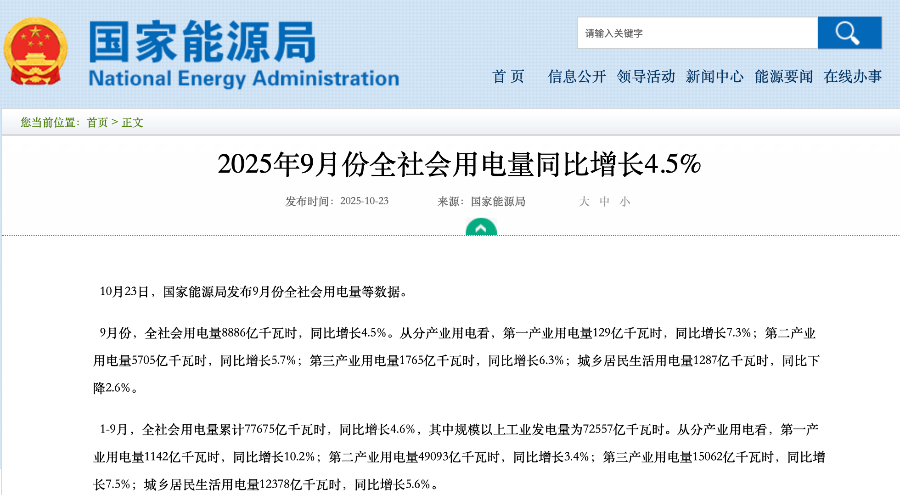
9月社会用电量同比增长4.5%
Shang Hai Zheng Quan Bao· 2025-10-23 09:07
Core Insights - In September, China's total electricity consumption reached 888.6 billion kWh, a year-on-year increase of 4.5% [1] - From January to September, total electricity consumption accumulated to 7,767.5 billion kWh, with a year-on-year growth of 4.6% [1] - The third quarter saw significant growth in electricity consumption, with a total of 2.9 trillion kWh, marking a new phase in energy consumption scale for China's economic development [1] Group 1: Electricity Consumption by Sector - In September, the first industry consumed 12.9 billion kWh, up 7.3% year-on-year; the second industry consumed 5,705 billion kWh, up 5.7%; the third industry consumed 1,765 billion kWh, up 6.3%; while urban and rural residential electricity consumption fell by 2.6% to 128.7 billion kWh [1] - The second industry's electricity consumption for the first three quarters was 4.91 trillion kWh, a year-on-year increase of 3.4%, with a notable recovery in the third quarter, growing by 5.1% [2] - The manufacturing sector's electricity consumption in the third quarter increased by 5.2%, with 17 provinces reporting growth rates exceeding 5% [2] Group 2: Growth Drivers - The growth in the second industry's electricity consumption was driven by a series of government policies aimed at stabilizing growth, particularly in sectors like electronics, automotive, and steel [2] - High-tech and equipment manufacturing sectors saw a significant increase in electricity consumption, with a 9.5% year-on-year growth in the third quarter, surpassing the average growth rate of the manufacturing sector [3] - The third industry's electricity consumption grew by 8.3% in the third quarter, supported by rapid development in new energy vehicles and infrastructure [4] Group 3: Residential Electricity Consumption - The average temperature in the third quarter was historically high, leading to a record residential electricity consumption exceeding 500 billion kWh [5] - Residential electricity consumption for the first three quarters increased by 5.6%, with a 6.4% increase in the third quarter [5] - Several provinces, including Tibet and Ningxia, reported residential electricity consumption growth exceeding 10% due to higher average temperatures [5]
前9月全社会用电量达7.77万亿千瓦时,经济动能持续增强
2 1 Shi Ji Jing Ji Bao Dao· 2025-10-23 09:01
Core Insights - In September, China's total electricity consumption reached 888.6 billion kWh, marking a year-on-year increase of 4.5% [1][3] - From January to September, total electricity consumption accumulated to 7,767.5 billion kWh, with a year-on-year growth of 4.6% [1][3] - The third quarter saw a total electricity consumption of 2.9 trillion kWh, with significant monthly increases, indicating a new phase in energy consumption scale [1][3] Electricity Consumption by Sector - In September, electricity consumption by sector showed varied growth: primary industry at 12.9 billion kWh (7.3% increase), secondary industry at 5,705 billion kWh (5.7% increase), and tertiary industry at 1,765 billion kWh (6.3% increase) [3][4] - Urban and rural residential electricity consumption decreased by 2.6% to 128.7 billion kWh [3][4] - The secondary industry contributed significantly to the overall growth, with a 5.1% increase in the third quarter, accounting for 51% of total electricity consumption growth [4] Policy Impact and Industrial Recovery - Government policies have positively influenced the recovery of the secondary industry, with a notable increase in electricity consumption due to various industry stabilization plans [4] - High-energy-consuming industries saw a 3.2% increase in electricity consumption in the third quarter, driven by traditional peak seasons and recovery in production [4] - High-tech and equipment manufacturing sectors experienced a 9.5% increase in electricity consumption, surpassing the average growth rate of the manufacturing sector [4] Tertiary Industry Performance - The tertiary industry maintained robust growth, with a 7.5% year-on-year increase in electricity consumption for the first three quarters and an 8.3% increase in the third quarter [5] - New infrastructure developments, such as electric vehicles and 5G, significantly boosted electricity consumption in information transmission and retail sectors, with growth rates of 18.3% and 11.7% respectively [5] - The internet and related services saw a remarkable 33.8% increase in electricity consumption, while electric vehicle charging services surged by 49.6% [5] Regional Electricity Consumption Trends - Electricity consumption growth varied significantly across regions, with provinces like Hainan (18.6%), Tibet (15.4%), and Jilin (14.9%) showing the highest increases in September [6] - In the third quarter, Tibet (14.7%), Jilin (11.9%), and Hebei (11.7%) led in electricity consumption growth [6] - High temperatures during the summer contributed to record levels of residential electricity consumption, exceeding 500 billion kWh in the third quarter [6] Residential and Manufacturing Sector Insights - Urban and rural residential electricity consumption grew by 5.6% in the first three quarters, with a 6.4% increase in the third quarter [7] - Several provinces, including Tibet and Jilin, reported manufacturing electricity consumption growth exceeding 5%, with Tibet achieving a remarkable 25.8% increase [7]

“反内卷”“稳增长”组合拳发力,三季度第二产业用电量高增
Bei Ke Cai Jing· 2025-10-23 06:05
Core Insights - In September, the total electricity consumption reached 888.6 billion kWh, marking a year-on-year increase of 4.5% [2] - The secondary industry's electricity consumption was 570.5 billion kWh, with a year-on-year growth of 5.7%, indicating a significant rebound [2] - The third industry's electricity consumption in September was 176.5 billion kWh, showing a year-on-year increase of 6.3% [3] Group 1: Electricity Consumption Trends - The total electricity consumption for the third quarter increased by 5.1% year-on-year, with the secondary industry contributing 51.0% to this growth [2] - Industrial electricity consumption grew by 5.4% year-on-year in the third quarter, an increase of 2.3 percentage points from the second quarter [2] - Manufacturing electricity consumption rose by 5.2% year-on-year in the third quarter, up by 3.2 percentage points from the previous quarter [2] Group 2: Sector-Specific Growth - The rapid development of new energy vehicles and charging infrastructure has significantly boosted electricity consumption in the information transmission/software and IT services sectors, which grew by 18.3% and 11.7% respectively in the third quarter [3] - The internet and related services sector saw a remarkable year-on-year growth of 33.8% in electricity consumption during the third quarter [3] - The electric vehicle charging services sector experienced a staggering year-on-year increase of 49.6% in electricity consumption [3]
湖北前三季度GDP增长6% 保持大省领先中部领跑态势
Chang Jiang Ri Bao· 2025-10-22 07:06
Economic Overview - Hubei Province achieved a GDP of 44,875.62 billion yuan in the first three quarters, with a year-on-year growth of 6.0% at constant prices [1] - The GDP growth rate accelerated by 0.2 and 0.3 percentage points compared to the previous year and the same period last year, respectively, and is 0.8 percentage points higher than the national average [1] Industry Performance - The primary industry added value was 3,855.36 billion yuan, growing by 3.2%, while the secondary industry increased by 5.9% to 17,072.96 billion yuan, and the tertiary industry grew by 6.5% to 23,947.30 billion yuan [1] - Industrial output for large-scale enterprises increased by 7.7%, with high-tech manufacturing leading the growth at 13.5%, contributing 26.7% to the overall industrial growth [2] - Key products such as lithium batteries, new energy vehicles, and smartphones saw production increases of 42.8%, 24.0%, and 20.0%, respectively [2] Service Sector - The service sector's added value grew by 6.5%, with significant contributions from transportation, warehousing, and postal services (10.1%), wholesale and retail (5.7%), accommodation and catering (4.1%), and finance (5.1%) [2] Investment and Consumption - Fixed asset investment rose by 6.5%, with manufacturing investment showing a notable increase of 12.5% [2] - The total retail sales of consumer goods reached 19,533.95 billion yuan, growing by 5.2%, with rapid sales growth in home appliances and furniture related to the old-for-new policy [2] - The total import and export volume was 6,176.9 billion yuan, marking a growth of 25.3%, with exports increasing by 30.8% [2] Employment and Income - The employment situation remained stable, with 816,100 new urban jobs created [2] - The per capita disposable income for residents was 28,036 yuan, reflecting a year-on-year growth of 5.3%, while the income gap between urban and rural residents continued to narrow [2] Future Outlook - The overall economic performance in the first three quarters indicates steady progress, with a focus on maintaining stability while pursuing growth [3] - The province aims to continue promoting stable growth, risk prevention, and livelihood protection to achieve sustainable and healthy economic development [3]
前三季度,北京市场总消费额同比增长0.5%
Xin Jing Bao· 2025-10-22 02:59
Core Insights - Beijing's total market consumption increased by 0.5% year-on-year in the first three quarters [1] - Retail sales of gold, silver, and jewelry surged by 33.5% within the wholesale and retail sector [1] Economic Performance - The service consumption sector showed robust performance, with a growth of 4.8% driven by information, transportation, and cultural entertainment [1] - Total retail sales of consumer goods reached 980.31 billion yuan, reflecting a decline of 5.1% [1] Sector Analysis - Within the total retail sales, commodity retail accounted for 879.31 billion yuan, down by 5.3%, while catering revenue was 101 billion yuan, decreasing by 3.7% [1] - Sales of upgraded goods remained strong, with basic living and fashion goods performing well; retail sales for grain and oil food, daily necessities, gold and silver jewelry, and cosmetics grew by 8.2%, 3.7%, 33.5%, and 8.1% respectively [1] - Conversely, retail sales for automobiles and communication equipment fell by 18.3% and 24.2% respectively [1]
经济运行保持平稳
Jing Ji Ri Bao· 2025-10-21 04:20
Core Viewpoint - The national economy of China has shown overall stability in the first three quarters, with a solid advancement in high-quality development under the strong leadership of the central government [1] Economic Performance - In the first three quarters, China's GDP reached 10,150.36 billion yuan, with a year-on-year growth of 5.2% [2] - The primary industry added value was 580.61 billion yuan, growing by 3.8%, contributing 4.7% to economic growth [2] - The secondary industry added value was 3,640.20 billion yuan, with a growth of 4.9%, contributing 34.6% to economic growth [2] - The tertiary industry added value was 5,929.55 billion yuan, growing by 5.4%, contributing 60.7% to economic growth [2] - In the third quarter, GDP was 354.50 billion yuan, with a year-on-year growth of 4.8% [3] Production and Supply - All sectors showed stable growth, with agriculture increasing by 4.0%, contributing 0.3 percentage points to economic growth [3] - Industrial production grew by 6.1%, contributing 1.8 percentage points to economic growth [3] - The service sector showed steady improvement, with significant contributions from information transmission, software, and IT services, which grew by 11.2% [3] Domestic Demand and Trade - Final consumption expenditure contributed 53.5% to economic growth, adding 2.8 percentage points to GDP [4] - Capital formation contributed 17.5% to economic growth, adding 0.9 percentage points to GDP [5] - Net exports contributed 29.0% to economic growth, adding 1.5 percentage points to GDP [5] Market Dynamics and New Growth Drivers - The digital economy has shown significant support, with revenue from the information transmission, software, and IT services sector growing by 12.1% from January to August [6] - The manufacturing sector is undergoing rapid transformation, with equipment manufacturing and high-tech manufacturing growing by 9.7% and 9.6% respectively [6] - Investment in high-tech services grew by 6.1%, surpassing the overall fixed asset investment growth rate [6]
2025年三季度国内生产总值初步核算结果
Guo Jia Tong Ji Ju· 2025-10-21 01:30
Core Points - The preliminary GDP results for the third quarter of 2025 indicate a GDP of 354,500 billion with a year-on-year growth of 4.8% and a growth of 5.2% for the first three quarters [8][5][4] - The primary industry grew by 4.0%, the secondary industry by 4.2%, and the tertiary industry by 5.4% in the third quarter [8][5] - The manufacturing sector showed a robust growth of 6.3%, while the construction industry faced a decline of 2.3% [8][5] GDP Growth Rates - Year-on-year growth rates for GDP from 2020 to 2025 show fluctuations, with 2025 projected to have a growth of 5.4% in Q1, 5.2% in Q2, and 4.8% in Q3 [5][4] - The quarterly growth rates indicate a consistent recovery post-pandemic, with 2023 showing a growth of 4.7% in Q1 and 6.5% in Q2 [5][4] Industry Performance - The agricultural sector (including forestry, animal husbandry, and fishery) reported a growth of 4.1% in Q3 2025 [8] - The industrial sector, particularly manufacturing, continues to be a strong contributor to GDP, with a growth rate of 6.3% [8] - The financial sector also showed positive growth at 5.2%, while the real estate sector faced challenges with a slight decline of 0.2% [8] Data Sources and Methodology - The GDP data is calculated using the production method, which reflects the value added by various industries [12][11] - The classification of industries follows the national standards set by the National Bureau of Statistics, ensuring consistency in reporting [22][23] - The GDP figures are subject to revisions as more comprehensive data becomes available, ensuring accuracy in reflecting economic conditions [33][34]
国民经济稳中有进显韧性——国家统计局相关部门负责人解读前三季度主要经济数据
Jing Ji Ri Bao· 2025-10-21 00:52
Economic Overview - The national economy is operating smoothly with high-quality development being steadily advanced under the strong leadership of the central government [1] - In the first three quarters, China's GDP reached 10,150.36 billion yuan, growing by 5.2% year-on-year [2] - The GDP for the third quarter was 3,545 billion yuan, with a year-on-year growth of 4.8% [3] Production and Supply - All sectors showed stable growth, with agriculture, industry, and services contributing positively to economic growth [4] - Agricultural production increased by 4.0%, contributing 0.3 percentage points to economic growth [4] - Industrial production grew by 6.1%, contributing 1.8 percentage points to economic growth [4] - The service sector's value added increased by 5.4%, contributing 3.1 percentage points to GDP growth [23] Domestic Demand and Trade - Final consumption expenditure contributed 53.5% to economic growth, adding 2.8 percentage points to GDP [5] - Capital formation contributed 17.5% to economic growth, adding 0.9 percentage points to GDP [6] - Net exports contributed 29.0% to economic growth, adding 1.5 percentage points to GDP [6] Market Dynamics and New Growth Drivers - The digital economy showed significant support, with revenue from information transmission and software services growing by 12.1% [7] - The manufacturing sector is undergoing transformation, with high-tech manufacturing increasing by 9.6% [7] - Investment in high-tech services grew by 6.1%, indicating a shift towards new growth drivers [30] Agricultural Sector - The agricultural economy is showing a stable and positive trend, with autumn grain production expected to be stable [8] - Livestock production is also stable, with pork production increasing by 3.0% [10] Industrial Development - Industrial production increased by 6.2% in the first three quarters, with 37 out of 41 major industrial sectors showing growth [14] - The export value of industrial products grew by 3.3%, indicating resilience in the industrial sector [14] Energy Sector - Energy production is steadily increasing, with coal production at 3.57 billion tons, up 2.0% year-on-year [18] - The share of non-fossil energy consumption is steadily rising, with a 1.7 percentage point increase compared to the previous year [21] Service Sector Growth - The service sector's value added reached 592,955 million yuan, growing by 5.4% [23] - The modern service industry is thriving, with significant growth in information technology and business services [24] Investment Trends - Fixed asset investment reached 371,535 billion yuan, a slight decline of 0.5% year-on-year, primarily due to real estate investment [26] - Industrial investment grew by 6.4%, contributing positively to overall investment growth [27] Consumer Market Expansion - Retail sales of consumer goods reached 365,877 billion yuan, growing by 4.5% year-on-year [33] - Online retail sales increased by 9.8%, indicating a shift towards digital consumption [36] Employment Stability - The urban unemployment rate averaged 5.2%, with major cities showing slightly lower rates [38] - Employment in key sectors such as transportation and hospitality has increased, reflecting a stable job market [39] Resident Income and Consumption - Per capita disposable income reached 32,509 yuan, growing by 5.1% year-on-year [41] - Per capita consumption expenditure was 21,575 yuan, with significant growth in categories like household goods and services [43]
工业保持较快增长,三季度工业增加值同比增长5.8%|快讯
Hua Xia Shi Bao· 2025-10-20 03:11
Group 1 - The industrial sector showed a strong growth trend in Q3, with an increase of 5.8% year-on-year, contributing 1.7 percentage points to economic growth [2] - The modern service industries, including information transmission, software, and IT services, as well as leasing and business services, experienced rapid growth, with value-added increasing by 11.7% and 8.6% respectively, contributing a total of 0.9 percentage points to economic growth [2] - The financial sector also performed well, with a year-on-year increase of 5.2% in value-added, contributing 0.4 percentage points to economic growth [2] Group 2 - In the first three quarters, industrial production maintained stable growth, with a year-on-year increase of 6.1% in industrial value-added, contributing 1.8 percentage points to economic growth [2] - The manufacturing sector outperformed the overall industrial growth, with a value-added increase of 6.5% [2] - Notably, the transformation and upgrading of the manufacturing sector accelerated, with value-added in equipment manufacturing and high-tech manufacturing increasing by 9.7% and 9.6% respectively, surpassing the overall industrial growth by 3.5 and 3.4 percentage points [2] Group 3 - The automotive manufacturing sector, as well as railway, shipbuilding, aerospace, and other transportation equipment manufacturing, maintained double-digit growth in investment year-on-year [3] - Driven by continuous innovation investment, several domestic general large models have reached international advanced levels, and significant breakthroughs have been achieved in various technology fields [3] - According to the World Intellectual Property Organization, China's innovation index is expected to enter the global top ten by 2025, with 24 innovation clusters ranked among the global top 100, maintaining the highest number for three consecutive years [3]