
白电

Search documents
产业在线8月空调数据简评:内销平稳外销好转,相对估值历史低位
Guolian Minsheng Securities· 2025-09-22 12:40
Investment Rating - The report maintains an "Outperform" rating for the home appliance industry [8][13]. Core Insights - In August, domestic air conditioner sales remained stable while export declines narrowed, indicating a potential recovery in the export market. The overall valuation of the industry is at a historical low [4][13]. - The report highlights that the air conditioning sector is expected to experience a slowdown in growth from September to December due to high shipment bases, despite supportive policies for domestic demand [4][10][13]. - Leading companies in the white goods sector, such as Midea Group, Haier Smart Home, Hisense Home Appliances, and Gree Electric Appliances, are recommended for their high quality and dividends [4][13]. Summary by Sections Air Conditioning Market Performance - In August, the production of household air conditioners reached 12.88 million units, a year-on-year increase of 9.43%, while sales totaled 13.02 million units, a decrease of 1.04%. Domestic sales were 7.74 million units, up 1.22%, and exports were 5.29 million units, down 4.18% [9][15]. - The report notes that the domestic market showed stable performance, with a slight increase in sales, while the export market is showing signs of recovery [10][12]. Company-Specific Performance - Gree's sales in August decreased by 3.39% (domestic sales flat, exports down 10.53%), while Midea's sales fell by 9.21% (domestic down 17.31%, exports up 8.33%). In contrast, Haier's sales increased by 15.63% (domestic up 27.12%, exports down 16.67%) [9][27]. - Hisense reported a 6.71% increase in sales (domestic up 50%, exports down 22.95%), while TCL saw a 2.86% increase (domestic down 8%, exports up 6.25%) [9][22]. Future Outlook - The report anticipates that from September to December, air conditioning shipments will likely see a year-on-year decline of 6%-7% due to high shipment bases, despite policy support [10][13]. - The external sales decline is expected to narrow further, with a projected year-on-year increase of 47% in air conditioning exports from September to December 2024 [12][13].




法国央行下调明后两年经济增长预估
Sou Hu Cai Jing· 2025-09-16 08:59
Group 1 - The French central bank predicts a GDP growth rate of 0.7% for this year, slightly up from the previous forecast of 0.6%, but lowers the growth expectations for the next two years to 0.9% and 1.1% from 1% and 1.2% respectively [1][2] - Political instability in France, including the resignation of former Prime Minister François Baroin due to a failed budget vote, is causing uncertainty that is suppressing investment and consumption [2][3] - France's public debt is approximately €3.3 trillion, accounting for 113.9% of GDP, with projections indicating it could rise to nearly 120% of GDP by 2026 [2][3] Group 2 - Analysts and credit rating agencies are increasingly concerned about France's economic outlook, with the central bank noting that the risks to growth expectations are skewed to the downside [3][4] - Fitch downgraded France's credit rating from AA- to A+ due to political chaos and doubts about fiscal consolidation capabilities, which could raise future financing costs for the government [3][4] - Standard & Poor's has placed France's rating outlook on "negative," indicating potential further downgrades if budget deficits do not improve significantly [3][4]
家电行业8月月报及9月投资策略:业绩稳中有进相对估值底部-20250915
Guolian Minsheng Securities· 2025-09-15 08:28
Group 1 - The report highlights a stable performance in the home appliance industry, with a focus on the support for domestic demand through policies and the potential turning point in exports [5][6] - White goods are expected to maintain strong sales momentum, supported by the third batch of subsidies for trade-in programs, with leading companies like Midea Group, Haier Smart Home, Hisense Home Appliances, and Gree Electric showing robust financial performance [7][8] - The black goods segment benefits from domestic trade-in policies, with a steady increase in average prices and a projected stable growth in the global market size by 2025, recommending Hisense Visual and TCL Electronics as key players [7][8] Group 2 - The report indicates that the two-wheeler market will see accelerated growth due to national subsidies, with leading companies like Yadea Holdings expected to outperform the industry significantly [7] - The post-cycle segment shows improved operations, with a narrowing decline due to supportive policies in real estate, recommending companies like Robam Appliances and Vatti Corporation for investment [7] - The small appliance sector is experiencing a turnaround, with expectations for improved demand and market dynamics by 2025, highlighting companies like Ecovacs Robotics and Supor as potential investment opportunities [7] Group 3 - The report provides a market review for August, noting that the home appliance index increased by 4.73%, although it underperformed compared to the broader market indices [16][17] - The relative valuation of the home appliance sector is at a low point, with a PE ratio of 14.14 times, indicating potential investment value [17][18] - Key data tracking shows fluctuations in commodity prices, with copper and aluminum prices increasing year-on-year, while shipping rates have decreased [22][24]



家用电器25W37周观点:扫地机持续高景气-20250914
Huafu Securities· 2025-09-14 09:53
Investment Rating - The report maintains an "Outperform" rating for the industry [8] Core Insights - The sales of robotic vacuum cleaners and washing machines have accelerated in August, indicating sustained industry vitality. The sales growth rates for robotic vacuum cleaners and washing machines in August were +88% and +68% year-on-year, respectively [3][12] - The report highlights the ongoing recovery of domestic demand supported by policy initiatives, with a focus on several key sectors including major appliances, pet products, small appliances, and electric two-wheelers [5][21][22] Summary by Sections Sales Performance - In August, the sales revenue for color TVs increased by 13.6% year-on-year, while air conditioners saw a 7.8% increase. Refrigerators and washing machines experienced slight declines in sales revenue, with changes of -0.6% and +12.7%, respectively. The sales revenue for robotic vacuum cleaners and washing machines showed significant growth, with year-on-year increases of +88% and +68% [3][12] Market Trends - The report notes that the market for robotic vacuum cleaners is experiencing a competitive landscape shift, with leading brands like Roborock and Ecovacs seeing substantial increases in sales revenue and market share [15][18] - The report emphasizes the importance of the "old-for-new" policy in driving demand for major appliances, suggesting that companies like Midea Group, Haier, and Gree Electric are well-positioned to benefit [5][21] Investment Recommendations - The report suggests focusing on several investment themes, including: 1. Major appliances benefiting from the "old-for-new" policy, recommending companies like Midea Group and Haier [5][21] 2. Pet products as a resilient sector, with companies like Guibao Pet and Zhongchong Co. highlighted [5][21] 3. Small appliances and branded apparel expected to recover from consumer fatigue, with recommendations for leading brands [5][21] 4. Electric two-wheelers showing strong domestic sales potential, with companies like Ninebot and Yadea recommended [5][21] Global Market Position - The report indicates that Chinese manufacturers maintain a competitive edge in global markets for major appliances and cleaning devices, with companies like Midea and Haier leading in production capacity and market share [25][22]
家电行业2025年中报总结:家电收入利润延续增长,关税扰动逐渐明晰
Shenwan Hongyuan Securities· 2025-09-11 05:44
Investment Rating - The report maintains a positive outlook on the home appliance industry, indicating a "Look Forward" investment rating for 2025 [3][5]. Core Insights - The home appliance industry experienced a year-on-year revenue growth of 7.34% in Q2 2025, with total revenue reaching 482.5 billion yuan [4][19]. - The net profit for the industry in Q2 2025 was 37.41 billion yuan, reflecting a year-on-year increase of 3.14% [4][22]. - The report identifies three main investment themes: 1) White goods benefiting from real estate policy changes and trade-in incentives; 2) Export opportunities driven by large customer orders; 3) Core components seeing increased demand due to the favorable market conditions for white goods [4][6]. Summary by Sections 1. Industry Performance Overview - The home appliance sector underperformed the market, with a decline of 5.3% from April 1 to June 30, 2025, compared to a 1.3% increase in the CSI 300 index [14][18]. 2. Q2 2025 Home Appliance Industry Performance - Revenue growth of 7.34% year-on-year, with total revenue of 482.5 billion yuan [4][19]. - Net profit growth of 3.14% year-on-year, totaling 37.41 billion yuan [4][22]. - The gross margin decreased by 1.36 percentage points to 23.21% [25]. 3. Sub-Industry Performance 3.1 White Goods - Revenue reached 300.21 billion yuan, growing by 5.81% year-on-year [41]. - Net profit was 30.38 billion yuan, with a year-on-year growth of 5.86% [42]. 3.2 Kitchen Appliances - Revenue declined by 8.36% to 7.944 billion yuan, with net profit down 13.80% to 0.813 billion yuan [46]. 3.3 Small Appliances - Revenue increased by 14.10% to 37.23 billion yuan, but net profit fell by 14.68% to 2.599 billion yuan [51]. 3.4 Black Goods - Revenue grew by 8.23% to 100.34 billion yuan, with net profit increasing by 13.93% to 1.342 billion yuan [55]. 4. Key Investment Targets - The report recommends investing in leading companies in the white goods sector, such as Hisense, Midea, Haier, and Gree, due to their favorable valuation and growth potential [4][5][6].
国联民生证券25H1家电行业财报综述:白电内销景气向上 清洁龙头高增
Zhi Tong Cai Jing· 2025-09-10 07:14
Group 1: Overall Industry Performance - The home appliance sector's revenue in Q2 2025 increased by 4.78% year-on-year to 431.5 billion yuan, with net profit attributable to shareholders rising by 3.38% to 38.1 billion yuan, indicating steady growth [1] - The "trade-in for new" policy is driving domestic demand, with the white goods segment showing an upward trend in domestic sales [1] Group 2: White Goods Sector - The white goods segment's revenue in Q2 2025 grew by 4.64% year-on-year to 303.2 billion yuan, supported by favorable domestic policies and increased demand for air conditioning due to high temperatures [2] - The net profit attributable to shareholders in the white goods sector increased by 6.08% year-on-year to 30.6 billion yuan, with a significant improvement in operating cash flow, which rose by 48.18% [2] Group 3: Black Goods Sector - The black goods segment's revenue in Q2 2025 rose by 5.81% year-on-year to 50.8 billion yuan, with improvements in product structure and a relatively stable cost environment for LCD TV panels [3] - However, the net profit attributable to shareholders in the black goods sector decreased by 1.04% year-on-year to 1.033 billion yuan, reflecting a divergence in financial performance among leading brands [3] Group 4: Kitchen Appliances Sector - The kitchen appliances segment experienced a revenue decline of 6.95% year-on-year to 12.4 billion yuan, primarily due to sluggish real estate conditions and increased difficulty in claiming subsidies [4] - The net profit attributable to shareholders in the kitchen appliances sector fell by 16.75% year-on-year to 1.96 billion yuan, indicating a decline in profitability [4] Group 5: Smart Home Sector - The smart home segment saw a significant revenue increase of 32.09% year-on-year to 12.564 billion yuan, driven by domestic promotions and overseas market growth [5] - However, the net profit attributable to shareholders in the smart home sector decreased by 12.95% year-on-year to 1.026 billion yuan due to increased marketing expenditures [5] Group 6: Traditional Small Appliances Sector - The traditional small appliances segment's revenue declined by 0.69% year-on-year to 23.1 billion yuan, with some companies experiencing negative growth due to changes in tariff policies and weakened external demand [6] - The net profit attributable to shareholders in this sector fell by 12.44% year-on-year to 1.344 billion yuan, reflecting pressure on profitability [6]

2025H1家电行业财报综述:稳中有进
Guolian Minsheng Securities· 2025-09-10 07:13
Investment Rating - The report maintains an "Outperform" rating for the home appliance industry [8][15]. Core Insights - The home appliance sector shows steady growth, with white goods domestic sales improving and external tariff impacts becoming evident. Leading brands demonstrate resilience, while cleaning product leaders experience high growth. Increased marketing expenses in discretionary categories have led to a slight decline in profitability. Future outlook suggests that trade-in programs will support domestic demand, and leading brands along with emerging categories will contribute to revenue growth, indicating investment value [4][15]. Summary by Sections Overall Performance - In Q2 2025, the home appliance sector's revenue increased by 4.78% year-on-year to 431.5 billion yuan, with a net profit attributable to shareholders rising by 3.38% to 38.1 billion yuan. The first half of 2025 saw revenue growth of 8.59% to 842.6 billion yuan and net profit growth of 11.23% to 71.2 billion yuan. The cost environment improved due to a decline in raw material prices and shipping costs [19][29]. White Goods - The white goods segment's revenue grew by 4.64% year-on-year to 303.2 billion yuan in Q2 2025, with net profit increasing by 6.08% to 30.6 billion yuan. Domestic demand is supported by favorable policies and high temperatures driving air conditioning needs. However, external sales showed weakness due to tariff impacts [10][20]. Black Goods - The black goods segment reported a revenue increase of 5.81% year-on-year to 50.8 billion yuan, but net profit decreased by 1.04% to 1.0 billion yuan. The segment faced challenges from fluctuating U.S. tariff policies and varying performance between self-owned brands and OEMs [11][29]. Kitchen Appliances - Kitchen appliance revenue declined by 6.95% year-on-year to 12.4 billion yuan, with net profit down by 16.75% to 1.96 billion yuan. The decline is attributed to sluggish real estate conditions and increased difficulty in subsidy applications [12][19]. Smart Home - The smart home segment experienced a significant revenue increase of 32.09% year-on-year to 12.6 billion yuan, although net profit fell by 12.95% to 1.0 billion yuan due to increased marketing expenditures [13][19]. Traditional Small Appliances - Revenue for traditional small appliances decreased by 0.69% year-on-year to 23.1 billion yuan, with net profit down by 12.44% to 1.3 billion yuan. The segment faced challenges from changing tariff policies and reduced external demand [14][19]. Upstream Performance - The upstream sector saw a revenue increase of 5.07% year-on-year to 29.5 billion yuan, with net profit rising by 12.56% to 2.2 billion yuan. The upstream segment's profitability improved due to better cost management [19][25].
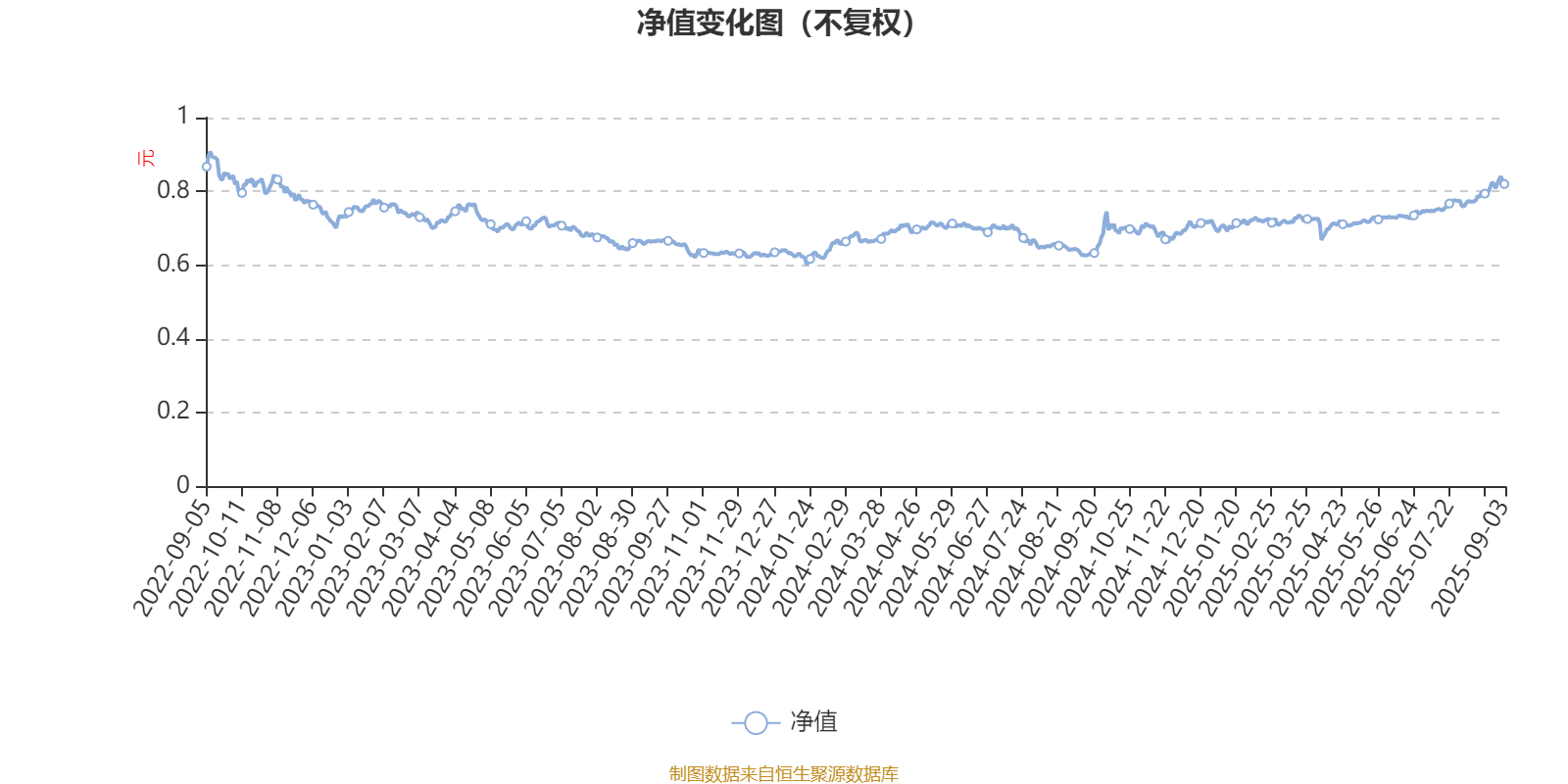
工银红利混合:2025年上半年利润1244.08万元 净值增长率4.13%
Sou Hu Cai Jing· 2025-09-05 09:21
Core Viewpoint - The AI Fund ICBC Dividend Mixed Fund (481006) reported a profit of 12.44 million yuan for the first half of 2025, with a net asset value growth rate of 4.13% [2]. Fund Performance - As of September 3, the fund's unit net value was 0.82 yuan, and it had a fund size of 312 million yuan [2][31]. - The fund's performance over various periods includes a three-month net value growth rate of 12.45%, a six-month growth rate of 15.69%, a one-year growth rate of 27.35%, and a three-year growth rate of -4.28% [6]. Investment Strategy - The fund manager indicated a high position operation despite market shocks from U.S. tariff policies, focusing on quality growth dividends as the basis for investment opportunities [2]. - The investment selection criteria include profitability stability, improvement in profitability, and dividends [2]. Sector Allocation - The fund's allocation includes a focus on the financial sector, particularly favoring brokerage firms over banks since the second quarter [3]. - In the resource sector, the fund is primarily invested in gold and other non-ferrous metals [3]. - The infrastructure sector allocation is concentrated on electricity and telecommunications operators, with a reduction in telecom operators since the second quarter [3]. - The consumer and technology sectors maintain investments in white goods, consumer electronics, and non-brewed food and beverage, with an increased allocation in pharmaceuticals [3]. Valuation Metrics - As of June 30, 2025, the fund's weighted average price-to-earnings (P/E) ratio was approximately 13.69 times, significantly lower than the industry average of 33.74 times [11]. - The weighted average price-to-book (P/B) ratio was about 1.77 times, compared to the industry average of 2.47 times [11]. - The weighted average price-to-sales (P/S) ratio was approximately 2.58 times, slightly higher than the industry average of 2.07 times [11]. Growth Metrics - For the first half of 2025, the fund's weighted average revenue growth rate was 0.13%, and the weighted average net profit growth rate was 0.21% [18]. Fund Holder Information - As of June 30, 2025, the fund had 18,600 holders, with individual investors holding 99.98% of the shares [34]. Turnover and Concentration - The fund's turnover rate for the last six months was approximately 109.26%, which has been below the industry average for two consecutive years [37]. - The fund has a high concentration in its top ten holdings, which include major companies like China Merchants Bank and Midea Group [40].

海尔智家(600690):1H25表现优异 持续兑现增长逻辑
Xin Lang Cai Jing· 2025-09-04 04:39
Group 1 - The core viewpoint of the article highlights Haier's strong performance in 1H25, with revenue and net profit showing significant year-on-year growth of 10.2% and 15.6%, reaching 156.49 billion and 12.03 billion yuan respectively [1] - Haier's gross margin improved by 0.1 percentage points to 26.9% due to the establishment of a digital procurement platform and optimization of marketing resources, while the sales expense ratio decreased by 0.1 percentage points to 10.1% [1] - The company reported regional revenue growth, with domestic sales increasing by 8.8% to 77.42 billion yuan and overseas sales rising by 11.7% to 79.08 billion yuan, with North America showing positive growth [1] Group 2 - Haier is implementing comprehensive inventory management across all categories and channels, achieving a centralized inventory ratio of 55% by 1H25, which has improved operational efficiency and reduced costs for distributors [2] - Despite a 10% revenue growth in 1H25, Haier maintains its guidance for high single-digit revenue growth and double-digit profit growth for the full year, with 2H25 revenue growth expected to be in the range of 4%-8% [2] - The company is streamlining operations in Europe and expects a revenue growth of 10%-15% in that region for 2H25, aiming to turn losses into profits [2] Group 3 - The company maintains its profit forecast and buy rating, with a target price of 32.80 yuan, corresponding to a 13 times P/E ratio for 2026 [3] - Revenue projections for 2025-2027 are expected to grow by 5.9%, 5.1%, and 4.8% respectively, reaching 302.96 billion, 318.43 billion, and 333.73 billion yuan [3] - Net profit forecasts for the same period are projected to increase by 13.0%, 11.6%, and 8.9%, reaching 21.18 billion, 23.65 billion, and 25.75 billion yuan [3]
中信建投:白电板块未来仍具备较强的成长性与配置价值
Zheng Quan Shi Bao Wang· 2025-09-04 01:01
Core Viewpoint - The white goods industry is expected to achieve both revenue and profit growth in the first half of 2025, driven by effective domestic "trade-in" policies and strong performance in emerging overseas markets [1] Group 1: Industry Performance - The domestic "trade-in" policy has effectively boosted demand for white goods [1] - Emerging overseas markets are showing strong performance, contributing to the industry's upward trend [1] - Despite external pressures such as tariffs, white goods companies are enhancing profitability and risk resistance through cost reduction and localization strategies [1] Group 2: Company Dynamics - Leading first-tier white goods companies are demonstrating stable performance [1] - There is a noticeable divergence in growth rates among second-tier companies [1] - The white goods sector is expected to maintain strong growth potential and investment value, supported by ongoing domestic policy initiatives and rising expectations of overseas interest rate cuts [1]
