
磷化工

Search documents
A股异动丨美国将磷和草甘膦列为国家安全优先事项,澄星股份、六国化工等多股涨停
Ge Long Hui A P P· 2026-02-25 01:53
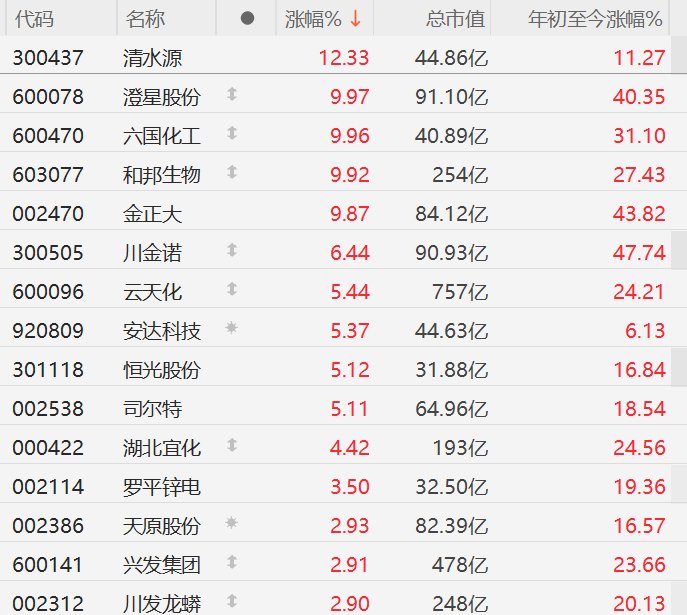
Group 1 - The A-share market saw a continued rise in phosphate chemical concept stocks, with Qing Shui Yuan rising over 12% and several other companies hitting the daily limit of 10% [1] - The U.S. President Trump signed an executive order on February 18, elevating phosphorus and glyphosate herbicides to national security priorities, citing their shortages as a direct threat to national security [1] - The U.S. Geological Survey (USGS) included phosphates in its critical minerals list for the first time in November 2025 [1] Group 2 - Glyphosate is a key end product in the phosphate chemical industry chain, produced from phosphate rock, and is widely used as a herbicide for major crops like corn, soybeans, cotton, and wheat [1] - China is the largest producer of glyphosate raw materials globally, supplying about 70% of the world's production, with the top four companies accounting for over 70% of the domestic market share [1] - Xingfa Group leads the domestic market with an annual production capacity of 230,000 tons, ranking second globally [1] Group 3 - The stock performance of key companies in the phosphate chemical sector includes Qing Shui Yuan with a 12.33% increase, Chengxing Co. with a 9.97% increase, and Liuguo Chemical with a 9.96% increase [2] - Other notable companies include HeBang Bio with a 9.92% increase and Jin Zheng Da with a 9.87% increase, reflecting strong market interest in the sector [2] - The overall market capitalization of these companies varies, with Chengxing Co. at 9.11 billion, Liuguo Chemical at 4.09 billion, and HeBang Bio at 25.4 billion [2]


A股高开,化工、有色金属板块再度走强
Di Yi Cai Jing Zi Xun· 2026-02-25 01:50
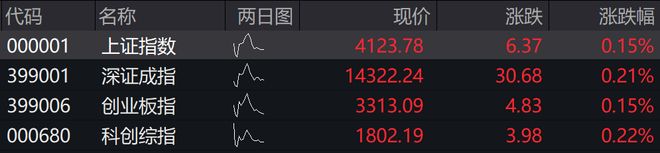
Group 1 - The phosphorus chemical sector remains active, with companies like Chengxing Co., Hebang Bio, Liuguo Chemical, Chuanjin Nuo, Yuntianhua, and Chuanfa Longmang experiencing gains [1] - On February 18, Trump signed an executive order designating elemental phosphorus and glyphosate as critical defense materials, indicating that supply disruptions could threaten U.S. defense and food security [1] - The White House has instructed the Department of Agriculture and the Department of Defense to develop measures to ensure stable domestic supply of these materials [1] Group 2 - The A-share market opened with slight gains across major indices, with the Shanghai Composite Index up 0.15%, Shenzhen Component Index up 0.21%, and the ChiNext Index up 0.15% [2][3] - The Hong Kong stock market also opened higher, with the Hang Seng Index rising 0.58% and the Hang Seng Tech Index increasing by 0.86%, driven by gains in companies like Haidilao and XPeng Motors [4][5]
磷化工暴涨6.42%!11股涨停,美国援引《国防生产法》管控磷元素,全球供应链重构
Jin Rong Jie· 2026-02-25 01:43
Group 1 - The phosphorus chemical sector opened with a rise of 6.42%, led by Chuanjin Nuo with a gain of 13.60%, and 11 stocks in the sector hit the daily limit [1] - The core logic driving the market's speculation on phosphorus chemicals is the expectation of price increases due to the global restructuring of the phosphorus supply chain, alongside a long-term tight balance in domestic phosphorus ore supply and demand [1][2] - The upcoming spring plowing season is expected to boost terminal demand for phosphorus fertilizers, while the growing demand for phosphorus-based materials in the new energy sector adds long-term growth momentum to the sector [1] Group 2 - On February 18, the U.S. President invoked the Defense Production Act to elevate phosphorus and glyphosate herbicides to national security priorities, indicating that shortages of these materials pose a direct threat to national security [2] - The international price of phosphorus fertilizers has surpassed $700 per ton, which has led to a recovery in the overall valuation of the domestic phosphorus chemical industry chain [2] - The domestic phosphorus ore market has maintained a long-term tight balance, with the spot price of 30% grade phosphorus ore averaging around 1,000 yuan per ton over the past three years, providing solid support for industry profitability [2] Group 3 - In phosphorus mining, China's phosphorus resources are rich but of low quality, and the difficulty and cost of mining are increasing due to years of high-intensity extraction and tightening environmental policies [3] - The production of glyphosate, which is the most widely used broad-spectrum herbicide globally, relies heavily on phosphorus ore, with China supplying about 70% of the world's glyphosate production [3] - The manufacturing of phosphorus fertilizers is significantly supported by high prices of core raw materials like sulfur, and companies with integrated production capabilities will have a competitive advantage [3] Group 4 - The explosive growth of the new energy vehicle and energy storage markets is driving rapid growth in the demand for lithium iron phosphate, which requires high-purity raw materials, making high-grade phosphorus ore resources scarce [3] - Companies that can integrate the entire supply chain from phosphorus ore to lithium iron phosphate will fully benefit from the growth in the new energy sector [3]
A股开盘:沪指微涨0.15%、深成指涨0.21%,磷化工板块、小金属概念股活跃,影视院线板块继续调整
Jin Rong Jie· 2026-02-25 01:38
Market Overview - A-shares opened slightly higher on February 25, with the Shanghai Composite Index up 0.15% at 4123.78 points, the Shenzhen Component Index up 0.21% at 14322.24 points, and the ChiNext Index up 0.15% at 3313.09 points [1] - The market saw high activity with a total trading volume of 2.2 trillion yuan, over 4000 stocks rising, and 109 stocks hitting the daily limit [1] Sector Performance - The phosphorous chemical sector continued its strong performance, with stocks like Chengxing Co. and HeBang Bio both experiencing consecutive gains [1] - The film and cinema sector faced declines, with companies like Bona Film Group and Huayi Brothers hitting the daily limit down [1] Key Stocks - Focus stocks included YN Holdings, which opened up 4.69%, and Meibang Co., which hit the daily limit [2] - Other notable stocks included AI application company Fengyuzhu, which opened down 3.27%, and commercial aerospace stock Tigid Group, which opened up 4.71% [2] Industry Insights - The global AI infrastructure investment boom is prompting Murata Manufacturing to consider raising prices for MLCCs, which are crucial for AI server power management [3] - ByteDance's adjustment of its billing model for AI tools reflects the growing strength of Chinese models, which account for 61% of the total token volume on platforms [4] Phosphorous Chemical Sector - U.S. policies are raising supply concerns in the phosphorous chemical market, as the U.S. relies heavily on a single domestic producer, while China dominates global production [5] Glass Fiber Sector - Manufacturers are expected to initiate a second round of price increases for glass fiber, with anticipated monthly hikes of 10% to 15%, driven by rising costs and supply constraints [6] Oil and Gas Sector - International oil prices rebounded during the Spring Festival, influenced by geopolitical tensions and U.S. trade policies, with Brent crude rising over 5% [7] Robotics Sector - Yushutech launched its fourth quadruped robot, Unitree As2, which boasts double the power performance of its predecessor and aims to advance the robotics industry [8] Transformer Sector - China's transformer exports are projected to grow by 36% by 2025, driven by North American power grid upgrades and increased demand from emerging markets [10] Cultural and Tourism Sector - The Chinese domestic tourism market reached record highs during the Spring Festival, with 596 million trips taken and total spending of 803.48 billion yuan [11] Company News - Dongyangguang is planning a major asset restructuring to acquire control of Yichang Dongshu No.1 Investment Co. [12] - Zhongke Shuguang reported a revenue increase of 13.86% to 14.97 billion yuan, driven by improved product structure [13] - Light Media's film "Racing Life 3" generated approximately 2.926 billion yuan in box office revenue, significantly exceeding its previous annual revenue [14] - Apple plans to procure over 100 million advanced chips from TSMC's Arizona factory and shift some Mac Mini production to the U.S. [15] - Wens Foodstuff's net profit fell by 43.59% to 5.235 billion yuan, attributed to a decline in pig sales prices [16] - Tongwei Co. is planning a major acquisition of Qinghai Lihua Qingneng Co. [17] - Changxin Bochuang signed a share acquisition letter of intent for a 93.81% stake in Shanghai Honghui Guangtong Technology [18] - Kaipu Cloud terminated its major asset restructuring plan due to market changes [19] - Zhongwei Semiconductor reported a revenue increase of 23.09% to 1.122 billion yuan [21] - SanSheng Guojian achieved a revenue surge of 251.81% to 4.199 billion yuan, largely due to a partnership with Pfizer [22] Institutional Strategies - CITIC Securities highlights the transformative opportunities presented by the evolution of AI agents into more human-like productivity tools [23] - Huatai Securities notes the acceleration of commercialization in the domestic robotics sector, driven by increased visibility and capital investment [24]
滚动更新丨A股三大指数小幅高开,化工、有色金属板块再度走强
Di Yi Cai Jing· 2026-02-25 01:33
Group 1 - The oil and gas, shipping, chemical, and non-ferrous metal sectors have shown renewed strength, while superconductors, PEEK materials, and high-speed copper connection concept stocks are active [1][3] - The phosphorous chemical sector remains active, with companies like Chengxing Co., Hebang Biotechnology, Liuguo Chemical, Chuanjinno, Yuntianhua, and Chuanfa Longmang experiencing gains following an executive order signed by Trump on February 18, which includes phosphorous and glyphosate as critical defense materials [1] - The executive order aims to ensure the stable domestic supply of these materials, as their disruption poses a direct threat to U.S. defense industry and food security [1] Group 2 - The A-share market opened with slight gains, with the Shanghai Composite Index up 0.15%, the Shenzhen Component Index up 0.21%, the ChiNext Index up 0.15%, and the Sci-Tech Innovation Index up 0.22% [2][3] - The Hang Seng Index opened up 0.58%, with the Hang Seng Tech Index rising by 0.86%, and notable gains observed in companies like Haidilao, China Hongqiao, Xiaopeng Motors, Kingdee International, and Trip.com, all increasing by over 2% [4][5]
A股早评:三大指数小幅高开,磷化工板块盘初活跃
Ge Long Hui· 2026-02-25 01:31
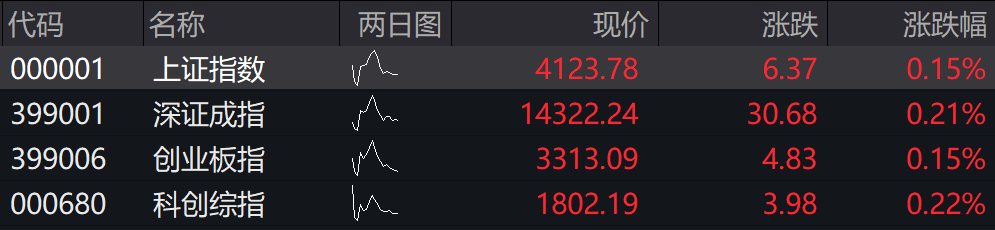
A股开盘,三大指数集体高开,沪指涨0.15%报4123.78点,深证成指涨0.21%,创业板指涨0.15%。盘面 上,磷化工、小金属板块盘初活跃,影视院线板块继续调整。 ...
市场迎普涨反弹,涨价概念逐步成为市场共识方向
Xin Lang Cai Jing· 2026-02-25 01:27
Group 1 - The market experienced a broad rebound with over 4,000 stocks closing in the green, driven by rising commodity prices, particularly in oil and gas, and non-ferrous metals [1] - The chemical sector, particularly phosphate chemicals, saw significant gains due to U.S. policy changes prioritizing certain agricultural products, leading to price increases in fertilizers [2] - The demand for AI computing power has positively impacted the prices of upstream materials such as glass fiber and optical fiber, with notable stock performances in related companies [3] Group 2 - The price of urea (small particles) increased to 1,783.8 RMB/ton, up 3.25% from the end of 2025 and 5.24% year-on-year, while potassium sulfate compound fertilizer reached 3,458.9 RMB/ton, up 16.9% year-on-year [2] - The price of monoammonium phosphate (55% powder) was reported at 3,850 RMB/ton, reflecting a year-on-year increase of 16.67%, which is expected to boost the overall performance of the chemical sector [2] - The electrical equipment sector, particularly related to overseas expansion, showed strong performance with key stocks hitting new highs, indicating potential opportunities in the "outbound chain" [3]
四大利好突袭!磷化工16股集体涨停,竟是美国一纸停令?社保独宠这一龙头
Sou Hu Cai Jing· 2026-02-25 01:15
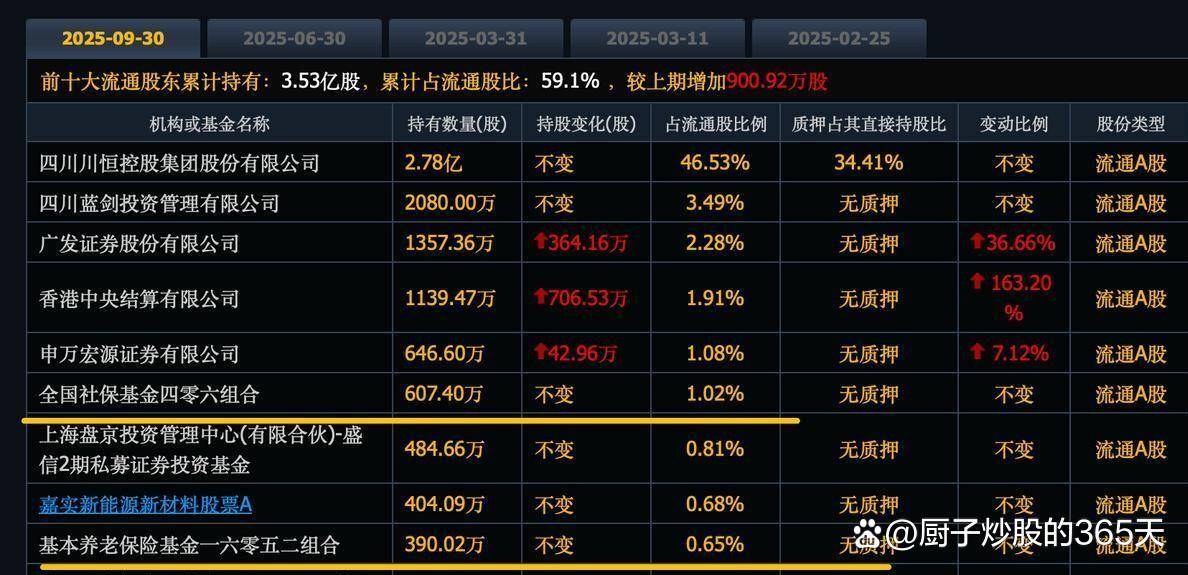
Core Viewpoint - The A-share market experienced a significant surge on the first trading day of the Year of the Horse, particularly in the phosphorus chemical sector, which saw a nearly 7% increase in the phosphorus chemical index, driven by a U.S. executive order designating phosphorus as a critical defense material [1][4][12]. Group 1: Market Reaction and Performance - On February 24, 2026, the Shanghai Composite Index rose over 1%, while the ChiNext Index surged by 1.76%, with the phosphorus chemical sector being the standout performer [1]. - A total of 16 leading phosphorus chemical stocks saw price increases exceeding 9% on the same day, indicating a collective surge in the sector [3]. - The main capital inflow into the phosphorus chemical sector exceeded 8 billion yuan in a single day, reflecting strong market interest [4]. Group 2: Policy Impact - On February 18, 2026, U.S. President Trump signed an executive order that classified phosphorus and glyphosate as critical defense materials, highlighting the strategic importance of these substances [6][7]. - The order revealed that the U.S. currently relies on imports for over 6 million kilograms of phosphorus annually, indicating a hollowing out of its domestic production capacity [9][10]. - This policy shift effectively ended the era of free trade in phosphorus chemicals, elevating phosphorus to the status of a strategic resource alongside rare earths and lithium [12]. Group 3: Price Dynamics - Following the U.S. executive order, domestic phosphorus ore prices surged, with the price of 30% grade phosphorus ore stabilizing above 1,020 yuan per ton, marking a significant increase from around 970 yuan per ton in January 2026 [13][14]. - The price of yellow phosphorus also saw an upward trend, with prices maintaining a high level around 23,300 to 23,600 yuan per ton [16]. - The price of industrial-grade phosphoric acid ranged from 6,200 to 6,400 yuan per ton, while monoammonium phosphate was priced between 3,250 and 3,300 yuan per ton, indicating a clear upward price trajectory across the industry [17]. Group 4: Demand Drivers - The demand for phosphorus is being driven not only by traditional agricultural needs but also by the burgeoning energy sector, particularly in lithium iron phosphate batteries, which require significant amounts of phosphorus [19][20]. - The expected increase in demand for phosphorus from the energy storage sector is projected to reach 4.31 million tons in 2026, with lithium iron phosphate contributing 4.07 million tons [19]. - The dual demand from agriculture and new energy sectors is creating a robust growth environment for the phosphorus chemical industry [20]. Group 5: Investment Opportunities - The reclassification of phosphorus companies from cyclical stocks to strategic resource stocks has led to a significant reevaluation of their market value, enhancing their pricing power [23][24]. - Companies with integrated phosphorus supply chains are positioned to benefit from rising prices and increasing demand, leading to expanded profit margins [23][29]. - The focus of institutional investors has shifted towards companies with strong resource bases and growth potential, as evidenced by the concentrated investments in specific phosphorus chemical firms [30][32]. Group 6: Company Spotlight - Chuanheng Co., which holds 530 million tons of phosphorus ore reserves and has an annual production capacity exceeding 3 million tons, has become a focal point for institutional investment [37][38]. - The company has established a strong market position in its traditional business segments and is also expanding into the lithium iron phosphate market, securing contracts with leading battery manufacturers [40]. - In the first three quarters of 2025, Chuanheng Co. reported revenues of 5.804 billion yuan, a year-on-year increase of 46.08%, and a net profit of 966 million yuan, reflecting its strong performance in a favorable market environment [42][43].



马年首个交易日股市涨势强劲 无锡92家上市公司迎来“开门红”
Sou Hu Cai Jing· 2026-02-25 00:36
Group 1 - The A-share market experienced a strong opening on the first trading day of the Year of the Horse, with all three major indices rising significantly, and over 70% of the 92 listed companies in Wuxi seeing stock price increases [1] - Key sectors driving the positive performance of Wuxi companies include storage chips, phosphorus chemicals, environmental equipment, new energy vehicles, and power grid equipment, indicating a strong market trend [1] - Taiji Industry showed remarkable performance with a 9.91% increase in stock price, achieving a transaction volume of 3.06 billion shares and a turnover of 32.66 billion yuan, benefiting from the booming storage chip industry [1] Group 2 - The market's "opening red" is seen as an expected positive signal, driven by favorable policies, concentrated capital inflow, and strong performance in the consumer sector during the Spring Festival [2] - The upcoming national two sessions are anticipated to catalyze the A-share market, with capital focusing on policy-driven industry themes and opportunities, leading to rapid style switching and rotation of policy hotspots [2] - As the disclosure of annual reports for 2025 approaches, companies with better-than-expected performance are likely to attract significant capital attention, becoming a core theme for future market trends [2]

