稀土

Search documents
准备单打独斗?普京下定决心,要用尽一切手段,摆脱对中国的依赖
Sou Hu Cai Jing· 2026-02-13 09:50
这一举措的背后,还隐藏着一层复杂的外交图谋。很多分析人士认为,俄罗斯之所以急于推进稀土产业独立,除了保障本国经济安全外,还把稀土作为与美 欧以及亚洲国家博弈的关键筹码。在面对美国提出的供应链多元化倡议时,俄罗斯拥有更多的自主资源,就能在谈判中占据更有利的位置。然而,由于俄乌 冲突尚未获得实质性进展,俄罗斯与西方国家在稀土领域的真正合作空间仍显得非常有限。美国在全球范围内争夺矿产资源的战略,迫使俄罗斯必须谨慎应 对。 俄罗斯总统普京最近在克里姆林宫下达了一项指令:要求政府制定一份完整的稀土及稀有金属的开采与生产路线图。此举的核心目标显而易见——让俄罗斯 尽快摆脱对中国在稀土供应和加工方面的依赖,建立起自主可控的产业链。 尽管俄罗斯资源丰富,但多年来在稀土领域的开采和深加工方面却未能形成完善的产业体系。在全球供应链风暴愈演愈烈的今天,这一短板暴露得尤为明 显,俄罗斯意识到,这样的局面必须加以改变。 稀土,远非普通的矿产,它是现代工业和国防技术的血液。从导弹制导系统、雷达设备,到电动汽车、电机永磁材料,几乎所有尖端技术的背后,都离不开 稀土的身影。近年来,中国对稀土出口实施了严格管控,将相关技术的出口纳入审批范围, ...


盛和资源股价跌5.01%,易方达基金旗下1只基金重仓,持有106.24万股浮亏损失164.67万元
Xin Lang Ji Jin· 2026-02-13 06:53
Group 1 - The core point of the news is that Shenghe Resources experienced a decline of 5.01% in its stock price, reaching 29.36 CNY per share, with a trading volume of 3.217 billion CNY and a turnover rate of 6.11%, resulting in a total market capitalization of 51.463 billion CNY [1] - Shenghe Resources Holdings Co., Ltd. is located in Chengdu, Sichuan Province, and was established on July 1, 1998, with its listing date on May 29, 2003. The company's main business involves rare earth smelting, separation, deep processing, and trading, as well as zirconium-titanium mining and processing [1] Group 2 - From the perspective of major fund holdings, data shows that one fund under E Fund has a significant position in Shenghe Resources. The E Fund CSI Rare Earth Industry ETF (159715) reduced its holdings by 103,500 shares in the fourth quarter, now holding 1.0624 million shares, which accounts for 4.23% of the fund's net value, ranking as the tenth largest holding [2] - The E Fund CSI Rare Earth Industry ETF (159715) was established on September 1, 2021, with a latest scale of 540 million CNY. Year-to-date, it has achieved a return of 16.71%, ranking 254 out of 5,569 in its category; over the past year, it has returned 95.37%, ranking 108 out of 4,295; and since inception, it has returned 40.55% [2] - The fund manager of E Fund CSI Rare Earth Industry ETF (159715) is Liu Wenkuai, who has been in the position for 2 years and 159 days. The total asset scale of the fund is 4.19 billion CNY, with the best return during his tenure being 108.42% and the worst being 0.58% [2]

稀土价格|氧化镨、氧化钆、氧化铽最新价格
Xin Lang Cai Jing· 2026-02-13 06:16
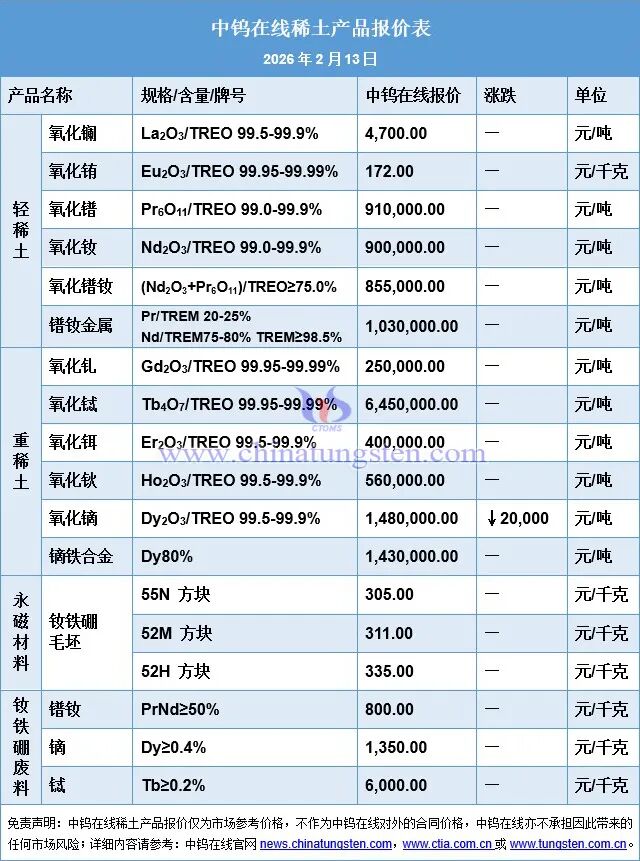
Group 1: Rare Earth Market Overview - The overall price level of rare earth products in China remains stable, with prices for praseodymium oxide, gadolinium oxide, and holmium oxide at approximately 910,000 CNY/ton, 250,000 CNY/ton, and 560,000 CNY/ton respectively [1][5] - The market activity has significantly decreased due to the upcoming Spring Festival, leading to lower trading willingness among buyers and sellers, which poses resistance to further price increases and results in limited actual transaction volumes [1][5] Group 2: Industrial Producer Price Trends - In January 2026, the national industrial producer price index increased by 0.4% month-on-month, with the growth rate expanding by 0.2 percentage points compared to the previous month [2][6] - The industrial producer purchase price index rose by 0.5% month-on-month, with an increase of 0.1 percentage points from the previous month [2][6] - Within the industrial producer price index, mining industry prices decreased by 1.7%, while raw material industry prices increased by 0.7% and processing industry prices rose by 0.5% [2][6]
金力永磁股价回调,受技术面、板块情绪及资金流出影响
Jing Ji Guan Cha Wang· 2026-02-13 05:41
Company Overview - Jinli Permanent Magnet achieved an annual production target of 40,000 tons of high-performance rare earth permanent magnet materials in 2025, with plans to expand production to 60,000 tons by 2027 [3] - The company is expected to see a net profit growth of 127%-161% year-on-year in 2025, but its price-to-earnings ratio (TTM) stands at 84.71, which is higher than the industry average, raising concerns among some investors about the profit realization pace post-expansion [3] Market Performance - On February 13, 2026, Jinli Permanent Magnet's stock price closed at 37.54 yuan, down 2.32% for the day, primarily influenced by a combination of technical adjustments, sector sentiment, capital outflows, and valuation pressures [1][5] - The stock price fell below the 5-day moving average of 37.41 yuan, with a negative MACD histogram (-0.068), indicating weakened short-term momentum [1] - The A-share non-ferrous metal sector dropped by 2.94% on the same day, reflecting a decline in market risk appetite that affected individual stocks [2] Capital Movements - On February 10, 2026, JPMorgan reduced its holdings in Jinli Permanent Magnet by 1.1198 million H-shares, totaling approximately 23.86 million Hong Kong dollars, raising market concerns regarding capital flows [4] - The China Minmetals Import and Export Chamber of Commerce is set to hold a rare earth export policy briefing on March 25, 2026, which may increase market uncertainty [4] Valuation Insights - Jinli Permanent Magnet's stock has seen a significant increase of 10.06% since the beginning of 2026, with a 5-day increase of 7.29%, leading some investors to take profits after the short-term rally [5] - The average target price from institutions is 38.50 yuan, which is close to the current stock price, indicating that further upward momentum will depend on exceeding performance expectations or favorable industry policies [5]
稀缺资源指数低开低走,关注稀土ETF易方达(159715)、化工行业ETF易方达(516570)等产品布局机会
Sou Hu Cai Jing· 2026-02-13 05:09
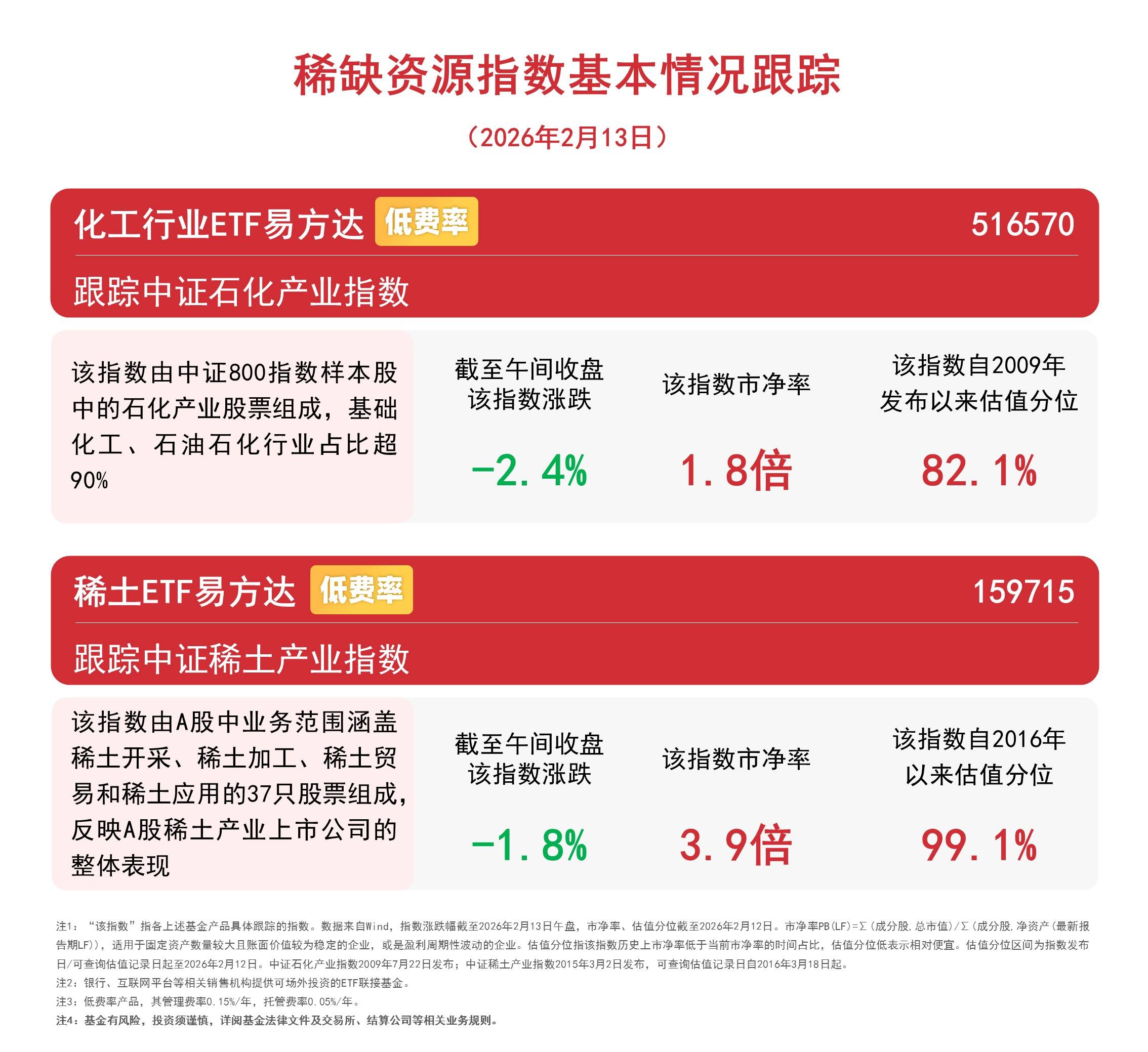
截至午间收盘,中证稀土产业指数下跌1.8%,中证石化产业指数下跌2.4%。相关ETF受资金关注,Wind数据显示,截至昨日,化工行业ETF易方达 (516570)近一月合计"吸金"超14亿元。 每日经济新闻 ...
太打脸!日本稀土宣布重大突破,中方一查:所谓富矿竟是海底淤泥
Sou Hu Cai Jing· 2026-02-13 05:09
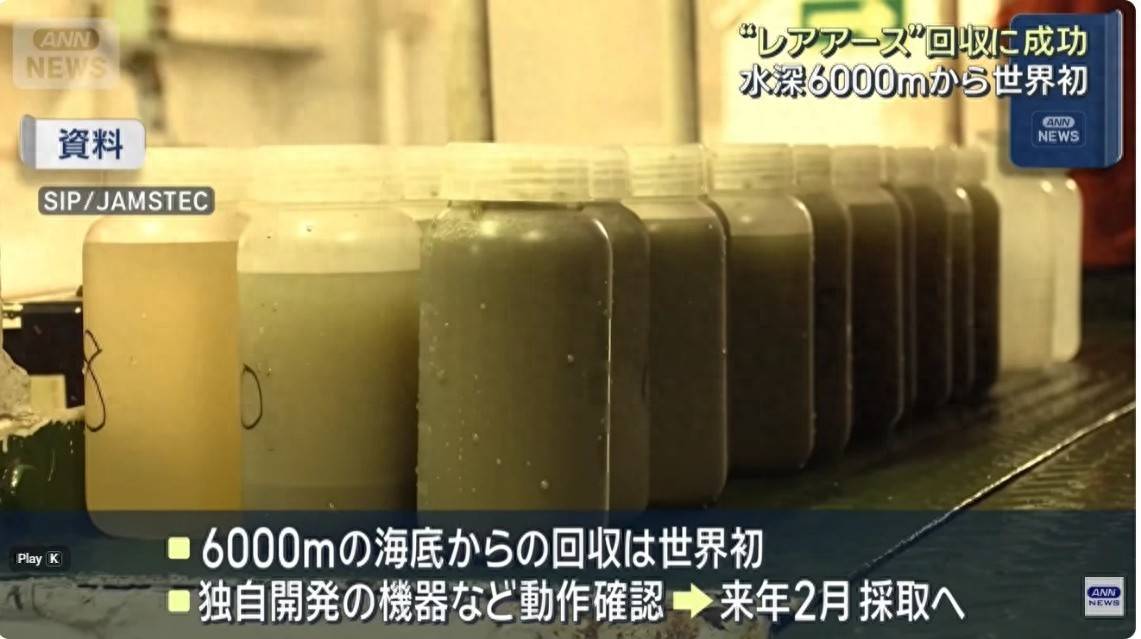
日本炒作深海稀土,明显是迫切的信号。其实,关于日本深海稀土的炒作早已有先例。早在2011年,他们就在南鸟岛附近的海域发现了稀土矿,储量据称高 达1600万吨,当时也曾引发过一阵全国范围的兴奋潮。不过,热潮并没有持续太久,因为开采深度达到5600米,技术难度之大,几乎让日本无力应对。而与 此同时,中国一直在稳定地供应着大量价格合理、质量可靠的稀土,成本低廉,且供货稳定。与之相比,日本尝试自行开采海底淤泥的计划,成本高昂且技 术不成熟,未必能带来实际的经济效益。 然而,日本在这一问题上的焦虑显而易见,他们急于将自己的成功炒作成一个巨大的突破。事实上,业内人士早就清楚,日本在稀土精炼方面的技术,始终 处于全球落后状态。我国在稀土领域的全球主导地位,不仅依靠丰富的储量,更依赖于技术上的全面领先,特别是在稀土精炼技术上。即便日本从深海开采 了大量稀土淤泥,他们依然无法独立完成关键的提纯加工,因为目前日本国内并没有任何一家公司能够处理这种高端精炼技术。这意味着,虽然日本能挖到 海底的稀土淤泥,但要完成精炼加工,仍然需要依赖中国。而摆脱依赖这种说法,无疑是自我安慰。事实上,巴克莱银行的研究报告早已指出,中国掌握了 全球90 ...
五矿会议聚焦稀土出口,百亿规模稀土ETF嘉实(516150)一键布局国内稀土产业链机遇
Xin Lang Cai Jing· 2026-02-13 02:48
Group 1 - The core viewpoint of the news highlights the decline of the China Rare Earth Industry Index by 1.00% as of February 13, 2026, with mixed performance among constituent stocks, indicating market volatility in the rare earth sector [1] - China Minmetals Import and Export Chamber of Commerce announced a conference on March 25, 2026, to discuss export policies and market conditions for rare earth and rare metals, aiming to address challenges faced by enterprises in exports [1] - Huaxi Securities reported that QS Company's solid-state battery technology has achieved delivery of the QSE-5 cell and completion of the Eagle production line, reflecting the urgent global demand for higher-performance batteries, with rare earth-based catalysts and hydrogen storage materials accelerating into next-generation energy technologies [1] Group 2 - As of January 30, 2026, the top ten weighted stocks in the China Rare Earth Industry Index include Northern Rare Earth, Goldwind Technology, Xiamen Tungsten, and others, collectively accounting for 61.43% of the index [2] - The Jiashi Rare Earth ETF (516150) closely tracks the China Rare Earth Industry Index, serving as a convenient tool for investors to access the domestic rare earth industry chain [2] - Investors can also utilize the Jiashi Rare Earth ETF linked fund (011036) to seize investment opportunities in the rare earth sector [3]
未知机构:稀土官方提法偏向于供给侧地缘交易再起2026212-20260213
未知机构· 2026-02-13 02:35
Summary of Key Points from the Conference Call on Rare Earth Industry Industry Overview - The conference focused on the rare earth industry, particularly in the context of recent government initiatives and market dynamics [1][2]. Core Insights and Arguments 1. **Government Focus on Supply-Side Policies**: Recent statements from government leaders emphasize the need for "reasonable development" of rare earth resources, indicating a shift towards supply-side reforms in the industry [1][2]. 2. **Supply Reform Validation**: - January production levels remained flat year-on-year, but considering the timing of the Lunar New Year, production should have increased by approximately 15%. The flat production indicates a reduction in output [3]. - Declines in operating rates were noted, with regions like Inner Mongolia, Hunan, and Sichuan experiencing over a 10 percentage point drop in both month-on-month and year-on-year comparisons [3]. 3. **Increased Overseas Stockpiling**: There are significant signs of overseas stockpiling, suggesting a growing demand for rare earth materials from international markets [3][4]. Additional Important Insights 1. **Geopolitical Factors**: The election of hardline officials in Japan has led to increased export controls from China, which may exacerbate supply constraints for Japan, a key producer of rare earth magnets [4][5]. 2. **Price Dynamics**: - The historical support for the industry may have reached its limit, necessitating a reevaluation of strategic resource prices amidst rising commodity prices [5][6]. - There is a belief that prices may not have an upper limit, with potential increases of 50-100% for key players like Northern Rare Earth and Shenghe Resources [6][7]. 3. **Market Expectations**: - Companies like China Rare Earth are expected to see significant price increases, with projections suggesting a potential rise of up to 100% [7]. This summary encapsulates the critical points discussed in the conference call regarding the rare earth industry, highlighting the implications of government policies, market dynamics, and geopolitical factors on future pricing and supply.
有色金属-岁启新章-金属为王
2026-02-13 02:17
Summary of Key Points from Conference Call Industry Overview - The conference call primarily discusses the non-ferrous metals industry, focusing on lithium, rare earths, copper, aluminum, and strategic metals [2][3][4][8][9]. Core Insights and Arguments Lithium Market - The lithium market shows strong fundamentals, with short-term supply weakness and strong demand. Inventory levels are low, with a significant price tolerance for lithium at 200,000 CNY/ton, yielding an IRR of over 8% [2][5]. - The impact of regulatory changes in Yichun and strict requirements for tailings storage may delay the resumption of production [2][5]. - Demand for lithium remains robust, with production in March expected to increase by 23% month-on-month and over 50% year-on-year [5]. Rare Earths - The rare earth sector demonstrates resilience, with prices continuing to rise, particularly in Wuxi where prices exceed 900,000 CNY. The market has not fully reflected the improvements in the fundamentals of rare earth prices [2][8]. - Supply tightness is expected to continue, with the overall price center projected to reach 800,000 CNY or higher in 2026 [8]. Copper Market - The outlook for the copper sector is optimistic, supported by macroeconomic trends and structural demand increases from AI data centers and strategic reserves [4][15]. - Supply remains rigid, with several companies lowering their production guidance for 2026 due to various constraints, leading to a projected supply gap of over 650,000 tons [16][17]. Aluminum Sector - The aluminum supply is expected to increase by approximately 70,000 tons this year, with global demand growth projected at 2.5% [21]. - The cost of alumina is anticipated to decrease, enhancing the profitability of Chinese electrolytic aluminum enterprises [24]. Strategic Metals - Investment in strategic metals is recommended due to their industrial applications and low cost ratios, with potential candidates including tungsten, oil, and antimony [10][11][12]. - The strategic metal sector is expected to benefit from geopolitical tensions and military applications, making it a compelling investment opportunity [9][10]. Additional Important Insights - The gold market is viewed as undergoing a technical correction, with expectations of a narrative consolidation period ahead [9]. - The copper market is influenced by China's actions to enhance its copper resource reserve system, which may increase demand and valuation [19]. - Companies to watch include major players in the non-ferrous metals sector such as Zijin Mining, Jiangxi Copper, and others that are expected to benefit from the current market dynamics [20][30]. This summary encapsulates the key points discussed in the conference call, providing insights into the current state and future outlook of the non-ferrous metals industry.
稀土年初暴涨打懵全球:镝铽冲顶,中美日竞速脱依赖能成吗
Sou Hu Cai Jing· 2026-02-12 16:32
Demand and Supply Dynamics - The recent surge in rare earth prices, including dysprosium reaching $960 per kilogram and terbium exceeding $4000, is driven by increased demand from electric vehicles and defense spending, while supply constraints are exacerbated by China's export restrictions [1][3] - China's dominance in the rare earth supply chain is significant, controlling approximately 61% of global mining and 92% of refining, making it challenging for other countries to replicate this capability quickly [3][8] Geopolitical Developments - The U.S. is actively working to reduce its dependence on Chinese rare earths, with a proposed $12 billion plan to build a strategic reserve for critical minerals, supported by private funding and loans [5] - Japan is exploring deep-sea mining for rare earths, with estimates of 16 million tons of resources, but faces significant cost challenges in extraction and processing [5][6] Industry Challenges - The refining capacity for rare earths is predominantly located in China, posing a challenge for countries like Japan that lack large-scale refining facilities, potentially leading to continued reliance on Chinese processing [8] - European efforts to diversify imports of critical materials have shown limited progress, with many key resources still heavily reliant on China [8][10] Future Outlook - The industry is expected to gradually diversify away from China, with companies like MP Materials and Lynas expanding production, but achieving significant scale may take five to ten years [10] - The ongoing volatility in prices and the strategic decisions by companies regarding inventory and supply chain adjustments remain critical issues for the industry [10]