
光通信

Search documents
中概股深夜拉升 标普500创新高 黄金白银跳水
2 1 Shi Ji Jing Ji Bao Dao· 2025-12-24 15:51
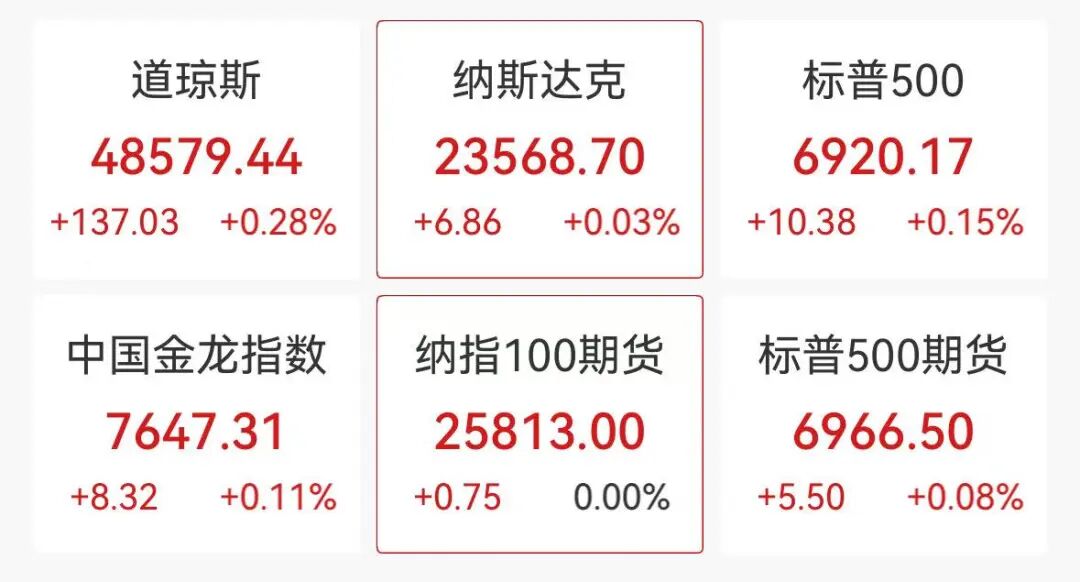
北京时间24日晚间,美股三大股指小幅低开,截至23:20左右,道琼斯指数涨0.28%,标普500指数涨0.15%,盘中一度涨至报6921点创新高,纳斯达克综 合指数涨0.03%。 美国科技七巨头多数下跌,特斯拉跌超1%,英伟达跌超0.6%。美股存储概念股拉升,美光科技涨4%,股价续创历史新高。 英特尔开盘跌3%,截至发稿跌幅收窄至2.4%。据券商中国,英伟达已暂停对英特尔18A制程工艺的测试。 美股光通信股Lumentum盘初拉升,股价突破400美元再创历史新高,年内累涨超370%。 全球贵金属冶炼巨头Heraeus最新发布的《2026贵金属展望》表示,预计银价在2026年将在43美元/盎司—62美元/盎司区间交易。 纳斯达克中国金龙指数盘初上演反弹行情,开盘跌0.35%后转涨,截至发稿涨幅0.11%,再鼎药业涨超8%,知乎涨超2%,小牛电动、迅雷、贝壳涨超 1%。 | 再鼎医药 | 18.904 | 8.15% | 0.82 | | --- | --- | --- | --- | | ZLAB.O | | | | | 亿咖通科技 | 1.740 | 5.45% | 0.00 | | ECX.O | | | ...

美股光通信股Lumentum盘初拉升,现涨超3%,股价突破400美元再创历史新高
Mei Ri Jing Ji Xin Wen· 2025-12-24 15:17
每经AI快讯,美股光通信股Lumentum盘初拉升,现涨超3%,股价突破400美元再创历史新高,年内累 涨超370%。 ...
国泰海通|策略:越世界,越中国——中国企业全球化与出海系列一
国泰海通证券研究· 2025-12-24 13:38
Core Viewpoint - Chinese enterprises are entering a new era of globalization, focusing on high-end segments of the global value chain, driven by the need for economic transformation and high-quality development [1][2]. Group 1: Industry Trends - The trend of Chinese companies going global is characterized by a systematic approach, moving from product exports to a model that includes "capacity + brand + channel" [2]. - China's trade competitiveness has significantly improved, especially in capital and technology-intensive sectors such as power equipment, engineering machinery, and motorcycles, with notable gains in passenger vehicles, machine tools, new materials, optical communications, and medical devices [2]. - The overseas gross profit margins of non-financial listed Chinese companies have surpassed domestic margins in the first half of 2023, indicating a shift towards higher value-added segments [2]. Group 2: Global Economic Context - The global industrial and infrastructure capital expenditure is entering an upward cycle, with emerging markets accelerating their capital spending due to previous high-interest rate constraints [3]. - Southeast Asian countries, with GDP per capita between $3,000 and $10,000, are experiencing explosive demand for electricity, infrastructure, production equipment, and durable consumer goods [3]. - Developed markets are also seeing a surge in demand for energy infrastructure updates driven by green transitions and AI-related needs, which is expected to boost demand for Chinese power equipment [3]. Group 3: Investment Recommendations - Recommended sectors include power equipment, machinery, automotive, new materials, innovative pharmaceuticals, and gaming, driven by industrialization in emerging markets and infrastructure updates in developed countries [4]. - High-value components are highlighted due to China's significant technological and cost advantages, with recommendations for communication equipment, automotive parts, innovative pharmaceuticals, and new materials [4]. - Consumer exports are expected to grow due to urbanization in emerging markets and the enhancement of China's cultural soft power, with recommendations for motorcycles, passenger vehicles, and gaming content [4].

AI春季攻势展望
2025-12-24 12:57
AI 春季攻势展望 20151223 为什么认为 2026 年的海外算力板块具有投资价值? 预计 2026 年海外算力板块将有显著增长,相关上市公司的利润平均增长率可 能达到 150%。例如,中际旭创、新易盛、盛弘科技、东山精密等公司在光模 块等领域有望实现 200%甚至 300%的增速。这些公司的估值普遍在 15 倍到 20 倍之间,非常便宜。展望 2027 年,这些公司的估值可能进一步降低至 7 倍 光通信行业未来几年将高速发展,2026-2027 年 1.6T 光模块需求量预 计达 6,000 万只左右,即使 800G 价格下降,整体行业增速仍可维持 50%-60%。硅光、LPO 等新技术将打开市场空间。 国产大模型如 Minimax、智谱具有全球竞争力,个性化助手方案将推动 存储与算力需求增长,未来两年应重点关注其在全球竞争中的表现。 到 10 倍,同时保持高增长。因此,该板块值得高度关注。 光纤光缆行业未来的发展趋势如何? 光纤光缆行业近期已经开始涨价,这反映了 AI 需求启动后带动整体需求上升的 趋势。目前供给略微过剩,但预计半年后将出现供不应求的情况,从而导致价 格大幅上涨。因此,虽然短期内业绩 ...
蘅东光(920045):新股覆盖研究
Huajin Securities· 2025-12-24 12:53
Investment Rating - The investment rating for the company is "Buy," indicating that it is expected to outperform the relevant market index by more than 15% over the next 6-12 months [40]. Core Insights - The company focuses on the research, manufacturing, and sales of passive optical devices in the optical communication field, with major business segments including passive optical fiber cabling, passive internal optical devices, and related supporting businesses [7][14]. - The company has shown significant revenue growth, with projected revenues of CNY 4.75 billion, CNY 6.13 billion, and CNY 13.15 billion for the years 2022, 2023, and 2024 respectively, reflecting year-over-year growth rates of 19.74%, 29.03%, and 114.40% [8][30]. - The company is well-positioned to benefit from the rapid growth in downstream sectors such as AI data centers, with over 80% of its revenue derived from this area [30][31]. Financial Performance - The company achieved a net profit of CNY 0.55 billion, CNY 0.65 billion, and CNY 1.48 billion for the years 2022, 2023, and 2024, with year-over-year growth rates of 347.21%, 16.62%, and 128.71% respectively [8][30]. - For the first half of 2025, the company reported revenues of CNY 16.25 billion, a 91.38% increase year-over-year, and a net profit of CNY 2.24 billion, up 123.75% from the previous year [8][30]. Industry Overview - The optical communication industry is experiencing steady growth, driven by increasing demand for high bandwidth and low latency solutions in data centers and telecommunications [15][20]. - The market size for optical communication in China is projected to grow from CNY 1,266 billion in 2021 to CNY 1,473 billion by 2024, with a compound annual growth rate of 5.18% [15][18]. Competitive Position - The company has established itself as a significant supplier of passive optical devices globally, with a strong customer base including major players like Google, Amazon, and Microsoft [30][31]. - The company is actively developing new products to meet the evolving demands of the market, including high-density optical fiber connectors and advanced passive optical devices [31][32]. Investment Projects - The company plans to invest in three main projects through its IPO proceeds, including the expansion of its manufacturing base in Guilin, a production base in Vietnam, and the establishment of an optical research and development center [33][34].
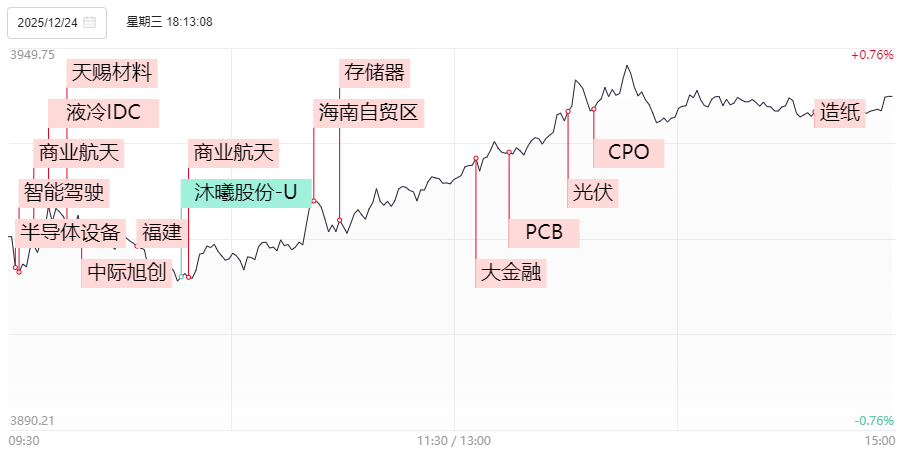
涨停复盘:今日全市共75股涨停,连板股总数14只,商业航天概念持续爆发,神剑股份5连板
Jin Rong Jie· 2025-12-24 10:50
Core Viewpoint - The A-share market showed a narrow fluctuation in the morning and rebounded in the afternoon, with significant gains across major indices, indicating a positive market sentiment and strong sector performance, particularly in commercial aerospace and computing hardware [1] Sector Movements - The commercial aerospace sector experienced a notable surge, with over 20 stocks hitting the daily limit, including Shenjian Co. with five consecutive limit-ups and Guoji Precision Engineering with three limit-ups in four days [1][7] - The computing hardware sector also saw a rise, with Huanxu Electronics achieving three limit-ups in six days and Yintang Intelligent Control hitting the limit [1][8] - The Fujian sector strengthened, highlighted by Anji Food with four limit-ups in seven days and Hexing Packaging with three consecutive limit-ups [1][8] - The PCB sector quickly escalated, with Shengyi Technology hitting the limit and reaching a historical high [1] Limit-Up Analysis - A total of 75 stocks hit the limit today, with 14 stocks achieving consecutive limit-ups, and a limit-up rate of 78% (excluding ST and delisted stocks) [1][4] - Key stocks in the commercial aerospace sector include: - Shenjian Co. (5 limit-ups) [7] - Guoji Precision Engineering (3 limit-ups in 4 days) [7] - Zai Sheng Technology (1 limit-up, supplier for SpaceX) [7] - Other notable stocks include: - Anji Food (10 limit-ups in 17 days) [8] - Hexing Packaging (3 limit-ups) [8] Related Hotspots - Recent developments in the commercial aerospace sector include the completion of the IPO guidance for Blue Arrow Aerospace, indicating a significant step in its capital market journey [8] - The successful first flight of the Long March 12A rocket on December 23, which aimed to achieve secondary orbit insertion, although the primary rocket recovery did not meet expectations, providing valuable data for future technology iterations [8]


CPO,百亿美元规模
半导体芯闻· 2025-12-24 10:19
Core Insights - The article discusses the advancements and market trends in the CPO (Co-Packaged Optics) technology within the optical communication industry, highlighting its growing importance for AI and data center applications [2][5]. Group 1: CPO Technology Developments - Nvidia announced the adoption of single-channel 200G CPO technology in its InfiniBand and Ethernet switches in March [2]. - Meta's testing in September demonstrated the reliability of Broadcom's previous CPO products, leading to Broadcom's launch of its third-generation single-channel 200G CPO product in October [2]. - At the TEF conference in December, Nvidia reported that AI clusters based on CPO switches showed a tenfold improvement in reliability compared to systems using pluggable optical modules, translating to a fivefold increase in cluster uptime [2]. Group 2: Market Trends and Predictions - Ciena's acquisition of Nubis Communications and Marvell's acquisition of Celestial AI indicate major companies' focus on CPO technology, with expectations of more M&A activities in this space by early 2026 [5]. - Currently, CPO applications are limited to Scale-Out network design switches, with the next challenge being to extend Scale-Up interconnects beyond single racks, aiming to scale GPU clusters from 128-144 chips to 500-1000 chips for accelerated AI training [5]. - Amazon is using AEC to interconnect Trainium accelerators across two racks, but this may not scale well to more racks, while Huawei employs 800G pluggable LPO optical modules in its vertical Scale-Up network [5]. Group 3: Future Market Outlook - LightCounting has raised its market forecast for CPO, which now includes 1.6T and 3.2T ports for Scale-Up scenarios with transmission distances under 50 meters [5]. - Broadcom and Nvidia are expected to launch integrated CPO Scale-Up switches, GPUs, or XPUs by 2026, with shipments starting in 2027 [8]. - By 2030, the market size for CPO engines covering both Scale-Up and Scale-Out scenarios is projected to reach $10 billion, with nearly 100 million CPO ports expected to be shipped [8].



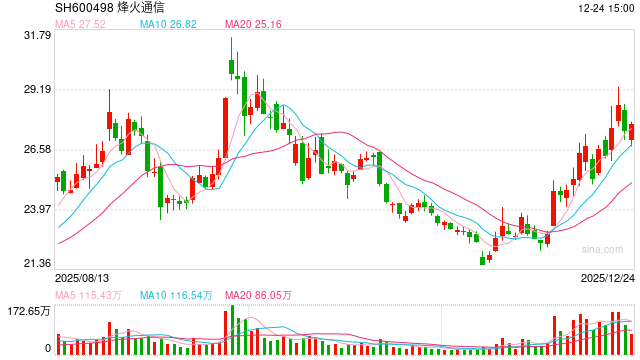
烽火通信关联方低价包揽11亿定增有息负债仍在攀升 营收下滑政府补贴上升远超净利|CPO融资潮
Xin Lang Zheng Quan· 2025-12-24 09:46
Core Viewpoint - The capital market is witnessing a surge in interest in the optical communication industry, driven by the demand for CPO (Co-Packaged Optics) technology, which is becoming a critical infrastructure for AI computing power [2][9]. Group 1: Company Financials - In 2024, the company reported revenue of 28.549 billion, a year-on-year decline of 8.29%, while net profit attributable to shareholders was 703 million, an increase of 39.05% [9]. - For the first three quarters of 2025, the company achieved revenue of 17.072 billion, a year-on-year decrease of 19.3%, with net profit of 513 million, up 30.28% [9]. - The company's gross profit margin has remained low, slightly above 20%, despite R&D expenditures consistently exceeding 12% of revenue [9][11]. Group 2: Debt and Financial Health - Following a recent capital increase, the company's debt ratio decreased from 64.99% at the end of 2024 to 61.42% by the end of Q3 2025, although interest-bearing debt rose significantly from approximately 10.3 billion to about 12.8 billion [3]. - The company has faced ongoing challenges with inventory depreciation and bad debt, with asset impairment losses increasing year-on-year [6][8]. Group 3: Government Support and Subsidies - Government subsidies and tax refunds have significantly contributed to the company's profitability, with these amounts surpassing net profit in recent years [9]. - From 2022 to 2024, government support and tax refunds totaled 280 million, 450 million, and 770 million, accounting for 68%, 89%, and 110% of net profit, respectively [9]. Group 4: Market Position and Technology - The company has developed a 400G coherent optical module and is preparing for 800G/1.6T silicon photonic module technology, which can reduce the size of 800G modules by 40% and power consumption by 35% [5]. - The CPO market is projected to reach 8.1 billion by 2030, with a compound annual growth rate of 137%, indicating significant growth potential in the optical communication sector [11].

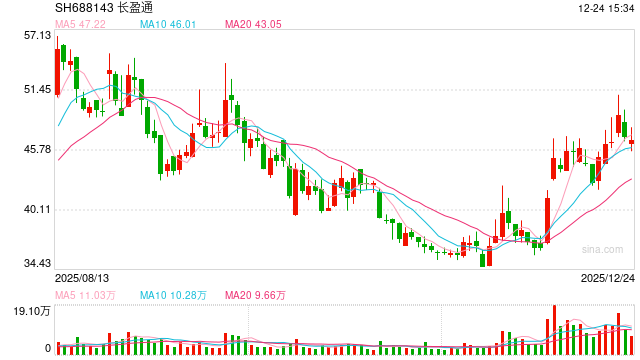
长盈通定增4.5倍溢价收购问题标的 管理费用率达20%、股权激励或成变相补贴|CPO融资潮
Xin Lang Cai Jing· 2025-12-24 09:46
Core Viewpoint - The capital heat in the optical communication industry has expanded from stock market exuberance to private placements and mergers, driven by the demand for AI computing power and the emergence of CPO technology as a core infrastructure [2][3]. Company Overview - Changyingtong's main business includes the research, production, and sales of specialty optical fibers, optical cables, optical devices, new materials, high-end equipment, and optoelectronic systems, with a focus on optical fiber rings used in fiber optic gyroscopes and specialty optical fibers for CPO technology [3][15]. Recent Financing Activity - In October 2023, Changyingtong finalized a private placement plan to raise 140 million yuan for the acquisition of 100% equity in Wuhan Shengyisheng Optoelectronics Technology Co., Ltd., with a transaction premium of 4.5 times [4][15]. - The acquisition price was 158 million yuan, representing a premium of 456.7% over Shengyisheng's net asset value, with a commitment from the seller to achieve a cumulative net profit of no less than 50 million yuan over the next three years [4][15]. Financial Performance - In the first three quarters of 2023, Changyingtong reported revenue of 269 million yuan, a year-on-year increase of 46.8%, and a net profit of 30.79 million yuan, marking a turnaround from losses [8][18]. - However, the company's capital expenditures have consistently exceeded operating cash flow, leading to financial strain [8][18]. Profitability Concerns - Shengyisheng's profitability is under scrutiny, with projected net profits of -2.45 million yuan in 2023 and 2.75 million yuan in 2024, and a forecasted increase to 10.97 million yuan in the first half of 2025, while its gross margin remains significantly lower than Changyingtong's and industry averages [4][17]. - The dependency on major clients is alarming, with the top five customers accounting for over 98% of Shengyisheng's revenue, raising concerns about customer concentration risk [7][17]. Accounts Receivable Issues - By the end of 2024, Shengyisheng's accounts receivable reached 28.59 million yuan, a year-on-year increase of 217.16%, with accounts receivable constituting 41.96% of total assets, indicating deteriorating cash flow and potential bad debt risks [7][17]. Management Expenses - Changyingtong's management expense ratio is notably high at 20%, significantly exceeding comparable companies, which raises questions about cost management [8][18]. - Part of the high management expenses is attributed to a recent stock incentive plan, which has been criticized for potentially providing disguised subsidies to a select group of employees due to low exercise thresholds [10][20]. Market Outlook - The CPO market is projected to reach a scale of 8.1 billion USD by 2030, with a compound annual growth rate of 137%, indicating significant growth potential in the optical communication sector [10][20].

达利凯普(301566.SZ):产品应用包括光通信等领域的毫米波信号等场景
Ge Long Hui· 2025-12-24 08:02
Group 1 - The core viewpoint of the article is that Dali Cap (301566.SZ) has indicated its products are applied in various fields, including millimeter-wave signals for optical communication [1] Group 2 - The company is involved in the development of technologies that utilize millimeter-wave signals [1] - The applications of the company's products extend to multiple scenarios, highlighting its versatility in the technology sector [1]