建筑业

Search documents
西安市第五次全国经济普查顺利完成
Xi An Ri Bao· 2025-04-29 03:45
Core Insights - The fifth national economic census in Xi'an reveals significant growth in the number of legal entities engaged in the secondary and tertiary industries, with a total of 470,800 units by the end of 2023, marking a 91.1% increase compared to the end of 2018 [1][2] Group 1: Legal Entities and Employment - By the end of 2023, the number of legal entities in the secondary and tertiary industries reached 470,800, an increase of 224,500 units, or 91.1% from 2018 [1] - The number of individual business operators reached 651,300, an increase of 118,600, or 22.3% [1] - Employment in the secondary and tertiary industries totaled 5.2973 million, an increase of 1.2681 million, or 31.5% since 2018 [2] Group 2: Industry Breakdown - The top three industries in terms of legal entities in the secondary and tertiary sectors are wholesale and retail (127,800 units, 27.2%), construction (86,200 units, 18.3%), and rental and business services (71,700 units, 15.2%) [1] - In individual business operators, the leading sectors are wholesale and retail (285,900 units, 43.9%), accommodation and catering (120,800 units, 18.6%), and information transmission, software, and IT services (63,100 units, 9.7%) [2] Group 3: High-Tech and Digital Economy - The number of legal entities in the information transmission, software, and IT services sector grew by 155.4% to 39,824 units, with employment increasing by 58.6% to 325,357 [3] - The high-tech manufacturing sector saw a 68.9% increase in legal entities, totaling 500, which represents 27.4% of all large-scale manufacturing entities [4] - The digital economy core industry had 45,903 legal entities, generating an annual revenue of 655.57 billion, with digital product manufacturing accounting for 54.7% of this revenue [6]
中东,中国基建的第二主场
3 6 Ke· 2025-04-29 01:12
Core Points - The completion of the world's tallest hotel, the Dubai Blue Sky Hotel, marks a significant achievement for China Railway 18th Bureau, showcasing China's construction capabilities in the Middle East [1][3] - China's investment in infrastructure projects in the Middle East has reached several hundred billion dollars, with a notable increase in contracts from 2013 to 2017, tripling from $18.46 billion to $55.66 billion [3][4] - The Middle East's wealth from oil exports provides a strong financial foundation for infrastructure development, making it an ideal market for Chinese construction companies [4][22] Demand - The Middle East, holding 60% of the world's oil reserves, has transformed from nomadic tribes to modern wealthy nations in a few decades [5] - In 2023, Saudi Aramco's revenue reached $440 billion, contributing 40% to Saudi Arabia's GDP, while Abu Dhabi contributed 68% to the UAE's GDP with a total income of $310 billion [6] - The region's population growth and economic development are driving significant infrastructure demand, with a population exceeding 500 million and a 6% annual growth rate [9][10] Advantages - Chinese construction companies have become the largest contractors in the Middle East, holding a 40% market share since 2022, supported by their technological strength and competitive pricing [11][22] - The Chinese construction industry has a strong foundation due to government support and rapid industrial growth, leading to a significant presence in global markets [12][17] - China's construction costs are typically 40% to 60% lower than those in other regions, with project timelines being 60% to 70% shorter, enhancing competitiveness [17] Market Trends - Middle Eastern countries have set ambitious infrastructure development goals, with Saudi Arabia's Vision 2030 plan aiming for $1.1 trillion in investments and the UAE planning to allocate 46% of its budget to infrastructure by 2025 [10][22] - The shift in global energy consumption patterns poses a challenge to the oil-dependent economies of the Middle East, prompting a diversification of their economic structures towards infrastructure, renewable energy, and high-end manufacturing [6][19] Conclusion - The journey of Chinese infrastructure in the Middle East began in 2009 with the Mecca Light Rail project, gradually building trust and reputation through high-quality and efficient project delivery [23] - As more projects are executed, the influence of Chinese construction firms in the Middle East and globally is expected to grow, positioning the region as a critical hub for international expansion [23]





全球4大“隐世家族”,据说他们控制着整个世界,中国也有一家
Sou Hu Cai Jing· 2025-04-28 03:44
Group 1: Rothschild Family - The Rothschild family is known for their historical financial maneuvers, such as Nathan Rothschild's strategic selling of British bonds during the Waterloo battle, which allowed them to profit significantly from the ensuing market panic [4][5] - The family maintains a low profile in modern times, engaging in substantial investments like the $27 billion restructuring of an energy giant, while adhering to traditional practices [5][7] Group 2: Rockefeller Family - The Rockefeller family, originally from the oil industry, successfully diversified their wealth after the breakup of Standard Oil, with descendants now managing significant real estate and investments [8][10] - Recently, the family has taken unconventional steps, such as insuring lunar assets in anticipation of space tourism, showcasing their continued influence and wealth [12] Group 3: DuPont Family - The DuPont family has a legacy that began with explosives and has evolved into a diverse conglomerate, producing everything from ammunition to beauty products [14][16] - Their unique approach to maintaining family lineage includes strict marriage rules, resulting in a notable focus on preserving their wealth and influence [18] Group 4: Bei Family - The Bei family, with roots in traditional Chinese medicine, has a rich history dating back to the Ming Dynasty, emphasizing cultural heritage and craftsmanship [19][21] - Their contributions to architecture, particularly through the work of architect I.M. Pei, reflect a blend of modernity and tradition, encapsulating their family's legacy [23] Group 5: Wealth Preservation Strategies - These elite families utilize advanced information networks, educational rigor, and a facade of modesty to maintain their wealth across generations [24][25] - The Rothschilds, Rockefellers, and Beis have all demonstrated unique methods of wealth management that intertwine cultural significance with financial acumen [24][25]

2024年黑龙江省国民经济和社会发展统计公报
Zhong Shang Chan Ye Yan Jiu Yuan· 2025-04-19 00:05
Investment Rating - The report does not explicitly provide an investment rating for the industry Core Insights - The overall economic performance of Heilongjiang Province in 2024 shows a GDP of 16476.9 billion yuan, with a growth rate of 3.2% compared to the previous year [8] - The three major industries' contributions to GDP are as follows: primary industry at 3203.3 billion yuan (2.9% growth), secondary industry at 4147.3 billion yuan (-0.2% decline), and tertiary industry at 9126.2 billion yuan (4.7% growth) [8] - The province's population at the end of 2024 is 30.29 million, with an urbanization rate of 68.05%, reflecting a 0.94 percentage point increase from the previous year [14] - The agricultural sector shows a total output value of 5904.1 billion yuan, with a growth of 3.1%, and a grain production of 8001.7 million tons, maintaining the top position among provinces [20] - Industrial production has seen a decline of 3.1% in the added value of large-scale industries, with notable growth in the petrochemical industry at 7.9% [24][25] - Fixed asset investment increased by 6.0%, with significant growth in infrastructure investment at 11.0% [32][33] - The retail market shows a total social retail sales of 5738.9 billion yuan, growing by 1.9%, with a notable increase in online retail sales by 9.2% [34][35] - The province's foreign trade reached a total value of 3122.8 billion yuan, with exports growing by 14.4% [36] Summary by Sections Economic Overview - Heilongjiang's GDP reached 16476.9 billion yuan, with a growth of 3.2% [8] - The three industries' contributions are 19.4% for primary, 25.2% for secondary, and 55.4% for tertiary [8] Population and Employment - The total population is 30.29 million, with an urbanization rate of 68.05% [14] - Urban employment increased by 37.7 million, exceeding the annual target by 125.5% [17] Agriculture - Total agricultural output value is 5904.1 billion yuan, with a growth of 3.1% [20] - Grain production is 8001.7 million tons, maintaining the top position nationally [20] Industry - Industrial added value decreased by 3.1%, with the petrochemical sector growing by 7.9% [24][25] - High-tech manufacturing increased by 4.1% [25] Investment - Fixed asset investment grew by 6.0%, with infrastructure investment up by 11.0% [32][33] Trade - Total foreign trade value reached 3122.8 billion yuan, with exports increasing by 14.4% [36] Consumer Market - Social retail sales totaled 5738.9 billion yuan, growing by 1.9% [34] - Online retail sales increased by 9.2% [35]
四川发布地方性“好房子”评价标准
Zhong Guo Xin Wen Wang· 2025-04-16 00:45
Core Points - The "Sichuan Province Good Housing Evaluation Standard" was officially released on April 15, emphasizing a results-oriented approach based on public needs [1] - The standard includes seven primary indicators: transportation and amenities, safety and quality, functionality and space, comfort and health, green and low-carbon, smart and convenient, and operation and property management, along with an "innovation bonus item" [1] - The evaluation criteria are based on over 7,000 resident questionnaires from across Sichuan, incorporating public transport, schools, and medical facilities into the assessment for the first time [1] - Key safety details such as falling objects and anti-slip measures are classified as "one-vote veto" items, promoting comprehensive safety management throughout the housing lifecycle [1] - The standard encourages the application of advanced technologies like drone delivery and home cloud systems, highlighting a future-oriented approach to housing [1] - The implementation of the standard aims to shift developers from "meeting standards" to "quality competition," providing consumers with transparent and scientific housing selection criteria [1] Implementation Details - The standard is guided by the Sichuan Provincial Department of Housing and Urban-Rural Development and was jointly compiled by various associations, set to be officially implemented on June 1, 2025 [2] - Future steps include pilot project evaluations and policy incentives to guide industry upgrades, with the goal of making "three-star good housing" a new residential hallmark in Sichuan [2]
产需两端继续扩张 3月份制造业PMI升至50.5%
Zheng Quan Ri Bao· 2025-03-31 16:29
本报记者 孟珂 3月31日,国家统计局服务业调查中心和中国物流与采购联合会发布了中国采购经理指数。数据显示,3月份,制造业采购 经理指数(PMI)、非制造业商务活动指数和综合PMI产出指数分别为50.5%、50.8%和51.4%,比2月份上升0.3个百分点、0.4 个百分点和0.3个百分点。 文韬认为,大型企业供需继续保持较快增长。随着一揽子存量政策和增量政策以及各项助力中小企业政策持续发力,加上 众多项目开工,中小企业回稳运行。 值得关注的是,三大重点行业PMI稳中有升。装备制造业、高技术制造业和消费品行业PMI分别为52.0%、52.3%和 50.0%,比2月份上升1.2个百分点、1.4个百分点和0.1个百分点,景气水平连续两个月回升;高耗能行业PMI为49.3%,比2月份 下降0.5个百分点。 展望二季度,文韬预计,叠加前期实施的一揽子存量政策和增量政策继续落地显效,二季度宏观经济预计继续取得"量的 稳定增长"和"质的较快提升"。企业对后市预期也较为乐观,3月份制造业生产经营活动预期指数为53.8%,连续6个月运行在 54%左右的较好水平。 数据显示,3月份,非制造业商务活动指数为50.8%,比上月上升 ...
如何理解PMI与EPMI背离?
申万宏源宏观· 2025-03-31 08:10
Core Viewpoint - The divergence between PMI and EPMI is primarily due to the differentiation in the economic conditions of emerging and traditional industries, with the former showing stronger performance in March [1][8]. Manufacturing Sector - In March, the manufacturing PMI increased moderately by 0.3 percentage points to 50.5%, which is below market expectations [1][8]. - The EPMI for strategic emerging industries rose significantly by 10.6 percentage points to 59.6%, indicating a strong recovery in these sectors [1][8]. - High-tech and equipment manufacturing sectors saw substantial PMI increases of 1.4 and 1.2 percentage points, reaching 52.3% and 52% respectively, while traditional sectors like consumer goods manufacturing only saw a marginal increase of 0.1 percentage points to 50% [2][13]. - The production index for EPMI surged by 21.6 percentage points, contrasting with a slight increase of 0.1 percentage points in the manufacturing PMI production index, which reached 52.6% [2][17]. Non-Manufacturing Sector - The non-manufacturing PMI rose by 0.4 percentage points to 50.8%, with the construction sector's PMI increasing by 0.7 percentage points to 53.4%, although this was weaker than seasonal expectations [3][5]. - The service sector's PMI increased by 0.3 percentage points to 50.3%, but this was also below the same period in previous years [3][5]. - The construction sector remains constrained by weak real estate investment, while the service sector is limited by the performance of life services [3][22]. Future Outlook - There are increasing risks to exports, but potential improvements in the economy may arise from accelerated import substitution and recovery in the service sector and real estate sales [3][31]. - The manufacturing sector may receive support from accelerated import substitution in industries like electrical and mechanical equipment, while the construction and service sectors show signs of recovery [3][31]. Regular Tracking - The manufacturing PMI continues to show a mild recovery, with production and new order indices slightly increasing [4][37]. - The non-manufacturing PMI reflects a general improvement, with both construction and service sectors showing slight increases [5][46].
【广发宏观钟林楠】怎么看利率走势
郭磊宏观茶座· 2025-03-30 12:01
Core Viewpoint - Since mid-February 2025, the bond market has experienced a notable adjustment, with the 10-year government bond yield rising from around 1.6% to approximately 1.9% [1][9]. Group 1: Market Adjustments and Trends - The rise in bond yields is attributed to three main factors: a significant breakthrough in Deep Seek, increased micro expectations and risk appetite in the financial market following a private entrepreneur symposium, and a clear front-loading of government bond issuance [1][9]. - The current pricing phase appears to be largely completed, with the 10-year government bond yield slightly decreasing to around 1.8% after peaking at 1.9% [1][10]. - The narrow liquidity has stabilized in March, with the central rate of funds not rising further, indicating a potential easing of market expectations regarding monetary policy tightening [1][10]. Group 2: Policy Rate Framework - The expected fluctuation range for the 10-year government bond yield this year is approximately 1.7% to 1.9%, with a projected reduction in policy rates by about 20-40 basis points to a range of 1.1% to 1.3% [2][12]. - The spread is expected to correlate well with the broad credit pulse, which is anticipated to be around 25%-26% this year, leading to a corresponding spread center of 60 basis points [2][12]. Group 3: Future Pricing Trends - Historical data indicates that the 10-year government bond yield has undergone significant adjustments in the past, with most returning to a downward trend after a 25-35 basis point adjustment. However, two instances in 2016 and 2020 saw trend reversals due to fundamental confirmations and shifts in monetary policy [3][13]. - The future trajectory of interest rates will be significantly influenced by the state of narrow liquidity, monetary policy, and economic fundamentals [3][13]. Group 4: Economic Fundamentals - The construction industry's performance is crucial in determining interest rate trends, with recent stabilization observed in the sector contributing to the upward movement of the yield center [6][20]. - Fiscal policies, including the issuance of special bonds and adjustments to high-risk debt areas, are expected to support the construction sector and overall economic recovery [6][20]. - Current low price levels are anticipated to rise, with policy adjustments aimed at stabilizing nominal growth and encouraging investment [7][22][23]. Group 5: Summary of Risks and Opportunities - The 10-year government bond yield is expected to trigger phase-specific opportunities upon reaching the upper limit of its fluctuation range, although expectations for narrow liquidity should remain tempered [8][25]. - Key risks include potential upward pressure from the construction sector and rising price levels, which require close monitoring of supply-side developments [8][25].

2025年Q2宏观形势展望:中美缓和窗口期风险偏好助力科技牛
ZHESHANG SECURITIES· 2025-03-16 05:43
Investment Rating - The report indicates a positive outlook for the technology sector, suggesting a "bull market" driven by improved risk appetite due to potential easing in US-China relations [1][8]. Core Insights - The core insight of the report emphasizes that the performance of major asset classes in Q2 will largely depend on risk appetite, with a particular focus on the equity market benefiting from improved US-China dialogue [1][8]. - The report anticipates a slight economic slowdown in Q2, with GDP growth expected to decrease to approximately 4.9% from 5.1% in Q1, primarily due to weaker internal dynamics in the private sector [2][12]. - The report highlights that broad infrastructure and manufacturing investments are expected to remain resilient, contributing to economic recovery [2][21]. Summary by Sections Economic Overview - Q2 GDP growth is projected to slow to 4.9%, influenced by a recovery in both supply and demand driven by counter-cyclical policies [2][12]. - Retail sales growth is expected to reach 5.5% in Q2, supported by low base effects and policy stimulus [18][19]. Monetary Policy - The report suggests a potential reserve requirement ratio (RRR) cut in Q2, while interest rate cuts remain uncertain due to external pressures [3][4]. Fiscal Policy - Fiscal policy is expected to maintain a proactive stance, with an increase in government bond issuance and a focus on special bonds for land reserves [4][46]. Industry Policy - The report indicates a push for innovation and energy consumption control, with a focus on supporting new industries such as quantum technology and AI [4][26]. US Economic Outlook - The US economy is expected to stabilize in Q2, with the report attributing recent economic slowdowns to uncertainties in fiscal policy and trade tariffs [5][7]. Major Asset Classes - The report predicts that the stock market will maintain a high-risk appetite leading up to potential meetings between US and Chinese leaders, with technology stocks expected to perform well [1][8].
热点思考 | “倒春寒”如何扰动经济?
赵伟宏观探索· 2025-03-10 09:37
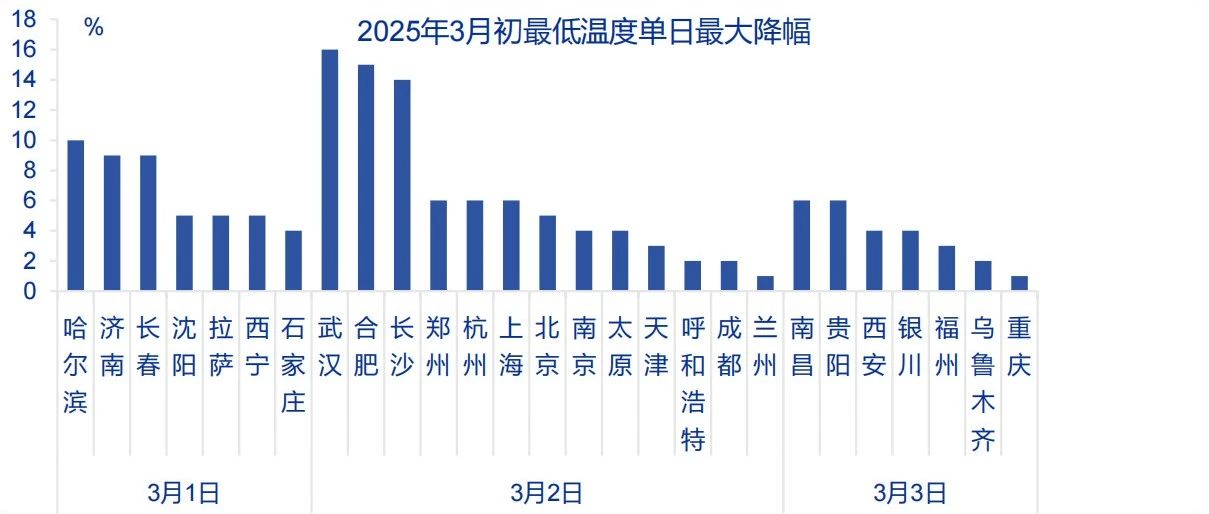
Group 1 - The core viewpoint of the article discusses the early occurrence and low intensity of the "late spring cold" phenomenon in March, which is unusual as it affected regions like Henan and Shandong [2][3][23] - The "late spring cold" typically occurs between March and May, with a significant drop in average temperatures below the seasonal norm, impacting agricultural production [2][4][10] - This year's "late spring cold" was noted for its early onset, being the earliest in nearly a decade, and lasted only three days, with temperature drops of 6-12°C, which is less severe than the historical average of around 15°C [2][11][24] Group 2 - The impact on agricultural prices is expected to be limited, as the "late spring cold" occurred before the flowering period of fruit trees, thus minimizing potential disruptions to fruit production [4][25][26] - Historical data indicates that previous "late spring cold" events during flowering periods led to significant price increases in fruits, but this year's timing suggests a lower risk of such price spikes [4][14][25] - Vegetable production is less affected by minimum temperatures and more by average temperatures; this year's average temperatures are close to seasonal norms, indicating manageable risks for vegetable supply [4][15][26] Group 3 - The construction industry experienced a noticeable decline in activity due to the cold weather, particularly in North and Central China, where temperatures fell below the suitable range for outdoor work [6][18][27] - The construction sector's slowdown may temporarily impact infrastructure investment, but a forecasted temperature rise later in March could mitigate long-term effects [6][19][27] - The cold weather also indirectly affected consumer movement and spending, but the overall risk to retail sales remains low due to the short duration of the cold spell and the relatively stable consumer activity in higher retail share regions [6][20][27]