高技术制造业

Search documents
国家统计局:工业生产较快增长,装备制造业和高技术制造业发展较好
Xin Lang Cai Jing· 2025-08-15 02:07
Core Insights - In July, the industrial added value of large-scale enterprises in China increased by 5.7% year-on-year and 0.38% month-on-month [1] - The mining industry saw a year-on-year increase of 5.0%, manufacturing increased by 6.2%, and the production and supply of electricity, heat, gas, and water grew by 3.3% [1] - The equipment manufacturing industry experienced an 8.4% year-on-year increase, while high-tech manufacturing grew by 9.3%, outperforming the overall industrial added value by 2.7 and 3.6 percentage points respectively [1] Economic Type Analysis - State-controlled enterprises' added value increased by 5.4% year-on-year; joint-stock enterprises grew by 6.5%, foreign and Hong Kong, Macao, and Taiwan-invested enterprises rose by 2.8%, and private enterprises increased by 5.0% [1] Product Performance - The production of 3D printing equipment, industrial robots, and new energy vehicles increased by 24.2%, 24.0%, and 17.1% year-on-year respectively [1] Overall Industrial Performance - From January to July, the industrial added value of large-scale enterprises increased by 6.3% year-on-year [1] - In July, the manufacturing purchasing managers' index was at 49.3%, while the business activity expectation index was at 52.6% [1] Profitability - From January to June, the total profit of large-scale industrial enterprises reached 34,365 billion yuan, a year-on-year decrease of 1.8% [1]
国家统计局:7月份国民经济保持稳中有进发展态势
Guo Jia Tong Ji Ju· 2025-08-15 02:05
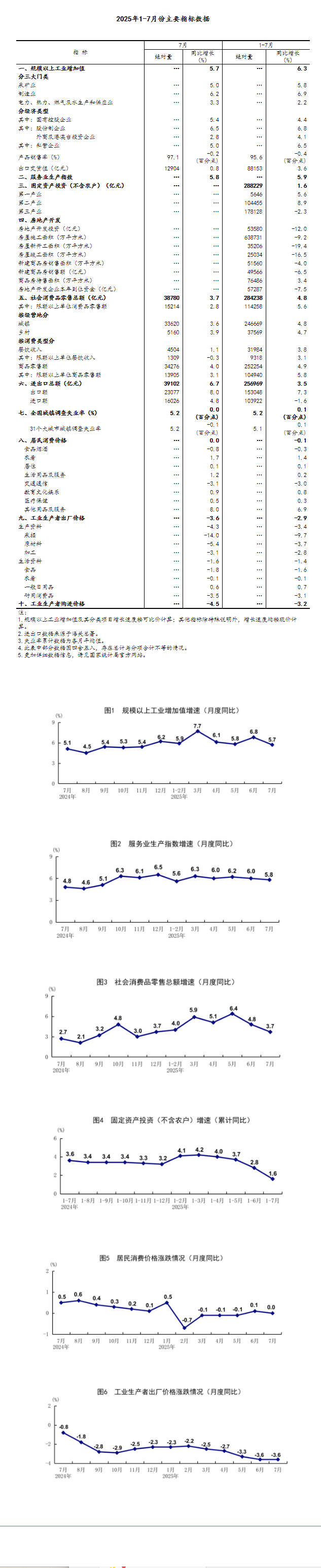
Economic Overview - In July, under the strong leadership of the Central Committee, the national economy maintained a steady growth trend, with production and demand continuing to rise, and overall employment and prices remaining stable [1][10]. Industrial Production - In July, the industrial added value above designated size increased by 5.7% year-on-year and 0.38% month-on-month. The mining industry grew by 5.0%, manufacturing by 6.2%, and electricity, heat, gas, and water production and supply by 3.3% [2]. - The equipment manufacturing industry saw an 8.4% increase, while high-tech manufacturing grew by 9.3%, outperforming the overall industrial growth by 2.7 and 3.6 percentage points respectively [2]. - From January to July, the industrial added value increased by 6.3% year-on-year, with the manufacturing purchasing managers' index at 49.3% in July [2]. Service Sector - The service production index rose by 5.8% year-on-year in July, with significant growth in information transmission, software, and IT services (11.9%), finance (8.7%), and leasing and business services (8.0%) [3]. - From January to July, the service production index increased by 5.9%, and the revenue of large-scale service enterprises grew by 7.5% in the first half of the year [3]. Retail Sales - In July, the total retail sales of consumer goods reached 38,780 billion yuan, a year-on-year increase of 3.7% [4]. - Online retail sales amounted to 86,835 billion yuan, growing by 9.2%, with physical goods online retail sales at 70,790 billion yuan, up 6.3% [4]. Fixed Asset Investment - From January to July, fixed asset investment (excluding rural households) totaled 288,229 billion yuan, a year-on-year increase of 1.6%, with manufacturing investment growing by 6.2% [5]. - Infrastructure investment rose by 3.2%, while real estate development investment fell by 12.0% [5]. Trade and Exports - In July, the total value of goods imports and exports reached 39,102 billion yuan, a year-on-year increase of 6.7%, with exports growing by 8.0% and imports by 4.8% [6][7]. - From January to July, the total value of goods imports and exports was 256,969 billion yuan, up 3.5% year-on-year [6]. Employment - The urban surveyed unemployment rate averaged 5.2% from January to July, with a slight increase of 0.2 percentage points in July compared to the previous month [8]. Consumer Prices - In July, the Consumer Price Index (CPI) remained flat year-on-year, with a month-on-month increase of 0.4% [9]. - The core CPI, excluding food and energy, rose by 0.8% year-on-year, indicating a slight increase in inflationary pressure [9].

7月份国民经济保持稳中有进发展态势
Guo Jia Tong Ji Ju· 2025-08-15 02:01
(2025年8月15日) 国家统计局 7月份,在以习近平同志为核心的党中央坚强领导下,各地区各部门认真贯彻落实党中央、国务院决策部署,坚持稳中求进工作总基调,完整准确全面贯彻 新发展理念,加快构建新发展格局,加紧实施更加积极有为的宏观政策,纵深推进全国统一大市场建设,国民经济保持稳中有进发展态势,生产需求持续增 长,就业物价总体稳定,新质生产力培育壮大,高质量发展取得新成效。 一、工业生产较快增长,装备制造业和高技术制造业发展较好 7月份,全国规模以上工业增加值同比增长5.7%,环比增长0.38%。分三大门类看,采矿业增加值同比增长5.0%,制造业增长6.2%,电力、热力、燃气及水 生产和供应业增长3.3%。装备制造业增加值同比增长8.4%,高技术制造业增加值增长9.3%,分别快于全部规模以上工业增加值2.7和3.6个百分点。分经济类 型看,国有控股企业增加值同比增长5.4%;股份制企业增长6.5%,外商及港澳台投资企业增长2.8%;私营企业增长5.0%。分产品看,3D打印设备、工业机 器人、新能源汽车产品产量同比分别增长24.2%、24.0%、17.1%。1-7月份,全国规模以上工业增加值同比增长6.3%。 ...

IMF上调中国2025增速至4.8% 外资齐增预期 市场信心高涨
Sou Hu Cai Jing· 2025-08-14 23:56
近期,多家外资金融机构密集上调对中国经济增速的预测,这一现象引发广泛关注。国际货币基金组织将中国2025年经济增速预测值上调至4.8%,较4月预 测提升0.8个百分点。高盛、摩根大通、摩根士丹利、野村等知名投行也纷纷调高预期,上调幅度在0.3至0.7个百分点之间。这种集体性的预期调整背后,反 映出国际市场对中国经济发展前景的信心增强。 财政政策与货币政策的紧密配合,为经济增长提供了有力保障。促消费、化解地方债务、优化营商环境、支持民营企业等措施同步推进,有效提振内需和市 场信心。上半年全国发行新增地方政府专项债券2.16万亿元,同比增长45%,货币政策保持流动性充裕,各类结构性货币政策工具加力支持科技创新、提振 消费、扶持小微企业。 核心CPI回升反映扩内需政策持续显效。7月份扣除食品和能源价格的核心CPI同比上涨0.8%,涨幅为2024年3月以来最高。家用器具、文娱耐用消费品等价 格环比涨幅明显,飞机票、旅游、宾馆住宿和交通工具租赁费价格环比涨幅均高于季节性水平。 近期出台的重点行业产能治理、培育服务消费新增长点等政策安排,将进一步推动经济结构优化。生育补贴、全面取消在就业地参保户籍限制等惠民生举措 密集落 ...

创新动能强劲 制造业利润有望持续改善
Zhong Guo Chan Ye Jing Ji Xin Xi Wang· 2025-08-14 22:56
Core Insights - The manufacturing sector in China has shown stable growth in sales revenue, with a notable increase in high-end and high-tech manufacturing, contributing significantly to economic stability [1][2] - In June, the profits of large-scale manufacturing enterprises turned from a decline of 4.1% in May to a growth of 1.4%, indicating a recovery trend [2][12] - The "Two New" policies have effectively supported various industries, leading to significant profit improvements, particularly in sectors like medical equipment and smart drones [5][6] Group 1: Manufacturing Performance - In the first half of the year, manufacturing sales revenue growth outpaced the overall growth of enterprises by 1.5 percentage points, with equipment manufacturing and high-tech manufacturing revenues increasing by 8.9% and 11.9% respectively [1] - The profit growth in the automotive sector was particularly striking, with a 96.8% increase in June, driven by promotional activities and investment returns [2][9] - The overall profit of large-scale industrial enterprises in June was 715.58 billion yuan, a year-on-year decline of 4.3%, but the decline was less severe than in May [2][12] Group 2: Policy Impact - The implementation of the "Two New" policies has expanded support categories and subsidies, leading to rapid profit growth in related industries [5][6] - The government has introduced financial measures, including the issuance of 200 billion yuan in long-term special bonds to support equipment upgrades, which has significantly boosted the equipment manufacturing sector [7][8] - The policies have created a positive cycle in the industry, enhancing operational efficiency and vitality within the supply chain [4][7] Group 3: Future Outlook - The manufacturing sector is expected to continue its recovery trend in the second half of the year, supported by stable domestic policies and a potential rebound in external demand [12] - The growth in high-end, intelligent, and green manufacturing is anticipated to provide a stable foundation for high-quality industrial development [10][11] - The market for equipment upgrades is projected to exceed 5 trillion yuan annually, indicating substantial potential for growth in the equipment manufacturing sector [7]
IMF上调中国经济增速预测,华尔街巨头纷纷看好中国,发生了什么?专家解读
Mei Ri Jing Ji Xin Wen· 2025-08-14 22:52
Group 1 - The core viewpoint of the articles indicates a rising optimism among fund managers regarding China's economic growth, with a net optimism value increasing to 11% in August, the highest since March 2025, compared to just 2% in July [1] - The IMF has raised its forecast for China's GDP growth in 2025 to 4.8%, an increase of 0.8 percentage points from its April prediction, reflecting a broader trend of upward revisions by various foreign financial institutions [2] - Key factors supporting the increased confidence in China's economic growth include resilient consumer spending, strong exports, and ongoing industrial transformation [5][6] Group 2 - The IMF attributes the unexpected GDP growth rate of 6.0% to robust exports and fiscal measures that support consumption, with exports to other regions compensating for declines in exports to the U.S. [3] - Four main reasons for the upward revision of economic growth expectations by foreign institutions are identified: unexpected economic resilience, the synergistic effect of policies, long-term trends in industrial competitiveness and technological breakthroughs, and marginal improvements in the external environment [5][6][7] - In the first half of the year, China's GDP grew by 5.3%, with domestic demand contributing 68.8% to this growth, highlighting the importance of internal consumption as a key driver [6][8] Group 3 - The contribution of final consumption expenditure to economic growth reached 52% in the first half of the year, with strong growth in high-tech manufacturing, particularly in sectors like 3D printing and new energy vehicles [8][11] - The ongoing structural upgrades in consumption, supported by policies and rising incomes, are expected to inject long-term growth momentum into the economy [13] - The "14th Five-Year Plan" emphasizes high-tech manufacturing as a core direction, with increased fiscal support for R&D and targeted monetary policies to facilitate industrial upgrades [14][19] Group 4 - Recent policy measures, including birth subsidies and social security reforms, are anticipated to activate consumer potential and enhance labor supply stability, further supporting economic growth [18][19] - The central government's focus on capacity governance and fostering new growth points in service consumption is expected to optimize economic structure and transition growth drivers [19]

多种经营主体稳定增长(锐财经)
Ren Min Ri Bao· 2025-08-12 20:10
Group 1: New Business Entities - In the first half of the year, a total of 13.278 million new business entities were established in China, including 4.62 million new enterprises, 8.629 million new individual businesses, and 29,000 new farmers' cooperatives, indicating stable growth across various business types [1] - The number of newly established private enterprises reached 4.346 million, representing a year-on-year increase of 4.6% [2] - The number of newly established foreign-funded enterprises was 33,000, with a year-on-year growth of 4.1% [2] Group 2: Foreign Investment - Actual foreign investment in the manufacturing sector amounted to 109.06 billion yuan, while the service sector attracted 305.87 billion yuan [2] - High-tech industries saw actual foreign investment of 127.87 billion yuan, with significant growth in e-commerce services (127.1%), pharmaceutical manufacturing (53%), aerospace equipment manufacturing (36.2%), and medical device manufacturing (17.7%) [2] - Investment from ASEAN countries increased by 8.8%, while Switzerland, Japan, the UK, Germany, and South Korea saw respective increases of 68.6%, 59.1%, 37.6%, 6.3%, and 2.7% [2] Group 3: Economic Structure and Growth - The growth in new business entities reflects a shift in economic structure, with 601,000 new entities in the primary industry, 965,000 in the secondary industry, and 1.1712 million in the tertiary industry [3] - By the end of June, there were 25.361 million registered "new economy" enterprises, accounting for 40.2% of the total, with a year-on-year growth of 6.6% [3] - The value added by the "new economy" in 2024 was projected at 24.2908 trillion yuan, growing by 6.7% year-on-year, and accounting for 18.01% of GDP [3] Group 4: Cultural Industry Highlights - The cultural industry showed significant growth, with new enterprises in the "cultural, sports, and entertainment" sector increasing by 17.5%, leading all sectors of the national economy [5] - Revenue from large-scale cultural and related industries reached 71.292 billion yuan, a year-on-year increase of 7.4%, while total profits grew by 19.3% to 6.298 billion yuan [6] - The cultural new economy, characterized by 16 sub-sectors, generated 31.564 billion yuan in revenue, growing by 13.6% year-on-year, outpacing the overall growth of large-scale cultural enterprises by 6.2 percentage points [6]
全国31省最新GDP出炉,排名更新:四川第5,山东远超河南,重庆16
Sou Hu Cai Jing· 2025-08-12 08:50
2025年上半年,全国31省区市GDP版图再现洗牌。国家统计局公布的数据显示,全国经济总量达到惊人的660535.8亿元,名义增速达4.25%,较去年同 期稳健复苏。 然而,区域经济发展格局依然呈现显著差异,竞争日趋激烈。 东部沿海地区继续领跑,广东以68725.4亿元的GDP傲居榜首,江苏和山东紧随其后,三省经济总量合计占据全国总量的28%,雄踞经济版图的中心位 置。 这一格局,再次彰显了沿海地区在经济发展中的主导地位。 然而,中西部地区的发展态势却呈现出显著分化。湖北省以6.22%的实际增速领衔全国,展现出强劲的增长活力。 但与此同时,内蒙古、山西等资源 型省份的增长却相对乏力,凸显了经济结构调整的迫切性。 | t | 川川日 | 4JUU4 | 4LJJ4 | L4JU | J. / U /0 | | --- | --- | --- | --- | --- | --- | | 5 | 四川省 | 31918.2 | 30445 | 1473.2 | 4.84% | | o | 河南省 | | 31683.8 30216.85 1466.95 | | 4.85% | | 7 | 湖北省 | 29642.6 ...

多项数据超预期 中国经济“开门红”传递暖意
Xin Hua Wang· 2025-08-12 06:29
Economic Performance - In the first two months, the industrial added value above designated size increased by 7.5% year-on-year, retail sales of consumer goods rose by 6.7%, and fixed asset investment (excluding rural households) grew by 12.2%, indicating a strong start for the Chinese economy in 2023 [1][2] - The manufacturing investment surged by 20.9%, supported by factors such as industrial base reconstruction, supply chain strengthening, technological upgrades, and high export demand [2] - High-tech manufacturing added value increased by 14.4%, and high-tech manufacturing investment rose by 42.7%, significantly outpacing overall manufacturing growth [3] Policy and Economic Outlook - The government will continue to implement stable growth policies, focusing on industrial stability and service sector relief, despite facing complex external challenges [1][4] - The economic recovery remains uneven, with pressures on small and micro enterprises and rising costs for businesses, necessitating ongoing support measures [4][5] - The overall economic operation is expected to maintain a stable development trend, with a target of achieving a 5.5% growth rate for the year deemed achievable [7][8] Investment and Consumption - Fixed asset investment is anticipated to play a significant role in driving macroeconomic growth, with expectations of increased investment efforts compared to 2021 [8] - The government aims to expand effective investment, optimize investment structure, and encourage private investment to support sustained economic development [8]
位于临界点附近,3月经济先行指标释放哪些信号?
Xin Hua Wang· 2025-08-12 06:28
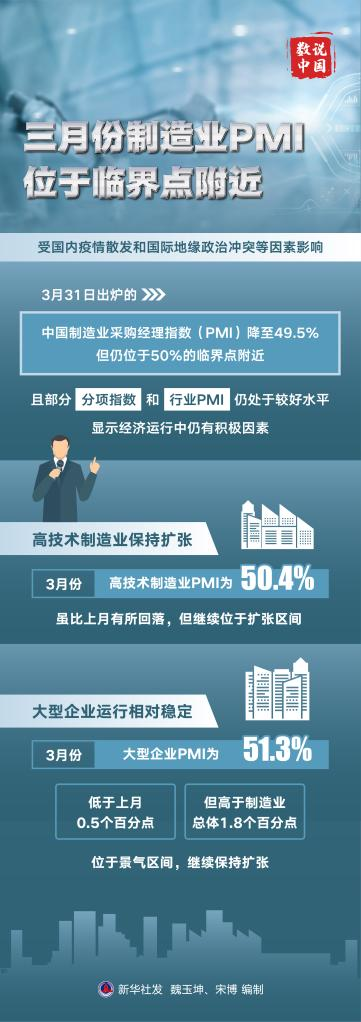
Core Viewpoint - The manufacturing Purchasing Managers' Index (PMI) in China dropped to 49.5% in March, indicating a contraction but remaining close to the critical threshold of 50%, suggesting mixed signals in the economy [2][3][4]. Manufacturing Sector - The manufacturing PMI fell to 49.5%, influenced by domestic COVID-19 outbreaks and international geopolitical conflicts, leading to reduced production and demand [3][4]. - The production index and new order index both fell into the contraction zone, with new export orders decreasing by 1.8 percentage points compared to the previous month [3][4]. - The PMI for large enterprises was 51.3%, indicating stability and continued expansion despite a slight decline from the previous month [5]. High-Tech Manufacturing - High-tech manufacturing PMI was reported at 50.4%, remaining in the expansion zone despite a decrease from the previous month [4]. - Employment and business activity expectation indices for high-tech manufacturing were 52.0% and 57.8%, respectively, indicating strong resilience and positive market outlook [4]. Basic Raw Materials - The PMI for the basic raw materials sector increased to 49.5%, reflecting a slight recovery despite pressures from rising raw material prices [4]. - The purchasing price index for basic raw materials was over 10 percentage points higher than that of equipment manufacturing, indicating some cost absorption within the sector [4]. Business Sentiment - The production and business activity expectation index was 55.7%, showing a relatively optimistic outlook despite a decline from the previous month [5]. - The non-manufacturing business activity index fell below the critical point, but construction activity showed signs of improvement as weather conditions became favorable [5]. Economic Challenges - The economy faces pressures from demand contraction, supply shocks, and weakened expectations, compounded by ongoing COVID-19 and geopolitical issues [5][6]. - Recommendations include improving pandemic control measures and expanding domestic demand policies to mitigate economic impacts [6].