
通信

Search documents
招商中国机遇股票A:2025年第四季度利润284.14万元 净值增长率1.04%
Sou Hu Cai Jing· 2026-01-22 12:21
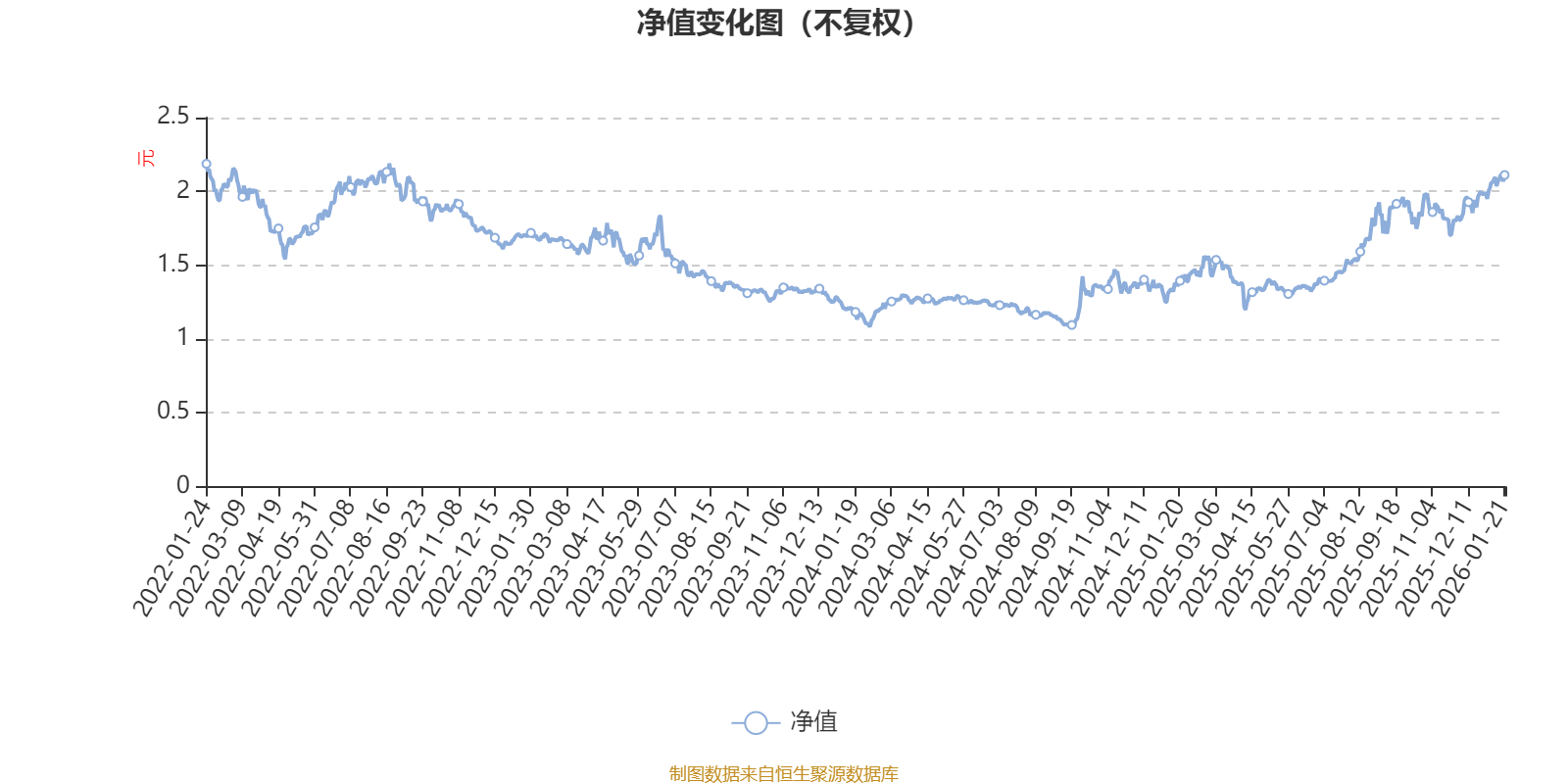
Core Insights - The AI Fund China Opportunity Stock A (001749) reported a profit of 2.8414 million yuan for Q4 2025, with a weighted average profit per fund share of 0.0198 yuan. The fund's net value growth rate for the reporting period was 1.04%, and the fund size reached 291 million yuan by the end of Q4 2025 [3][17]. Fund Performance - As of January 21, the fund's unit net value was 2.111 yuan. Over the past year, the fund achieved a cumulative net value growth rate of 48.66%, the highest among the two funds managed by the fund manager Li Huajian, who has maintained positive returns across both funds [3]. - The fund's performance rankings among comparable funds are as follows: 13.74% growth over the last three months (46/167), 44.99% over the last six months (22/167), and 22.95% over the last three years (81/156) [4]. Investment Strategy - The fund maintained a relatively high position during the reporting period, with an average stock position of 88.52% over the last three years, slightly above the industry average of 88.27%. The highest position reached was 93.14% in mid-2025, while the lowest was 79.84% in mid-2024 [15]. - The fund's investment focus includes sectors such as telecommunications, semiconductors, and electronics, while reducing exposure to media and pharmaceutical stocks. There is an increased allocation towards non-ferrous metals, power equipment, and commercial aerospace [3]. Market Outlook - The fund manager anticipates that the market will continue to experience an upward trend, with technology innovation being the core theme of the current bull market. The telecommunications sector is expected to benefit from the rapid development of the global AI industry, while the domestic semiconductor industry is poised to gain from favorable factors such as AI computing power and domestic production [3]. Top Holdings - As of Q4 2025, the fund's top ten holdings include companies such as Cambricon Technologies, Newyea, Zhongji Xuchuang, and others, indicating a strong focus on technology and innovation [20].

主力资金丨机器人概念热门股尾盘遭主力大幅砸盘
Zheng Quan Shi Bao Wang· 2026-01-22 12:16
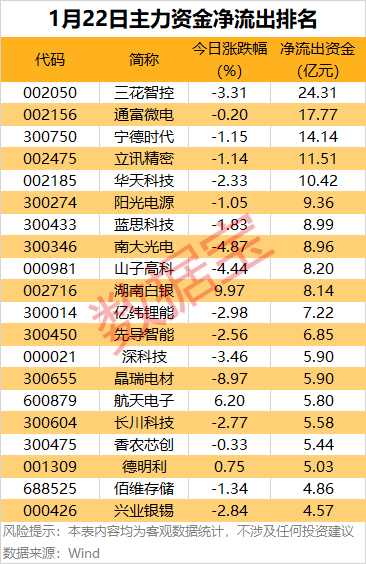
Market Overview - On January 22, A-shares saw all three major indices rise collectively, with significant gains in sectors such as aerospace, mining, shipbuilding, glass fiber, gas, oil, photovoltaic equipment, coal, and cement [1] - The main funds in the Shanghai and Shenzhen markets experienced a net outflow of 10.442 billion yuan, while 14 industries saw net inflows [1] Sector Performance - The telecommunications, defense, and non-bank financial sectors had the highest net inflows, amounting to 7.884 billion yuan, 2.916 billion yuan, and 1.371 billion yuan respectively [1] - In contrast, the electronics, power equipment, non-ferrous metals, and basic chemicals sectors faced the largest net outflows, totaling 7.979 billion yuan, 5.42 billion yuan, 2.773 billion yuan, and 2.077 billion yuan respectively [1] Individual Stock Highlights - A total of 51 stocks received net inflows exceeding 200 million yuan, with nine stocks seeing inflows over 600 million yuan [1] - The top three stocks attracting main fund inflows were New Yisheng, Zhongji Xuchuang, and Tianfu Communication, with net inflows of 2.193 billion yuan, 2.188 billion yuan, and 1.337 billion yuan respectively [1] Earnings Forecast - Tianfu Communication announced an earnings forecast for 2025, expecting a net profit attributable to shareholders of approximately 1.881 billion to 2.15 billion yuan, representing a year-on-year growth of 40% to 60% [2] Tail-End Fund Movements - In the tail-end trading session, the main funds saw a net inflow of 1.797 billion yuan, with the telecommunications sector leading with over 1 billion yuan in inflows [5] - Notable stocks with significant tail-end inflows included China Great Wall, New Yisheng, and Industrial Fulian, each exceeding 200 million yuan [5] Notable Outflows - The robot concept stock Sanhua Intelligent Control experienced a net outflow exceeding 400 million yuan, while other companies like Ningde Times and Tongfu Microelectronics also saw significant outflows [7]






净买入逾52亿港元 加仓阿里及小米流出中移动
Xin Lang Cai Jing· 2026-01-22 11:55
Core Viewpoint - Southbound capital continues to flow into Hong Kong stocks, with a net inflow of approximately 52.39 billion HKD today, marking the fifth consecutive trading day of inflows [2][3]. Group 1: Market Overview - Today's southbound trading volume was about 931.59 billion HKD, a decrease of approximately 158 billion HKD from the previous day, accounting for 39.68% of the total turnover of the Hang Seng Index, falling below 40% [2]. - The Hong Kong stock market exhibited a mixed performance, with the three major indices showing varied results [2]. Group 2: Stock Performance - Significant net buying by southbound capital included: - Alibaba-W (09988.HK): 14.13 billion HKD - China National Offshore Oil Corporation (00883.HK): 5.92 billion HKD - Kuaishou-W (01024.HK): 4.79 billion HKD - China Life (02628.HK): 4.45 billion HKD - Pop Mart (09992.HK): 3.74 billion HKD - Xiaomi Group-W (01810.HK): 4.47 billion HKD [3]. - Major net outflows included: - China Mobile (00941.HK): 8.74 billion HKD - Tencent Holdings (0700.HK): 6.69 billion HKD - Horizon Robotics-W (09660.HK): 1.21 billion HKD [3]. Group 3: Individual Stock Insights - Alibaba-W increased by 0.98%, with a net accumulation of 2.042 million shares over the past five days, indicating a short-term focus on inflows [4]. - China National Offshore Oil Corporation rose by 2.52%, but saw a reduction of 836,000 shares over the past five days, suggesting a prevailing trend of outflows [5]. - Kuaishou-W experienced a slight increase of 0.38%, with a reduction of 401,000 shares over the past five days, indicating a slowdown in outflows [5]. - China Life decreased by 3.82%, with a net accumulation of 3.234 million shares over the past five days, showing a trend of inflows [5]. - Pop Mart surged by 5.97%, with a net accumulation of 196,000 shares over the past five days, indicating sustained inflows [5]. - Xiaomi Group-W fell by 0.51%, with a net accumulation of 917,000 shares over the past five days, continuing the trend of inflows [5]. - China Mobile declined by 0.25%, with a reduction of 4.235 million shares over the past five days, indicating a continued trend of outflows [5]. - Tencent Holdings dropped by 0.83%, with a net accumulation of 470,000 shares over the past five days, suggesting a slowdown in inflows [5]. - Horizon Robotics-W fell by 4.31%, with a reduction of 1.004 million shares over the past five days, indicating a signal of outflows [5].







协同通信:供股获有效接纳约9.71%
Zhi Tong Cai Jing· 2026-01-22 11:50
Core Viewpoint - The company announced a rights issue with a total of 449 million shares issued as of the record date, but only 87.12 million shares were subscribed, indicating a significant shortfall in the rights issue subscription [1] Group 1: Rights Issue Details - The maximum number of shares to be issued under the rights issue is 897 million shares [1] - As of the record date, there were no disqualified shareholders, resulting in no unsold shares due to disqualification [1] - The company received a total of 6 valid applications for provisional allotments, amounting to approximately 9.71% of the total shares available for subscription [1] Group 2: Subscription Shortfall - There are 810 million shares that remain unsubscribed, which is about 90.29% of the total shares available for subscription [1] - The company will implement compensation arrangements for the unsubscribed shares [1] - The placement agent will make efforts to ensure that all or as many of the unsubscribed shares are taken up by potential subscribers by February 6, 2026 [1] Group 3: Impact on Share Issuance - Any unsubscribed shares under the compensation arrangements will not be issued by the company, leading to a corresponding reduction in the scale of the rights issue [1]
风险月报 | 多维度指标分化持续缓和,聚焦估值业绩匹配度
中泰证券资管· 2026-01-22 11:33
Core Viewpoint - The overall market risk preference has improved, with the risk scoring system indicating a recovery in valuation, expectations, and sentiment, leading to a more stable market environment [2][3]. Market Risk Scoring - The risk score for the CSI 300 Index is 60.35, up from 54.89 last month, indicating a significant recovery [2]. - The valuation score for the CSI 300 has slightly increased to 65.54 from 61.54, remaining at a near one-year high [2]. - There is a persistent valuation divergence among industries, with sectors like chemicals, steel, electronics, and real estate showing valuations above the historical 60th percentile, while agriculture, food and beverage, and non-bank financials remain below the 10th percentile [2]. Market Expectations - The market expectation score has risen to 60.00 from 50.00, reflecting a more optimistic outlook despite a projected decline in GDP growth for Q4 2025 [2]. - The government is expected to implement proactive macroeconomic policies in 2026, with a focus on coordinated monetary and fiscal measures, including an anticipated reduction in reserve requirements [2]. Market Sentiment - Market sentiment has continued to recover, with a score of 55.33, moving from a "neutral" to a "slightly positive" range [3]. - Margin financing scores have reached recent highs, indicating increased enthusiasm for leveraged investments [3]. - The willingness of long-term funds to enter the market remains stable, while volatility is at historical lows [3]. Economic Data Insights - December economic data showed weakness in fixed asset investment, real estate investment, and retail sales, but had limited impact on the bond market [8]. - The overall fixed asset investment for 2025 is projected to decline by 3.8%, primarily due to a significant drop in real estate development investment [8]. - Exports in December increased by 6.6% year-on-year, while imports rose by 5.7%, indicating strong global competitiveness despite geopolitical pressures [8]. Liquidity and Credit Conditions - In December, the total social financing increased by 2.21 trillion yuan, with a cumulative annual increase of 35.6 trillion yuan, reflecting a stable credit environment [10]. - The M2 money supply grew by 8.5% year-on-year, while M1 growth slowed, indicating a potential issue with funds not effectively flowing into the real economy [11]. Bond Market Overview - The bond market remains generally stable, with the central bank maintaining a moderately loose monetary policy [12]. - Despite supportive fundamentals and loose monetary policy, the bond market has shown average performance, with concerns about future supply pressures [12].

公募基金2025年四季报全扫描【国信金工】
量化藏经阁· 2026-01-22 10:58
Fund Position Monitoring - The median position of ordinary equity funds is 91.51%, and for mixed equity funds, it is 90.42%, showing a slight decrease compared to the previous quarter. The current positions are at historical percentiles of 92.19% and 95.31% respectively [1][6] - The average Hong Kong stock allocation for ordinary equity funds is 11.89%, down by 1.1% from the previous quarter, while for mixed equity funds, it is 14.56%, down by 2.54% [11][6] - The number of funds investing in Hong Kong stocks is 243 for ordinary equity funds and 1692 for mixed equity funds, with a total allocation ratio of 59.59% [11][9] Fund Holding Concentration Monitoring - The proportion of heavy-weight stocks in equity allocation is 55.03%, remaining stable compared to the previous period. The total number of stocks held by fund managers increased to 2467 from 2379, indicating greater diversity in stock holdings [10][6] Sector Allocation Monitoring - The disclosed allocation weights for the main board, ChiNext, and Sci-Tech Innovation Board are 49.04%, 20.96%, and 13.89% respectively, with a significant decrease in Hong Kong stock allocation to 16.11% [21][23] - The allocation to large cycle sectors increased by 4.3% to 26.13%, while technology and pharmaceutical sectors saw reductions of 2.94% and 1.59% respectively [23][21] Industry Allocation Monitoring - The top three industries by allocation weight are electronics (23.01%), communication (11.08%), and electric power equipment and new energy (9.28%) [26][25] - The industries with the most active increases in allocation are non-ferrous metals (1.22%), basic chemicals (1.13%), and non-bank financials (0.81%), while the most reduced allocations are in computing (-1.34%), media (-0.98%), and national defense and military industry (-0.75%) [27][25] Individual Stock Allocation Monitoring - The stocks with the highest absolute market value allocations are Zhongji Xuchuang (768 billion), Xinyi Sheng (638 billion), and Ningde Times (630 billion) [30][29] Performance Fund and Billion Fund Industry Allocation Monitoring - The top three industries allocated by performance funds are communication (32.74%), electronics (27.73%), and non-ferrous metals (12.72%) [34][35] - The top three industries allocated by billion-scale funds are electronics (27.21%), communication (13.47%), and pharmaceuticals (10.45%) [34][35]




A股五张图:ETF的“混合双打”何时是个头?
Xuan Gu Bao· 2026-01-22 10:36
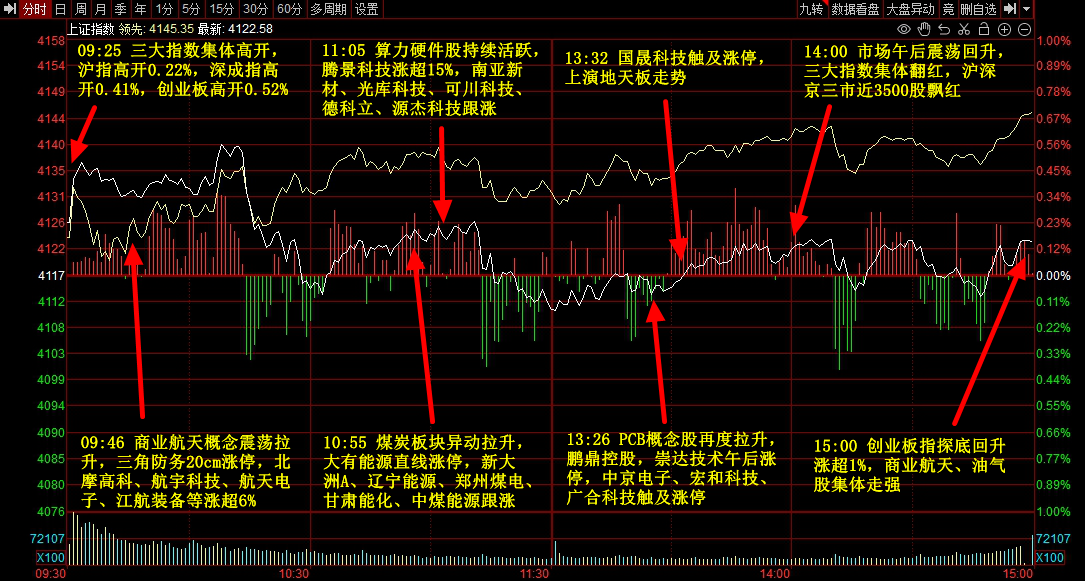
Market Overview - The market experienced a relatively calm day with significant gains in various sectors, including SpaceX-related stocks, which saw a notable increase, with companies like Western Materials and Zai Sheng Technology hitting the daily limit [3] - The computing power leasing sector also showed strength, with companies like Zhongbei Communication and Qingyun Technology reaching their daily limit, while others like Yuke and China Great Wall also performed well [3] - The PCB sector collectively surged, with multiple companies such as Honghe Technology and Guanghe Technology hitting the daily limit, and others like Jin'an Guoji and Chongda Technology also seeing substantial gains [3] - The natural gas sector had localized gains, with companies like Lanyan Holdings and Shengli Shares reaching their daily limit, while others like Zhongtai Shares and PetroChina Oilfield Services also performed well [3] - Overall, the Shanghai Composite Index, Shenzhen Component Index, and ChiNext Index closed up by 0.14%, 0.5%, and 1.01% respectively, with over 3,500 stocks rising and trading volume maintaining at 2.7 trillion [3] ETF Activity - The CSI 300 ETF and the CSI 1000 ETF continued to show a "mixed start" trading pattern, although the trading volume was lighter compared to the previous day [5] - There has been a noticeable trend of selling pressure in ETFs over the past six days, yet the indices have remained relatively stable [6] Company-Specific Developments - Guosheng Technology experienced a significant decline, hitting six consecutive daily limit downs, with its stock price nearly halving from its peak [9] - The stock's trading history included a notable first-day limit down followed by a brief rebound before entering a series of limit downs, indicating a volatile trading environment [10] - Zhejiang Fu Holdings announced its deep involvement in the development of core components for China's fusion engineering demonstration reactor, leading to a sharp increase in its stock price [12] - XW Communication faced a situation where false news about a $10 billion contract with SpaceX circulated, yet the stock remained stable, closing up over 10% despite the misleading information [14]

加配大盘与红利——主动权益类公募基金年报持仓透视
Huafu Securities· 2026-01-22 09:48
Core Insights - The report highlights that as of January 22, 2025, the disclosure rate of active equity public funds is 95.6%, with a notable increase in A-share holdings and a decrease in Hong Kong stock holdings [2][11] - The report indicates a strategic shift towards large-cap and dividend stocks while reducing exposure to small-cap stocks [2][11] - There is a clear preference for cyclical and consumer sectors, with increased allocations to these areas and a reduction in growth stocks [2][11] - In terms of industry allocation, there is an increase in exposure to non-ferrous metals, telecommunications, and machinery, while reducing allocations to defense, media, and electronics [2][11] Fund Position Changes - As of Q4 2025, the stock position of active equity public funds stands at 86.45%, reflecting a decrease of 0.97 percentage points from the previous quarter. A-share holdings increased by 1.07 percentage points, while Hong Kong stock holdings decreased by 2.05 percentage points [3][12] Sector Allocation Broad Indices - The report notes an increase in allocation to the CSI 300 index, with a holding ratio of 60.12%, and an over-allocation of 14.51% to the CSI 300 and 3.68% to the CSI 500. There is a tendency to reduce exposure to the CSI 1000 index [4][15] Listed Sectors - The report indicates a decrease in Hong Kong stock holdings, with an increased allocation to the ChiNext board. The Hong Kong stock position decreased by 0.68 percentage points, while the ChiNext allocation increased by 1.09 percentage points [4][20] Style Preferences - The report shows an increase in allocations to cyclical and consumer sectors, with cyclical stocks seeing an increase of 1.58 percentage points and consumer stocks an increase of 0.66 percentage points. Conversely, growth stocks saw a decrease of 2.48 percentage points [4][24] Industry Distribution First-Level Industries - The report highlights increased allocations to non-ferrous metals, telecommunications, and machinery, while reducing allocations to defense, media, and electronics. The top five industries with increased allocations include non-ferrous metals (+0.95 percentage points), telecommunications (+0.93 percentage points), and machinery (+0.63 percentage points) [4][27][30] Second-Level Industries - The report identifies increased allocations to semiconductors, internet e-commerce, batteries, chemical pharmaceuticals, and biological products. The top five industries with increased holdings include semiconductors (+0.57 percentage points) and batteries (+3.86 percentage points) [4][34][38] Individual Stock Allocation - The concentration of the top 10 holdings (CR10) in active equity public funds remains stable at 13%. The top 20 stocks with increased market value are primarily in the power equipment, electronics, and non-ferrous metals sectors, while companies like CATL, Industrial Fulian, and Alibaba have seen significant declines in their market values [5][42]
67股特大单净流入资金超2亿元
Zheng Quan Shi Bao Wang· 2026-01-22 09:41
Market Overview - The two markets experienced a net outflow of 7.516 billion yuan, with 67 stocks seeing a net inflow exceeding 200 million yuan, led by Zhongji Xuchuang with a net inflow of 2.795 billion yuan [1] - The Shanghai Composite Index closed up 0.14% [1] Industry Performance - Among the 16 industries with net inflows, the telecommunications sector had the highest net inflow of 8.751 billion yuan, with an index increase of 2.83%. The defense and military industry followed with a net inflow of 5.038 billion yuan and a 3.23% increase [1] - 15 industries experienced net outflows, with the electronics sector seeing the largest outflow of 9.158 billion yuan, followed by the power equipment sector with 5.073 billion yuan [1] Individual Stock Performance - The top stocks with net inflows exceeding 200 million yuan included Zhongji Xuchuang (2.795 billion yuan), Xinyi Sheng (2.489 billion yuan), and China Great Wall (1.928 billion yuan) [2] - Stocks with significant net outflows included Zhaoyi Innovation (1.520 billion yuan), CATL (1.520 billion yuan), and Sanhua Intelligent Control (1.461 billion yuan) [4] Stock Price Movements - Stocks with net inflows over 200 million yuan saw an average increase of 8.58%, outperforming the Shanghai Composite Index. Notable performers included Tengjing Technology and Shenxinfeng, which closed at the daily limit [2] - The electronics, telecommunications, and defense industries had the highest concentration of stocks with significant net inflows, with 16, 9, and 8 stocks respectively [2]

银行行业资金流出榜:招商银行、华夏银行等净流出资金居前
Zheng Quan Shi Bao Wang· 2026-01-22 09:25
Market Overview - The Shanghai Composite Index rose by 0.14% on January 22, with 22 out of the 28 sectors experiencing gains. The top-performing sectors were building materials and defense, with increases of 4.09% and 3.23% respectively. The banking sector was among the top decliners, down by 0.43% [1] Capital Flow Analysis - The main capital flow showed a net outflow of 21.612 billion yuan across the two markets. However, 12 sectors saw net inflows, with the telecommunications sector leading at a net inflow of 8.019 billion yuan and a daily increase of 2.83%. The defense sector also performed well, with a net inflow of 5.713 billion yuan and a daily increase of 3.23% [1] - Conversely, 19 sectors experienced net outflows, with the electronics sector leading at a net outflow of 13.206 billion yuan, followed by the power equipment sector with a net outflow of 7.206 billion yuan. Other sectors with significant outflows included non-ferrous metals, automobiles, and pharmaceuticals [1] Banking Sector Performance - The banking sector saw a decline of 0.43% with a net outflow of 545 million yuan. Out of 42 stocks in this sector, 26 rose while 14 fell. Notably, 25 stocks had net inflows, with Jiangsu Bank leading at a net inflow of 224 million yuan, followed by Bank of Communications and Minsheng Bank with inflows of 152 million yuan and 98.929 million yuan respectively [2] - The stocks with the highest net outflows included China Merchants Bank, Huaxia Bank, and Shanghai Pudong Development Bank, with outflows of 743 million yuan, 184 million yuan, and 156 million yuan respectively [2] Individual Stock Performance - The following table summarizes the performance of key banking stocks based on their net capital flow and daily change: | Stock Code | Stock Name | Daily Change (%) | Turnover Rate (%) | Net Capital Flow (10,000 yuan) | | --- | --- | --- | --- | --- | | 600036 | China Merchants Bank | -1.02 | 0.91 | -7426.622 | | 600015 | Huaxia Bank | -0.92 | 0.82 | -1836.242 | | 600000 | Shanghai Pudong Development Bank | -1.02 | 0.46 | -1555.792 | | 601939 | China Construction Bank | -1.92 | 1.44 | -1473.762 | | 601988 | Bank of China | -0.56 | 0.12 | -1247.776 | | 601288 | Agricultural Bank of China | -2.16 | 0.15 | -504.228 | | 601166 | Industrial Bank | -1.33 | 0.69 | -398.051 | | 601998 | CITIC Bank | -1.58 | 0.17 | -213.897 | | 002936 | Zhengzhou Bank | 0.53 | 1.30 | -147.699 | | 601665 | Qilu Bank | 1.65 | 0.89 | -144.610 | | 601577 | Changsha Bank | 0.75 | 0.32 | -122.400 | | 601187 | Xiamen Bank | -1.40 | 0.49 | -100.037 | | 603323 | Suning Bank | 1.01 | 1.52 | -89.489 | | 002839 | Zhangjiagang Bank | 0.90 | 1.07 | -67.650 | | 002958 | Qingnong Commercial Bank | 0.97 | 0.86 | -54.434 | | 601963 | Chongqing Bank | 0.10 | 0.48 | -44.601 | | 601997 | Guiyang Bank | 0.35 | 0.71 | -9.478 | | 600928 | Xi'an Bank | 0.82 | 0.49 | 47.776 | | 601860 | Zijin Bank | 0.73 | 1.18 | 49.415 | [2][3]





