
教育

Search documents
港股异动丨教育股部分上涨 教育部称已建成世界上规模最大的职业教育体系
Ge Long Hui· 2025-09-23 03:29
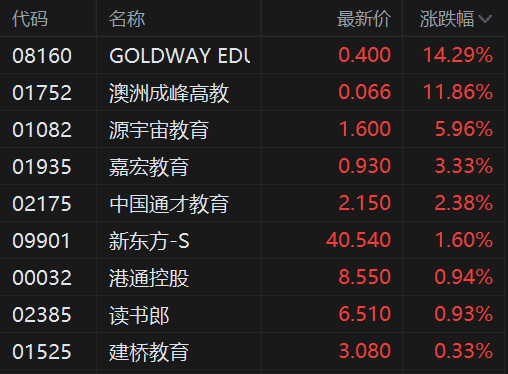
Core Viewpoint - The recent statements from the Ministry of Education regarding vocational education have significantly boosted investor confidence in the education sector, indicating a shift in market focus from K12 education to vocational training aligned with economic development [1][1]. Group 1: Market Performance - Several education stocks in Hong Kong have seen gains, with notable increases such as Australia New Oriental Education rising nearly 12% and Yuan Universe Education up 6% [2]. - Other companies like Jia Hong Education and China Tongcai Education also reported increases of over 3% [1][2]. Group 2: Government Initiatives - The Ministry of Education has outlined the structure of vocational education in China, which includes 9,302 secondary vocational schools, 1,562 higher vocational schools, and 87 vocational undergraduate institutions, serving a total of 34 million students [1]. - The Minister emphasized the need for a robust higher education system that aligns with the requirements of Chinese modernization and contributes to high-quality economic and social development [1]. Group 3: Industry Outlook - Analysts suggest that the Ministry's recent guidance represents a clear direction for the education sector, particularly following the "double reduction" policy, which has shifted the focus towards vocational education [1]. - This transition is expected to create new investment opportunities in the vocational education sector, which is now seen as a key area for growth [1].

上海南京西路功能区与CGF共同探索打造绿色消费场景试点
Sou Hu Cai Jing· 2025-09-22 14:48
中新网上海9月22日电 (记者 陈静)22日,2025"南京西路可持续生活周"在上海开幕。南京西路功能区与 消费品论坛(CGF)将共同探索打造绿色消费场景试点。这一试点项目旨在为静安区可持续消费发展注入 新动能,推动绿色消费从理念走向实践。 在南京西路街区,"美丽街区"建设持续推进,花园城区图景随处可见。政府部门积极探索以可持续消费 助推高质量发展,在推动消费模式绿色转型、创新多元化消费场景等的同时,让更多国内外品牌进一步 了解静安区可持续消费发展趋势,为区域经济发展持续注入新活力。 当天,上海交通大学安泰经济与管理学院营销系副教授张铄分享了由南京西路功能区与上海交通大学 ESG研究院合作编制的"可持续消费指南"。该指南基于"绿色选品指南",结合了静安区与南京西路商圈 品牌的可持续案例分析,为消费者和企业提供实用的可持续消费参考。 据悉,未来,南京西路功能区将培育"国际人才引力场",进一步改善营商环境,吸引更多全球企业、前 沿人才汇聚;打造"全球街区创新实验室",探索街区发展的创新模式。(完) 2025"南京西路可持续生活周"在上海开幕。(静安区新闻办供图) 记者当日获悉,位于上海市中心闹市区的南京西路功能区 ...

多元融合、科技赋能,银发经济挖掘“人口第二红利”
Di Yi Cai Jing· 2025-09-22 12:37
Core Viewpoint - The aging population presents both challenges and opportunities, with the development of the silver economy being a key strategy to enhance the well-being of the elderly and promote sustainable economic growth [1][8]. Policy Support - Since the 18th National Congress, China has gradually improved its policy framework to support the development of the silver economy, establishing a clear path for advancement [2]. - The "Healthy China 2030 Planning Outline" and subsequent national strategies have integrated the silver economy into health and aging policies, emphasizing the importance of a multi-level policy system [2]. - The 2024 State Council policy on the silver economy includes 26 specific measures aimed at enhancing the welfare of the elderly, marking a shift towards precise implementation [2]. Silver Economy Definition - The silver economy encompasses a wide range of economic activities related to the aging population, not limited to elder care services, but forming a complete economic system that includes production, distribution, circulation, and consumption [3]. - It consists of both established industries and emerging sectors, with significant growth in areas such as silver goods, services, finance, and real estate [3][5]. Market Dynamics - The silver economy in China has shown rapid expansion, with the overall market size exceeding 12 trillion yuan in 2023, growing at an average annual rate of over 10% from 2019 to 2023 [5]. - Key growth areas include rehabilitation medical devices, which are projected to reach a market size of 71.46 billion yuan in 2024, and the silver service industry, which saw a market size exceeding 5 trillion yuan in 2023 [5][6]. Future Trends - The silver economy is expected to evolve through "multi-dimensional integration and technological empowerment," with a focus on meeting the diverse needs of the elderly population [7]. - By 2035, the elderly population in China is projected to exceed 400 million, driving demand for high-quality products and services, particularly in the fields of rehabilitation and home care [7]. Economic Impact - The silver economy is positioned as a critical area for optimizing economic structure and fostering new growth drivers, contributing to both improved living standards for the elderly and overall economic growth [8].
观点丨美联储降息为渴望在美国上市的企业开绿灯!
Sou Hu Cai Jing· 2025-09-22 06:06
Group 1 - The Federal Reserve's interest rate cut has cleared the path for private companies to enter the U.S. IPO market, with many companies expected to file for IPOs in the coming weeks [1][3] - Companies like Neptune Insurance Holdings Inc. and the parent company of the University of Phoenix have submitted applications to U.S. regulators and may begin roadshows soon [1][3] - The current market conditions, including the U.S. stock market nearing historical highs and low volatility, are favorable for IPOs, leading to expectations of more companies conducting roadshows [1][2] Group 2 - As of mid-September, 14 companies have raised $7 billion through U.S. IPOs, marking the highest level for this period since 2020 [2] - If the market remains strong, the number of notable transactions in October may exceed those in September [2] - The beginning of the Federal Reserve's easing cycle is expected to create opportunities for companies seeking to go public, with a need for timely applications to avoid delays until 2026 [3] Group 3 - The fall IPO window has opened, with the number of IPOs reaching or exceeding $250 million, the highest level since October 2021 [3] - Recent IPO performance has been mixed, with some companies like StubHub Holdings Inc. and Gemini Space Station Inc. seeing stock prices fall below their IPO prices, while others like Figure Technology Solutions Inc. and Black Rock Coffee Bar Inc. have seen significant gains [4] - The performance of newly listed companies is crucial for encouraging investor interest in future IPOs, with recent trends prompting a reassessment of market conditions [4]
中非共创 擦出时尚新火花
Ren Min Ri Bao Hai Wai Ban· 2025-09-22 03:18
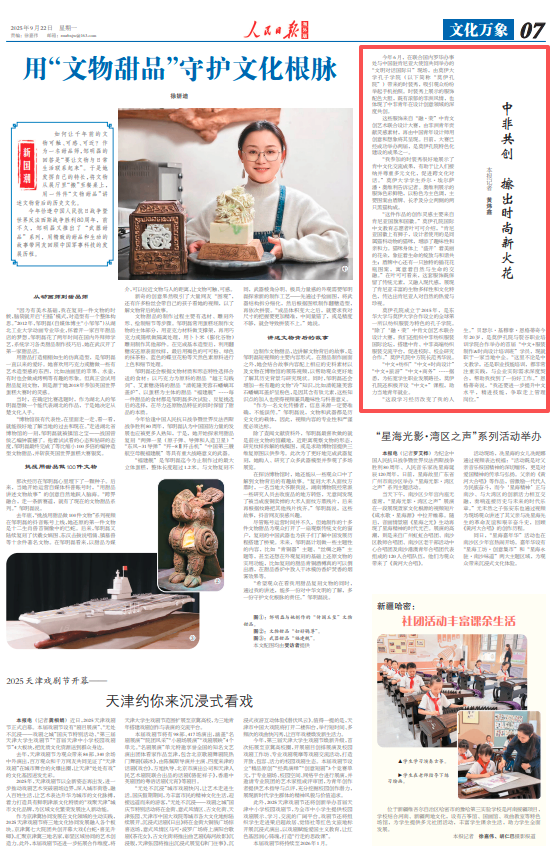
Group 1 - The "融·荣" Sino-Kenyan Cultural and Creative Arts Joint Design Competition showcases the collaboration between African and Chinese youth in fashion design, highlighting bold colors and African cultural elements [1][2] - The competition has been successfully held for two editions and is part of the unique development of the Moy University Confucius Institute, which focuses on textile and fashion [2][3] - The Moy University Confucius Institute, established in 2015, aims to promote Sino-Kenyan and Sino-African exchanges in the textile and fashion sectors through various initiatives, including international forums and "Chinese +" courses [2][3] Group 2 - The first "Chinese + Fashion Design & Garment Making Training Class" was launched in collaboration with Rift Valley Vocational Training Institute, emphasizing practical skills aligned with local industry needs [3] - The training program has positively impacted students' career prospects, with graduates securing jobs in local Chinese enterprises and aiming for further skill enhancement [3]
武汉南昌双城记: 黄鹤楼和滕王阁的双向奔赴
Chang Jiang Ri Bao· 2025-09-22 01:03
Core Viewpoint - The article highlights the growing tourism and economic collaboration between Wuhan and Nanchang, emphasizing their geographical proximity and cultural connections, which are fostering a "golden travel route" and enhancing cooperative development in various sectors. Transportation - The travel time between Wuhan and Nanchang is currently 1 hour and 51 minutes by train, with plans to reduce it to 1 hour and 30 minutes through ongoing railway construction initiatives [1] - The "Central Six Provinces Capital City Transportation Cooperation Initiative" aims to accelerate the development of key railway lines, enhancing connectivity between the two cities [1] Cultural Significance - Both cities are rich in cultural heritage, with landmarks like Wuhan's Yellow Crane Tower and Nanchang's Tengwang Pavilion symbolizing their historical significance [2] - The cities share a deep historical connection, illustrated by events such as the Nanchang Uprising and the August 7th Meeting [3] Culinary Diversity - The culinary offerings of both cities reflect their cultural ties, with local dishes like Wuhan's hot dry noodles and Nanchang's rice noodles being popular among tourists [1][4] Economic Collaboration - Wuhan and Nanchang are key cities in the Central Region and the Yangtze River Midstream Urban Agglomeration, with a strong foundation for cooperation [5] - Recent meetings led by President Xi Jinping have emphasized the importance of innovation-driven development and collaboration between the two cities [5][6] Technological Cooperation - A framework agreement for technological cooperation has been established among Hubei, Jiangxi, and Hunan provinces, promoting joint initiatives and resource sharing [7] - The "Wuchuangyuan" disruptive technology innovation competition has been held in Nanchang, showcasing collaborative efforts in technology and innovation [7] Education and Research - Educational institutions from both cities, such as Nanchang University and Wuhan University, have signed cooperation agreements to facilitate student exchanges and joint research [8] - Experts from Nanchang are actively participating in significant technological assessments and collaborative events in Wuhan [8] Business Development - Wuhan's local commercial group, Wushang, has chosen Nanchang as its first expansion destination, with sales reaching 3.1 billion yuan in 2024 [8] - The establishment of a public housing fund that allows for mutual recognition and lending between the two cities supports residents in living a "dual-city life" [9] Future Prospects - The article suggests that the collaboration between Wuhan and Nanchang can lead to the development of influential industrial clusters, particularly in sectors where each city has its strengths, such as optics and artificial intelligence in Wuhan and aviation and biomedicine in Nanchang [9]

社会服务2025H1中报总结及展望
2025-09-22 00:59
Summary of the Conference Call Records Industry Overview - The social services sector in the first half of 2025 showed uneven recovery, reaching only 79% of 2019 levels. Key areas of growth included K12 training, human resources, and scenic spots, while the travel chain and higher vocational education faced challenges [1][2][26]. Key Points and Arguments K12 Training - K12 training maintained high industry prosperity due to clear policy definitions, contributing positively to the sector's performance [2][3]. Human Resources - The human resources sector experienced significant growth driven by outsourcing and headhunting services, with a reported revenue increase of approximately 30% [3][17]. Scenic Spots - Scenic areas saw both revenue and profit growth, with companies like Xiangyuan Cultural Tourism and Jiuhua Tourism leading the way through asset injections [4][10]. OTA (Online Travel Agency) - The OTA sector, particularly Ctrip, benefited from travel demand, achieving net profit above expectations due to precise overseas spending and strong domestic accommodation and transportation bookings [5][12][26]. Hotel Industry - The hotel sector is nearing a turning point, with average RevPAR down by 4%-5%. However, leading companies like Huazhu and Atour managed to achieve profit growth through operational excellence [5][13][26]. Restaurant and Beverage Sector - The restaurant and beverage industry showed structural highlights despite facing pressures, such as the June alcohol ban. Notable performers included Xiaocaiyuan and Green Tea, with profit growth rates of 35%-36% and 40%, respectively [6][21][23]. Future Outlook - Strong operational companies are expected to outperform in the second half of the year and into 2026. The hotel industry is anticipated to see a supply curve slowdown, indicating a potential turning point. Flight booking data for the upcoming National Day shows a year-on-year increase of 5.7%, suggesting a continued recovery in travel demand [7][8][26]. Xiangyuan Cultural Tourism - Xiangyuan Cultural Tourism is expected to further develop through asset injections and is actively building an online platform to create private traffic [9]. Jiuhua Tourism - Jiuhua Tourism reported a robust performance with a 20% increase in visitor numbers, benefiting from favorable timing and improved transportation access [10]. Challenges and Opportunities in Scenic Areas - Scenic areas face challenges such as increased customer acquisition pressure and rising sales costs. However, those with unique resources, like Jiuhua Mountain and Changbai Mountain, are expected to attract visitors and improve profitability [11]. Investment Recommendations - Investment opportunities are recommended in the OTA sector, particularly Ctrip, and in the hotel sector, with a focus on companies like Shoulv and Huazhu. The restaurant sector also presents potential with companies like Xiaocaiyuan and Green Tea [26][27][29]. Other Important Insights - The duty-free industry is currently in an adjustment phase, with a 9% decline in sales but a 20% increase in average transaction value. The focus is on identifying the turning point in this sector [14][15]. - The professional services industry is embracing AI technology to enhance efficiency and reduce costs, with notable advancements in recruitment and event management [16]. - The education sector is seeing varied performance, with companies like China Oriental Education showing resilience and growth potential through strategic adjustments [18][19][28]. This summary encapsulates the key insights and developments within the social services sector and its sub-industries, highlighting both challenges and opportunities for investors.

美国移民身份“明码标价”:工签10万、绿卡100万、白金卡500万,哪家公司是受益者?
3 6 Ke· 2025-09-21 23:45
Core Points - The Trump administration has made significant changes to the U.S. high-skilled immigration policy, introducing a $100,000 annual fee for new H-1B visa applicants and new visa channels like the "Gold Card" and "Platinum Card" [1][2][3] Group 1: Changes to H-1B Visa - A $100,000 fee will be imposed on new H-1B visa applications, a drastic increase from previous fees in the thousands [2] - This fee applies only to new applicants and not to current H-1B holders or those renewing their visas [2] - The new regulations will take effect on September 21, 2025, causing confusion and concern among companies and employees [2] Group 2: New Visa Channels - The "Gold Card" allows individuals to obtain a green card-like status for a payment of $1 million, with a company sponsorship option at $2 million [3] - The "Platinum Card" costs $5 million and offers greater tax benefits, such as exemptions on non-U.S. sourced income [3] - These new channels may partially replace existing employment-based immigration categories like EB-1 and EB-2 [3] Group 3: Impact on Countries - Indian nationals are the most affected, making up approximately 71% of H-1B approvals this year, while Chinese nationals account for about 11.7% [5] - The Indian government and industry organizations have expressed strong concerns about the humanitarian impact on Indian professionals and their families [5] Group 4: Market Reactions and Uncertainties - The implementation of these policies faces legal challenges and requires congressional approval, leading to market uncertainty [7] - Companies are already adjusting hiring strategies and advising employees to return to the U.S. before the policy takes effect [7] Group 5: Sector-Specific Impacts - Tech giants like Amazon, Microsoft, Google, Meta, and Apple, which rely heavily on H-1B workers, may face increased labor costs and pressure to shift to domestic hiring or automation [8] - Small tech companies and startups may struggle with the new costs, potentially leading to downsizing or relocation of R&D efforts [8] - Educational institutions and study abroad agencies may see a decline in international student enrollment due to the increased costs associated with H-1B visas [8] Group 6: Opportunities and Risks - Domestic talent development and training institutions may benefit from increased investment as companies seek to hire local talent [9] - Fields like artificial intelligence, automation, and low-code tools may experience growth as companies look to reduce reliance on expensive foreign labor [9] - Immigration consulting services may see a surge in demand as affected individuals seek legal assistance and adjustments [9] Group 7: Short-term and Mid-term Market Effects - Short-term market reactions may include volatility and selling pressure on tech stocks that depend on foreign talent [10] - In the mid-term, a dual-track system may emerge, favoring top talent while forcing lower-skilled positions to be localized or automated [10] Group 8: Investor Strategies - Investors should reassess their portfolios, particularly focusing on companies' abilities to localize hiring and adapt to the new regulations [11] - Monitoring legal challenges to the policy will be crucial, as any delays could present buying opportunities for quality tech stocks [11] - Exploring emerging sectors like training, AI automation, and immigration consulting could yield potential investment opportunities [11] Group 9: Conclusion - The changes signify a shift in U.S. immigration policy towards a wealth-based system, impacting talent structures and competitive advantages in the tech industry [12] - Companies that adapt to these changes by investing in local talent and automation may benefit, while those unprepared could face significant pressures [12]

A股惊现单日缩量8113亿!三大指数齐跌,下周金融发布会能否引发行情
Sou Hu Cai Jing· 2025-09-21 17:00
Core Viewpoint - Four listed companies, Fudan Fuhua, Sike Rui, Juewei Food, and Chuangyi Information, announced financial fraud, leading to risk warnings and a collective trading suspension, affecting nearly 200,000 shareholders [1][3][4] Group 1: Company Announcements - The four companies will be placed under special treatment ("ST") due to financial fraud, with trading suspended for one day starting Monday [1][4] - The announcement has caused significant concern among shareholders, including long-term investors and new entrants [3] Group 2: Regulatory Environment - The regulatory authorities have taken a strong stance against financial fraud, with recent cases leading to trading suspensions for companies like ST Hongyang and ST Zhongli [4][5] - The China Securities Regulatory Commission (CSRC) is intensifying its focus on information disclosure, which has become a critical area of scrutiny [5][7] Group 3: Market Reactions - The market has shown cautious trading behavior, with a notable decrease in trading volume and mixed performance across sectors [9] - Despite the recent turmoil, there are positive signals from foreign investment, with Goldman Sachs recommending an overweight position in Chinese stocks [11] Group 4: Economic Context - The People's Bank of China and other financial regulators are expected to provide insights into the financial sector's development during an upcoming press conference [8] - The recent interest rate cut by the Federal Reserve may positively impact domestic equity assets, particularly growth-oriented stocks [12]



海外消费周报:海外教育:营利性分类管理条件成熟,市场化改革推动高校扩张,承接增量高教需求-20250921
Shenwan Hongyuan Securities· 2025-09-21 14:43
Group 1: Industry Investment Rating - The report maintains a positive outlook on the overseas education sector, indicating a favorable investment rating due to the maturation of profit-oriented classification management and market reforms driving the expansion of higher education institutions [1][2]. Group 2: Core Insights - The conditions for profit-oriented classification management in private education are gradually maturing, with quality improvement in private schools being a crucial prerequisite for this transition. The report anticipates an acceleration in the implementation of profit-oriented policies for private schools, which will enhance the supply of higher education while ensuring quality [1][9]. - The establishment of profit distribution rights for private schools has led to increased certainty in asset returns. The average profit margin for the six listed private higher education companies is approximately 30.9%, with an average ROE of 12%. This indicates a robust commercial model that seeks to expand scale and revenue [2][10]. - The report highlights a significant mismatch between supply and demand in the higher education sector, with the number of college admissions only increasing from 10.36 million in 2021 to 10.69 million in 2024, while the number of high school graduates entering the college entrance examination has risen from 10.78 million in 2021 to 13.42 million in 2024. This has resulted in a declining college admission rate from 96.1% in 2021 to 79.6% in 2024 [2][10]. - The report suggests that the current quality standards achieved by listed private higher education companies will lay a solid foundation for the reintroduction of profit-oriented choices, which is expected to enhance the valuation of the higher education sector [2][11]. Group 3: Company Focus - The report recommends focusing on several key companies in the overseas education sector, including Yuhua Education, Zhongjiao Holdings, China Kepei, Neusoft Ruixin, Zhonghui Group, New Higher Education, Xijiao International Holdings, and Huaxia Holdings, as they are well-positioned to benefit from the anticipated policy changes [3][11][14].