房地产

Search documents
房地产行业2026年展望:核心销售趋于均衡,投资开发仍需助力
GUOTAI HAITONG SECURITIES· 2026-01-29 14:39
Investment Rating - The report rates the real estate sector as "Overweight" [4] Core Insights - The industry is expected to stabilize as supply decreases and quality improves, with new and old drivers working together to push the market towards a bottoming out [2] - Key cities are anticipated to find a balance in sales by 2026, although long-tail cities will continue to drag down overall performance, albeit at a reduced rate [2] Summary by Sections 2025 Industry Review - The industry faced a significant downturn in sales and investment, with actual sales area data falling below previous lower predictions due to overly optimistic expectations for third and fourth-tier cities [8] - The decline in new construction and investment was more pronounced than expected, with new construction area growth at -20.4% and completion area growth at -18.1% [10][24] 2026 Industry Outlook - The focus will be on high-quality development, with key cities expected to stabilize sales. The central economic work conference emphasized stabilizing the real estate market and encouraging the acquisition of existing properties for affordable housing [7][9] - Investment growth is projected to be slow, with construction area growth expected between -5.8% and -10.2%, and corresponding investment growth between -4.0% and -12.5% [10][11] - The report predicts that the sales amount for 2026 could vary under optimistic, neutral, and pessimistic scenarios, with forecasts of 2.6%, -4.9%, and -11.4% respectively [10] Policy Focus - The main pressures on the industry will stem from investment growth challenges, with expectations for interest rate cuts and asset recovery policies to support the sector [10][11] - The report highlights the importance of monitoring the implementation of policies related to interest rate reductions, asset recovery, and urban renewal [10][11] Sales and Investment Predictions - The report provides a detailed forecast for 2026, indicating that the total sales area is expected to stabilize between 7-8 billion square meters, driven by improving demand and urban renewal initiatives [44][50] - The sales amount and land acquisition trends are expected to reflect a continued focus on quality and strategic development in key urban areas [50][55]






珠江股份发预增,预计2025年归母净利润同比增加253.14%到429.72%
Zhi Tong Cai Jing· 2026-01-29 14:04
Core Viewpoint - The company, Zhujiang Co., Ltd. (600684.SH), expects to achieve a net profit attributable to shareholders of between 55 million to 82.5 million yuan for the year 2025, indicating a significant increase compared to the previous year [1] Financial Performance - The projected net profit represents an increase of 39.4256 million to 66.9256 million yuan year-on-year [1] - This translates to a year-on-year growth rate of 253.14% to 429.72% [1]

香港业界料美联储仍有降息空间 利好金融和房地产市场
Zhong Guo Xin Wen Wang· 2026-01-29 12:52
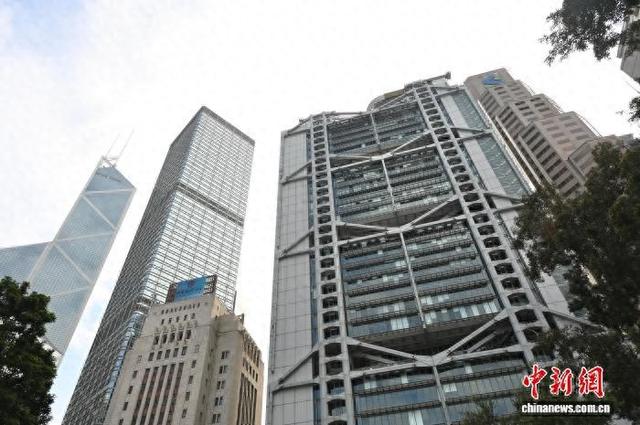
中新社香港1月29日电 (记者 魏华都)2026年美国联邦储备委员会(简称"美联储")首次议息后宣布维持利 率不变,符合市场预期。香港业内人士29日表示,美联储仍有降息空间,利好金融市场和房地产市场。 当天,香港三家发钞行——渣打银行(香港)有限公司、中国银行(香港)有限公司、香港上海汇丰银行有 限公司宣布维持最优惠利率不变。香港金融管理局表示,香港货币及金融市场保持有序运作。 市场普遍认为,美联储今年将继续降息,有助于降低企业融资成本,进一步提高投资信心,以及股市和 楼市发挥"联动"效应。 中国银行(香港)财富策略及分析处主管张诗琪表示,美联储会后声明反映其对于美国经济展望略趋乐 观,故不急于短期降息,后续降息步伐将取决于经济数据表现。而按目前美国就业情况加上通胀逐步回 落,美联储仍有降息空间。 1月29日,香港三家发钞行——渣打银行(香港)有限公司、中国银行(香港)有限公司、香港上海汇丰银行 有限公司宣布维持最优惠利率不变。图为2025年12月拍摄的汇丰总行大厦(右二)、中银大厦(左一)、渣 打银行大厦(右一)。 中新社记者 李志华 摄 中欧基金国际投资总监叶英聪接受中新社记者采访时表示,预计2026年有 ...

今天,盘面出现三大异象!市场风格生变?
Mei Ri Jing Ji Xin Wen· 2026-01-29 11:31
Market Overview - The A-share market showed mixed results with the Shanghai Composite Index rising by 0.16%, while the Shenzhen Component and ChiNext Index fell by 0.30% and 0.57% respectively [1][17] - The total trading volume in the Shanghai, Shenzhen, and Beijing markets reached 32,597 billion yuan, an increase of 2,671 billion yuan compared to the previous day [1][17] - A total of 1,803 stocks rose, with the median decline of stocks being 0.92% [1][17] Notable Market Phenomena - Three significant anomalies were observed in the market: a reversal in the trend of broad-based ETFs, with some experiencing volume increases, such as the SSE 50 ETF [2][18] - The SSE 50 and CSI 300 indices led the gains, while small-cap indices adjusted, with the Sci-Tech 50 index experiencing a notable decline of 3.03% [2][18] - The low-positioned liquor and real estate sectors saw substantial gains, with liquor stocks nearing full limit-up and the liquor ETF hitting the limit [2][18] Sector Performance - The liquor sector, which had been underperforming for the past two years, experienced a sudden surge, surprising many investors [3][19] - Other sectors, particularly the previously high-performing materials and technology sectors, faced significant declines, indicating a shift in market dynamics [3][19] - The real estate sector's rise was linked to the easing of regulatory requirements regarding the "three red lines" policy for several property companies [7][10][26] Liquor Sector Insights - The recent surge in the liquor sector is attributed to favorable demand conditions during the upcoming Spring Festival, with reports indicating that some distributors have sold out their quotas for premium products [6][22] - The China Securities White Wine Index recently rebounded strongly, suggesting strong support, with significant trading volume indicating substantial capital inflow [8][24] - Institutions are cautiously optimistic about the liquor sector's recovery, with expectations for stable sales during the 2026 Spring Festival [9][25] Technology and Materials Sector Trends - The technology sector, including semiconductors and communication devices, faced declines, but the overall trend has not completely broken down, warranting further observation [11][26] - The materials sector experienced significant volatility, with the index having nearly doubled since last year's lows, making it less suitable for high-risk investments [12][27] Market Sentiment and Future Outlook - Recent market trends indicate a temporary shift in style, with blue-chip stocks gaining strength while technology stocks weaken [4][20] - The market is experiencing a rotation, with many stocks showing volatility, making it challenging for investors to navigate [5][21] - The potential for a more sustained change in market style remains uncertain and will require ongoing observation of blue-chip performance [4][20][29]
1754公顷!淄博发布2026年国有建设用地供应计划
Qi Lu Wan Bao· 2026-01-29 11:26
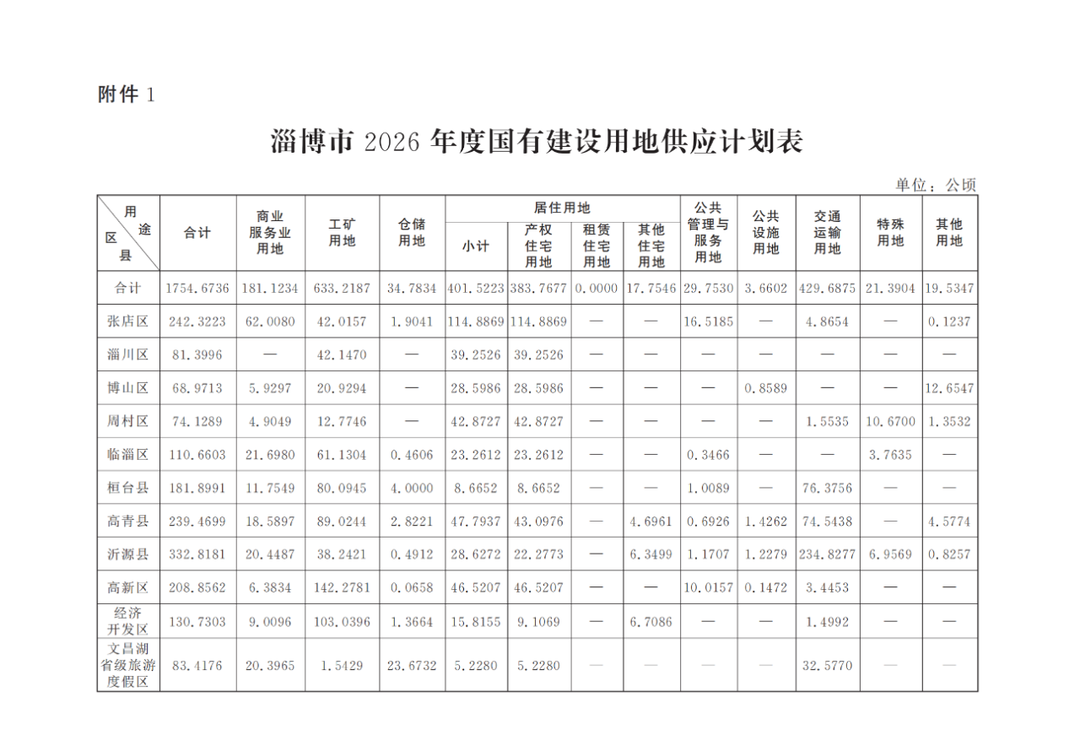
Core Viewpoint - The government of Zibo has released the 2026 State-owned Construction Land Supply Plan, aiming to regulate the land market, optimize land use, and support high-quality urban development with a total supply of 1,754.6736 hectares [1]. Summary by Category Total Land Supply - The total planned supply of state-owned construction land in Zibo for 2026 is 1,754.6736 hectares [1]. Land Use Categories - Residential land supply is planned at 401.5223 hectares, accounting for 22.88% of the total supply, which includes 383.7677 hectares for property residential land and 17.7546 hectares for other residential land [2]. - Commercial service land supply is set at 181.1234 hectares, while industrial land supply is 633.2187 hectares [2]. - Other categories include warehouse land at 34.7834 hectares, public management and service land at 29.7530 hectares, public facility land at 3.6602 hectares, transportation land at 429.6875 hectares, special land at 21.3904 hectares, and other land at 19.5347 hectares [2]. Land Supply by District - The land supply by district includes: - Zhangdian District: 242.3223 hectares - Zichuan District: 81.3996 hectares - Boshan District: 68.9713 hectares - Zhoucun District: 74.1289 hectares - Linzi District: 110.6603 hectares - Huantai County: 181.8991 hectares - Gaoqing County: 239.4699 hectares - Yiyuan County: 332.8181 hectares - High-tech Zone: 208.8562 hectares - Economic Development Zone: 130.7303 hectares - Wenchang Lake Provincial Tourism Resort: 83.4176 hectares [3]. Residential Land Supply by District - The planned supply of residential land by district includes: - Zhangdian District: 114.8869 hectares - Zichuan District: 39.2526 hectares - Boshan District: 28.5986 hectares - Zhoucun District: 42.8727 hectares - Linzi District: 23.2612 hectares - Huantai County: 8.6652 hectares - Gaoqing County: 47.7937 hectares - Yiyuan County: 28.6272 hectares - High-tech Zone: 46.5207 hectares - Economic Development Zone: 15.8155 hectares - Wenchang Lake Resort: 5.2280 hectares [6].
白酒板块大反弹
Tebon Securities· 2026-01-29 11:14
Market Analysis - The A-share market showed significant structural differentiation, with the Shanghai Composite Index fluctuating around 4150 points and closing at 4157.98 points, up 0.16%. The Shenzhen Component Index fell 0.30% to 14300.08 points, and the ChiNext Index dropped 0.57% to 3304.51 points, indicating a mixed performance across the market [3][6] - The beverage sector led the market with a notable increase of 6.74%, while the liquor index surged by 9.93%. Notably, the price of Moutai rose by 20 yuan to 1610 yuan per bottle, suggesting strong sales activity ahead of the Spring Festival [6][8] - The real estate sector also saw a rise of 2.48%, with several companies hitting the daily limit up. Reports indicate that some real estate firms are no longer required to report "three red lines" indicators monthly, hinting at a potential easing of regulatory pressures [6][8] Investment Opportunities - The report suggests that the liquor sector may benefit from improved sales activity before the Spring Festival, while the real estate sector could gain from expectations of regulatory easing. Resource stocks are expected to continue their strong performance due to rising prices and safe-haven demand [8][18] - The report emphasizes a focus on sectors such as photovoltaic (solar energy), commercial aerospace, and precious metals, which are seen as key investment themes in the current market environment [8][17] Commodity Market Insights - The commodity index continued its strong upward trend, with copper prices reaching new historical highs. The Shanghai copper price closed at 109,110 yuan per ton, while LME copper peaked at 14,125 USD per ton [11][12] - Precious metals also experienced significant gains, with gold and silver prices rising sharply, driven by geopolitical uncertainties and a weak US dollar, which enhances the attractiveness of dollar-denominated assets [11][12] Trading Hotspots - Recent hot sectors include AI applications, commercial aerospace, nuclear fusion, quantum technology, brain-computer interfaces, and robotics, all of which are supported by government policies and technological advancements [15][17] - The report highlights the ongoing strong performance of precious metals and industrial metals, suggesting that the momentum may continue in the future [18]

保利发展:启动商业不动产REITs发行,增强持续经营能力-20260129
GUOTAI HAITONG SECURITIES· 2026-01-29 10:25
| [姓名table_Authors] | 电话 | 邮箱 | 登记编号 | | --- | --- | --- | --- | | 涂力磊(分析师) | 021-23185710 | tulilei@gtht.com | S0880525040101 | | 谢皓宇(分析师) | 010-83939826 | xiehaoyu@gtht.com | S0880518010002 | | 谢盐(分析师) | 021-23185696 | xieyan@gtht.com | S0880525040098 | 本报告导读: 1 月 27 日,公司审议通过了《关于开展商业不动产 REITs 申报发行工作及相关授权 事项的议案》,这将进一步构筑公司不动产经营能力,增强可持续发展能力。 投资要点: [Table_Summary] 维持"增持"评级。1 月 27 日,公司审议通过了《关于开展商业不 动产 REITs 申报发行工作及相关授权事项的议案》。我们认为,这 将进一步构筑公司不动产经营能力,优化资本结构,增强可持续发 展能力。我们预计 25 年 EPS 为 0.09 元和 BPS 为 16.59 元,参考 PB 估 ...
李嘉诚的预言已应验?若无意外,2026年楼市或将面临3大转变
Sou Hu Cai Jing· 2026-01-29 10:16
Core Viewpoint - The real estate market in China is undergoing a significant correction after years of rising prices, with various factors contributing to this shift, leading to a more cautious outlook for the future [1][14]. Group 1: Market Dynamics - The trajectory of China's real estate over the past two decades has not been a smooth ascent but rather a rapid rise followed by a sudden halt [3]. - For a long time, rising property prices were a common belief, with the assumption that as long as cities developed and populations flowed, prices would continue to rise [5]. - The long-term increase in property prices was supported by three main factors: continuous population inflow, rapid urbanization, and a loose financial environment [7]. - Recent years have seen a simultaneous change in these factors, including a declining birth rate and a slowdown in population inflow in many cities [9]. - Urbanization is no longer as rapid as before, leading to a decrease in new housing demand, while high leverage in the residential sector has begun to reveal risks [10]. Group 2: Industry Challenges - The real estate industry has faced increasing issues, such as inventory buildup, tight cash flow, and pressure on project delivery, due to a reliance on high turnover and high leverage [12]. - The downturn in the real estate market is not attributed to a single policy or year but is seen as a concentrated correction after long-term accumulation of issues [14]. - The exit of prominent investors, such as Li Ka-shing, reflects a recognition that the market has reached a turning point, where risks outweigh opportunities [15]. Group 3: Policy Changes - Starting in 2024, there has been a noticeable increase in policy measures aimed at the real estate market, including lowering down payments, interest rates, and tax reductions [17]. - These policies aim to alleviate cash pressure on homebuyers, facilitating transactions for genuine housing needs rather than encouraging speculation [19]. - The focus of current policies has shifted from stimulating demand to stabilizing the market, creating a "safety net" rather than a "launchpad" for price increases [25]. Group 4: Future Outlook - By 2026, the real estate market is expected to enter a prolonged bottoming phase, with a slower pace of decline and a clearer differentiation among cities based on their economic fundamentals [29]. - Changes in living arrangements are anticipated, with renting becoming a long-term choice for many families, impacting the structure of housing demand [30]. - The criteria for evaluating property value are being reshaped, with a greater emphasis on living experience and community amenities rather than just potential price appreciation [31]. - The real estate industry is transitioning from a focus on scale and speed to one emphasizing quality and operational stability, making risk management and product suitability more critical for developers [33].

2026年中国房地产年度趋势论坛举办 激活需求引热议
Zhong Guo Xin Wen Wang· 2026-01-29 10:05
Group 1 - The core viewpoint of the article emphasizes the need to activate demand as a driving force for the real estate industry's development, with a shift in competition towards quality products and services rather than just scale and speed [1] - The 2026 macroeconomic outlook for the real estate sector remains cautiously optimistic among leading industry players, although expectations for the real estate market are more conservative [1][2] - The report suggests that in the residential market for 2026, it is essential to strengthen demand-side support through measures such as lifting purchase restrictions, increasing mortgage tax deductions, and implementing mortgage interest subsidies to lower housing costs and release reasonable demand [2] Group 2 - The stability of consumer demand growth is linked to improvements in employment, income, and asset conditions, which require a gradual accumulation process rather than immediate results [2] - New supply in the real estate sector is necessary to stimulate new demand, with urban renewal and enhancements to existing projects being key areas of focus [2]
亚商投顾熊舞:今日市场三大指数涨跌不一,沪指窄幅震荡
Sou Hu Cai Jing· 2026-01-29 09:21
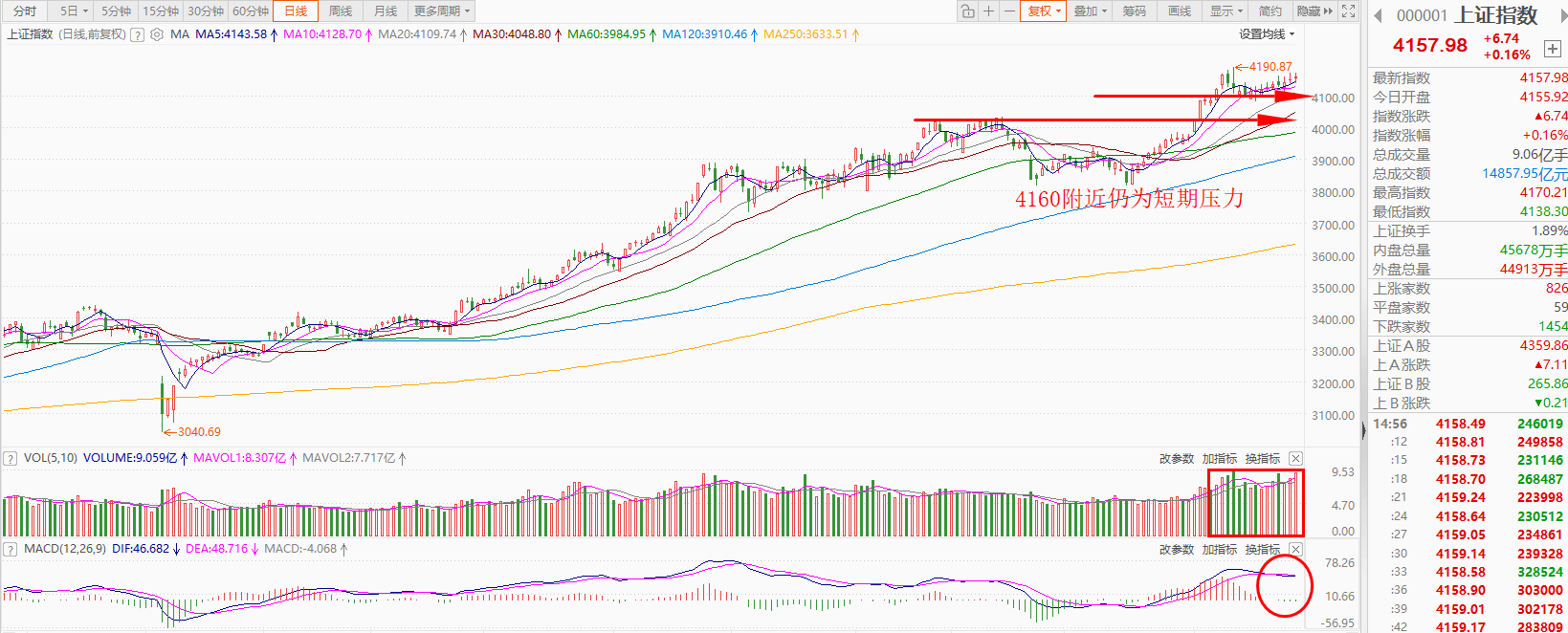
亚商投顾熊舞老师提醒大家:股市有风险,投资需要多加小心,避免不必要的风险。 一、大盘 1.盘面 上证指数早盘小幅高开,随后窄幅震荡,午后再度小幅震荡,截止收盘,指数上涨0.16%,收出十字线,全天成交额1.49万亿,相比上交易日的1.37万亿, 增加了1200亿。 深证成指早盘小幅低开,随后冲高回落,午后低位震荡,截止收盘,指数下跌0.30%,收出十字线,全天成交额1.74万亿,相比上交易日的1.60万亿,增加 了1400亿。 2.技术分析 图片来源:东方财富 上证指数今日依旧小幅震荡,沿着5日线稳健攀升,整体来看趋势仍属多头主导的温和上行格局;不过从分时图上可清晰观察到黄白线午后再度背离,指数 虽稳如泰山,但个股似乎并没那么乐观,跌多涨少格局再度凸显,赚钱效应持续萎缩,所以近几日大家的体感并不好,多数个股并不跟随指数上涨,反而出 现"赚指数不赚钱"现象。且最近"权重"与"题材"形成了跷跷板效应,资金在权重蓝筹与题材成长之间快速腾挪,导致二者此消彼长、节奏错位;所以操作上 务必严守"高低切换"纪律,避免追高已兑现品种,优先关注低位启动、量价配合良好、且具备业绩支撑的科技细分龙头。 深证成指今日窄幅震荡,小幅收 ...