电动汽车

Search documents
大行评级丨伯恩斯坦:维持小米“跑赢大盘”评级,建议长期投资者在当前具吸引力的估值水平买入
Ge Long Hui· 2025-11-12 06:24
Core Viewpoint - Bernstein maintains an "outperform" rating for Xiaomi Group (1810.HK) due to its technology-driven premium strategy, strong overseas IoT business potential, and growth opportunities in electric vehicles in both China and international markets [1] Group 1: Investment Recommendation - Analysts note that Xiaomi's stock price has corrected approximately 28% from its peak since late September, suggesting that current valuation levels are attractive for long-term investors to buy [1]
美国已经追不上中国?华尔街巨头得出结论:中国的重心正在改变
Sou Hu Cai Jing· 2025-11-12 02:57
Core Insights - The narrative surrounding China's economic growth has shifted, with trade with Belt and Road Initiative countries now accounting for nearly half of China's total trade, up from just over 30% a few years ago [2] - China's export growth is increasingly driven by emerging markets, with a significant transformation in export structure from low-value products to electric vehicles, photovoltaic equipment, energy storage products, and AI software systems [4][6] - The Regional Comprehensive Economic Partnership (RCEP) has led to a significant reduction in tariffs, boosting trade within the region to over 2.5 trillion RMB [7] Trade Dynamics - U.S. companies are facing challenges in reducing reliance on China, as many products shipped from Southeast Asia and Mexico are still produced by Chinese firms operating overseas [9] - China has shifted its soybean imports from the U.S. to Brazil and Argentina, highlighting the strategic importance of its agricultural and technological sectors [11] - China's semiconductor self-sufficiency is projected to reach over 30% by 2025, as the country accelerates its domestic R&D efforts [11] Economic Resilience - China's economy is showing resilience through internal vitality, with GDP growth of 5.2% year-on-year in the first three quarters of the year [15] - The manufacturing sector is evolving, with high-tech manufacturing accounting for 16.7% of industrial value added, and green energy consumption increasing by approximately 1.7 percentage points [17] - The "new economy" (new industries, new business models) is becoming a significant growth engine, with a projected growth rate of 6.7% in 2024, outpacing overall GDP growth [19] Global Economic Landscape - The global economic landscape is undergoing a transformation, with the dominance of the U.S. dollar gradually weakening, while China's manufacturing and market potential become more pronounced [21] - China's competitive edge is bolstered by its manufacturing resilience, renewable energy advantages, and market potential, positioning it as a leader in the new global economic arena [21]


以开放之姿拥抱世界 以合作之笔共绘未来
Shan Xi Ri Bao· 2025-11-12 00:31
Group 1 - The core focus of the news is on the investment opportunities and collaborative efforts in Shaanxi, particularly in the context of attracting multinational companies to the region [1][2][3]. - Shaanxi is actively promoting its unique value and broad prospects for investment, especially in key industries such as automotive, semiconductors, and aerospace [2][3]. - The "Invest in Shaanxi" event attracted 178 multinational companies from 18 countries, highlighting the region's commitment to developing an open economy and enhancing international cooperation [1][4]. Group 2 - The event featured various activities including product exhibitions and project inspections, aimed at facilitating precise connections between industries and improving investment cooperation [4][5]. - A total of 57 key projects were signed or announced during the event, with a combined project cooperation amount of 992.34 billion yuan [5]. - Shaanxi has established 18 international routes for the China-Europe Railway Express, enhancing its logistics capabilities and attracting foreign investment [6]. Group 3 - The region's strong educational and research institutions are seen as vital for economic development, with many foreign companies expressing interest in collaboration [3][6]. - Shaanxi has become a hub for foreign investment, with 8,892 foreign-funded enterprises established from 93 countries and regions, including over 200 Fortune 500 companies [6][7]. - Recent favorable policies have been introduced to support local enterprises in enhancing their internationalization, boosting investor confidence in Shaanxi's development [7].
8点1氪:云南通报“赤裸小孩”事件;小米回应SU7改款涨价;苹果推出新配件,售价1299元起
36氪· 2025-11-12 00:12
Group 1 - The article discusses the investigation into the "naked child" incident in Yunnan, where a child was photographed crawling naked, leading to public concern about potential child abuse or trafficking [4][5][7] - A joint working group was established to investigate the situation, ensuring the family's well-being and conducting health assessments for the children [5][6] - The parents expressed gratitude for public concern and confidence in their ability to raise their children properly, hoping for a resolution to the media frenzy [7] Group 2 - The article highlights the significant growth in China's new energy vehicle (NEV) sales, with October 2025 marking the first month where NEV sales exceeded 50% of total new car sales, reaching 51.6% [15][16] - The total production and sales of automobiles in China from January to October 2025 were reported at 27.69 million units, with NEV production and sales showing a year-on-year increase of 33.1% and 32.7% respectively [15][16] Group 3 - The article mentions that SoftBank sold all its shares in Nvidia for $5.83 billion to fund its investment in OpenAI, indicating a strategic shift in investment focus [18] - Tesla's sales in China saw a significant decline, with October sales dropping 63.64% month-on-month, leading to a drop in brand ranking from 7th to 27th [17] - The article also notes that Apple has delayed the release of the next-generation iPhone Air due to lower-than-expected sales, impacting its supply chain [18]

中国构建了有效的创新体系(国际论坛·读懂中国·读懂中国式现代化)
Ren Min Ri Bao· 2025-11-11 22:33
Group 1 - China's technological innovation is rapidly advancing across various fields, particularly in artificial intelligence, electric vehicles, and battery technology [1][2] - The number of high-level international journal papers and citations from Chinese institutions in artificial intelligence is increasing at an incredible rate, with 8 Chinese institutions ranked among the top ten in the Nature Index 2025 [2] - China now holds 60% of the global patents in artificial intelligence, a significant increase from a decade ago when it lagged behind Europe and the US [2] Group 2 - The Chinese innovation system is effective due to its long-term focus, with government and private sectors collaborating to support technological advancements [2][3] - Western countries have underestimated China's innovation capabilities and have responded to competition with restrictions rather than embracing collaboration [3] - The need for Western countries to learn from China's approach to building an innovation system is emphasized, as many key areas of advantage are being challenged [3]
10月CPI转正让资本狂欢!关乎你的收入与消费,看懂三点稳住钱包
Sou Hu Cai Jing· 2025-11-11 16:17
Group 1 - The October Consumer Price Index (CPI) increased by 0.2% year-on-year, reversing a 0.3% decline in September and exceeding market expectations of a 0.1% decrease [1][3] - The rise in CPI is attributed to the consumption boost during the Golden Week holiday, with significant increases in service consumption and prices, particularly in travel, dining, and transportation [3][5] - Core CPI, excluding food and energy, maintained a steady growth of 1.2%, indicating a stable domestic consumption base supported by essential services like healthcare and education [5][7] Group 2 - The Producer Price Index (PPI) and GDP deflator indicate deeper economic issues, with the PPI showing a 2.9% year-on-year decline, marking 37 consecutive months in negative territory [5][7] - The GDP deflator has been declining for over two years, suggesting that nominal GDP growth is lagging behind actual GDP growth, raising concerns about economic quality and sustainability [7][9] - Policy measures are being implemented to curb price wars in sectors like electric vehicles and food delivery, aiming to stabilize growth while preventing deflation [9][10] Group 3 - The central bank aims to promote a reasonable recovery in prices, with potential measures including lowering reserve requirements and interest rates to boost liquidity and demand [10][12] - Consumers are advised to adopt rational consumption behaviors, focusing on essential purchases and avoiding excessive stockpiling, while investors are encouraged to steer clear of weak cyclical industries and focus on healthcare, education, and emerging sectors [12]
上调目标价!大摩猛赞小鹏汽车:不仅能对抗电动汽车同行,还能与成熟科技公司竞争
Zhi Tong Cai Jing· 2025-11-11 14:23
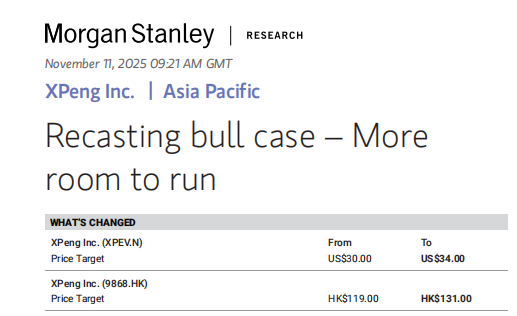
Core Viewpoint - XPeng Motors' stock price has surged significantly after a prolonged period of stagnation, with a 16% increase in US markets and an 18% rise in Hong Kong markets following a positive report from Morgan Stanley, which raised the target price to $34 per share and HK$131 [1][2]. Group 1: Strategic Positioning - Morgan Stanley believes XPeng is transitioning from being merely an electric vehicle manufacturer to a diversified player in artificial intelligence applications, which is expected to provide asymmetric advantages against competitors in both the EV and tech sectors [3]. - Despite having a smaller fleet compared to industry giants like BYD and Geely, XPeng's early focus on autonomous driving and self-developed AI computing is anticipated to accelerate its data collection and learning processes [3]. Group 2: Technological Advancements - XPeng showcased new products, including humanoid robots and autonomous taxis, during its technology day, which operate on the same foundational models, enhancing data acquisition and machine learning capabilities [4]. - The introduction of XPeng's AI Turing chip, which supports L3 autonomous driving, is a key component of its VLA 2.0 system and is expected to be integrated into new vehicle models starting in 2025 [7]. Group 3: Valuation and Market Potential - Morgan Stanley has updated its bullish scenario for XPeng, incorporating the potential revenue from AI products, humanoid robots, and autonomous taxis, alongside the ongoing expansion of its EV business [5]. - The estimated valuation for XPeng's AI Turing chip business is projected at 47 billion RMB, with potential revenue reaching 5-6 billion RMB by 2028 [8]. - The humanoid robot segment is valued at 7 billion RMB, with expectations of rapid growth from 2026 to 2030 [10]. - The autonomous taxi business is estimated to be worth 14 billion RMB, with a projected fleet size of 65,000 vehicles by 2028 [11]. - Overall, Morgan Stanley's bullish scenario values XPeng at approximately 368 billion RMB, factoring in the automotive business, AI chip business, humanoid robots, and autonomous taxis [12].
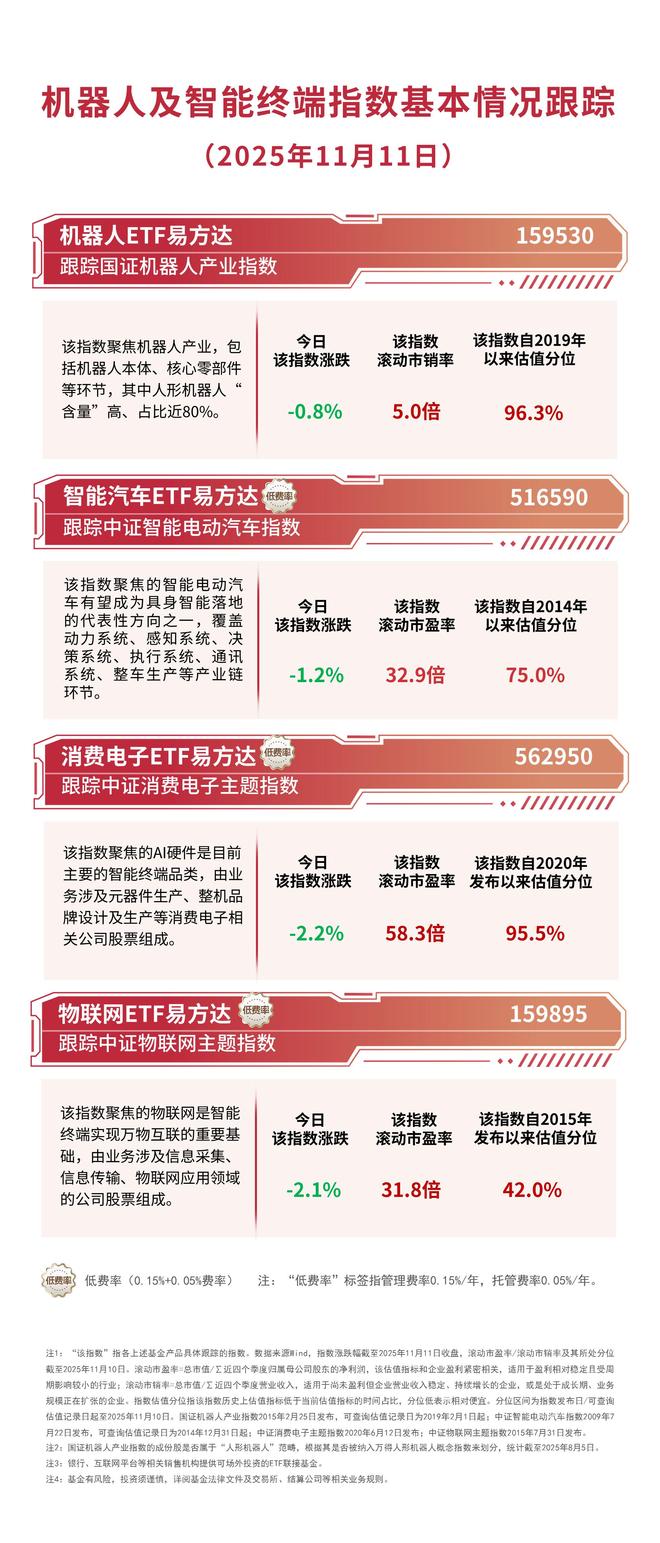
特斯拉筹备扩建机器人超级工厂,机器人ETF易方达(159530)助力布局产业链龙头
Mei Ri Jing Ji Xin Wen· 2025-11-11 10:27
Market Performance - The National Robot Industry Index decreased by 0.8%, the China Securities Intelligent Electric Vehicle Index fell by 1.2%, the China Securities Internet of Things Theme Index dropped by 2.1%, and the China Securities Consumer Electronics Theme Index declined by 2.2% [1] Tesla's Expansion Plans - Tesla is preparing to expand its Texas Gigafactory by building a dedicated facility for the mass production of its humanoid robot, Optimus [1] - Currently, Tesla has established a pilot production line in Fremont, California, for assembling some Optimus prototypes, but the majority of the production capacity for the Optimus project is planned to be located at the Texas Gigafactory [1] - The company aims to achieve an annual production capacity of 10 million units for the Optimus robot [1]


法企高管:真正危险在于中国不再模仿,而是创新并超越我们
Xin Lang Cai Jing· 2025-11-11 07:29
Core Viewpoint - The article emphasizes that China is transitioning from being perceived as a "copycat" to becoming a global leader in innovation, particularly in sectors like electric vehicles and clean energy technology, which poses a challenge to Western companies [1][2]. Group 1: China's Innovation and Investment - China has significantly increased its investment in research and development, with an expected growth of 8% by 2024, reaching approximately 2.7% of its GDP, surpassing the EU's average of 2.1% [1]. - The "Made in China 2025" strategy, initiated in 2015, aims to develop world-class technology enterprises, with a major focus on artificial intelligence (AI) investments starting in 2017, targeting to become a global leader by 2030 [1]. Group 2: Global Patent Landscape - In 2022, nearly half of the global patent applications originated from China, indicating a shift in competitiveness that now includes innovation and quality, not just pricing [2]. - The perception of China has evolved from being a mere imitator to a significant player in the global innovation landscape, as highlighted by a French publication noting China's rapid ascent to a position of leadership in the patent market [4]. Group 3: Western Response and Reflection - The increasing competitiveness of Chinese companies has prompted European firms to reassess their intellectual property strategies to avoid over-reliance on Chinese partners [4]. - In the U.S., there is a growing recognition that the belief in China's lack of innovation capabilities is outdated, with former U.S. Ambassador to China Nicholas Burns stating that China has become a formidable competitor [5].
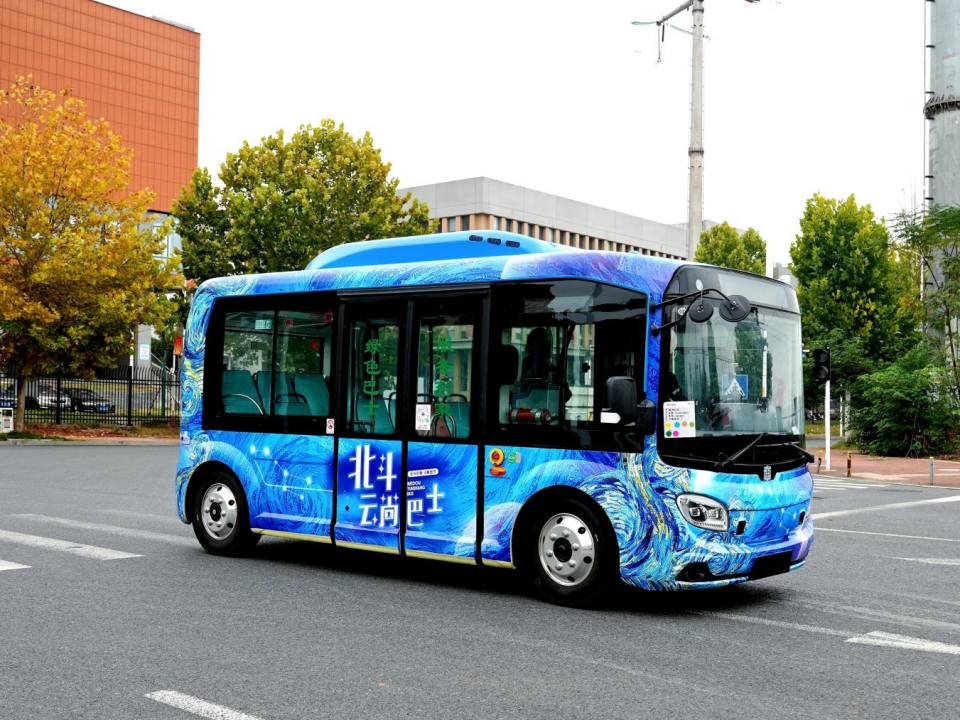
从北斗应用到零碳园区:解码湖南金融赋能新质生产力的实践样本
Zhong Guo Jin Rong Xin Xi Wang· 2025-11-11 03:21
Group 1: Financial Empowerment in Technological Innovation - Hunan's financial system is increasingly acting as a "strategic partner" in supporting technological innovation and industrial upgrades through a service ecosystem tailored to these needs [1][2] - Agricultural Bank of China in Zhuzhou completed a credit approval of 1.97 billion yuan in just 20 days during the initial phase of the Beidou Industrial Park, marking a historical high for the bank [2] - China Railway Construction Heavy Industry Group received 3.88 billion yuan in loans from the National Development Bank to tackle key technologies in high-end tunnel boring machines (TBM), maintaining a leading market share in China [5] Group 2: Innovations in Transportation and Energy - The North Cloud Bus developed by CRRC Times Electric Co., Ltd. utilizes the Beidou system for real-time positioning and intelligent scheduling, showcasing significant technological advantages [4] - Hunan's financial institutions are supporting projects like the Dazeh Lake low-carbon demonstration park, which aims to create a clean energy system through geothermal energy [7][9] - Hunan Junxin Environmental Protection Co., Ltd. has built a leading environmental park with support from China Merchants Bank, processing nearly 10,000 tons of waste daily and achieving significant carbon reduction [10] Group 3: Support for Traditional Industries and Sustainable Development - The Chang-Zhu-Tan logistics hub project is a key national initiative aimed at transforming traditional logistics into a smart and low-carbon model, with a credit line of 1.45 billion yuan from the Bank of Communications [11] - Long-term partnerships between banks and companies, such as the 20-year collaboration between Changsha Bank and Salted Snack Manufacturer, illustrate the role of financial support in transitioning from traditional to smart manufacturing [13] - Hunan Liyu Environmental Energy Co., Ltd. has received 576 million yuan in loans since 2019, enabling it to provide approximately 11.9 billion kWh of green electricity annually and expand into international markets [10]