
制造业

Search documents
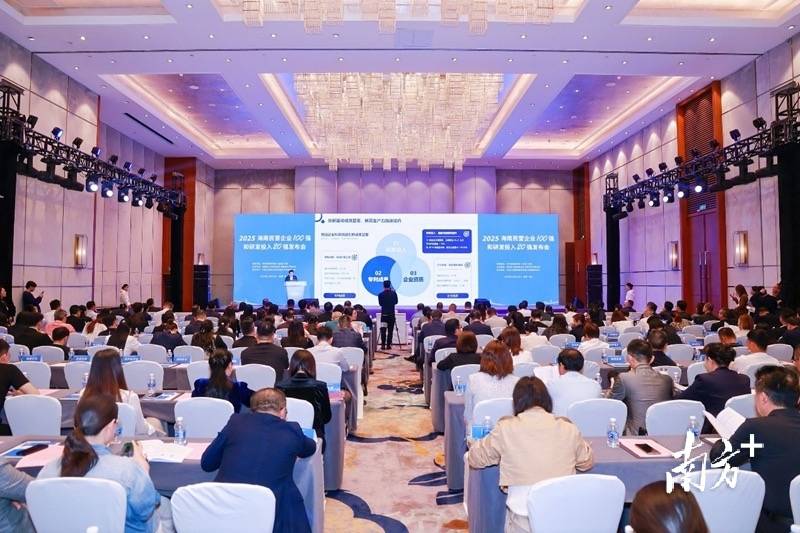
6家营收超百亿元!2025海南民企百强榜出炉
Sou Hu Cai Jing· 2026-01-01 15:47
Core Insights - The "2025 Hainan Private Enterprises Top 100" and "2025 Hainan Private Enterprises R&D Investment Top 20" lists were released, showcasing the strong development capabilities of Hainan's private sector [3][4] - The total revenue of the top 100 private enterprises reached 346.79 billion yuan in 2024, with an average revenue of 3.468 billion yuan per enterprise, reflecting a year-on-year growth of 10.35% [3][4] - The R&D investment of the top 20 enterprises surpassed 4 billion yuan, reaching 4.166 billion yuan, with an average R&D intensity of 15.31%, indicating a robust commitment to innovation [4] Group 1: Top 100 Private Enterprises - The entry threshold for the top 100 private enterprises increased to 299 million yuan, with 6 companies reporting revenues exceeding 10 billion yuan [3][4] - The top 100 enterprises span 35 industries, with a significant presence in manufacturing, which accounts for 36% of the list, highlighting the sector's role as a core support for the real economy [3][4] Group 2: R&D Investment Top 20 - The entry threshold for the R&D investment top 20 reached 52.34 million yuan, with total R&D expenses growing by 10.71% year-on-year [4] - The top 20 enterprises demonstrated solid operational performance, with total assets and revenue increasing by 12.79% and 21.59% respectively [4] Group 3: Economic Contribution - In the first three quarters of the year, Hainan's private economy contributed 338.63 billion yuan, representing a year-on-year growth of 4.2%, accounting for nearly 60% of the province's GDP and over 90% of employment positions [4]



大涨4462点,人民币进入6字头,中国官媒12个字罕见警告
Sou Hu Cai Jing· 2026-01-01 11:41
Group 1 - The core point of the article is that the recent appreciation of the Renminbi (RMB) against the US dollar is a result of both external and internal factors, leading to a complex situation where the Chinese government has issued warnings despite the apparent benefits of currency appreciation [2][3][5][11]. - The external factor driving the RMB appreciation is the change in US monetary policy, specifically the shift from interest rate hikes to rate cuts, which weakened the US dollar and made RMB assets more attractive to international investors [5][9]. - Internally, a "settlement tide" has emerged as Chinese export companies, previously holding onto US dollars in anticipation of further depreciation, are now converting their dollars to RMB due to fears of losing value, creating a self-reinforcing cycle of appreciation [7][9]. Group 2 - The Chinese government warns that while currency appreciation may seem beneficial, it poses risks to export-oriented businesses, as a stronger RMB can make their products more expensive and less competitive internationally [11][13]. - There is concern about speculative capital entering the market, which could lead to volatility and potential financial instability, reminiscent of past economic crises in other countries [13][15]. - The government emphasizes the importance of maintaining a stable RMB exchange rate rather than focusing solely on appreciation, advocating for a dual-directional fluctuation as the norm to prevent market overheating and speculative behavior [15][16]. Group 3 - For businesses, especially exporters, it is crucial to adopt a "risk-neutral" mindset and utilize financial instruments to hedge against currency fluctuations, ensuring stable profits regardless of exchange rate movements [16][18]. - Ordinary individuals are advised not to engage in currency speculation unless there is a clear need for foreign currency, as the long-term stability of the RMB is expected, and efforts should be focused on enhancing personal capabilities and investing in domestic assets [19][21]. - The article concludes that the recent RMB appreciation is justified by underlying factors, but the government's warnings serve as a precaution against potential market excesses that could harm the real economy [21].
深度复盘2025消费大变局:政策与市场双轮驱动下的品牌重塑与科技共生
Sou Hu Cai Jing· 2026-01-01 10:13
Core Insights - The article emphasizes the importance of consumption as a key driver of economic growth in China, highlighting that it is a primary focus of government policy for 2025, aiming for a unique development path characterized by stability and progress [1][14]. Macroeconomic Context - In 2025, consumption's contribution to economic growth reached 53.5%, an increase of 9 percentage points from the previous year, showcasing its stability amid pressures on investment and exports [3]. - From January to November, the total retail sales of consumer goods grew by 4.0% year-on-year, with service retail sales leading at a growth rate of 5.4% [3]. Trends in Consumption - **Smart Replacement Trend**: The introduction of long-term special government bonds and local subsidies has led to a surge in sales from old-for-new consumption, exceeding 2.5 trillion yuan, marking a significant reduction in consumption barriers [4]. - **Emotional Value Rise**: A notable 56.3% of Generation Z consumers are willing to pay for emotional experiences, indicating a shift from functional consumption to products that resonate emotionally [7]. - **Channel Revolution**: Online retail sales of physical goods approached 26%, with live e-commerce and instant retail reshaping consumption dynamics, particularly in previously underserved county markets [10]. - **Supply-Side Awakening**: The light industry and manufacturing sectors are proactively creating new demand by eliminating low-value capacity and adopting smart manufacturing technologies [11]. Expert Perspectives - A leading brand expert highlights that the 2025 consumer market signifies a new cycle of "brand technology," where successful companies leverage both hard technology and emotional appeal to thrive in a competitive landscape [12]. - The expert stresses that digital transformation is essential for survival in the market, advocating for deep integration of technological innovation throughout the product lifecycle to elevate "Chinese manufacturing" to "Chinese branding" [12]. Conclusion - The article concludes that the "steady progress" in the consumer market is a result of effective policy and market vitality, suggesting that the future of China's consumption landscape will continue to evolve through structural reforms and the emergence of new productive forces [14].

新年献词 | 试看将来的市场,必立大A的旗杆
Zhong Guo Zheng Quan Bao - Zhong Zheng Wang· 2026-01-01 06:21
Core Insights - The article emphasizes the importance of identifying trends and preparing for future opportunities as the market shifts from short-term fluctuations to a focus on solid fundamentals [1][9] - It highlights the significance of China's strategic positioning as a core growth engine and innovation hub in the global landscape, suggesting that distancing from the Chinese market may lead to missed growth opportunities [3][11] Group 1: Economic and Market Trends - By 2035, China aims to achieve a per capita GDP level comparable to that of moderately developed countries, marking a shift from mere economic growth to a focus on quality and innovation [3][11] - The article discusses a historical wealth migration, with a weakening of real estate investment attributes and a surge in investable assets, indicating a need for new avenues for value creation [3][11] Group 2: Investment Opportunities - Market opportunities are emerging from the intersection of grand narratives and subtle changes, rooted in the ongoing industrial revolution and the optimization of economic structures [4][12] - The transition from old to new driving forces and the cultivation of internal momentum are expected to give rise to globally competitive enterprises that will form the backbone of the new market landscape [4][12] Group 3: Strategic Insights - The article warns that the greatest risks often stem from stagnation in understanding, emphasizing the need for insight and foresight in investment decisions [6][14] - It stresses the importance of recognizing historical context and establishing faith in long-term trends over chasing short-term market movements [6][14]

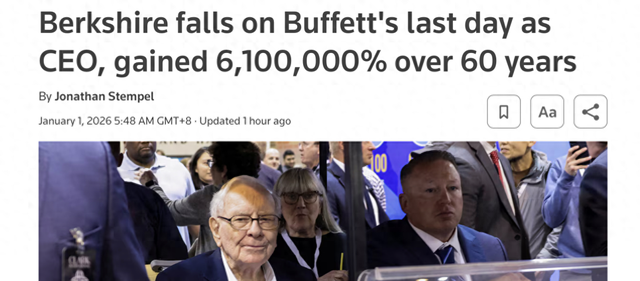
巴菲特任内最后一天,伯克希尔股价微跌,60年回报61000倍!
Hua Er Jie Jian Wen· 2026-01-01 03:46
Core Insights - Warren Buffett concluded his 60-year tenure as CEO of Berkshire Hathaway, marking the end of an era with a slight decline in A and B class shares on his last trading day [3] - Under Buffett's leadership since 1965, Berkshire Hathaway generated approximately 6,100,000% total return for shareholders, significantly outperforming the S&P 500's return of about 46,000% [3] - Despite historical success, Berkshire's stock performance has lagged behind the S&P 500 in the past decade and is expected to face challenges in finding impactful acquisition targets for its $1.08 trillion empire [3] Management Transition and Structure - Greg Abel, aged 63, has taken over as CEO after joining Berkshire in 2000 and serving as Vice Chairman since 2018, overseeing non-insurance operations [4] - Warren Buffett, now 95, will remain as Chairman and plans to support Abel's transition from his office in Omaha [4] - The management structure includes Ajit Jain continuing to oversee insurance operations, while Abel focuses on BNSF Railway, manufacturing, and energy sectors, with consumer goods and retail now managed by Adam Johnson of NetJets [4] Investment Portfolio Management - Berkshire Hathaway has not yet announced who will manage its $283.2 billion stock portfolio, which includes major holdings like Apple and American Express [5] - There were expectations for Todd Combs and Ted Weschler to take over, but Combs has recently left for JPMorgan, creating uncertainty in succession plans [5] - Buffett indicated that Greg Abel is capable of managing the investment portfolio, providing a crucial hint regarding the future management of investment rights [5]
股市“四辩”︱重阳投资2026年投资策略报告
私募排排网· 2026-01-01 03:05
Core Viewpoint - In 2025, the Chinese stock market experienced a strong rebound, with the Shanghai Composite Index reaching a ten-year high, while the market structure showed significant differentiation. Looking ahead to 2026, the company aims to identify new opportunities through four debates: future debate, allocation debate, current debate, and strategy debate [3]. Future Debate - China is unlikely to follow Japan's path of economic stagnation, primarily due to its superior innovation capabilities and irreplaceability in the global market. The perception of the Chinese market has shifted from "uninvestable" to having "strategic allocation value" [5][10]. - The Chinese stock market's performance from 2021 to 2024 raised concerns about a potential "lost decade," similar to Japan's experience. However, the market's recovery in 2025 has led to a more optimistic outlook [10][11]. Current Debate - The anticipated capital expenditure in AI may not materialize as expected. While AI is seen as a significant technological revolution, the high profit margins and capital requirements in the industry present challenges for sustainable growth [21][29]. - The contradiction between massive capital expenditure and high profit margins in the AI industry could limit growth potential. The market's expectations for cloud service providers' capital expenditures are substantial, but achieving the necessary revenue growth poses a significant challenge [22][23][27]. Strategy Debate - The company maintains a positive outlook for the market in 2026 but advises investors to temper their return expectations. The focus will be on defensive strategies and seeking opportunities in technology and advanced manufacturing sectors, while also exploring contrarian investments in underappreciated sectors like consumption, military, and real estate [30][31]. - The company emphasizes the importance of rational and gradual asset reallocation in the current market environment, contrasting with previous market behaviors characterized by herd mentality [15][20]. Investment Focus Areas - The company is optimistic about the technology sector, particularly in AI applications and innovative pharmaceuticals, as well as advanced manufacturing, which has shown significant growth potential [32][33]. - In the consumer sector, despite a challenging environment, some leading companies have demonstrated resilience and growth, making them attractive for stable investment [33]. - The military sector is expected to benefit from ongoing geopolitical tensions, while the real estate market is viewed as having structural opportunities despite current challenges [34].

2026年济宁聚力新型工业化强市,“五大行动”激活工业动能
Qi Lu Wan Bao· 2026-01-01 01:38
Group 1: Core Objectives - Jining aims to accelerate the construction of a new type of industrialized strong city as one of its three major positions by 2026, focusing on traditional, emerging, and future industries while promoting intelligent, green, and integrated development [1] - The city plans to implement the "number one project" for industrial economy, targeting a "one trillion, five-fold increase" strategy to strengthen its "232" advantageous industrial clusters, with a goal to steadily increase the manufacturing value-added share of GDP by 2026 [1] Group 2: Key Actions - The city will implement five major actions to support the construction of a new industrialized strong city, including enhancing key industrial chains through a comprehensive "chain leader system" focusing on 15 key industrial chains, with tailored development action plans for each [2] - A high-quality development opinion for industrial parks will be introduced, optimizing the layout of the "1+15+N" industrial parks, and planning the construction of several "in-park" areas to foster industrial growth [2] - A plan for nurturing quality enterprises will be established to cultivate more leading, backbone, and high-growth companies, with a focus on new provincial-level "specialized, refined, distinctive, and innovative" enterprises [2] Group 3: Investment and Service Expansion - The city will focus on aggressive investment attraction strategies, targeting key regions such as Beijing-Tianjin-Hebei, Yangtze River Delta, and Guangdong-Hong Kong-Macau Greater Bay Area, emphasizing enterprise and park-based investment [3] - The expansion of the productive service industry will be prioritized, with initiatives aimed at enhancing trade, logistics, and financial support, while fostering high-level service platforms and nurturing market entities [3] - The goal is to increase the number of regulated service industry enterprises by over 150 within the year, with a target of achieving over 6% growth in service industry value-added [3]
巴菲特卸任伯克希尔CEO 执掌60年创逾6.1万倍回报
Xin Lang Cai Jing· 2026-01-01 01:17
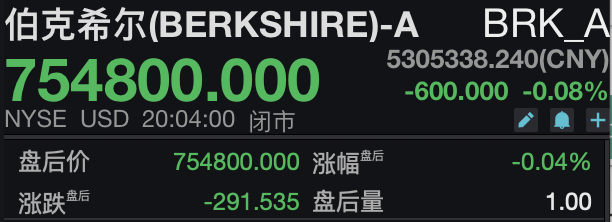
来源:环球网 【环球网财经综合报道】据路透社等外媒报道,在传奇投资者沃伦·巴菲特即将卸任首席执行官职务的 前夕,伯克希尔·哈撒韦公司(BRK_A)股价当地时间周三小幅收跌。当日,伯克希尔A类股下跌600美 元,跌幅0.1%,收于754,800美元;B类股下跌1.06美元,跌幅0.2%,收于502.65美元。同期,标准普尔 500指数下跌0.7%。 (图片来 自1965年巴菲特接任伯克希尔CEO以来,长期持有该公司股票的投资者获得了约6.1万倍的惊人回报 率,远超同期标普500指数约460倍的涨幅(含股息)。尽管伯克希尔在2025年及过去十年中从未出现年 度亏损,但其股价表现仍略逊于大盘。 伯克希尔的业务版图庞大,旗下子公司包括保险公司Geico、BNSF铁路公司、数十家制造与能源企业, 以及Brooks、Dairy Queen、Fruit of the Loom、See's Candies等知名零售品牌。截至2025年9月底,公司 持有3817亿美元的现金及现金等价物。 95岁的巴菲特在卸任CEO后,将继续担任董事长,并计划每日前往位于内布拉斯加州奥马哈的伯克希尔 总部(距其住所约3.2公里),协助继任者开展 ...
2026年我国经济高质量发展三大看点
Guo Ji Jin Rong Bao· 2026-01-01 00:31
Group 1 - China's economy is expected to maintain steady growth in 2025, successfully achieving annual targets, with strong momentum continuing into 2026 driven by new consumption, enhanced production capabilities, and a solid export position in global supply chains [1] Group 2 - New consumption is set to expand and improve, with policies aimed at boosting domestic demand, including increased quotas for trade-in programs and an expanded range of supported products, leading to over 2.5 trillion yuan in sales benefiting more than 360 million people in 2025 [2] - The shift in consumer trends towards value-for-money and emotional value is notable, with experiential consumption in areas like culture, travel, and fitness driving growth [2] - AI is enhancing both online and offline retail experiences, with innovations like instant retail and smart shopping becoming more prevalent, expected to lead to deeper integration and quality improvements in consumption by 2026 [3] Group 3 - Core technology breakthroughs are reshaping industrial advantages, with advancements in AI, semiconductors, and commercial aerospace expected to drive high-quality upgrades in various sectors [4] - The renewable energy sector is projected to expand significantly, with an expected addition of over 20 million kilowatts of wind and solar power capacity by 2026, contributing to energy structure optimization and carbon peak goals [4] - The digital transformation of manufacturing is advancing, with a penetration rate of 68% in 2025, leading to efficiency improvements of over 25% in key industries [4] Group 4 - Export resilience is anticipated, with a focus on diversifying markets and consolidating China's leading position in global supply chains [6] - The reduction of tariff uncertainties is expected to stabilize trade with the U.S., while high-value, green products are becoming key growth drivers, with electric vehicle exports reaching 3.01 million units in 2025, a 62% increase [7] - China's trade with Belt and Road Initiative countries accounted for over 50% of exports in 2025, indicating a strong foundation for non-U.S. trade [7] - Continued high-level openness and trade innovation are expected to strengthen global supply chain positions, with rapid growth in cross-border e-commerce and digital technologies reducing trade costs [8]
2025年巴新经济部门表现与挑战
Shang Wu Bu Wang Zhan· 2025-12-31 17:19
Agriculture Sector - Cocoa exports are performing strongly, with revenue reaching a historical high of 1.2 billion Kina in 2024 and expected to increase to 2 billion Kina in 2025, driven by production increases in provinces like Bougainville [1] - Global cocoa prices have declined from approximately $10,000 per ton at the beginning of the year to about $6,000 per ton by year-end due to production recovery in Côte d'Ivoire [1] - The coffee industry is facing challenges, with declines in production, yield, and exports despite high global market prices; key measures include the "Freight Assurance Program" launched in July and the establishment of a new coffee processing plant in Morobe Province [1] Mining and Oil Sector - The mining sector, while not in its best year, has made significant contributions to the economy through company income taxes, with the Domestic Revenue Commission collecting around 1.6 billion Kina from major mines, aiming for a total of 2 billion Kina for the year [2] - Investment in the Central Province's lime and cement project exceeds 3 billion Kina, with a final investment decision expected to reduce cement imports by 50% [2] - The PNG LNG project has generated over 5 billion Kina in export revenue this year, while the Papua LNG project's final investment decision has been postponed to early 2026, which is crucial for the future development of the oil sector and meeting long-term demand in Asia [2] Retail, Manufacturing, and SMEs - Retail and manufacturing activities in Port Moresby are relatively subdued, facing intense competition, while the manufacturing sector is hindered by ongoing power outages and high network costs, leading to significant losses [2] - The performance stagnation of state-owned enterprises and infrastructure issues are identified as barriers to economic growth [2] - Access to funding for small and medium-sized enterprises (SMEs) remains a major obstacle, with government support funds struggling to reach entrepreneurs due to banking policy regulations [2] - The geographical advantages of Papua New Guinea present significant trade potential, but overall growth requires the finalization of large resource projects like Papua LNG to stimulate downstream business activities and address critical infrastructure and financing challenges for SMEs [2]