
国防军工

Search documents
【盘中播报】沪指涨1.00% 通信行业涨幅最大
Zheng Quan Shi Bao Wang· 2025-11-25 06:37
| 申万行业 | 行业涨跌(%) | 成交额(亿元) | 比上日(%) | 领涨(跌)股 | 涨跌幅(%) | | --- | --- | --- | --- | --- | --- | | 通信 | 3.14 | 1037.59 | 21.46 | 德科立 | 20.00 | | 传媒 | 3.13 | 957.07 | 22.46 | 富春股份 | 20.00 | | 综合 | 2.61 | 40.11 | 0.04 | 东阳光 | 5.85 | | 有色金属 | 2.49 | 789.13 | 7.19 | 铂科新材 | 11.03 | | 电子 | 2.31 | 2426.46 | 18.32 | 长光华芯 | 20.00 | | 建筑材料 | 1.98 | 100.49 | -0.17 | 垒知集团 | 10.07 | | 社会服务 | 1.85 | 141.91 | 18.99 | 科德教育 | 19.99 | | 计算机 | 1.72 | 1360.95 | 8.69 | 佳缘科技 | 20.00 | | 电力设备 | 1.70 | 1477.77 | 9.40 | 欧陆通 | 15.49 | ...
流动性&交易拥挤度&投资者温度计周报:自媒体A股搜索热度重回高位-20251125
Huachuang Securities· 2025-11-25 05:17
Liquidity - The supply side of funds is expanding, with equity public offerings rebounding to 111 billion yuan, up from 59 billion yuan, representing an increase to the 82nd percentile over the past three years[11] - The net inflow of southbound funds reached a historical high of nearly 700 billion yuan over the past six months, with a weekly net inflow of 353.1 billion yuan[44] - The demand side is slightly contracting, with equity financing dropping to 81 billion yuan from 259 billion yuan, at the 46th percentile over the past three years[32] Trading Congestion - The trading heat in the chemical industry increased by 42 percentage points to 79%, while the insurance sector decreased by 17 percentage points to 16%[62] - Media sector trading heat rose by 13 percentage points to 47%, while central enterprises fell by 14 percentage points to 26%[62] Investor Sentiment - Retail investor net inflow reached 205.4 billion yuan, an increase of 633.3 billion yuan from the previous value, placing it in the 93.7th percentile over the past five years[2] - The overall market saw a correction, with the Shanghai Composite Index dropping 2.5% to below 3900 points on November 21[78] - The search heat for A-shares on social media platforms returned to a high not seen since August, indicating increased investor interest[78]
疯狂“抢筹”!万里挑三
Mei Ri Jing Ji Xin Wen· 2025-11-25 05:01
Market Overview - The three major A-share indices experienced slight increases, with the Shanghai Composite Index rising by 0.05%, the Shenzhen Component Index by 0.37%, and the ChiNext Index by 0.31% [1] - The total trading volume in the Shanghai and Shenzhen markets was 1.7278 trillion yuan, a decrease of 237.9 billion yuan compared to the previous trading day [1] - A total of 4,228 stocks rose while 1,104 fell, with a median increase of 1.31% for the stocks [1] Market Trends - The market is showing signs of rebound, but the intensity of the rebound is considered moderate [2] - Following a peak on November 14, the market has adjusted for seven trading days, indicating a potential for further slight declines in index levels [2] - The main downtrend phase is believed to be over, transitioning into a period of slow oscillation and subsequent range-bound trading [2] Sector Performance - Key sectors showing strong performance include defense and military, commercial aerospace, AI applications, Google supply chain, and Alibaba concepts [2] - The defense and military sector is driven by geopolitical factors, with expectations for accelerated military orders due to the current complex geopolitical environment [2][3] - The commercial aerospace sector saw significant gains, with 16 stocks hitting the daily limit or rising over 10% [3] AI Applications - The AI applications sector is gaining traction, particularly in industries such as internet services, software, advertising, education, and entertainment, with the advertising sector reaching a three-and-a-half-year high [4][5] - The article from Xinhua highlights the rapid emergence of domestic AI applications, indicating a strong market demand for high-quality AI products [6] - Goldman Sachs' chief China equity strategist noted that Chinese AI companies are focusing more on application areas rather than just computing power, suggesting a stronger potential for commercialization in the short term [6] Investment Strategies - Investors are advised to adopt a cautious approach, focusing on low-cost acquisitions in hot sectors rather than chasing high prices [2][9] - The military and semiconductor sectors are noted for their inconsistent investor reputation, suggesting caution in pursuing these stocks after significant price increases [9]
行业轮动周报:指数回撤下融资资金净流出,ETF资金大幅净流入,GRU调入传媒-20251125
China Post Securities· 2025-11-25 04:54
Quantitative Models and Construction Methods 1. Model Name: Diffusion Index Model - **Model Construction Idea**: The model is based on the principle of price momentum, aiming to capture upward trends in industries and sectors[22][23] - **Model Construction Process**: The diffusion index is calculated for each industry based on its price momentum. The model ranks industries by their diffusion index values and selects the top-performing industries for portfolio allocation. The model has been tracking out-of-sample performance since 2021, with adjustments made monthly or weekly based on updated diffusion index rankings[22][23] - **Model Evaluation**: The model has shown strong performance in capturing industry trends during momentum-driven markets but struggles during market reversals[22][36] 2. Model Name: GRU Factor Model - **Model Construction Idea**: This model leverages minute-level price and volume data processed through a GRU (Gated Recurrent Unit) deep learning network to generate industry factors for rotation strategies[37] - **Model Construction Process**: The GRU model uses historical price and volume data as input to train a deep learning network. The network identifies patterns and generates factors that are used to rank industries. The top-ranked industries are selected for portfolio allocation. The model is updated weekly to reflect changes in the rankings[30][31][37] - **Model Evaluation**: The GRU model performs well in short-term trading environments but has shown limited effectiveness in long-term scenarios. It is also sensitive to extreme market conditions[37] --- Backtesting Results of Models 1. Diffusion Index Model - **Weekly Average Return**: -5.50% - **Excess Return over Equal-Weighted CSI First-Level Industry Index**: -0.42% - **November-to-Date Excess Return**: -1.13% - **Year-to-Date Excess Return**: 1.22%[26][22][23] 2. GRU Factor Model - **Weekly Average Return**: -4.71% - **Excess Return over Equal-Weighted CSI First-Level Industry Index**: 0.35% - **November-to-Date Excess Return**: 2.92% - **Year-to-Date Excess Return**: -2.74%[35][30][31] --- Quantitative Factors and Construction Methods 1. Factor Name: Diffusion Index - **Factor Construction Idea**: The diffusion index measures the momentum of industries by analyzing price trends and ranks industries based on their momentum[22][23] - **Factor Construction Process**: The diffusion index is calculated for each industry using price momentum data. Industries are ranked based on their diffusion index values, and the top-ranked industries are selected for portfolio allocation. The index is updated weekly or monthly to reflect changes in industry momentum[22][23] - **Factor Evaluation**: The factor effectively captures upward trends in industries but may underperform during market reversals[22][36] 2. Factor Name: GRU Industry Factor - **Factor Construction Idea**: The GRU industry factor is derived from minute-level price and volume data processed through a GRU deep learning network to identify patterns and rank industries[37] - **Factor Construction Process**: The GRU model processes historical price and volume data through a deep learning network. The network generates factors that are used to rank industries. The top-ranked industries are selected for portfolio allocation, with updates made weekly[30][31][37] - **Factor Evaluation**: The factor is effective in short-term trading environments but less so in long-term scenarios. It is also sensitive to extreme market conditions[37] --- Backtesting Results of Factors 1. Diffusion Index Factor - **Weekly Average Return**: -5.50% - **Excess Return over Equal-Weighted CSI First-Level Industry Index**: -0.42% - **November-to-Date Excess Return**: -1.13% - **Year-to-Date Excess Return**: 1.22%[26][22][23] 2. GRU Industry Factor - **Weekly Average Return**: -4.71% - **Excess Return over Equal-Weighted CSI First-Level Industry Index**: 0.35% - **November-to-Date Excess Return**: 2.92% - **Year-to-Date Excess Return**: -2.74%[35][30][31]
光大期货金融期货日报-20251125
Guang Da Qi Huo· 2025-11-25 04:19
Report Summary 1. Investment Rating - No investment rating for the industry is provided in the report. 2. Core Views - **Stock Index Futures**: The A - share market closed up with fluctuations on November 24, 2025, with National Defense and Military Industry leading the gains and TMT strengthening. The Wind All - A index rose 0.62%, with a trading volume of 1.74 trillion yuan. The CSI 1000 Index rose 1.26%, the CSI 500 Index rose 0.76%, while the SSE 50 Index fell 0.18% and the CSI 300 Index fell 0.12%. After the liquidity rally since June ended, the market refocused on fundamentals. New - quality productivity themes led by AI have optimistic growth expectations for the next three years, especially in the upstream hardware manufacturing of the technology sector. However, these themes have had large gains since June, and lack further catalysts near the end of the year, entering a volatile market in November. Traditional economic sectors like consumption and cyclicals are in a volatile recovery, with limited short - term prospects for a fundamental bull market. Market trading volume, volatility, and risk appetite are decreasing, and the index is expected to fluctuate in the short term. Overseas technology stocks also face expectation divergence, with concerns about AI's actual profitability, an economic data vacuum due to the US government shutdown, and a hawkish Fed stance on a December rate cut leading to a correction in US technology stocks last week [1]. - **Treasury Bond Futures**: On November 24, 2025, treasury bond futures closed higher, with the 30 - year main contract up 0.16%, the 10 - year main contract up 0.08%, the 5 - year main contract up 0.08%, and the 2 - year main contract up 0.01%. The central bank conducted 338.7 billion yuan of 7 - day reverse repurchases on November 24, with a winning bid rate of 1.4%, realizing a net injection of 5.57 billion yuan. Liquidity is reasonably abundant, but the pressure to achieve the annual economic growth target is low, so the expectation of a central bank rate cut is weak, and the bond market lacks upward momentum. In the short term, as November enters a brief domestic economic data vacuum period, the bond market is expected to fluctuate narrowly [1][2]. 3. Daily Price Changes - **Stock Index Futures**: On November 24, 2025, compared with November 21, 2025, IH decreased by 2.0 points (-0.07%) to 2,944.4; IF increased by 6.8 points (0.15%) to 4,435.2; IC increased by 57.6 points (0.85%) to 6,827.6; IM increased by 77.0 points (1.10%) to 7,095.2 [3]. - **Stock Indexes**: The SSE 50 Index decreased by 5.3 points (-0.18%) to 2,950.6; the CSI 300 Index decreased by 5.6 points (-0.12%) to 4,448.0; the CSI 500 Index increased by 51.6 points (0.76%) to 6,869.0; the CSI 1000 Index increased by 88.7 points (1.26%) to 7,156.4 [3]. - **Treasury Bond Futures**: TS increased by 0.008 points (0.01%) to 102.42; TF increased by 0.14 points (0.13%) to 106.00; T decreased by 0.095 points (-0.09%) to 108.34; TL increased by 0.19 points (0.16%) to 115.76 [3]. 4. Market News - The Chinese Foreign Ministry spokesperson Mao Ning stated on November 24 that due to recent wrong remarks on the Taiwan issue by Japanese leaders, which have damaged the foundation and atmosphere of China - Japan - South Korea cooperation, the current conditions are not suitable for holding a China - Japan - South Korea leaders' meeting [4]. 5. Chart Analysis - **Stock Index Futures**: The report provides charts of the trends of IH, IF, IM, IC main contracts, and their respective monthly basis trends [6][7][9]. - **Treasury Bond Futures**: Charts include the trends of treasury bond futures main contracts, treasury bond spot yields, basis of 2 - year, 5 - year, 10 - year, and 30 - year treasury bond futures, inter - delivery spreads of different - term treasury bond futures, cross - variety spreads, and capital interest rates [13][14][18][19]. - **Exchange Rates**: There are charts showing the central parity rates of the US dollar, euro against the RMB, forward exchange rates of the US dollar and euro against the RMB, the US dollar index, euro - US dollar, pound - US dollar, and US dollar - yen exchange rates [22][23][26][27]. 6. Member Introduction - Zhu Jintao, a master of economics from Jilin University, is the director of macro - financial research at Everbright Futures Research Institute, with futures qualification number F3060829 and futures trading consultation qualification number Z0015271 [29]. - Wang Dongying, an index analyst with a master's degree from Columbia University, mainly tracks stock index futures, is responsible for macro - fundamental quantification, key industry sector research, index earnings report analysis, and market capital tracking, with futures qualification number F03087149 and futures trading consultation qualification number Z0019537 [29].
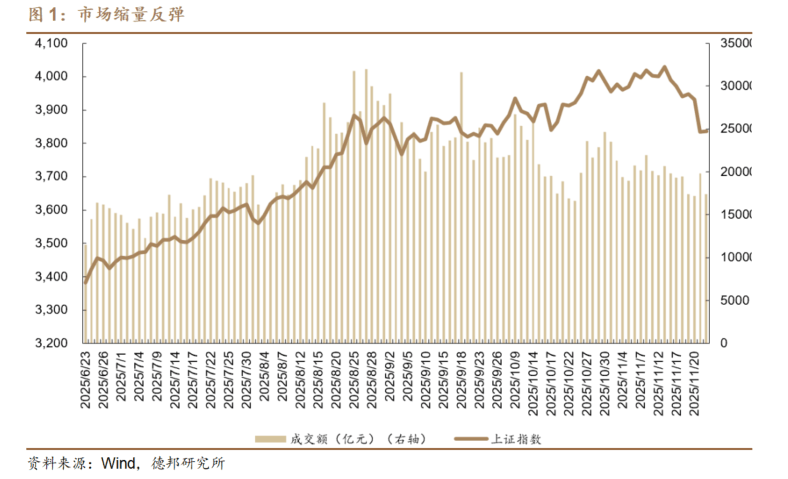
程强:缩量反弹,军工、AI应用活跃
Sou Hu Cai Jing· 2025-11-25 04:10
Market Overview - The A-share market experienced a slight rebound with reduced trading volume, while the government bond futures market showed signs of recovery. The commodity index rebounded, but lithium carbonate continued its adjustment [1]. Market Analysis Stock Market - The stock market saw a slight rebound with significant differentiation. The Shanghai Composite Index closed at 3836.77 points, up 0.05%. The Shenzhen Component Index rose 0.37% to 12585.08 points, and the ChiNext Index increased by 0.31% to 2929.04 points. The STAR 50 Index gained 0.84%. Notably, small-cap stocks outperformed, with the STAR 200 Index surging 3.02% and the Wind Micro Cap Index rising 2.21%. The total market turnover was 1.74 trillion yuan, down approximately 12.3% from the previous trading day, indicating weak buying interest [2][4]. Bond Market - The government bond futures market showed a slight increase, with the 30-year main contract rising by 0.15%. The 10-year, 5-year, and 2-year contracts increased by 0.06%, 0.03%, and 0.01%, respectively. The overall liquidity in the market remained ample, with the central bank conducting a 3387 billion yuan reverse repurchase operation at a rate of 1.40% [7][8]. Commodity Market - The commodity index rebounded, with the Nanhua Commodity Index closing at 2516.25 points, up 0.55%. The market showed structural differentiation, with the energy and chemical sectors leading gains, while agricultural products and black metals showed localized strength. However, lithium carbonate prices continued to decline, dropping by 2.88% [9][11]. Trading Hotspots Recent Hot Products - Dividend stocks are attractive due to their yield and risk-averse positioning, with future attention on commodity price trends and corporate dividend situations [13]. - AI applications are gaining traction, with products like Alibaba's Qianwen and Google's Gemini driving interest, focusing on application scenario transformations and technological breakthroughs [13]. - The consumer sector is benefiting from the appreciation of the yuan and market style shifts, with future attention on economic recovery and potential stimulus policies [13]. - Brokerage firms are seeing active trading and deposit migration, with future focus on A-share market trading volume and potential changes in trading regulations [13]. Core Thoughts Summary - The equity market is expected to remain weak due to external factors such as the Federal Reserve's interest rate expectations and tensions in Sino-Japanese relations, with a cautious risk appetite anticipated [14]. - The bond market is likely to maintain a loose liquidity environment in the short term, with attention on domestic policies and the Federal Reserve's interest rate decisions [14]. - The industrial product market is shifting from speculative trading to focusing on the real supply-demand fundamentals, while precious metals may have upward opportunities if U.S. non-farm data is weak or geopolitical risks increase [14].





计算机板块净流入约108亿元居首 龙虎榜机构抢筹多股
Zheng Quan Shi Bao Wang· 2025-11-25 03:51
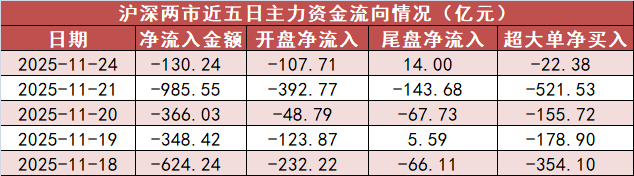
11月24日,A股市场整体小幅上涨。截至收盘,上证指数收报3836.77点,上涨0.05%,深证成指收报12585.08点,上涨0.37%,创业板指收报2929.04 点,上涨0.31%,北证50指数上涨0.63%。A股市场合计成交17405.74亿元,较上一交易日减少2433.32亿元。 1.A股市场全天主力资金净流出130.24亿元 今日A股市场主力资金开盘净流出107.71亿元,尾盘主力资金净流入14亿元,A股市场全天主力资金净流出130.24亿元。 | | | 沪深两市近五日主力资金流向情况(亿元) | | | | --- | --- | --- | --- | --- | | 日期 | | 人供快速 开盘免流入 | | 尾盘净流入 超大单净买入 | | 2025-11-24 | -130.24 | -107. 71 | 14. 00 | -22. 38 | | 2025-11-21 | -985. 55 | -392. 77 | -143. 68 | -521.53 | | 2025-11-20 | -366.03 | -48.79 | -67.73 | -155.72 | | 2025-11-19 ...
金融工程日报:沪指缩量小幅反弹,军工股集体爆发-20251125
Guoxin Securities· 2025-11-25 03:23
- The CSI 2000 Index performed well among the scale indices, with the CSI 500 Growth Index performing well among the style indices[1][5] - The defense and military industry, media, computers, machinery, and consumer services sectors performed well, while the petroleum and petrochemical, coal, banking, food and beverage, and non-ferrous metals sectors performed poorly[1][6] - The market sentiment was high, with a sealing rate of 74% and a continuous board rate of 45%, both showing significant improvement from the previous day[1][16] - The financing balance was 24,452 billion yuan, and the securities lending balance was 163 billion yuan, with the financing balance accounting for 2.6% of the circulating market value and the financing transaction accounting for 9.3% of the market transaction amount[1][18][21] - The ETF with the highest premium was the Sci-Tech Innovation and Entrepreneurship 50 ETF, with a premium of 1.80%, while the ETF with the highest discount was the All-Index Cash Flow ETF, with a discount of 1.18%[2][22] - The median annualized discount rates for the main contracts of the SSE 50, CSI 300, CSI 500, and CSI 1000 stock index futures over the past year were 0.48%, 3.41%, 10.86%, and 13.39%, respectively[2][27] - The top ten stocks with net inflows from institutional seats included Dazhong Mining, Delijia, Hainan Haiyao, Worth Buying, Haima Automobile, Beifang Changlong, China Haifang, Tietuo Machinery, Zhongfu Circuit, etc.[3][35] - The top ten stocks with net inflows from Northbound Trading included BlueFocus, Haima Automobile, Huasheng Tiancheng, Worth Buying, Dazhong Mining, Aerospace Changfeng, Aerospace Development, Jiuzhiyang, Inspur Software, Aerospace Huanyu, etc.[3][36]
【早盘三分钟】11月25日ETF早知道
Xin Lang Ji Jin· 2025-11-25 01:31
Core Insights - The defense and military industry is experiencing significant investment inflows, driven by geopolitical factors and increased defense spending, with a notable surge in the defense military ETF (512810) which saw a single-day increase of 3.78% and total inflows exceeding 13.3 billion yuan [3][6]. Market Temperature - The market temperature indicators show that the Shanghai Composite Index, Shenzhen Component Index, and ChiNext Index have percentile PE ratios of 88.44%, 71.66%, and 31.43% respectively, indicating varying levels of market valuation [1]. Sector Performance - The top three sectors with inflows include Defense and Military (2.498 billion yuan), Media (2.027 billion yuan), and Retail (0.407 billion yuan), while the sectors with the highest outflows are Electronics (-4.019 billion yuan), Computers (-2.693 billion yuan), and Electric Equipment (-2.527 billion yuan) [2]. ETF Performance - The Defense and Military ETF (512810) has shown a 15.38% increase over the past six months, indicating strong performance in the sector [3]. - The Hong Kong Internet ETF (513770) has also performed well, with a 2.2% increase on the day and a notable recovery in the past six months [6]. Investment Opportunities - The current market conditions suggest that the Hong Kong AI sector may be entering a favorable investment phase, with significant interest in technology companies involved in AI, cloud computing, and semiconductors, which are becoming increasingly integrated into global supply chains [6][8].

17股获融资净买入额超1亿元 蓝色光标居首
Zheng Quan Shi Bao Wang· 2025-11-25 01:28
Wind统计显示,11月24日,申万31个一级行业中有14个行业获融资净买入,其中,传媒行业获融资净 买入额居首,当日净买入8.47亿元;获融资净买入居前的行业还有国防军工、交通运输、银行、农林牧 渔、有色金属等。 个股方面,11月24日,有1745只个股获融资净买入,净买入金额在3000万元以上的有113股。其中,17 股获融资净买入额超1亿元。蓝色光标获融资净买入额居首,净买入3.93亿元;融资净买入金额居前的 还有寒武纪、天齐锂业、融捷股份、易点天下、张江高科、天海防务、华友钴业、长芯博创等股。 ...
