
钢铁

Search documents
螺纹热卷日报-20260224
Yin He Qi Huo· 2026-02-24 10:19
1. Report Industry Investment Rating No relevant information provided. 2. Core View of the Report - Today, the steel futures market declined overall, and the spot prices decreased slightly compared to before the holiday. During the holiday, the overall production of the five major steel products increased, and the impact on hot metal production was small. The total steel inventory increased at an accelerated pace, but the inventory accumulation rate of rebar was slower than in previous years. The export of steel was affected by the decline in export licenses, and the overseas manufacturing industry ended the restocking process. The inventory of hot-rolled coils accumulated rapidly, and the current inventory levels of billets and plates were high, with great demand pressure. The performance of rebar was stronger than that of hot-rolled coils. The raw material replenishment of steel mills before the holiday has ended, and the enthusiasm for winter storage this year was insufficient. Currently, the steel inventory is high, and the capital expenditure after the holiday may fall short of expectations. The demand recovery situation remains to be seen. The pessimistic expectations of steel mills may also limit the height of hot metal production this year, putting pressure on raw materials. However, the current absolute price of steel is low, and even if it falls, the space is relatively limited. Overall, it may maintain a weak and volatile trend [5]. 3. Summary by Relevant Catalogs Market Information - Spot prices: Shanghai Zhongtian rebar was priced at 3,180 yuan (-10), Beijing Jingye rebar at 3,110 yuan (-10), Shanghai Angang hot-rolled coil at 3,220 yuan (-20), and Tianjin Hegang hot-rolled coil at 3,130 yuan (-10) [4]. Market Research and Judgment Trading Strategy - Unilateral: Maintain a weak and volatile trend before the holiday [6]. - Arbitrage: It is recommended to short the hot-rolled coil to coking coal ratio at high levels, and continue to hold the short position of the hot-rolled coil to rebar spread [6]. - Options: It is recommended to wait and see [7]. Important Information - On February 20, 2026, US President Trump signed an announcement, stipulating that a 10% import tax would be imposed on imported goods within 150 days. The temporary import tariff would take effect at 00:01 on February 24, 2026. On February 21, Trump raised the import tariff rate on global goods from 10% to 15% [8]. - On February 24, 2026, the price of common billet resources of Songting Iron and Steel in Qian'an, Tangshan decreased by 10, and the ex-factory price was 2,880 yuan including tax [9]. Relevant Attachments - The report provides multiple charts, including the basis of rebar and hot-rolled coil contracts in different months, the price difference between different contracts, the spread between hot-rolled coil and rebar, the disk profit of rebar and hot-rolled coil contracts, the cash profit of different steel products, the cost of electric furnaces, etc. The data sources are Galaxy Futures, Mysteel, and Wind [14][16][18].
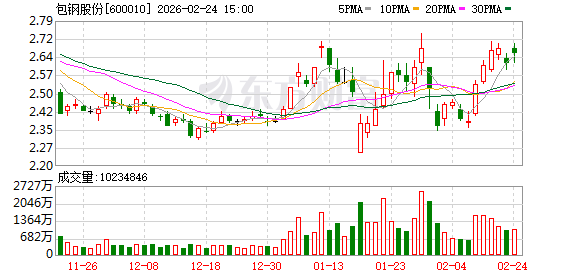
包钢股份:截至2026年2月10日公司股东总户数为789764户
Zheng Quan Ri Bao· 2026-02-24 10:15
(文章来源:证券日报) 证券日报网讯 2月24日,包钢股份在互动平台回答投资者提问时表示,截至2026年2月10日,公司股东 总户数为789764户。 ...


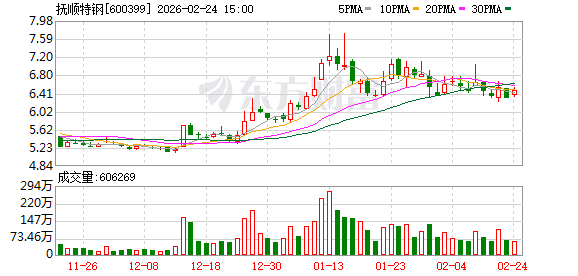
抚顺特钢:公司高温合金产品主要应用于航空发动机等领域
Zheng Quan Ri Bao· 2026-02-24 10:12
Group 1 - The core viewpoint of the article is that Fushun Special Steel has provided insights into its high-temperature alloy products and their applications in various industries [2][3] - The company’s high-temperature alloy products are primarily used in aerospace engines, ships, gas turbines, energy power, and petrochemical sectors [2] - The projected production of high-temperature alloys for 2024 is 0.85 million tons, while the production from January to September 2025 is expected to be 0.57 million tons [2]

A股迎马年开门红
Tebon Securities· 2026-02-24 10:05
Market Overview - The A-share market experienced a strong opening for the Year of the Horse, with the Shanghai Composite Index rising 0.87% to close at 4117.41 points, surpassing the 4100 mark. The Shenzhen Component Index increased by 1.36% to 14291.57 points, and the ChiNext Index rose by 0.99% to 3308.26 points. Over 4000 stocks gained, with a trading volume of 2.22 trillion yuan, an 11% increase from the previous trading day [2][5][7]. Sector Performance - Cyclical sectors led the market rally, with significant gains in oil and petrochemicals (up 5.25%), building materials (up 3.50%), non-ferrous metals (up 3.34%), coal (up 3.14%), and basic chemicals (up 2.85%). Notable stocks included Tongyuan Petroleum and China National Petroleum, which hit the daily limit [5][7]. - AI hardware stocks showed strong performance, with Tianfu Communication rising nearly 13% to a new historical high. The cultivated diamond index surged by 12.05%, indicating a transformative opportunity in the diamond industry for applications in AI chips and new energy vehicles [5][7]. Economic Indicators - The bond market saw a comprehensive rise, with the 30-year main contract closing at 112.96 yuan, up 0.20%. The People's Bank of China conducted a significant reverse repo operation, resulting in a net withdrawal of 926.4 billion yuan, indicating a tightening liquidity environment [7][11]. - The LPR remained unchanged, with the 1-year LPR at 3.0% and the 5-year LPR at 3.5%, reflecting the central bank's focus on targeted measures rather than broad monetary easing [7][11]. Commodity Market - The commodity index rose by 3.05%, led by precious metals, with silver and lithium carbonate increasing by 12.84% and 10.56%, respectively. Crude oil prices also surged, closing at 493.30 yuan per barrel, up 6.18%, driven by geopolitical tensions in the Middle East [7][11]. - The uncertainty surrounding U.S. tariffs has led to a resurgence in precious metal prices, with gold and silver showing strong upward trends [7][11]. Investment Opportunities - The report suggests a balanced allocation in technology and consumer sectors, with a focus on cyclical stocks as the spring market is expected to continue its upward trajectory. Key sectors to watch include photovoltaic technology, commercial aerospace, and non-ferrous metals, which may see new catalysts in the near future [7][11].
南京工业企业开足马力奋战新春“第一棒”
Zhong Guo Fa Zhan Wang· 2026-02-24 09:39
Group 1 - The manufacturing sector in Nanjing is experiencing a strong start to the year, with companies operating at full capacity during the Spring Festival, reflecting a proactive approach to meet high demand [1][9] - Nanjing LG Panda Electric Co. reported a 30% year-on-year increase in order volume and a 20% increase in actual sales in January, indicating a positive market outlook [2] - The company has achieved nearly 50% automation in its production lines, which has led to significant labor cost savings and high production efficiency, with a daily output of around 15,000 washing machines [2][9] Group 2 - Nanjing Steel Group is also operating at full capacity, producing over 5,000 tons of steel plates daily, with orders for major international projects, showcasing the company's robust production capabilities [5] - The logistics support for these operations is efficient, with 85% of products shipped immediately after production, and a dedicated international freight service enhancing global reach [3][9] - Nanjing Huaxin Fiber Optic Co. is expanding its production capacity significantly to meet the surging demand for high-performance optical fibers, with plans to double its export volume this year [6][7] Group 3 - Guoxuan High-Tech's production base has grown from a capacity of 1 GWh to 28 GWh, supplying major automotive manufacturers and aiming for over 180 billion yuan in annual output by 2024 [8][9] - The continuous operation during the Spring Festival across various companies reflects a commitment to maintaining production momentum and meeting market demands [8][9] - The overall trend indicates a shift from labor-intensive to technology-intensive manufacturing in Nanjing, supported by advancements in automation and logistics [9]

山东日照钢铁产业蝶变新生
Xin Hua Cai Jing· 2026-02-24 08:55
Core Insights - The steel industry in Rizhao, Shandong, is advancing towards high-end production, leveraging technology as a key driver for quality development [1][2][3] Group 1: Technological Innovations - The successful application of full-spec nickel-based steel in 270,000 cubic meter LNG storage tanks has broken foreign monopolies [1] - The ESP (Endless Strip Production) technology has achieved over 70% reduction in energy consumption per ton of steel [1] - A team of over 100 personnel at Shandong Steel Group's Rizhao company has conducted nearly a thousand experiments to solve challenges related to ultra-thin steel plate deformation [2] Group 2: Industry Upgrades - Rizhao's steel industry is transitioning from low-end to high-end products, with 70% of steel exports previously being low-end [2] - The city has established 45 national and provincial technology innovation platforms, with 15 technologies breaking foreign monopolies [3] - The digital transformation rate among key steel enterprises in Rizhao has reached 97%, with over 90% of key processes being numerically controlled [6] Group 3: Environmental Initiatives - Rizhao is focusing on green production, with over 150 billion yuan invested in environmental protection by local steel enterprises [8] - Major pollutants' emissions have decreased by 44% for sulfur dioxide and nitrogen oxides, and by 12% for particulate matter compared to 2020 [8] - The city is promoting a shift from passive emission reduction to proactive carbon reduction strategies [7][8]
行业研究|行业周报|钢铁:如何展望节后的钢铁行情?-20260224
Changjiang Securities· 2026-02-24 08:42
Investment Rating - The investment rating for the steel industry is Neutral, maintained [8] Core Insights - The current steel sector exhibits significant elasticity and potential for exceeding expectations, with low inventory levels alleviating post-holiday destocking pressure. The probability of price increases for finished steel is greater than that of declines, indicating a notable price elasticity if demand or supply is catalyzed [2][5] - The market is expected to show a strong performance post-holiday due to factors such as low inventory, cost support, and the anticipation of a demand peak in March. The sentiment among traders is bullish, supported by the low profitability and inventory levels of steel mills [4][5] - The winter storage effort this year is the weakest in recent years, with total inventory of five major steel products showing a month-on-month increase of 19.16% but a year-on-year decrease of 8.2% [4][5] Summary by Sections Market Performance - During the Spring Festival, the market remained stable, with prices holding steady compared to pre-holiday levels. Post-holiday, the market is expected to experience strong fluctuations due to the inertia of steel mills pushing prices up and low inventory levels in certain regions [4][5] Supply and Demand Dynamics - Demand during the holiday was stable, with a low level of market activity. However, the expectation of a demand peak post-holiday is likely to support prices. Supply is showing divergence, with blast furnaces maintaining normal production while electric arc furnaces are generally offline for maintenance [4][5] - The overall supply is expected to gradually recover after the holiday, with the current production levels remaining low [4] Price Trends - The price of rebar has stabilized around 3,210 CNY/ton, while hot-rolled steel remains at 3,230 CNY/ton, both unchanged from the previous period. The estimated profit for rebar is currently negative, indicating a challenging profitability environment for steel mills [4][5] Investment Opportunities - The report suggests focusing on the steel sector during the peak demand season, with capital markets showing optimism for a rebound in cyclical sectors. Companies with strong volume growth expectations and high profit elasticity, such as Fangda, CITIC, and Baosteel, are highlighted as potential investment targets [6][5]
“钢铁+AI”重塑特钢制造 中信泰富特钢领航制造业数智化转型
Xin Lang Cai Jing· 2026-02-24 08:09
Core Viewpoint - The article highlights the technological revolution in the manufacturing of special seamless steel pipes, particularly through the integration of artificial intelligence (AI) in the production process, as demonstrated by CITIC Pacific Special Steel's achievement in the "Bloom Cup" digital application competition [1][2]. Group 1: Technological Innovations - CITIC Pacific Special Steel has developed a comprehensive AI technology system that addresses three major challenges in the manufacturing of high-end special seamless steel pipes: low R&D efficiency, challenges in flexible manufacturing, and difficulties in global optimization decision-making [2][4]. - The company has created 34 AI applications that cover the entire production process of seamless steel pipes, enabling intelligent decision-making and collaboration throughout the manufacturing workflow [2][4]. Group 2: Material Tracking and Quality Control - A notable feature of the AI system is the material tracking capability, which utilizes image recognition and various AI technologies to achieve precise tracking of each steel pipe throughout the production process [3][15]. - The tracking system has achieved a multi-target cross-camera tracking accuracy of over 96.8% and an automatic alert rate of over 96.5%, significantly improving the identification precision and efficiency [3][15]. Group 3: Quality Assurance and Efficiency - The AI technology has enhanced the efficiency and quality of the inspection process, achieving a raw material information recognition accuracy of 99.5% and a surface defect detection rate of 99.2%, while tripling the speed of full-size inspections [7][18]. - The implementation of AI has led to a 30% increase in overall production scheduling efficiency and a 95% accuracy rate in automatic production planning, significantly improving on-time delivery rates [7][18]. Group 4: Industry Impact and Future Goals - The special seamless steel pipes produced by CITIC Pacific Special Steel are critical for various national infrastructure and defense projects, showcasing their importance in high-stakes applications [5][17]. - The company aims to further integrate AI across all manufacturing processes, establish a comprehensive AI ecosystem, and achieve a leading position in the global smart steel industry by 2030 [10][22].

——金属&新材料行业周报20260216-20260220:避险情绪升级,贵金属价格强势-20260224
Shenwan Hongyuan Securities· 2026-02-24 07:42
Investment Rating - The report suggests a positive outlook for the metals and new materials industry, indicating potential investment opportunities in the sector [3][5][6]. Core Insights - The report highlights that the overall market sentiment is shifting towards safe-haven assets, particularly precious metals, which are expected to see price increases due to ongoing geopolitical tensions and economic uncertainties [2][5]. - The performance of various metal sectors shows a mixed trend, with precious metals experiencing a decline while energy metals and small metals have shown significant gains [11][16]. - The report emphasizes the importance of monitoring supply chain dynamics and inventory levels, particularly for copper and aluminum, as these factors will influence future price movements [29][30]. Summary by Sections Market Overview - The Shanghai Composite Index rose by 0.41%, while the Shenzhen Component increased by 1.39% during the week ending February 13, 2026. The non-ferrous metals index outperformed the broader market, rising by 1.70% [5][6]. - Year-to-date, the non-ferrous metals index has increased by 14.07%, significantly outperforming the Shanghai Composite Index by 13.41 percentage points [6][9]. Price Changes - Industrial and precious metals prices have shown varied movements, with copper prices increasing by 0.64% and aluminum by 0.81% as of February 20, 2026. Precious metals like gold and silver saw increases of 1.31% and 9.45%, respectively [11][17]. - Lithium prices have surged, with lithium spodumene increasing by 10.53% and battery-grade lithium carbonate rising by 7.41% [17][19]. Sector Analysis - **Copper**: The report notes a rise in domestic social inventory to 354,000 tons, indicating a supply increase. The demand for copper products has decreased, with operating rates for electrolytic copper rods and wire and cable dropping [29][30]. - **Aluminum**: The report indicates a tightening supply-demand balance, with domestic electrolytic aluminum inventory rising to 1.198 million tons. The price outlook remains positive due to production constraints [29][30]. - **Steel**: Steel production has increased, but demand has decreased, leading to a rise in inventory levels. The report suggests monitoring supply adjustments and seasonal demand [29][30]. Key Company Valuations - The report provides a detailed valuation of key companies in the non-ferrous metals sector, highlighting their earnings per share (EPS) and price-to-earnings (PE) ratios for 2024 to 2027, indicating potential investment opportunities [20][21].




2026年1月信用利差月报:配置盘支撑下,1月信用利差全线收窄-20260224
Dong Fang Jin Cheng· 2026-02-24 06:51
1. Report Industry Investment Rating - No information provided in the content 2. Core View of the Report - In January 2026, the bond market showed a relatively strong and volatile trend. Driven by factors such as the coupon advantage of credit bonds over interest - rate bonds, increased credit - bond allocation demand from banks and insurance companies during the "good start" period, and the investment preference shift of amortized bond funds during their concentrated opening periods, credit bonds outperformed interest - rate bonds, and credit spreads narrowed across the board. Currently, the spreads of short - duration credit bonds have generally been compressed to historical lows, while some medium - and long - duration varieties still have certain spread spaces. Considering the allocation demand of amortized bond funds for medium - and high - grade credit bonds, it is advisable to moderately extend the duration and use carry trade and leverage on 3 - 5 - year medium - and high - grade credit bonds to enhance returns [2]. 3. Summary According to the Directory 3.1 Various Credit Bond Spread Performances - In January 2026, the bond market was volatile. At the beginning to the middle of the month, the strong performance of the stock and commodity markets suppressed the bond market. In the second half of the month, due to factors such as profit - taking, an increase in margin requirements for financing, the mild implementation of the new public - fund fee regulations, interest - rate cuts by the central bank's structural monetary policy tools, and strong buying by institutional investors, the bond market recovered. Credit bonds outperformed interest - rate bonds, and credit spreads narrowed across the board [3]. - By the end of January, the spreads of most credit - bond varieties narrowed compared to the end of the previous month. Only the spreads of 3 - year AAA - grade non - public industrial bonds, 5 - year medium - and high - grade non - public urban investment bonds, and 5 - year AA + and AA - grade securities company subordinated bonds widened slightly. The spreads of Tier 2 capital bonds and short - and medium - duration low - grade non - financial credit bonds compressed significantly [3]. - In terms of historical quantiles, at the end of January, the historical quantiles of short - duration credit spreads were generally around 5%. The historical quantiles of 3 - year non - public industrial bonds, perpetual industrial bonds, non - public urban investment bonds, bank Tier 2 capital bonds, and insurance company capital - supplementary bonds were around 20%. The historical quantiles of 5 - year AA - grade varieties, medium - and high - grade non - public urban investment bonds, and financial bonds were relatively high, around 25% [3]. - At the end of January, the grade spreads of most credit bonds of various tenors narrowed. Only the grade spreads of short - duration financial bonds and some tenors of industrial bonds widened slightly. The 5 - year (AA +) - AAA and AA - AAA grade spreads were relatively high, mostly above the 40% historical quantile. The 1 - year and 3 - year non - public industrial bonds and the (AA +) - AAA grade spreads of bank perpetual bonds were at relatively high historical quantiles, all above 50%, with the 1 - year bank perpetual bond (AA +) - AAA grade spread reaching 87.9% [6]. - Supported by the "good start" of banks and insurance companies and the allocation demand for medium - and long - duration credit bonds from amortized - cost bond funds during their concentrated opening periods, the term spreads of credit bonds of all grades generally narrowed at the end of January compared to the end of the previous month. However, attention should be paid to the relatively large widening of the 5Y - 1Y spread of medium - and high - grade non - public urban investment bonds. In terms of historical quantiles, at the end of January, the term spreads of non - public urban investment bonds rated AA and above and the 3Y - 1Y spread of non - public industrial bonds were relatively high, all above 55%. The term spreads of public industrial bonds, public, and perpetual urban investment bonds were around the 40% historical quantile. The term spreads of financial bonds were relatively high, with the term spreads of bank Tier 2 and perpetual bonds of all grades generally around the 50% historical quantile, the term spreads of insurance company capital - supplementary bonds of all grades above 60%, and the 5Y - 1Y spread of AAA - grade securities company subordinated bonds reaching 89% [8]. 3.2 Industrial Bond Spreads 3.2.1 Industry - wide Spreads - In January, the credit spreads of AAA - grade industrial bonds generally narrowed. Only the spreads of public and private bonds in the real - estate industry and private bonds in the steel industry widened. Among public bonds, at the end of January, the spreads of the social - service, real - estate, and power - equipment industries were above 50bps. Compared with the end of December, only the spread of the real - estate industry widened by 6.24bps, while the spreads of other industries narrowed, with the social - service industry having the largest narrowing amplitude of 7.20bps. Among private bonds, at the end of January, the spreads of the real - estate, financial - holding, building - materials, and steel industries were above 70bps. Only the spreads of the real - estate and steel industries widened by 3.06bps and 0.89bps respectively compared to the end of the previous month. The spreads of the food - and - beverage and coal industries both narrowed by more than 9bps compared to the end of the previous month [11]. 3.2.2 Key Industry Observations - At the end of January, the credit spreads of 3 - year medium - and high - grade public bonds in key industries (steel, coal, power, and construction engineering) generally narrowed compared to the end of the previous month. Only the AA + - grade spread in the steel industry widened slightly by 0.2bps. Among major bond - issuing enterprises, in the steel industry, the spreads of most enterprises narrowed, with only the spread of China Baowu widening by 5.86bps. In the coal industry, the spreads of key enterprises generally narrowed, with the spread of State Energy Investment remaining basically the same as at the end of the previous month, and the spreads of Jincheng State - owned Investment and Shaanxi Coal and Chemical Industry narrowing by 9bps and 8bps respectively. Affected by the bond extension event of Vanke, the spreads of outstanding bonds of most entities in the real - estate industry widened, with only Beijing Urban Construction, CCCC Group, Nanjing Anju Construction, and Shenzhen Metro narrowing slightly, with the narrowing amplitude within 5bps [14]. 3.3 Urban Investment Bond Spreads - In January, the yields of urban investment bonds of major ratings and tenors declined across the board, and the credit spreads of medium - and long - duration low - grade urban investment bonds declined more significantly. Specifically, at the end of January, the credit spreads of 3 - year AAA, AA +, AA, and AA - grade urban investment bonds were 16.21bps, 20.21bps, 26.61bps, and 59.61bps respectively, narrowing by 1.94bps, 3.94bps, 5.94bps, and 11.94bps respectively compared to the end of the previous month. The spreads of 5 - year AAA, AA +, AA, and AA - grade urban investment bonds narrowed by 2.30bps, 5.80bps, 9.30bp, and 7.30bps respectively compared to the end of the previous month [30]. - Regionally, in January, the credit spreads of public and private urban investment bonds in all provinces narrowed across the board. Among public bonds, at the end of January, the spreads of Inner Mongolia and Guizhou exceeded 100bps, and the spreads of Qinghai, Inner Mongolia, Guangxi, Tianjin, Ningxia, and Yunnan narrowed by more than 10bps compared to the end of the previous month. Among private bonds, at the end of January, the spreads of Guizhou, Heilongjiang, Inner Mongolia, Qinghai, Yunnan, and Guangxi exceeded 120bps, and the spreads of Heilongjiang, Liaoning, Shaanxi, and Tianjin narrowed by more than 11bps [33][34]. 3.4 Financial Bond Spreads 3.4.1 Bank Tier 2 and Perpetual Bonds - In January, the credit spreads of bank Tier 2 and perpetual bonds narrowed across the board. At the end of January, the credit spreads of 3 - year AAA -, AA +, AA, and AA - grade bank Tier 2 capital bonds narrowed by 5.30bps, 7.32bps, 8.32bps, and 6.32bps respectively compared to the end of the previous month; the spreads of 3 - year AAA -, AA +, AA, and AA - grade bank perpetual bonds narrowed by 9.36bps, 9.36bps, 9.36bps, and 9.326bps respectively. The yield curve flattened and declined, and the term spreads narrowed across the board. The 3Y - 1Y and 5Y - 1Y spreads of AAA - grade bank Tier 2 capital bonds narrowed by 1.37bps and 4.62bps respectively; the 3Y - 1Y and 5Y - 1Y spreads of AAA - grade bank perpetual bonds narrowed by 5.11bps and 0.9bps respectively. The grade spreads of bank Tier 2 capital bonds narrowed across the board, while the grade spreads of bank perpetual bonds remained the same as the previous month [36]. 3.4.2 Securities Subordinated Bonds/Insurance Company Capital - Supplementary Bonds - At the end of January, the credit spreads of securities company subordinated bonds and insurance company capital - supplementary bonds both narrowed compared to the end of the previous month. Specifically, at the end of January, the credit spreads of 3 - year AA + and AA - grade securities company subordinated bonds declined by 13.66bps and 10.66bps respectively to 25.99bps and 35.99bps; the credit spreads of 3 - year AA + and AA - grade insurance company capital - supplementary bonds declined by 5.73bps and 5.73bps respectively to 29.60bps and 35.60bps [45].