
医药生物

Search documents
主动偏股基金加仓有色、通信,减仓医药
Huajin Securities· 2026-02-13 02:55
Group 1: Fund Positioning - In Q4 2025, the overall equity position of actively managed equity funds decreased to 86.45%, down by 0.97 percentage points from Q3 2025[4] - The main board's position decreased by 0.2 percentage points to 58.4%, while the Sci-Tech Innovation Board's position fell by 1.0 percentage points to 16.4%; the ChiNext Board's position increased by 1.2 percentage points to 24.8%[5] - The cyclical sector saw the largest increase in position, rising from 18.2% to 21.5%, an increase of 3.3 percentage points[10] Group 2: Sector Adjustments - Actively managed equity funds increased their positions in non-ferrous metals and communications while reducing their holdings in pharmaceuticals and electronics[10] - The top five sectors by position in Q4 2025 were electronics (23.7%), electric power equipment (11.4%), communications (11.1%), pharmaceuticals (8.1%), and non-ferrous metals (8.0%)[13] - The growth sector's position decreased by 2.5 percentage points to 57.6%, while the consumer sector fell by 1.6 percentage points to 14.7%[10] Group 3: Concentration of Holdings - The concentration of holdings in the top 20 stocks increased, with the top 5, 10, 30, and 50 stocks' holdings rising by 1.3, 0.8, 0.6, and 0.2 percentage points respectively[20] - The top stocks with increased holdings included those in the electric power equipment and non-ferrous metals sectors, while reductions were primarily in electronics and media[23] Group 4: Future Expectations - It is anticipated that holdings in the growth, certain cyclical, and consumer sectors may rebound or remain high in Q1 2026 due to policy support and market conditions[27] - The TMT (Technology, Media, Telecommunications), electric new energy, pharmaceuticals, and certain consumer sectors are expected to attract attention for potential investment[28]
【12日资金路线图】两市主力资金净流出近12亿元,电子等行业实现净流入
证券时报· 2026-02-12 12:55
Market Overview - The A-share market experienced a narrow range of consolidation on February 12, with the Shanghai Composite Index rising by 0.05%, the Shenzhen Component Index increasing by 0.86%, and the ChiNext Index up by 1.32%. The total trading volume for the day was 2.16 trillion yuan, compared to 2 trillion yuan the previous day [1]. Capital Flow - The main funds in the Shanghai and Shenzhen markets saw a net outflow of approximately 12 billion yuan, with an opening net outflow of 31.42 billion yuan and a closing net outflow of 8 billion yuan, resulting in a total net outflow of 11.81 billion yuan for the day [2]. - Over the last five trading days, the main funds have shown a consistent trend of outflow, particularly in the ChiNext, which saw a net outflow of 39.79 billion yuan on February 12, while the CSI 300 index recorded a net inflow of 10.85 billion yuan [3][4]. Sector Performance - The electronics sector achieved a net inflow of 167.93 billion yuan, with a growth of 1.36%. Other sectors with positive net inflows included electric power equipment (143.16 billion yuan, up 1.10%) and computers (81.72 billion yuan, up 0.89%) [5]. - Conversely, the banking sector experienced a significant net outflow of 76.90 billion yuan, declining by 1.51%. Other sectors with notable outflows included non-bank financials (-64.83 billion yuan), pharmaceuticals (-57.24 billion yuan), and retail (-40.91 billion yuan) [5]. Institutional Activity - The top stocks with net buying from institutions included Yingweike (32.02 million yuan, up 10.00%), Zhichuan Co. (22.56 million yuan, down 4.92%), and Jingchen Co. (18.68 million yuan, up 15.75%) [7]. - The stocks with the highest net selling included Jihua Group (-12.02 million yuan, down 14.19%) and Jianxin Culture (-10.16 million yuan, down 14.19%) [9]. Institutional Focus - Recent institutional ratings highlighted stocks such as Guangdong Hongtu (target price 13.00 yuan, current price 12.25 yuan, potential upside 6.12%) and China Duty Free Group (target price 116.00 yuan, current price 94.17 yuan, potential upside 23.18%) [10].


平均两天换一个“老板”!上市公司控股权变更潮涌
证券时报· 2026-02-12 12:55
Core Viewpoint - The article highlights a significant trend in the A-share market, where there has been a surge in control changes among listed companies, reflecting increased market activity and strategic repositioning by various stakeholders [2][12]. Group 1: Control Changes in Listed Companies - Since 2025, at least 150 listed companies have announced plans for control changes, averaging one company every two days [2][3]. - As of 2026, over 60 companies have reported progress on control changes, indicating a continuation of this trend [2]. - The majority of control changes are occurring in traditional industries such as chemicals, textiles, and consumer goods, with acquirers including individuals, state-owned enterprises, and investment firms [2][5]. Group 2: Industry Distribution of Control Changes - The distribution of control changes shows that traditional industries dominate, with 12.77% of changes in the oil and petrochemical sector, and significant activity in environmental services, construction, and light manufacturing [5][7]. - Other sectors like agriculture, textiles, and real estate also show notable percentages of control changes, indicating a broad impact across various industries [5][7]. Group 3: Market Capitalization of Companies Involved - A significant portion of companies undergoing control changes are small-cap firms, with 169 companies having a market capitalization below 10 billion yuan, accounting for nearly 80% of the total [8][9]. - Companies with a market cap below 5 billion yuan represent 47.44%, while those between 5 billion and 10 billion yuan make up 31.16% [9][10]. Group 4: Motivations Behind Control Changes - The motivations for these control changes include financial distress among original controlling shareholders, strategic shifts in traditional industries, and pressures from debt [12][14]. - The trend is also driven by the need for new capital and resources to enhance company governance and operational efficiency [11][12]. Group 5: Types of Acquirers - The acquirers in these control changes are primarily state-owned enterprises, industrial capital, and limited partnership firms, with state-owned entities frequently taking over to optimize industrial layouts and stabilize the market [14]. - Industrial capital is also a significant player, often seeking to enhance synergies and expand into new business areas [14].



北交所2026年1月定期报告:北证50延续调整,成分股2025年业绩承压
金融街证券· 2026-02-12 10:30
Market Overview - As of January 31, 2026, the total number of listed companies on the Beijing Stock Exchange (BSE) is 292, with a total market capitalization of CNY 936.30 billion, averaging CNY 32.07 billion per company[8] - The number of listed companies increased by 4 from the previous month, and the total market capitalization rose by 7.69% month-on-month[8] Index Performance - The BSE 50 Index closed at 1531.55 points at the end of January, reflecting a month-on-month increase of 6.33%, outperforming the CSI 300 Index (+1.65%) and the ChiNext Index (+4.47%) but underperforming the STAR 50 Index (+12.29%) and the Wind Micro-Cap Index (+10.58%)[15][16] - The BSE Specialized and New Index recorded a month-on-month increase of 6.06%, which is lower than several comparable indices[15][16] Valuation Metrics - As of January 31, 2026, the PE (TTM, excluding negatives) for the BSE 50 Index is 45.96 times, while the BSE Specialized and New Index stands at 67.10 times, indicating a higher valuation for the latter[18] - The BSE 50 Index ranks third in PE (TTM, excluding negatives) among comparable indices, higher than the CSI 300 Index (13.50 times) and the ChiNext Index (39.26 times) but lower than the STAR 50 Index (84.13 times) and the Wind Micro-Cap Index (59.20 times)[19] Liquidity Analysis - The trading volume for the BSE 50 Index in January was CNY 607.27 billion, while the BSE Specialized and New Index had a trading volume of CNY 192.70 billion, both lower than other broad-based indices[27] - The average turnover rate for the BSE 50 Index was 64.45%, lower than the ChiNext Index (89.74%) but higher than the CSI 300 Index (18.26%)[27] Sector Performance - Among seven key sectors, only the automotive sector had a negative average price change in January, while the power equipment, basic chemicals, and computer sectors showed positive average price changes of 11.82%, 7.43%, and 5.51%, respectively[35] - The average PE (TTM, excluding negatives) for the computer and electronics sectors was notably high at 122.40 times and 71.81 times, respectively, while other sectors ranged from 33.68 times to 44.88 times[37] Individual Stock Highlights - The top five performing stocks in January were Liancheng CNC (+130.47%), Liujin Technology (+94.94%), Yinen Power (+77.70%), Keli Co. (+77.40%), and Meibang Technology (+67.45%) with significant price increases[41] - Conversely, the bottom five stocks were Kema Materials (-34.72%), *ST Yunchuang (-29.63%), Henghe Co. (-28.18%), Jinhao Medical (-27.85%), and Tianming Technology (-26.67%) with substantial declines[41]
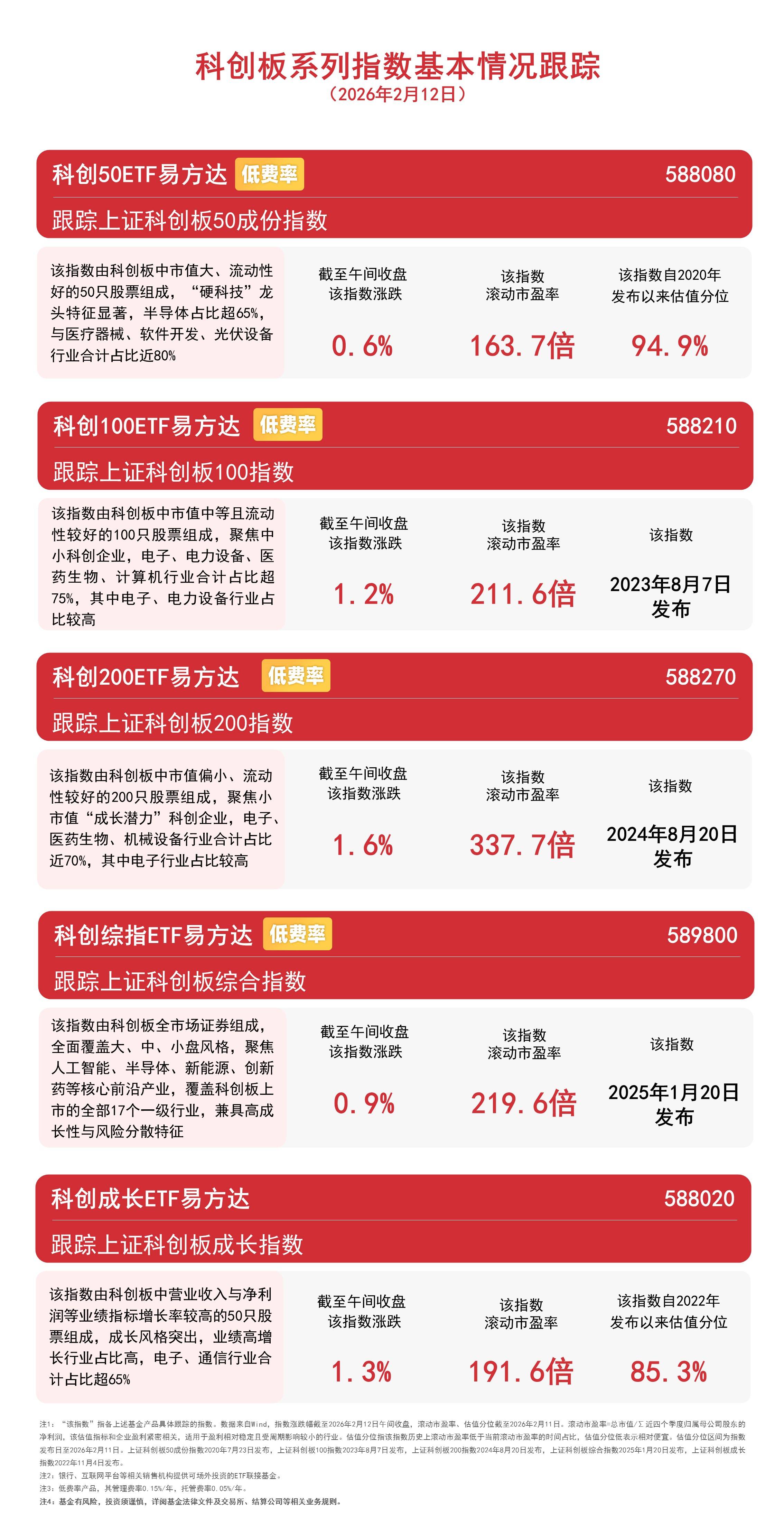
硬科技板块活跃,关注科创200ETF易方达(588270)、科创50ETF易方达(588080)等产品投资机会
Sou Hu Cai Jing· 2026-02-12 05:23
Group 1 - The core viewpoint of the news highlights the active performance of hard technology sectors, including CPO, optical chips, and AI computing power, with significant index increases observed in the morning session on February 12 [1][5]. - The Sci-Tech 200 Index rose by 1.6%, the Sci-Tech Growth Index increased by 1.3%, the Sci-Tech 100 Index went up by 1.2%, the Sci-Tech Comprehensive Index climbed by 0.9%, and the Sci-Tech 50 Index gained 0.6% by midday [1][5]. - The Sci-Tech 200 ETF, managed by E Fund, tracks the Sci-Tech 200 Index, which consists of 200 stocks from the Sci-Tech board that are smaller in market capitalization and have good liquidity, focusing on small-cap "growth potential" companies [5]. Group 2 - The sectors represented in the Sci-Tech 200 Index include electronics, power equipment, and biomedicine, which together account for over 75% of the index, with a particularly high proportion from the electronics and power equipment sectors [5]. - The Sci-Tech Comprehensive Index ETF, also managed by E Fund, tracks the overall market of the Sci-Tech board, covering large, medium, and small-cap styles, with a focus on artificial intelligence, semiconductors, and new energy [5].
20cm速递|周期搭台、科技蓄力,科技板块回调或可布局,科创创业ETF国泰(588360)回调超1.6%
Mei Ri Jing Ji Xin Wen· 2026-02-11 07:13
Group 1 - The core viewpoint of the article highlights a market trend characterized by "cyclical support and technological accumulation," indicating a divergence in performance between cyclical sectors and technology stocks [1] - The A-share market is experiencing a strong performance in undervalued cyclical sectors driven by rising economic recovery expectations and global reflation trades, while technology stocks are in a consolidation phase due to a lack of strong catalysts [1] - The Guotai Science and Innovation ETF (588360) tracks the Science and Innovation 50 Index (931643), which includes 50 large-cap emerging industry companies, reflecting the overall performance of representative emerging industries [1] Group 2 - The Science and Innovation 50 Index focuses on sectors such as electronics, power equipment, communications, and biomedicine, emphasizing technological attributes and innovative growth [1] - The index has a daily price fluctuation limit of 20%, indicating a high level of volatility and potential for significant price movements [1] - The overall market is expected to maintain a dynamic balance, with cyclical momentum requiring continuous validation from demand, while the next wave of technology advancement awaits clearer industrial signals and performance support [1]

新年大吉,“红”运当头!节前轮动加速,如何跨市场构建一个攻守有道的红利组合?
Sou Hu Cai Jing· 2026-02-11 06:54
Core Viewpoint - The article emphasizes the importance of dividend strategies as a stable investment approach amidst market volatility, highlighting the "Dividend Triad" as a key framework for long-term investment planning [1]. Group 1: Dividend Strategies - The "Dividend Triad" represents a diversified investment strategy focusing on high-quality assets that provide stable growth and cash flow [1][17]. - The article suggests that dividends serve as a "ballast" in turbulent markets, allowing investors to concentrate on quality assets and pursue steady growth [1]. Group 2: Index Performance - The CSI Dividend Quality Index is characterized as an "offensive" dividend index that emphasizes dividend yield while also considering quality factors like ROE and earnings stability [3]. - The CSI Dividend Quality Index has shown superior performance compared to mainstream dividend and broad-based indices, with an annualized return of 17.97% since inception [4][10]. - The CSI Dividend All-Return Index has increased by 76.35% since its base period, with an annualized return exceeding 10%, outperforming both the CSI 300 and CSI 500 indices [11]. Group 3: Sector Distribution - The top sectors represented in the CSI Dividend Quality Index include Food & Beverage (13.8%), Pharmaceutical & Biological (10.1%), and Media (6.4%) [3]. - The index excludes banking stocks, focusing instead on sectors like non-ferrous metals, food and beverage, and pharmaceuticals, which are seen as "value growth" representatives [3]. Group 4: Comparison with Other Indices - The Hang Seng High Dividend Low Volatility Index offers a higher dividend yield (6.83%) and lower valuation (P/E of 7.46) compared to the CSI Dividend Index (5.07% yield, P/E of 8.55) [14][13]. - Since early 2020, the Hang Seng High Dividend Low Volatility Index has achieved a cumulative increase of 65.48% with an annualized return of 9.31%, indicating a favorable risk-return profile [12][13].

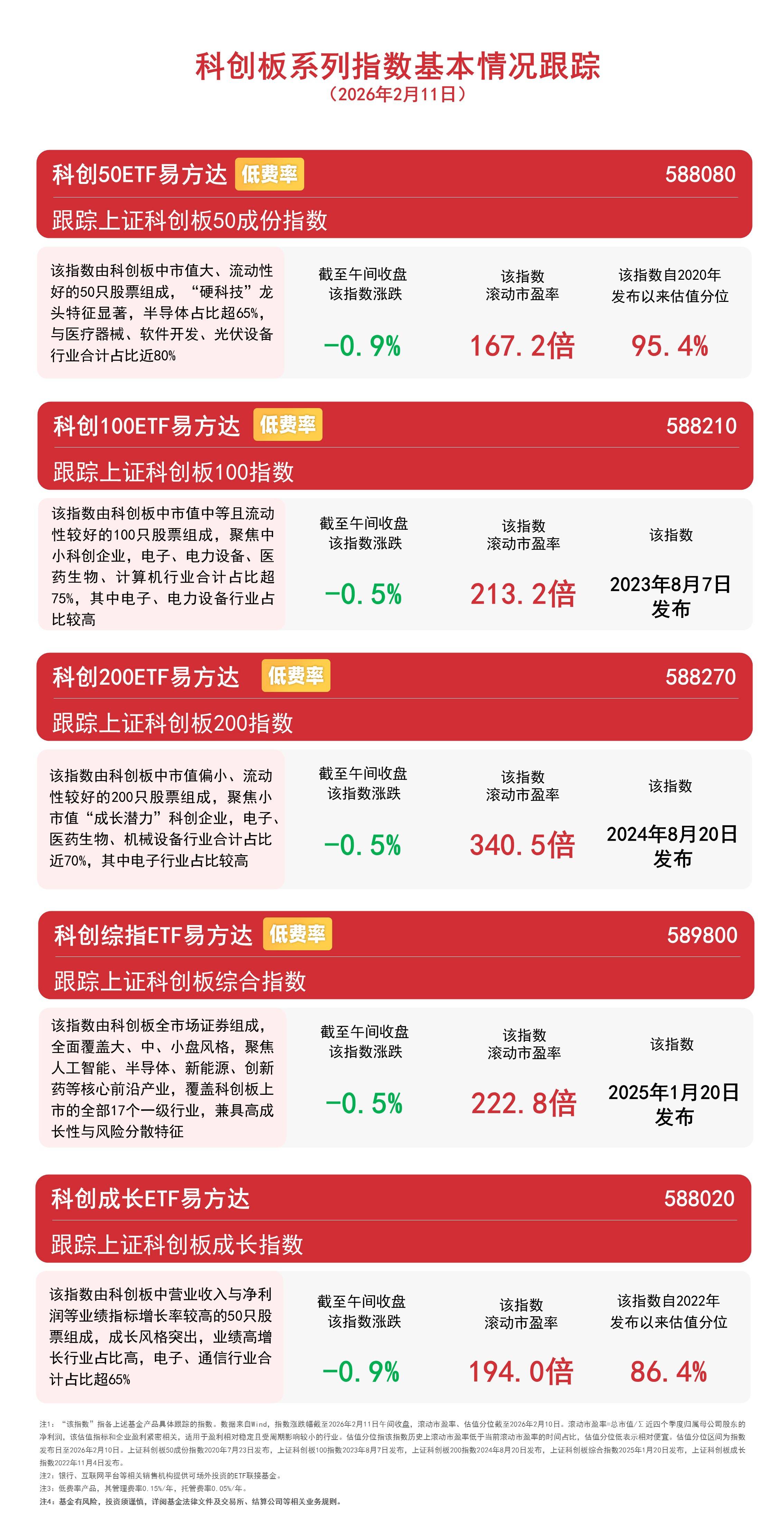
硬科技板块集体调整,持续关注科创200ETF易方达(588270)、科创50ETF易方达(588080)投资机会
Sou Hu Cai Jing· 2026-02-11 05:16
Group 1 - The core viewpoint of the news indicates a collective adjustment in hard technology sectors such as CPO, storage chips, and semiconductor equipment, with a decline in AI application concepts as of the morning session on February 11 [1] - The ChiNext 100 Index, ChiNext 200 Index, and ChiNext Composite Index all experienced a drop of 0.5%, while the ChiNext 50 Index and ChiNext Growth Index fell by 0.9% [1] Group 2 - The ChiNext 200 ETF is designed to track the ChiNext 200 Index, which consists of 200 stocks from the ChiNext board that are smaller in market capitalization and have good liquidity, focusing on small-cap "growth potential" technology enterprises [7] - The electronic and biomedical sectors, along with machinery equipment, account for nearly 70% of the ChiNext 200 Index, with the electronic sector having a significant share [7] - The ChiNext Composite Index ETF aims to track the comprehensive index of the ChiNext board, covering large, medium, and small-cap styles, with a focus on artificial intelligence, semiconductors, and new energy [7]
节前波动加大,如何跨市场构建一个攻守有道的红利组合?
Sou Hu Cai Jing· 2026-02-11 03:06
Core Viewpoint - The article emphasizes the importance of dividend strategies as a stable investment approach amidst market volatility, highlighting the "Dividend Three Heroes" as a framework for long-term investment planning [1]. Group 1: Dividend Strategy Overview - The "China Securities Dividend Quality ETF" focuses on high-quality companies with solid fundamentals, excluding banks, and aims for a balance between dividend yield and growth potential [3][5]. - The index prioritizes sectors such as pharmaceuticals, food and beverage, and non-ferrous metals, showcasing a "value growth" characteristic that has historically outperformed mainstream dividend indices [5][6]. Group 2: Performance Metrics - The "China Securities Dividend Quality Total Return Index" has shown a total return of 588.87% with an annualized return of 17.97% since its inception, indicating strong performance compared to other indices [6]. - The annualized volatility and maximum drawdown of the "China Securities Dividend Quality Total Return Index" are relatively controlled, suggesting a favorable risk-return profile [6][10]. Group 3: Comparison with Other Indices - The "China Securities Dividend Index" includes 100 stocks with high cash dividend yields and consistent dividend payments, outperforming benchmark indices for six consecutive years since 2020 [8][10]. - The "Hang Seng High Dividend Low Volatility Index" offers a higher dividend yield of 6.83% compared to the "China Securities Dividend Index" at 5.07%, indicating a potentially better value proposition in the current market [14][13]. Group 4: Investment Recommendations - The article suggests a diversified approach to dividend investing, combining core defensive positions with growth-oriented and low-volatility options to navigate market fluctuations effectively [19][18].

20cm速递|科技+顺周期主线价值凸显,科创创业ETF国泰(588360)盘中涨超1%
Mei Ri Jing Ji Xin Wen· 2026-02-10 17:30
Group 1 - The core viewpoint emphasizes that the combination of technology and cyclical sectors remains a key investment theme, with expectations of PPI turning positive driving EPS growth and liquidity support [1] - The article highlights the importance of focusing on stable growth in end-user sectors and the commercialization of ToB applications, particularly in areas such as computing hardware, energy storage, AI applications, and intelligent driving [1] - The Guotai Science and Innovation ETF (588360) tracks the Science and Innovation 50 Index (931643), which includes 50 large-cap emerging industry companies from the Sci-Tech and ChiNext boards, reflecting the overall performance of representative emerging industries [1] Group 2 - The index focuses on industries such as electronics, power equipment, communications, and biomedicine, emphasizing technological attributes and innovative growth, with a relatively balanced industry allocation [1] - The cyclical sectors are expected to show significant price and valuation elasticity during the phase of PPI turning positive, with reduced competition potentially leading to improved performance in sectors like non-ferrous metals, chemicals, machinery, steel, and building materials [1]