有色金属行业

Search documents
资讯早班车-2025-11-07-20251107
Bao Cheng Qi Huo· 2025-11-07 03:03
1. Macroeconomic Data Overview - GDP growth rate in Q3 2025 was 4.8% year - on - year, down from 5.2% in the previous quarter but up from 4.6% in the same period last year [1] - Manufacturing PMI in October 2025 was 49%, down from 49.8% in the previous month and 50.1% in the same period last year [1] - Non - manufacturing PMI in October 2025 was 50.1%, up from 50% in the previous month but down from 50.2% in the same period last year [1] - In September 2025, the year - on - year growth rates of M0, M1, and M2 were 11.5%, 7.2%, and 8.4% respectively [1] - In September 2025, CPI was - 0.3% year - on - year, and PPI was - 2.3% year - on - year [1] - In September 2025, exports and imports increased by 8.3% and 7.4% year - on - year respectively [1] 2. Commodity Investment Reference 2.1 Comprehensive - China conducts license reviews on rare earths and related items in accordance with laws and regulations, aiming to ensure the security and stability of the global industrial and supply chains [2] - After the gold tax policy adjustment on November 1st, the Shenzhen Shuibei gold market has experienced "pricing chaos", with the gap between purchase and recycling prices widening significantly [2] - On November 6th, 32 domestic commodity varieties had positive basis, and 36 had negative basis [3] 2.2 Metals - On November 6th, international precious metal futures generally closed lower due to the Fed's stance on inflation and monetary policy [4] - Many institutions believe that a new cycle of resource commodities may have begun [5] - On November 6th, LME nickel cancelled warehouse receipts decreased by 7,218 tons, the largest decline since May [6] 2.3 Coal, Coke, Steel, and Minerals - Multiple provinces and cities have issued air pollution prevention and control action plans for the autumn and winter of 2025 - 2026, with some steel enterprises facing production restrictions [7] - The US has included copper in its 2025 list of critical minerals [7] - Indonesia has stopped approving applications for nickel ore processing plants producing certain intermediate products [7] 2.4 Energy and Chemicals - On November 6th, the main contract of US crude oil closed lower due to concerns about supply surplus and weak demand [8] - A new safety standard for chemical enterprises' flammable liquid atmospheric storage tank areas will be implemented on April 30, 2026 [8] - Saudi Aramco has lowered its crude oil selling prices to Asia for December [8] 2.5 Agricultural Products - Market regulatory authorities are soliciting public opinions on the "List of First - Time Non - Penalty for Administrative Violations in Market Supervision (II)" and the "List of Non - Penalty for Minor Administrative Violations in Market Supervision (II)" [10] - Malaysian enterprises will ensure the supply of raw materials for local sustainable aviation fuel plants [10] - Germany's grain corn production in 2025 is expected to decrease by 3.5% year - on - year [11] 3. Financial News Compilation 3.1 Open Market - On November 6th, the central bank conducted 928 billion yuan of 7 - day reverse repurchase operations, with a net withdrawal of 249.8 billion yuan [12] 3.2 Important News - China aims to achieve the goals of Hainan Free Trade Port construction, expanding institutional opening - up and promoting the cross - border flow of production factors [13] - The Dutch government is responsible for the escalation of the global supply chain crisis regarding the Anshi Semiconductor issue [13] - Most multinational enterprises are confident in the Chinese market, with an increasing proportion optimistic about China's economic growth in the next 3 - 5 years [14] - A polysilicon industry consolidation may be on the way, with a planned fund of about 70 billion yuan [15] - The "15th Five - Year Plan" proposes to improve the central bank system and the "dual - pillar" regulatory framework of monetary and macro - prudential policies [16] - The US employment situation is severe, increasing the expectation of a Fed rate cut in December [20] - The UK central bank maintained its interest rate at 4%, with increased internal divergence [20] 3.3 Bond Market Summary - A - share strength put pressure on the bond market, with bond yields generally rising and some bond prices falling [22] - Convertible bond indices showed mixed performance, with some bonds rising and others falling [23] - US and European bond yields generally declined [26] 3.4 Foreign Exchange Market - The on - shore RMB against the US dollar rose on November 6th, and the US dollar index fell [27] 3.5 Research Report Highlights - Huatai Securities warns of potential risks in overseas AI development, especially during the transition period [28] - CITIC Securities expects the real estate market to stabilize in 2026, and some enterprises may see the bottom of the profit cycle [28] - Shenwan Fixed Income believes that floating - rate bonds have advantages and the market may expand [29] - UBS Group analyzes the potential impact of a possible US Supreme Court ruling on Trump's tariff policy [29] 4. Stock Market News - A - shares rose unilaterally, with the Shanghai Composite Index returning to 4000 points, and the computing power hardware industry chain booming [32] - The Hong Kong Hang Seng Index and related indices rose, with some new stocks breaking their issue prices [32] - MSCI China Index added 26 stocks and removed 20 stocks in its November adjustment [32] - China Securities Index Company will release new indices on November 7th [33]
有色套利早报-20251107
Yong An Qi Huo· 2025-11-07 01:06
Report Industry Investment Rating - No information provided Core Viewpoints - The report presents cross - market, cross - period, spot - futures, and cross - variety arbitrage tracking data for multiple non - ferrous metals including copper, zinc, aluminum, nickel, lead, and tin on November 7, 2025 [1][3][4] Summary by Relevant Catalogs Cross - Market Arbitrage Tracking - **Copper**: On November 7, 2025, the domestic spot price was 86030, the LME spot price was 10736, with a spot import equilibrium ratio of 8.09 and a loss of 384.81 for spot import, while there was a profit of 524.53 for spot export. The domestic three - month price was 86350, the LME three - month price was 10767, and the ratio was 7.97 [1] - **Zinc**: The domestic spot price was 22490, the LME spot price was 3159, with a ratio of 7.12. The domestic three - month price was 22710, the LME three - month price was 3055, and the ratio was 5.69. The spot import equilibrium ratio was 8.51, and the loss for spot import was 4386.00 [1] - **Aluminum**: The domestic spot price was 21360, the LME spot price was 2857, with a ratio of 7.47. The domestic three - month price was 21665, the LME three - month price was 2872, and the ratio was 7.46. The spot import equilibrium ratio was 8.33, and the loss for spot import was 2439.70 [1] - **Nickel**: The domestic spot price was 121850, the LME spot price was 14891, with a ratio of 8.18. The spot import equilibrium ratio was 8.18, and the loss for spot import was 2113.55 [1] - **Lead**: The domestic spot price was 17200, the LME spot price was 2007, with a ratio of 8.58. The domestic three - month price was 17450, the LME three - month price was 2022, and the ratio was 11.15. The spot import equilibrium ratio was 8.73, and the loss for spot import was 292.83 [3] Cross - Period Arbitrage Tracking - **Copper**: On November 7, 2025, the spreads between the next month, three - month, four - month, and five - month contracts and the spot month were 20, 50, 50, and 20 respectively, while the theoretical spreads were 534, 965, 1406, and 1846 [4] - **Zinc**: The spreads were 45, 80, 85, and 85 respectively, and the theoretical spreads were 216, 338, 460, and 583 [4] - **Aluminum**: The spreads were 35, 70, 80, and 90 respectively, and the theoretical spreads were 219, 339, 459, and 579 [4] - **Lead**: The spreads were 60, 80, 75, and 65 respectively, and the theoretical spreads were 212, 320, 428, and 535 [4] - **Nickel**: The spreads were 270, 490, 710, and 970 respectively [4] - **Tin**: The spread between the 5 - month and 1 - month contracts was - 750, and the theoretical spread was 5863 [4] Spot - Futures Arbitrage Tracking - **Copper**: On November 7, 2025, the spreads between the current - month and next - month contracts and the spot were 335 and 355 respectively, while the theoretical spreads were 250 and 729 [4] - **Zinc**: The spreads were 140 and 185 respectively, and the theoretical spreads were 132 and 263 [4] - **Lead**: The spreads were 170 and 230 respectively, and the theoretical spreads were 132 and 246 [5] Cross - Variety Arbitrage Tracking - On November 7, 2025, the ratios of copper/zinc, copper/aluminum, copper/lead, aluminum/zinc, aluminum/lead, and lead/zinc for Shanghai (three - continuous contracts) were 3.80, 3.99, 4.95, 0.95, 1.24, and 0.77 respectively, and for London (three - continuous contracts) were 3.51, 3.76, 5.26, 0.93, 1.40, and 0.67 respectively [5]
寒锐钴业:11月5日召开董事会会议
Mei Ri Jing Ji Xin Wen· 2025-11-05 11:47
Group 1 - The core point of the article is that Hanrui Cobalt Industry (SZ 300618) held its 17th meeting of the 5th board of directors on November 5, 2025, to discuss the proposal for the first extraordinary shareholders' meeting of 2025 [1] - For the year 2024, Hanrui Cobalt's revenue composition is as follows: 96.19% from the non-ferrous metal industry, 2.73% from new energy battery materials, and 1.07% from other businesses [1] - As of the report date, Hanrui Cobalt's market capitalization is 14.4 billion yuan [1]

有色金属日报-20251104
Guo Tou Qi Huo· 2025-11-04 01:12
Report Industry Investment Ratings - Copper: Not clearly stated, represented by "な女女" [1] - Aluminum: Not clearly stated, represented by "な女女" [1] - Alumina: Not clearly stated, represented by "な女女" [1] - Cast Aluminum Alloy: Not clearly stated, represented by "文文文" [1] - Zinc and Stainless Steel: ☆☆☆, indicating a relatively clear upward trend [1] - Tin: Not clearly stated, represented by "な女女" [1] - Lithium Carbonate: Not clearly stated, represented by "ななな" [1] - Industrial Silicon: Not clearly stated, represented by "ななな" [1] - Polysilicon: ☆☆☆, indicating a relatively clear upward trend [1] Core Views - The overall performance of the non - ferrous metals market is diverse, with different metals showing different trends and influencing factors [2][3][4] - Market sentiment, supply - demand relationships, cost factors, and policy expectations all play important roles in determining the price trends of various non - ferrous metals [9][10][11] Summary by Metal Copper - Copper prices reaching new highs are supported by supply - loss themes and high capital allocation interest. There are concerns about high prices suppressing consumption in the medium - and short - term. Domestic supply and demand are both weak, with low processing fees. The closure of the port in Tanzania may slow down copper exports to China in November. There is a risk of short - term correction after reaching a record high, but the MA20 moving average provides strong support [2] Aluminum & Alumina & Aluminum Alloy - The Shanghai aluminum price rose. The social inventory of aluminum ingots increased, and the apparent consumption was basically flat year - on - year. The aluminum market is mainly driven by macro - sentiment, with limited fundamental resonance. Cast aluminum alloy follows the aluminum price and has no independent market. Alumina has a supply - surplus situation, with limited rebound space [3] Zinc - The zinc ingot export window is open. LME zinc inventory increased slightly, and SMM zinc social inventory decreased. Domestic and imported ore TC decreased. The short - term rebound momentum of Shanghai zinc is strong, and short - term long positions can be considered [4] Nickel and Stainless Steel - Shanghai nickel fluctuated narrowly, with weak downstream demand. The support from the rebound of upstream prices is weakening, and the overall nickel industry chain price may be dragged down. Shanghai nickel is in a weak operation with a downward - moving center of gravity [7] Tin - Tin prices oscillated last week, mainly following the copper price rhythm. The closure of the port in Tanzania may affect tin exports to China. There is still demand for spot tin at rigid - need price points. It is advisable to short at high levels or wait for a clear breakthrough [8] Lithium Carbonate - Lithium carbonate is in a high - level oscillation, with active market trading. The market has strong supply and demand. The total inventory decreased. The futures price is strengthening, and it is expected to be in a short - term strong oscillation [9] Industrial Silicon - Industrial silicon futures closed slightly lower. Supply has decreased significantly due to the dry - season production cuts in Sichuan and Yunnan. The industry has entered a stage of weak supply and demand. The price is expected to be firm, but the upward space is limited by the uncertainty of polysilicon demand [10] Polysilicon - Polysilicon futures are firm, with a slight increase. The market is in a game between policy expectations and fundamental reality. The short - term market is driven by sentiment, but there is a significant risk of high - level correction if policies are not implemented or spot prices do not follow [11]
中国银河证券:加强有色金属资源安全保障 加快新材料产业发展
智通财经网· 2025-11-03 01:29
Core Viewpoint - The report from China Galaxy Securities indicates that China's non-ferrous metals industry is expected to continue its steadfast development during the "14th Five-Year Plan" period, focusing on resource security, technological innovation, green transformation, and industrial upgrading [1][2] Group 1: Resource Security and Development - The non-ferrous metals industry is crucial for the national economy, providing essential raw materials for manufacturing and ensuring economic stability [1] - The "14th Five-Year Plan" emphasizes enhancing resource supply capabilities and the strategic importance of domestic mineral resources, with specific policies to support the development of key minerals such as copper, aluminum, lithium, nickel, cobalt, and tin [1] - The upcoming "15th Five-Year Plan" aims to solidify national resource security, ensuring the safety of food, energy, and critical supply chains, while enhancing the exploration and development of strategic mineral resources [1] Group 2: Technological Innovation and Industry Upgrading - Technological innovation is identified as the core driver for upgrading the non-ferrous metals industry and achieving high-quality development [2] - The "15th Five-Year Plan" proposes to foster emerging industries and accelerate the development of strategic new material clusters, focusing on breakthroughs in advanced materials and key technologies [2] - Key areas for development include AI chips, solid-state battery materials, lightweight alloys for robotics, and high-end titanium alloys for aerospace applications, which are expected to see significant advancements during the "15th Five-Year Plan" period [2]

【盘前三分钟】10月30日ETF早知道
Xin Lang Ji Jin· 2025-10-30 01:03
Core Insights - The article discusses the performance and trends of various ETFs, highlighting the strong performance of the non-ferrous metals sector and the impact of Nvidia's announcements on the optical module industry [7]. Market Overview - The article mentions the launch of the first ETF focused on semiconductor technology, indicating a growing interest in this sector [1]. - The market temperature gauge shows that the Shanghai Composite Index, Shenzhen Component Index, and ChiNext Index have P/E ratios at 99.96%, 83%, and 50.95% respectively, indicating a bullish sentiment in the market [1]. Sector Performance - The non-ferrous metals sector has seen significant inflows, with a net inflow of 9.441 billion in this sector, making it one of the top three sectors for capital inflow [2]. - The article lists the top-performing sectors, with non-ferrous metals up by 1.53%, while sectors like textiles and food and beverage showed declines [2]. Fund Performance - The article highlights the performance of various ETFs, with the non-ferrous metals ETF showing a 4.58% increase and a 68.39% rise over the past six months [5]. - The green energy ETF has also performed well, with a 49.64% increase over the same period [5]. Key Events - Nvidia's recent announcements at the GTC Keynote have confirmed the strong performance expectations for the optical module sector, which is expected to transition into a phase of earnings realization by 2026 [7]. - The non-ferrous metals sector is characterized by supply tightness and increased demand for strategic metal resources, positioning it as a core investment opportunity in the current market cycle [7].


刚刚!暴力拉升!
中国基金报· 2025-10-29 07:53
Market Overview - The A-share market experienced a significant rally, with the Shanghai Composite Index surpassing 4000 points and the North Exchange 50 Index soaring over 8% [3][11] - By the end of the trading day, the Shanghai Composite Index rose by 0.7%, the Shenzhen Component Index increased by 1.95%, and the ChiNext Index climbed by 2.93% [3][4] Sector Performance - The photovoltaic and energy storage sectors saw a strong surge, with companies like Longi Green Energy and Tongwei Co. hitting the daily limit [5][6] - Lithium mining stocks also performed well, with firms such as Dazhong Mining reaching their upper limit [7] - The non-ferrous metals sector experienced a boost, with companies like Chang Aluminum and Jiangxi Copper showing significant gains [8] Policy and Regulatory Developments - The chairman of the Beijing Stock Exchange announced plans to accelerate the launch of the North Exchange 50 ETF and explore after-hours fixed-price trading to enhance trading convenience [11][12] - The Ministry of Commerce and other departments released the "Urban Commercial Quality Improvement Action Plan," aiming to enhance urban commercial systems and promote new consumption scenarios [12][13] - Beijing's financial authorities introduced policies to support venture capital and equity investment, as well as to facilitate mergers and acquisitions for high-quality development [12][14] - The State Administration of Foreign Exchange announced measures to promote cross-border trade and support foreign trade development [14] International Relations - A significant meeting between the leaders of China and the United States is scheduled, which is expected to address strategic and long-term issues in bilateral relations [14]





洛阳钼业(603993):2025年三季报点评:主力矿山挖潜发力业绩续创同期历史新高
Zhong Guo Yin He Zheng Quan· 2025-10-28 14:29
Investment Rating - The report maintains a "Recommended" rating for the company [3][7]. Core Insights - The company reported a revenue of 145.49 billion yuan for the first three quarters of 2025, a decrease of 6% year-on-year, while the net profit attributable to shareholders increased by 72.6% to 14.28 billion yuan [1]. - In Q3 2025, the company achieved a revenue of 50.71 billion yuan, down 2.4% year-on-year but up 4% quarter-on-quarter, with a net profit of 5.61 billion yuan, reflecting a year-on-year increase of 96.4% [1]. - The company has exceeded production targets for copper and other products, with copper production reaching 540,000 tons, a 14% increase year-on-year [2]. Summary by Sections Financial Performance - For Q1-3 2025, the company reported a net profit of 14.28 billion yuan, a 72.6% increase year-on-year, and a net profit of 5.61 billion yuan in Q3, a 96.4% increase year-on-year [1]. - The company’s revenue for Q1-3 2025 was 145.49 billion yuan, with a Q3 revenue of 50.71 billion yuan [1]. Production and Sales - The company’s copper production in Q3 2025 was 190,000 tons, a 4% increase from the previous quarter, while diamond production decreased by 12% to 27,000 tons [2]. - The company achieved a production completion rate of 80% for copper and 79% for diamonds in the first three quarters [2]. Pricing and Cost Management - The LME copper price increased by 4% to 9,864 USD/ton in Q3 2025, while domestic tungsten prices surged by 40% to 330,000 yuan/ton [2]. - The company successfully reduced operating costs by 0.5% in Q3 2025, with overall recovery rates improving from approximately 88% to 91% [2]. Future Growth Prospects - The company is advancing new projects, including the expansion of TFM and KFM copper production, with an investment of 1.084 billion USD for KFM's second phase, expected to be operational by 2027 [7]. - The company anticipates net profits of 19.5 billion yuan, 23.7 billion yuan, and 25.2 billion yuan for 2025, 2026, and 2027, respectively, with corresponding EPS of 0.91, 1.10, and 1.17 [7].

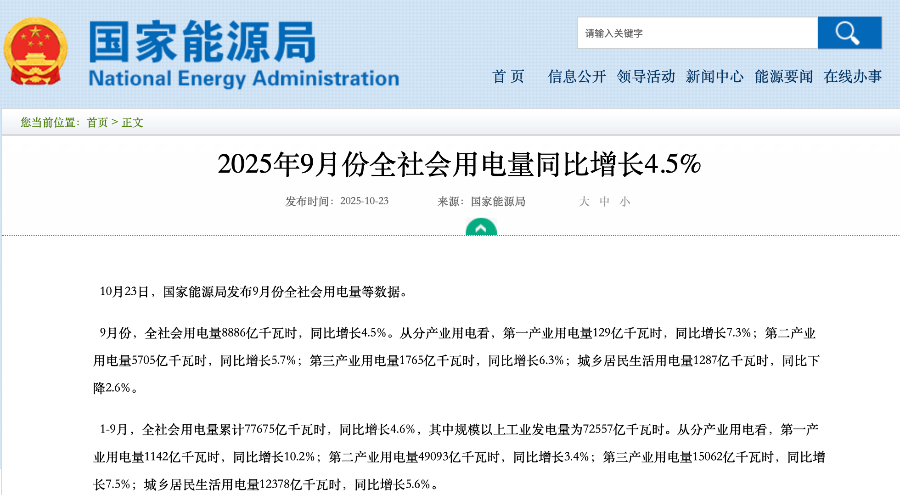
9月社会用电量同比增长4.5%
Shang Hai Zheng Quan Bao· 2025-10-23 09:07
Core Insights - In September, China's total electricity consumption reached 888.6 billion kWh, a year-on-year increase of 4.5% [1] - From January to September, total electricity consumption accumulated to 7,767.5 billion kWh, with a year-on-year growth of 4.6% [1] - The third quarter saw significant growth in electricity consumption, with a total of 2.9 trillion kWh, marking a new phase in energy consumption scale for China's economic development [1] Group 1: Electricity Consumption by Sector - In September, the first industry consumed 12.9 billion kWh, up 7.3% year-on-year; the second industry consumed 5,705 billion kWh, up 5.7%; the third industry consumed 1,765 billion kWh, up 6.3%; while urban and rural residential electricity consumption fell by 2.6% to 128.7 billion kWh [1] - The second industry's electricity consumption for the first three quarters was 4.91 trillion kWh, a year-on-year increase of 3.4%, with a notable recovery in the third quarter, growing by 5.1% [2] - The manufacturing sector's electricity consumption in the third quarter increased by 5.2%, with 17 provinces reporting growth rates exceeding 5% [2] Group 2: Growth Drivers - The growth in the second industry's electricity consumption was driven by a series of government policies aimed at stabilizing growth, particularly in sectors like electronics, automotive, and steel [2] - High-tech and equipment manufacturing sectors saw a significant increase in electricity consumption, with a 9.5% year-on-year growth in the third quarter, surpassing the average growth rate of the manufacturing sector [3] - The third industry's electricity consumption grew by 8.3% in the third quarter, supported by rapid development in new energy vehicles and infrastructure [4] Group 3: Residential Electricity Consumption - The average temperature in the third quarter was historically high, leading to a record residential electricity consumption exceeding 500 billion kWh [5] - Residential electricity consumption for the first three quarters increased by 5.6%, with a 6.4% increase in the third quarter [5] - Several provinces, including Tibet and Ningxia, reported residential electricity consumption growth exceeding 10% due to higher average temperatures [5]
前9月全社会用电量达7.77万亿千瓦时,经济动能持续增强
2 1 Shi Ji Jing Ji Bao Dao· 2025-10-23 09:01
Core Insights - In September, China's total electricity consumption reached 888.6 billion kWh, marking a year-on-year increase of 4.5% [1][3] - From January to September, total electricity consumption accumulated to 7,767.5 billion kWh, with a year-on-year growth of 4.6% [1][3] - The third quarter saw a total electricity consumption of 2.9 trillion kWh, with significant monthly increases, indicating a new phase in energy consumption scale [1][3] Electricity Consumption by Sector - In September, electricity consumption by sector showed varied growth: primary industry at 12.9 billion kWh (7.3% increase), secondary industry at 5,705 billion kWh (5.7% increase), and tertiary industry at 1,765 billion kWh (6.3% increase) [3][4] - Urban and rural residential electricity consumption decreased by 2.6% to 128.7 billion kWh [3][4] - The secondary industry contributed significantly to the overall growth, with a 5.1% increase in the third quarter, accounting for 51% of total electricity consumption growth [4] Policy Impact and Industrial Recovery - Government policies have positively influenced the recovery of the secondary industry, with a notable increase in electricity consumption due to various industry stabilization plans [4] - High-energy-consuming industries saw a 3.2% increase in electricity consumption in the third quarter, driven by traditional peak seasons and recovery in production [4] - High-tech and equipment manufacturing sectors experienced a 9.5% increase in electricity consumption, surpassing the average growth rate of the manufacturing sector [4] Tertiary Industry Performance - The tertiary industry maintained robust growth, with a 7.5% year-on-year increase in electricity consumption for the first three quarters and an 8.3% increase in the third quarter [5] - New infrastructure developments, such as electric vehicles and 5G, significantly boosted electricity consumption in information transmission and retail sectors, with growth rates of 18.3% and 11.7% respectively [5] - The internet and related services saw a remarkable 33.8% increase in electricity consumption, while electric vehicle charging services surged by 49.6% [5] Regional Electricity Consumption Trends - Electricity consumption growth varied significantly across regions, with provinces like Hainan (18.6%), Tibet (15.4%), and Jilin (14.9%) showing the highest increases in September [6] - In the third quarter, Tibet (14.7%), Jilin (11.9%), and Hebei (11.7%) led in electricity consumption growth [6] - High temperatures during the summer contributed to record levels of residential electricity consumption, exceeding 500 billion kWh in the third quarter [6] Residential and Manufacturing Sector Insights - Urban and rural residential electricity consumption grew by 5.6% in the first three quarters, with a 6.4% increase in the third quarter [7] - Several provinces, including Tibet and Jilin, reported manufacturing electricity consumption growth exceeding 5%, with Tibet achieving a remarkable 25.8% increase [7]