
电商平台

Search documents
电商运营:2025年Q4中国电商平台商家投诉数据报告
Sou Hu Cai Jing· 2026-01-09 23:46
Core Insights - The report highlights the coexistence of a peak shopping season and a significant number of merchant complaints in the Chinese e-commerce sector during Q4 2025, with platforms like Kuaishou focusing on promotional activities while facing merchant rights issues [1][9] Summary by Sections 1. Report Overview - In Q4, e-commerce merchants on platforms such as JD, Taobao, Pinduoduo, and Douyin experienced a crucial business peak supported by various promotional activities and policies [5] - Platforms like Tmall launched initiatives like the "Thousand Stars Plan" to provide resources for potential merchants, while advertising competition intensified during key sales events, potentially increasing customer acquisition costs [5][8] 2. Overall Data - The report includes comprehensive data on merchant complaints across various e-commerce platforms, revealing significant challenges faced by merchants [9] 3. Complaint Platform Distribution - The complaint distribution among platforms in Q4 was as follows: Douyin (38.75%), Pinduoduo (33.55%), Taobao (10.92%), JD (2.08%), and others [6][10] 4. Complaint Issue Types - The primary complaint issues were: arbitrary refunds (37.09%), excessive consumer protection (19.97%), withholding of deposits (9.99%), arbitrary fines (9.73%), and others [12][14] 5. Complaint Regional Distribution - The top regions for merchant complaints were Guangdong (23.86%), Zhejiang (14.53%), and Shandong (11.80%) [16] 6. Complaint Business Category Distribution - The leading categories for complaints included apparel (15.95%), 3C digital products (10.64%), and food and fresh produce (9.08%) [18] 7. Complaint Amount Distribution - The majority of complaint amounts were concentrated in the range of 0-50,000 yuan, with 95.07% of complaints falling within the 0-50,000 yuan bracket [20] 8. Complaint Merchant Gender Distribution - The gender distribution of complaint merchants showed that 70.78% were male and 29.22% were female [22] 9. Douyin E-commerce Specific Data - Douyin's complaints were primarily about arbitrary refunds (46.64%) and excessive consumer protection (29.53%) [25] - The top regions for Douyin complaints were Zhejiang (19.46%) and Guangdong (19.13%) [28] - The main complaint categories for Douyin included apparel (23.49%) and outdoor products (14.43%) [31] 10. Taobao Specific Data - Taobao's complaints were mainly about arbitrary refunds (30.95%) and excessive consumer protection (28.57%) [34] - The top regions for Taobao complaints were Guangdong (28.57%) and Zhejiang (17.86%) [36] - The leading complaint categories for Taobao included apparel (14.29%) and home goods (9.52%) [39]



Temu跻身全球前三:中国供应链与数字化出海的双重胜利
Sou Hu Cai Jing· 2026-01-09 07:31
Core Insights - Temu has rapidly ascended to become a major player in the global e-commerce landscape, ranking third in monthly active users with 246.4 million, just three years after its North American launch [1] - The platform's success is attributed not only to its low-price strategy but also to its keen understanding of global consumer demand, particularly among middle-class consumers in the U.S. [1][2] - Temu's marketing strategies, including high-profile advertising and social media engagement, have significantly boosted its user base and brand recognition [2] Group 1: User Growth and Market Position - Temu's user base has grown significantly, with a 45% increase in downloads following its Super Bowl advertisement, and a 20% rise in daily active users [2] - By October 2025, Temu's global downloads surpassed 1.2 billion, indicating that approximately one in seven people worldwide has downloaded the app [2] - The platform has successfully penetrated various markets, with 40% of its GMV coming from Europe and significant growth in Latin America and Africa [5] Group 2: Supply Chain and Operational Strategy - Temu's supply chain strategy has evolved from a fully managed model to a semi-managed model, allowing for better adaptation to global market complexities [3] - The platform's "local seller program" has been implemented in over 30 markets, enhancing delivery efficiency and local market responsiveness [3][4] - Temu's supply chain not only supports its operations but also empowers Chinese manufacturers to innovate and improve product offerings based on global consumer feedback [4] Group 3: Challenges and Strategic Adjustments - Temu faces increasing competition from established players like Amazon and TikTok Shop, which are targeting similar consumer demographics [4] - Regulatory challenges have emerged, particularly in the U.S. and EU, impacting Temu's operations and necessitating adjustments in compliance and tax strategies [4][5] - The company is shifting its focus towards emerging markets and enhancing its brand positioning by allowing merchants to set their own prices and manage customer service [5] Group 4: Broader Implications for the Industry - Temu's growth exemplifies the potential of Chinese e-commerce platforms to leverage digital capabilities and supply chain advantages in global markets [6] - The company's model serves as a reference for other Chinese e-commerce ventures, highlighting the importance of integrating supply chain flexibility with digital platforms [6]

平台经济迎来两部新规,这些行为被“划红线”!
Xin Lang Cai Jing· 2026-01-08 19:02
Core Viewpoint - The recent issuance of the "Regulations on the Supervision and Management of Online Trading Platforms" and the "Regulations on the Supervision of Live E-commerce" aims to establish rules for the online market, ensuring healthy development and protecting the rights of all parties involved, marking a new phase of refined and systematic regulation in China's platform economy [1][2]. Group 1: Key Regulations - The "Regulations on the Supervision and Management of Online Trading Platforms" explicitly prohibits platforms from imposing unreasonable restrictions on operators, charging unreasonable fees, and diminishing member rights to safeguard the autonomy of platform merchants and protect consumer rights [2]. - The regulations require that any changes to member rights during the service period must be communicated to consumers in a prominent manner, preventing unilateral modifications by the platform [2]. - The "Regulations on the Supervision of Live E-commerce" outline the obligations of live stream operators regarding information disclosure, verification of actual operators, and compliance checks, while prohibiting false advertising and the sale of illegal goods [3]. Group 2: Enforcement and Penalties - The regulations establish legal responsibilities for platform operators and live stream marketers, allowing for penalties under various laws, including the E-commerce Law and the Anti-Unfair Competition Law, depending on the severity of violations [4]. - The regulations mandate collaboration between market supervision and internet information departments to enhance information sharing and enforcement mechanisms, including the ability to interview platform officials regarding compliance [4]. - Live stream platforms are required to take immediate action against violators, which may include warnings, limiting functionalities, suspending broadcasts, or blacklisting offenders [4]. Group 3: Addressing New Challenges - The "Regulations on the Supervision of Live E-commerce" incorporate the regulation of digital influencers and AI-generated content to prevent the misuse of technology for spreading false information [5][6]. - Measures are outlined to ensure that AI-generated images and videos used in live commerce comply with legal standards and are clearly labeled to inform consumers [6]. - The regulations aim to tackle issues such as false advertising, the sale of counterfeit goods, and misleading marketing practices, particularly in the context of live e-commerce [6].
扩大免佣范围、缩短账期,抖音电商发布2026年扶持方案
Guan Cha Zhe Wang· 2026-01-08 10:34
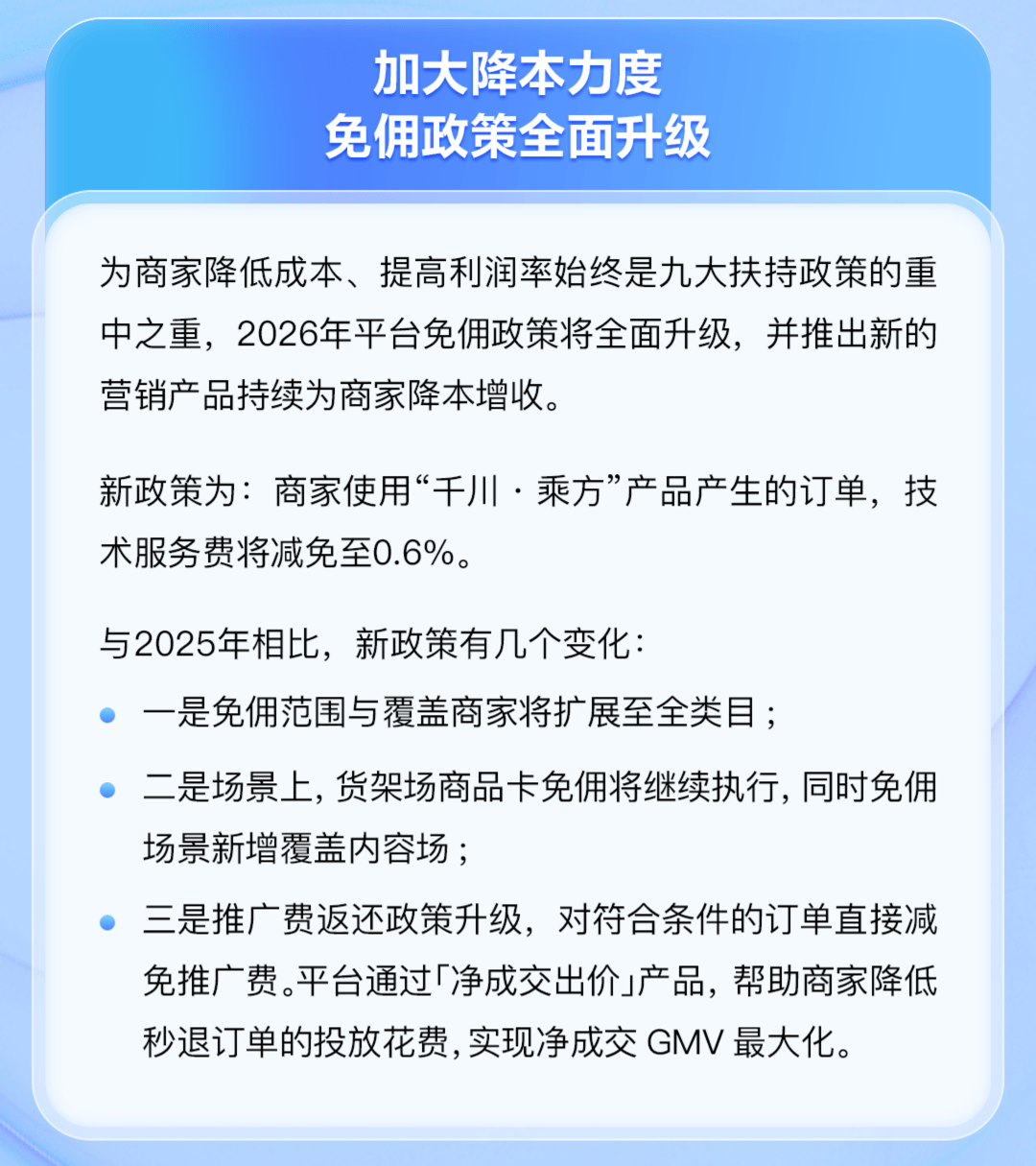
Group 1 - The core viewpoint of the article is that Douyin E-commerce has launched an upgraded plan for its "Nine Merchant Support Policies" aimed at reducing operational costs and enhancing efficiency for merchants, thereby supporting their long-term development [1][2] - The new policies address key concerns of merchants, including comprehensive cost pressure, traffic acquisition and conversion efficiency, transaction uncertainty, and operational efficiency [1][2] - Over the past year, Douyin E-commerce has saved merchants over 32 billion yuan through various initiatives such as commission waivers and support funds for small businesses [1] Group 2 - The platform will expand its commission-free policy to all categories, reducing technical service fees for orders generated by the "Qianchuan·Chengfang" product to 0.6% [1] - Douyin E-commerce will enhance its AI capabilities to help merchants reduce labor costs and improve response efficiency, including free AI customer service and dynamic AIGC creative capabilities [1][2] - A cash incentive program will be launched to promote high-value content production, with 3.67 million creators participating by the end of 2025 [2] Group 3 - The platform will implement a 10 billion yuan coupon subsidy plan and introduce a "dual commission" feature to lower overall costs for merchants [2] - Douyin E-commerce will prioritize support for merchants with high settlement rates, fast shipping, and good service experiences, while also optimizing advertising and recommendation logic [2] - The platform will provide differentiated support for various merchants, including financial and service support for small and medium-sized businesses and optimizing payment terms [2][3]

电商平台监管新规:不得强制“仅退款”“二选一”,不得“杀熟”
Sou Hu Cai Jing· 2026-01-08 09:41
Core Viewpoint - The newly released "Regulations on the Supervision and Management of Rules for Online Trading Platforms" aims to address issues of arbitrary rule-making and execution by e-commerce platforms, which have harmed the interests of merchants [2][3]. Group 1: Issues in E-commerce Platforms - E-commerce platforms have been criticized for unreasonable charges, such as flow promotion fees and service fees, which squeeze merchants' profit margins [3]. - The "only refund" policy has led to significant financial losses for merchants, as costs are unilaterally transferred to them without effective oversight [3][4]. - Price discrimination against loyal customers, known as "big data killing familiarity," has severely undermined fair trading rights [3][7]. Group 2: New Regulations - The new regulations prohibit platforms from forcing merchants into "only refund" policies or requiring them to choose between two options, which has been a major source of conflict [5][6]. - Platforms are not allowed to impose unreasonable restrictions on merchants' operations or charge unreasonable fees, such as duplicate charges or fees for minimal service [6]. - The regulations also address the issue of price discrimination, mandating that platforms cannot charge different prices for the same goods or services under equal trading conditions [6][7]. Group 3: Consumer Rights Protection - The regulations require platforms to avoid setting different prices for the same product or service without consumer knowledge, addressing the long-standing issue of "big data killing familiarity" [7]. - Platforms are prohibited from unilaterally changing membership rules during the service period, ensuring that consumers are informed of any changes related to their membership rights [7]. Group 4: Implementation Challenges - Experts highlight the challenges in enforcing the new regulations, as platforms often use complex rules and algorithms that may not be easily monitored by regulators [8]. - The competitive nature of the e-commerce market may lead platforms to prioritize consumer interests over merchants, complicating the balance of rule enforcement [8]. - There is a need for clear guidelines on what constitutes significant matters for communication and negotiation, as well as how to handle disputes that cannot be resolved [9].

抖音电商升级九大商家扶持政策 2025年累计为商家节省成本超320亿元
Sou Hu Cai Jing· 2026-01-08 08:27
Core Insights - Douyin E-commerce announced an upgrade to its "Nine Merchant Support Policies" for 2026, focusing on enhancing long-term certainty for merchants by increasing investment across various operational aspects [1] - The platform aims to address common merchant concerns such as cost pressure, traffic acquisition, conversion efficiency, and operational efficiency through systematic upgrades [1] Group 1: Cost Reduction and Efficiency Improvement - The upgraded support plan emphasizes reducing merchant operating costs, with a new commission exemption policy that lowers technical service fees to 0.6% for orders generated using the "Qianchuan·Chengfang" product [2] - The exemption range has been expanded to cover all categories, and promotional fee refund policies have been optimized to enhance return on investment [2] - The platform will also provide a large number of materials to help merchants save on production costs [5] Group 2: Traffic Distribution and Transaction Mechanism - The platform will optimize algorithms and distribution mechanisms to direct traffic towards high-quality content and efficient supply [6] - A cash incentive and growth support program will be upgraded to encourage the continuous production of high-value content, with 3.67 million creators participating in the "Grass Planting Incentive Program" by the end of 2025 [6] - A 10 billion yuan coupon subsidy plan will be launched to lower overall operating costs for merchants and stabilize revenue expectations [6] Group 3: Transaction Certainty and Risk Management - The platform will enhance transaction certainty by supporting merchants with high settlement rates and fast shipping, while also improving the identification and removal of abnormal and high-risk orders [8] - Advertising and recommendation logic will be optimized to improve product and user demand matching, and a return diagnosis tool will be developed to help merchants analyze return reasons [8] Group 4: Fair Business Environment and Support for Different Merchant Stages - Douyin E-commerce will strengthen intellectual property protection and market order governance, including measures to combat false advertising and counterfeit goods [10] - Differentiated support arrangements will be provided for merchants at various development stages, including financial, traffic, and service support for small and medium-sized merchants [10] - The platform will also reduce the minimum payment period to three days after order confirmation to alleviate cash flow pressure for merchants [10] Group 5: Industry Context and Future Outlook - The platform will continue to listen to merchant feedback to improve communication and service mechanisms, promoting stable growth for good products, content, and services [12] - The integration of live-streaming e-commerce is highlighted as a significant growth area, with the potential to improve merchant operations and lower transaction costs [12]
阿里巴巴-W午后跌超3% 2026年坚定加大淘宝闪购力度投入
Zhi Tong Cai Jing· 2026-01-08 06:31
Core Viewpoint - Alibaba's stock price has seen a decline of over 3%, currently trading at 141.5 HKD, with a trading volume of 8.779 billion HKD. The company has communicated significant developments regarding its Taobao Flash Sale initiative, indicating a strategic focus on market share growth and increased investment to achieve market leadership by 2026 [1]. Group 1: Financial Performance - Alibaba's stock has dropped by 3.02% as of the latest report [1]. - The trading volume for Alibaba's shares reached 8.779 billion HKD [1]. Group 2: Strategic Developments - Taobao Flash Sale has made key progress in the latest quarter, with a clear investment strategy outlined for 2026 [1]. - The primary goal for Taobao Flash Sale is to increase market share, with a commitment to significantly boost investments to secure the top position in the market [1]. Group 3: Operational Metrics - In the December quarter, Taobao Flash Sale's GMV (Gross Merchandise Volume) share has continued to grow [1]. - The Average Order Value (AOV) has maintained an upward trend, while order share remains stable [1]. - There has been a continuous improvement in order structure, with a steady increase in the proportion of medium to high-value orders [1].

市场获利回吐,恒指短线调整
Guodu Securities Hongkong· 2026-01-08 03:18
Group 1: Market Overview - The Hang Seng Index experienced a decline of 251 points or 0.94%, closing at 26,458 points after a strong start to the year with a cumulative rise of over 1,000 points in the first three trading days [3][4] - The market faced profit-taking pressure, particularly in e-commerce, technology, and automotive sectors, leading to significant sell-offs in major stocks like Alibaba, Tencent, and Meituan [3][4] Group 2: Economic and Industry Insights - Citigroup maintains its year-end target for the Hang Seng Index at 28,800 points, indicating a potential upside of approximately 9% from current levels, with a mid-year target of 27,500 points [7] - The outlook for Chinese stocks is cautious, with earnings performance being a key factor for future growth, particularly influenced by consumer confidence and property prices in mainland China [7] - Citigroup is optimistic about sectors such as technology, internet, insurance, healthcare, and consumer stocks, anticipating benefits from national policies and earnings growth [7] Group 3: Company-Specific Developments - Kuaishou is reportedly considering its first issuance of offshore bonds, joining the trend of Chinese tech companies raising funds in the global debt market [11] - GF Securities plans to raise approximately 6.125 billion HKD through a combination of new H-share placements and zero-coupon convertible bonds, aimed at supporting its international business development [12] - Busy Ming, a Chinese snack retail chain, has passed the listing hearing for an IPO on the Hong Kong Stock Exchange, showing significant growth with a GMV of 66.1 billion RMB, a 74.5% increase year-on-year [13]

TikTok Shop年活跃消费者已达4亿,GMV近千亿美元
Sou Hu Cai Jing· 2026-01-07 09:36
Core Insights - TikTok Shop is projected to reach 400 million active consumers and nearly $100 billion in GMV by 2025, ranking fifth among global e-commerce platforms and showing the fastest growth rate [1] - The platform operates on an "interest e-commerce" model, leveraging short videos and live streaming to create a transaction loop that enhances consumer discovery and trust [1] - TikTok Shop has expanded to 17 global markets since its launch in 2021, including the US, Europe, Southeast Asia, Mexico, Brazil, and Japan [1] Market Performance - TikTok Shop's GMV is expected to exceed $25 billion in Q4 2025, driven by the Black Friday Cyber Monday shopping season, surpassing eBay [2] - In the US, TikTok Shop's sales are projected to grow by 400% in 2024 and 108% in 2025, with a GMV of over $500 million during the Black Friday period in 2025 [2] - The platform's short video sales contribute 40% of its GMV in the US, with natural traffic accounting for 70%-80%, significantly reducing customer acquisition costs for merchants [3] Regional Growth - In Southeast Asia, TikTok Shop has become the second-largest player, trailing only Shopee, with a GMV growth of 2.7 times during the "Double Twelve" event in 2025 [4] - The European market is also showing strong growth, with an expected increase of over 100% in 2025, and plans for further expansion in 2026 [4] - In Brazil, TikTok Shop's GMV grew 25 times within the first three months of launch, while in Japan, it increased 20 times within four months [4] Competitive Landscape - Traditional e-commerce platforms like Amazon and Shopee maintain a stronghold in developed markets, with Amazon investing heavily in logistics and user retention [5][6] - Many brands are collaborating with e-commerce service providers like Shopify to drive traffic to their independent sites, indicating a competitive shift in the market [6] - Despite TikTok Shop's rapid growth, it faces challenges from established players in various markets [4][5]
TikTok Shop去年增速全球第一 应对市场激烈竞争
Nan Fang Du Shi Bao· 2026-01-07 04:59
Core Insights - TikTok Shop is experiencing rapid growth, with projections indicating 400 million active consumers by 2025 and a GMV approaching $100 billion, ranking fifth among global e-commerce platforms [1][2] - The platform utilizes an "interest e-commerce" model, focusing on content-driven discovery through short videos and live streaming, which has resonated well with consumers [1] - TikTok Shop has expanded into 17 global markets since its launch in 2021, including the US, Europe, Southeast Asia, and Latin America [1] Market Performance - TikTok Shop's GMV is expected to match eBay's by Q3 2025, with a projected GMV exceeding $25 billion during the 2025 Black Friday-Cyber Monday shopping season [2] - In the US, sales are forecasted to grow by 400% in 2024 and 108% in 2025, with a significant increase in consumer engagement during the Black Friday period [2][3] - The platform has seen a 40% contribution to GMV from short video sales in the US, with a high percentage of natural traffic reducing customer acquisition costs [3] Regional Growth - In Southeast Asia, TikTok Shop has quickly become the second-largest player, with a GMV growth of 2.7 times year-on-year during the 2025 "Double Twelve" shopping event [4] - The European market is also showing strong growth, with an expected increase of over 100% in 2025, and plans for further market expansion in 2026 [4] - In Brazil and Japan, TikTok Shop has reported impressive early growth, with GMV increasing 25 times in Brazil and 20 times in Japan within the first few months of operation [4] Competitive Landscape - Despite its rapid growth, TikTok Shop faces significant competition from established e-commerce giants like Amazon and Shopee, which have strong market positions and substantial investments in logistics [5][6] - Amazon has launched features mimicking TikTok's model, while Shopee is enhancing its live commerce capabilities to compete directly with TikTok Shop [6] - Traditional e-commerce platforms are adapting to the rise of content-driven commerce, indicating a shift in the competitive dynamics of the industry [5][6]

