Workflow
icon
Search documents
欧盟碳边境调节机制正式落地对我国影响几何
中国能源报· 2026-01-12 05:55
Core Viewpoint - The implementation of the EU Carbon Border Adjustment Mechanism (CBAM) starting January 1 will significantly impact China's high-carbon industries, particularly steel and aluminum exports to the EU, which account for approximately 3.5% of China's total exports to the EU [2][3]. Group 1: Short-term Impact - The short-term pressure from CBAM is manageable, with the initial carbon cost set at a base rate of 2.5%, allowing companies some time to adapt [3]. - Companies that have not undertaken energy-saving and carbon-reduction transformations will face the most significant challenges, especially those relying on default values for carbon emissions reporting [2][3]. - The default emission values set by the EU are particularly high for Chinese products, creating a barrier for exports [2][3]. Group 2: Carbon Management and Compliance - Exporting companies must shift from relying on default values to establishing their own carbon data monitoring and reporting systems to avoid increased carbon costs [5]. - Over 90% of Chinese companies used global average default values during the trial phase, which will lead to higher costs once country-specific default values are published [5]. - Companies are encouraged to engage with third-party certification bodies to enhance the credibility and compliance of their carbon data [5]. Group 3: Long-term Strategy - In the long term, companies need to focus on low-carbon transformation as a key strategic direction for sustainable development [8]. - The expansion of CBAM to include 180 downstream products by 2028 will increase the complexity of carbon footprint calculations, necessitating a comprehensive approach to carbon management across the supply chain [8]. - Companies should evaluate potential partners based on their carbon data transparency and low-carbon transition plans to ensure compliance and competitiveness [8]. Group 4: External Environment and Policy Recommendations - There is a call for the improvement of the domestic carbon market and the introduction of quota auction mechanisms to create a more competitive environment for companies [9]. - Diplomatic efforts are suggested to negotiate with the EU for recognition of China's carbon pricing, which could alleviate some of the carbon cost burdens on Chinese exporters [9]. - The Chinese government aims to maintain fair trade practices and protect the interests of its enterprises while addressing global climate change challenges [9].
南山铝业跌2.05%,成交额10.84亿元,主力资金净流出1.57亿元
Xin Lang Zheng Quan· 2026-01-12 03:03
Core Viewpoint - Nanshan Aluminum experienced a stock price decline of 2.05% on January 12, 2023, with a current price of 5.73 CNY per share and a market capitalization of 65.802 billion CNY, despite a year-to-date increase of 6.51% in stock price [1] Financial Performance - For the period from January to September 2025, Nanshan Aluminum reported a revenue of 26.325 billion CNY, reflecting a year-on-year growth of 8.66%, and a net profit attributable to shareholders of 3.772 billion CNY, which is an increase of 8.09% compared to the previous year [2] Shareholder Information - As of September 30, 2025, the number of shareholders for Nanshan Aluminum reached 183,700, an increase of 11.00% from the previous period, while the average number of circulating shares per shareholder decreased by 9.91% to 63,218 shares [2] Dividend Distribution - Nanshan Aluminum has cumulatively distributed dividends amounting to 12.999 billion CNY since its A-share listing, with 7.278 billion CNY distributed over the last three years [3] Major Shareholders - As of December 31, 2025, major shareholders include China Securities Finance Corporation, holding 589 million shares, and Hong Kong Central Clearing Limited, holding 572 million shares, which saw a reduction of 56.4812 million shares from the previous period [3]
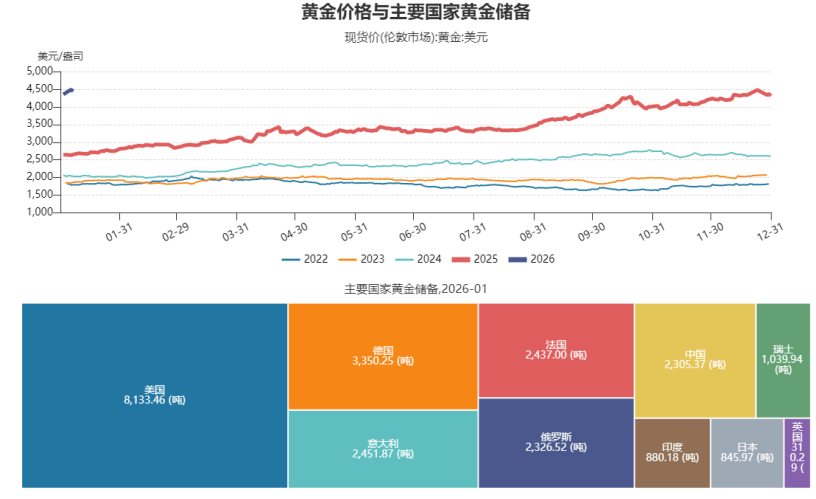
ETF盘中资讯 突破4600!金价再创历史新高!有色ETF华宝(159876)盘中拉升2.5%,刷新上市以来的高点!近10日狂揽3.3亿元
Jin Rong Jie· 2026-01-12 02:32
Group 1 - The core viewpoint of the articles highlights the surge in gold prices due to escalating geopolitical risks, with gold reaching a historical high of over $4600 per ounce, and predictions of further increases in the coming years [3] - The Huabao Nonferrous ETF (159876) has seen significant inflows, with a net subscription of 15 million units and a total of 331 million yuan in the last 10 days, indicating strong investor interest [1][3] - Major stocks within the nonferrous sector, such as Zhongjin Rare Earth and Shengxin Lithium Energy, have experienced notable price increases, reflecting the overall bullish sentiment in the market [1][3] Group 2 - Goldman Sachs forecasts that gold prices will rise to $4900 per ounce by the end of 2026, while Yardeni Research has raised its long-term gold price target from $5000 to $6000 per ounce, with a potential peak of $10000 per ounce by the end of the decade [3] - The nonferrous ETF Huabao covers a wide range of metals including copper, aluminum, gold, rare earths, and lithium, allowing investors to capture the beta performance across different market cycles [4] - The market outlook suggests that due to loose liquidity, frequent supply disruptions, and strong structural demand, various metals including copper, aluminum, and battery metals are expected to continue their upward trend [3]
能源成本下行-看好商品周期与科技主线需求共振-能源及有色行业2026年度投资策略
2026-01-12 01:41
Summary of Key Points from Conference Call Records Industry Overview - The conference call discusses the energy and non-ferrous metal industries, focusing on commodity cycles and market dynamics in 2026 [1][2]. Core Insights and Arguments - **Commodity Cycle Dynamics**: The acceleration of commodity cycle rotation is influenced by global economic recovery and pandemic impacts, similar to the commodity volatility seen after the collapse of the Bretton Woods system in the 1970s. It is challenging to determine the current cycle position, necessitating a comprehensive analysis of various commodities to identify patterns [1][2]. - **Oil Prices and Commodity Volatility**: Oil prices are highly correlated with overall commodity volatility, serving as a benchmark for energy costs. Gold has started to rise as a leading indicator, but other commodities have not followed suit significantly, likely due to the lack of a clear upward trend in oil prices [1][4]. - **Gold Price Influences**: The price of gold is affected by the transition between the old and new world orders. Currently, gold is viewed as a safe-haven asset amid the remnants of the old world wealth. Historical trends show that after the decoupling of the dollar from gold in 1971, significant price increases in gold and other commodities occurred due to excessive dollar issuance [5]. - **U.S. Treasury Credit and Precious Metals**: The loosening of U.S. Treasury credit post-2009 financial crisis has led to increased market preference for precious metals as a hedge. Despite multiple interest rate cuts by the Federal Reserve, Treasury yields have not significantly decreased, indicating a weakening preference for Treasury securities [6]. - **Future Gold Price Trends**: A long-term downward expectation for the U.S. dollar index, driven by an expanding trade deficit and potential appreciation of the Renminbi, suggests that gold prices may have room to rise [7]. - **Oil Supply and Demand**: Short-term oil supply and demand are heavily influenced by political factors, while long-term demand changes will have a more significant impact on price volatility. Current U.S. inventory increases and stable Chinese supply contribute to short-term price stability, but long-term demand fluctuations could lead to potential volatility [8]. - **U.S. Oil Production and Price Forecast**: U.S. oil production has seen a year-on-year increase of approximately 300,000 barrels, but the number of drilling rigs is declining. The forecast for oil prices in 2026 is expected to fluctuate between $40 and $70 per barrel, with a more stable range of $50 to $70 per barrel if political factors are excluded [9][10]. Additional Important Insights - **Energy Costs in China**: Domestic energy costs are stable, with sufficient supply in coal and natural gas, leading to no significant price increases. Electricity prices are expected to have limited rebound potential due to overall cost constraints [11]. - **Non-Ferrous Metals Market**: The aluminum market is expected to remain in a supply-demand imbalance due to limited domestic production capacity and stable demand growth. Copper prices are projected to range between $11,000 and $15,000 per ton in 2026, driven by increasing demand in power construction and unstable production in major copper mining regions [12][13]. - **Domestic Economic Impact on Metal Demand**: The demand for non-ferrous metals is closely tied to domestic economic development, particularly in sectors like real estate and automotive. A positive GDP outlook suggests continued growth in aluminum demand [14]. - **Global Copper Inventory and Consumption**: As of September 2025, global electrolytic copper inventory was 1.451 million tons, with a consumption increase of 3% year-on-year, indicating a stable demand environment [15]. - **Challenges in the Copper Market**: The domestic copper market faces challenges such as resource scarcity and price increases affecting downstream procurement. Additionally, cyclical patterns in the manufacturing sector impact demand [16][17]. - **Cable Demand in China**: There is strong demand for cables driven by investments in power generation and infrastructure, with a rebound in terminal electrical equipment demand noted [18]. - **Silver Market Dynamics**: The silver market is influenced by financial attributes, with increased speculative demand as gold prices rise. Industrial demand, particularly from photovoltaic and electronics sectors, is expected to support silver prices [19]. - **Rare Earth Industry Development**: The rare earth industry in China is positioned as a competitive sector, benefiting from trends in high-end manufacturing and energy equipment [20]. - **Commodity Market Trends**: The commodity market is experiencing structural demand resonance rather than short-term volatility, with significant implications from U.S. monetary policy and inflation on commodity prices [21]. - **Investment Recommendations**: Suggested investments include resource companies like PetroChina and CNOOC, integrated firms such as Hengli and Rongsheng, and non-ferrous metal companies like Yun Aluminum and Huadong Cable. Additionally, companies in the rare earth sector are noted for their potential [22].
有色金属周报:珍惜彭博调参机会,坚定买入有色牛市-20260111
SINOLINK SECURITIES· 2026-01-11 13:37
Group 1: Copper - The LME copper price increased by 1.94% to $12,702.0 per ton, while Shanghai copper rose by 3.23% to 101,400 yuan per ton [1] - Domestic copper inventory increased by 6.29% week-on-week, marking six consecutive weeks of accumulation, with total inventory up by 168,100 tons year-on-year [1][12] - The operating rate of the yellow copper rod industry decreased by 0.61% to 46.98%, while the enameled wire industry saw a decline of 0.66% in operating rate to 74.87% [1][12] Group 2: Aluminum - The LME aluminum price rose by 2.22% to $3,088.00 per ton, and Shanghai aluminum increased by 6.13% to 24,300 yuan per ton [2][13] - The operating rate of domestic aluminum processing leading enterprises increased by 0.2% to 60.1%, indicating a mixed performance across different aluminum processing sectors [2][13] - The total production capacity of metallurgical-grade alumina reached 110.32 million tons per year, with an operating rate of 80.51% [2][13] Group 3: Gold - COMEX gold price increased by 3.36% to $4,487.9 per ounce, with SPDR gold holdings rising by 2 tons to 1,067.13 tons [3][14] - Geopolitical risks, including U.S. military actions in Venezuela and unrest in Iran, have contributed to a strong and volatile market for gold [3][14] Group 4: Rare Earths - The price of praseodymium and neodymium oxide increased by 2.90%, with November exports of rare earth permanent magnets rising by 12% month-on-month and 28% year-on-year, reaching a historical high for the month [4][36] - The expectation of more relaxed export policies and ongoing supply constraints are likely to support future demand and price increases in the rare earth sector [4][36] Group 5: Lithium - The average price of lithium carbonate increased by 11.5% to 131,800 yuan per ton, while lithium hydroxide rose by 10.9% to 126,900 yuan per ton [4][60] - Total lithium carbonate production reached 22,500 tons, with a slight increase of 0.01 million tons week-on-week [4][60] Group 6: Cobalt - The price of cobalt in the Jiangxi market rose by 1.1% to 460,000 yuan per ton, with cobalt intermediate prices also showing slight increases [5][63] - The overall cobalt market remains strong, with supply tightness expected to continue, supporting price stability [5][63] Group 7: Nickel - LME nickel price increased by 1.8% to $17,100 per ton, while Shanghai nickel rose by 4.3% to 138,000 yuan per ton [5][64] - Nickel market sentiment turned optimistic due to potential tightening of nickel ore quotas in Indonesia, leading to price increases [5][64]
铝锭淡季累库,光伏、电池出口退税调整:铝行业周报-20260111
Guohai Securities· 2026-01-11 13:03
Investment Rating - The report maintains a "Recommended" rating for the aluminum industry [1] Core Views - The aluminum industry is experiencing a seasonal inventory accumulation, with adjustments in export tax rebates for photovoltaic and battery products [1] - Despite a favorable macroeconomic environment, the industry faces challenges due to declining demand and high aluminum prices, which are suppressing downstream consumption [6][11] - The report suggests that while short-term pressures exist, the long-term outlook for the aluminum industry remains positive due to limited supply growth and potential demand increases [11] Summary by Sections 1. Prices - As of January 9, the LME three-month aluminum closing price is $3,136.0 per ton, up $115.0 from the previous week, and the Shanghai aluminum active contract closing price is ¥24,330.0 per ton, up ¥1,405.0 [15][21] - The average price of A00 aluminum in Changjiang is ¥24,060.0 per ton, reflecting a week-on-week increase of ¥1,540.0 [21] 2. Production - In December 2025, the production of electrolytic aluminum reached 3.781 million tons, a month-on-month increase of 144,000 tons, and a year-on-year increase of 197,000 tons [53] - The production of alumina in December 2025 was 7.520 million tons, with a month-on-month increase of 80,000 tons and a year-on-year increase of 181,000 tons [53] 3. Inventory - As of January 8, the domestic electrolytic aluminum ingot inventory was recorded at 714,000 tons, an increase of 54,000 tons week-on-week [7] - The alumina inventory at alumina plants increased by 33,000 tons, indicating a continued accumulation trend [9] 4. Key Companies and Earnings Forecast - Key companies include China Hongqiao, Tianshan Aluminum, Shenhuo Co., China Aluminum, and Yun Aluminum, all rated as "Buy" with projected earnings per share (EPS) growth for 2026 [5]
有色金属大宗商品周报(2026/1/5-2026/1/9):铝价再创新高,电解铝盈利持续扩张-20260111
Hua Yuan Zheng Quan· 2026-01-11 12:57
Investment Rating - The investment rating for the non-ferrous metals industry is "Positive" (maintained) [4] Core Views - Aluminum prices have reached new highs, and the profitability of electrolytic aluminum continues to expand [3] - Copper prices are expected to experience high-level fluctuations due to inventory accumulation and supply disruptions [5] - Lithium demand remains strong, with a reversal in supply and demand dynamics leading to an upward trend in lithium prices [76] - Cobalt prices are expected to continue rising due to tight raw material supply [88] Summary by Sections 1. Industry Overview - The U.S. December ISM Manufacturing PMI was reported at 47.9, below expectations [9] - The U.S. December non-farm employment figure was 50,000, also below expectations [9] 2. Market Performance - The non-ferrous metals sector outperformed the Shanghai Composite Index, with an 8.56% increase compared to a 3.82% increase in the index [11] - The sector ranked fourth among all sectors in terms of performance [11] 3. Valuation Changes - The TTM PE for the non-ferrous metals sector is 30.92, with a change of 1.69 [21] - The PB for the sector is 3.81, with a change of 0.20 [21] 4. Industrial Metals - Copper prices increased by 3.84% for London copper and 3.23% for Shanghai copper [26] - Aluminum prices rose by 5.02% for London aluminum and 5.47% for Shanghai aluminum, with aluminum enterprise profits increasing by 23.33% to 8,463 CNY/ton [36] - Lead and zinc prices also saw increases, with lead prices up by 1.57% and zinc prices up by 0.38% [47] 5. Energy Metals - Lithium prices saw significant increases, with lithium carbonate rising by 18.14% to 140,000 CNY/ton [76] - Cobalt prices increased by 2.61% to 25.53 USD/pound, while domestic cobalt prices fell by 6.53% to 458,000 CNY/ton [88]
贵金属价格高位震荡,碳酸锂价格大幅上涨:有色金属20260111周报-20260111
Huafu Securities· 2026-01-11 12:41
Investment Rating - The report maintains a rating of "Outperform" for the industry [6] Core Views - Precious metals are experiencing high volatility due to geopolitical tensions, with gold prices supported by weak manufacturing data and expectations of further monetary easing from the Federal Reserve [3][11] - Industrial metals, particularly copper, are facing supply disruptions amid geopolitical tensions, leading to fluctuating prices, while aluminum prices are influenced by international supply constraints and domestic demand [4][12][13] - The price of lithium carbonate has surged significantly, driven by strong demand from the electric vehicle and energy storage sectors, indicating potential investment opportunities in lithium-related stocks [17][18] - Other minor metals, such as rare earths, are showing stable price increases, with limited low-priced offerings in the market [19] Summary by Sections 1. Precious Metals - Geopolitical conflicts have heightened demand for safe-haven assets, leading to fluctuations in gold prices, with the market awaiting key economic data [10][11] - Key stocks to watch include Zijin Mining, Zhongjin Lingbao, and various H-shares [3][11] 2. Industrial Metals - Copper prices have seen a rise due to supply concerns from Chile and Ecuador, with market optimism for year-end prices [4][12] - Aluminum prices have been volatile, influenced by geopolitical tensions and domestic consumption patterns [13][16] - Notable stocks include Jiangxi Copper, Luoyang Molybdenum, and various H-shares [4][16] 3. New Energy Metals - Lithium carbonate prices have increased significantly, with futures prices nearing 150,000 yuan/ton, indicating strong demand from the supply chain [17] - Key stocks in this sector include Ganfeng Lithium, Tianhua, and others [18] 4. Other Minor Metals - Rare earth prices are on the rise, with limited low-priced offerings in the market, indicating a tightening supply [19] - Stocks to monitor include China Rare Earth, Northern Rare Earth, and others [19] 5. Market Review - The non-ferrous metals index rose by 8.6%, outperforming the broader market, with tungsten showing the largest gains among sub-sectors [22][30] - Top-performing stocks include Zhizhe New Materials and Dongyangguang, with significant price increases noted [33] 6. Valuation - The current P/E ratio for the non-ferrous metals industry stands at 32.29, with aluminum showing potential for valuation increases due to supply constraints [35]
有色钢铁行业周观点(2026年第2周):金属商品大涨的启示-20260111
Orient Securities· 2026-01-11 12:29
Investment Rating - The report maintains a "Positive" investment rating for the non-ferrous and steel industry in China [5] Core Insights - The report emphasizes that investing in resource stocks is not only about bullish metal prices but also serves as a hedge against rising inflation. The recent surge in metal prices, including gold, silver, copper, and aluminum, is attributed to a significant drop in market expectations for a Federal Reserve rate cut, alongside rising inflation expectations [8][13] - The aluminum sector is expected to benefit from geopolitical events, with China's electrolytic aluminum industry poised to enjoy valuation premiums due to its supply chain security and competitive advantages. The report highlights the increasing domestic supply of bauxite and alumina, which enhances the industry's resource security [14] - The precious metals sector is viewed positively as the long-term debt cycle enters its late stage, with rising physical prices reflecting a loss of trust in fiat currency systems. The report anticipates that precious metal prices will continue to reach historical highs in 2026 [15] - The copper sector faces supply chain vulnerabilities, with recent labor disputes leading to production cuts. The report suggests that the basic fundamentals support the equity side of copper investments, which are expected to rise alongside copper prices [16] Summary by Sections Non-Ferrous Metals - The report indicates that the recent collective rise in metal prices is a response to inflationary pressures and a re-evaluation of physical asset values as the dollar debt cycle matures [8][13] - The aluminum sector is highlighted for its strong supply chain capabilities, with domestic production of bauxite and alumina expected to increase, providing a competitive edge [14] - The precious metals market is projected to see continued price increases, driven by a shift in investor sentiment towards physical assets as a safeguard against debt risks [15] Steel Industry - The steel industry is currently experiencing a weak fundamental outlook as it approaches the year-end off-season, with a slight increase in iron and steel production but a decrease in demand [17][22] - Inventory levels for both social and steel mill stocks have increased, indicating a potential oversupply situation [24] - Steel prices have shown a slight overall increase, with specific products like hot-rolled steel experiencing marginal price rises [36][37] New Energy Metals - The report notes a significant year-on-year increase in lithium carbonate production, with December 2025 figures showing a 69.09% rise [40] - The demand for new energy vehicles remains strong, with production and sales figures for November 2025 reflecting substantial growth [44] - Prices for lithium and cobalt have risen sharply, indicating a robust market for new energy metals [49][50]
以确定性转型破局 中国重塑全球气候治理新生态
Core Viewpoint - The implementation of the EU Carbon Border Adjustment Mechanism (CBAM) on January 1, 2026, complicates the global climate governance landscape, necessitating China's transition from an "important participant" to an "active leader" in global climate governance [1][2]. Group 1: China's Role in Global Climate Governance - China aims to respond to international climate rules' uncertainties through a systematic transformation towards a green and low-carbon economy, turning external pressures into high-quality development drivers [1]. - The country is positioned as a significant supplier of green production capacity, leveraging its full industrial chain technology advantages in solar, wind, and energy storage sectors [1]. - Projects like the Al Dhafra Solar Power Plant in the UAE, with a capacity of 2.1 GW, exemplify China's commitment to reducing carbon emissions by 2.4 million tons annually and supporting local employment [1]. Group 2: Renewable Energy Cooperation - Through South-South cooperation, China has initiated renewable energy technology transfer projects with countries like Ghana and Zambia, providing clean energy solutions and creating numerous job opportunities [2]. - The De Aar Wind Power Project in South Africa, developed by China National Energy Group, delivers 770 million kWh of clean electricity annually, benefiting 300,000 households and training over 110 local technicians [2]. Group 3: Strategic Responses to CBAM - To address the challenges posed by CBAM, China needs to implement a systematic strategy that includes accelerating the national carbon market's development and establishing a transparent carbon accounting system [3]. - The focus should be on integrating affected industries like steel, aluminum, and cement into carbon market rules and exploring carbon pricing mechanisms to avoid double payments [3]. Group 4: Industry Decarbonization and Competitiveness - The "carbon barrier" represents a competition in green competitiveness, and industries must deeply decarbonize to gain a competitive edge [4]. - Companies like Baosteel and Taiyuan Iron and Steel are leading the way in reducing carbon footprints through innovative processes and clean energy adoption, setting benchmarks for high-energy-consuming industries [4]. - The overall goal is to create a new advantage in green supply chains, making low-carbon practices central to high-quality industrial development [4].