
半导体

Search documents
存储超级周期还是最后狂欢?2 月天量数据背后的危险信号
美股研究社· 2026-03-09 11:12
Core Viewpoint - The storage chip industry is entering a "super cycle," with predictions of DRAM profit margins potentially exceeding 60% and NAND flash surpassing 30%, driven by AI and cloud computing demand [1][2][4] Group 1: Industry Demand and Performance - Current industry demand significantly exceeds production capacity, primarily driven by AI servers, cloud computing, and high-end smart devices [2] - South Korea's semiconductor exports surged by 161% year-on-year in February, marking one of the most extreme growth records in recent years, indicating strong industry health [3] - Taiwan's Nanya Technology reported a staggering 587% year-on-year sales increase in February, a rare occurrence in mature industry cycles [3] Group 2: Profitability and Market Dynamics - Historically, DRAM profit margins have fluctuated between 30% and 40%, but current expectations suggest margins could exceed 60%, indicating a peak in profitability [4][5] - The high profit margins are attributed to operational leverage, where increased production leads to minimal marginal costs, resulting in exponential profit growth [4] Group 3: Market Risks and Signals - The South Korean stock market has experienced significant volatility, triggering three circuit breakers in one week, reflecting investor concerns about the semiconductor sector's health [7][11] - Rising global energy costs, exacerbated by geopolitical tensions, pose a risk to the semiconductor industry's profitability, as energy costs constitute 10% to 15% of manufacturing expenses [9] - The potential for demand elasticity in storage products raises concerns; if prices rise too quickly, downstream manufacturers may delay purchases or reduce configurations, leading to inventory buildup [10][18] Group 4: Historical Context and Future Outlook - Historical patterns indicate that record sales and prices often occur at the peak of a cycle, suggesting that current market conditions may signal an impending downturn [12][20] - The semiconductor industry has previously experienced rapid price increases followed by sharp declines, as seen in 2018 and 2021, when demand quickly fell after initial surges [13][14] - The current market environment presents a "three-way game" with AI demand, sluggish consumer electronics recovery, and rising energy prices, potentially leading to a precarious situation for the industry [16][18] Group 5: Investment Considerations - Divergence in market sentiment regarding the storage industry indicates underlying risks; while some believe in a structural demand surge due to AI, others caution against extreme price and profit levels [19][21] - Investors should focus on inventory metrics, such as "inventory turnover days" and "channel inventory levels," as these indicators may reveal shifts in market dynamics before profit figures do [21]


半导体3月投资策略:建议关注半导体生产链及周期复苏的模拟功率板块
Guoxin Securities· 2026-03-09 11:04
Core Insights - The report suggests focusing on the semiconductor production chain and the cyclical recovery of the analog power sector, highlighting the strong growth potential in this area [5]. Group 1: Market Performance - In January, the SW semiconductor index rose by 18.04%, with valuations at the 91.62% percentile since 2019 [2]. - As of February 27, 2026, the SW semiconductor index PE (TTM) was 118.01x, positioned at the 91.23% percentile since 2019 [22]. - The semiconductor index fell by 1.37% in February 2026, underperforming the electronic sector by 3.47 percentage points [11]. Group 2: Sales and Revenue Growth - Global semiconductor sales in January 2026 reached $82.54 billion, marking a year-on-year increase of 46.1% and a quarter-on-quarter increase of 3.7% [4]. - China's semiconductor sales in January 2026 were $22.82 billion, reflecting a year-on-year growth of 47.0% [4]. - The DRAM contract prices continued to rise, with expectations for a 90-95% increase in the first quarter [49]. Group 3: Investment Strategy - The report recommends monitoring companies in the analog chip sector, such as 圣邦股份 (Sengbang), 杰华特 (Jiehuate), and 思瑞浦 (Siyipu), as well as power semiconductor firms like 新洁能 (Xinjieneng) and 扬杰科技 (Yangjiete) [5]. - 中芯国际 (SMIC) and 华虹半导体 (Huahong) reported high capacity utilization rates of 95.7% and 103.8%, respectively, indicating strong operational performance [56]. - The report emphasizes the importance of domestic production trends and the ongoing expansion of high-end chip manufacturing capabilities [5]. Group 4: Fund Holdings Analysis - In Q4 2025, active funds had a semiconductor heavy holding ratio of 11.66%, which is 5.6 percentage points above the semiconductor market cap ratio [3]. - The top five semiconductor holdings in active funds accounted for 45% of the total semiconductor holdings, up from 41% in the previous quarter [38]. - New entries in the top twenty holdings included companies like 佰维存储 (Baiwei Storage) and 长川科技 (Changchuan Technology), replacing others like 芯原股份 (Xinyuan) and 瑞芯微 (Ruixinwei) [39].
抄底?
第一财经· 2026-03-09 10:44
Market Overview - The three major indices of A-shares collectively adjusted, with the Shanghai Composite Index rebounding after hitting a low, supported by strong performances from energy stocks like China Petroleum and China National Offshore Oil Corporation [5] - The Shenzhen Component Index gradually recovered to above 14,000 points, driven by the energy and power sectors, while the ChiNext Index faced pressure from the new energy and semiconductor sectors but showed some resilience [5] Market Dynamics - The market exhibited a significant divergence, with 1,422 stocks rising and 1,100 falling, indicating a clear split in performance. Energy and defensive sectors drove gains, while technology growth sectors faced substantial declines [6] - The trading volume in both markets reached 65 billion, a 20.30% increase, reflecting a notable shift in market sentiment towards risk aversion and a "high-low switch" in capital allocation [7] Capital Flow - Institutional investors demonstrated a clear "high-low switch" strategy, moving funds from high-valuation growth sectors (like electronics and semiconductors) to undervalued defensive sectors (such as oil, coal, and power equipment) [8] - Retail investors primarily followed market trends, with some attempting to "catch the bottom," focusing on traditional defensive sectors like consumption and pharmaceuticals, as well as some oversold small-cap stocks, which differed from the direction of institutional capital [8]

韩国芯片,暴跌
半导体芯闻· 2026-03-09 10:34
Core Viewpoint - The semiconductor stocks, including Samsung Electronics and SK Hynix, have experienced significant declines due to heightened concerns over the semiconductor supply chain amid the ongoing Iran conflict, which may persist for an extended period [1][4]. Group 1: Stock Performance - Samsung Electronics' stock price fell to 169,300 KRW, down 10.04% from the previous trading day, while SK Hynix dropped 11.58% to 817,000 KRW [1]. - Compared to the previous week, Samsung Electronics and SK Hynix saw declines of 16.7% and 17.6%, respectively [1]. Group 2: Supply Chain Concerns - The ongoing conflict has raised fears about the supply chain for critical materials, particularly helium, which is essential for cooling semiconductor wafers [2]. - Reports indicate that one-third of the global helium supply has disappeared since the conflict began, with Qatar's helium production facilities being shut down [2]. - The blockade of the Strait of Hormuz has disrupted helium transportation routes, exacerbating supply concerns [2]. Group 3: Energy Costs and Manufacturing Impact - Rising energy costs, with oil prices reaching 111 USD per barrel, are expected to increase operational burdens on semiconductor manufacturing, which is energy-intensive [3]. - Despite the challenges, the Korean semiconductor industry has been reducing reliance on external power through self-generation and energy-saving investments [3]. Group 4: Long-term Outlook - Despite short-term volatility and cost pressures, the semiconductor industry is expected to maintain strong long-term growth, supported by structural factors such as rising memory prices and ongoing shortages in DRAM and NAND flash supplies [3][4]. - The report warns that prolonged conflict could lead to delayed data center investments and increased difficulties in capital raising, particularly affecting South Korea due to its reliance on energy from the Strait of Hormuz [4].

英特尔先进封装,强势崛起
半导体芯闻· 2026-03-09 10:34
Core Insights - The demand for AI chips is rapidly increasing, making advanced packaging technology in the semiconductor industry a critical component [1] - TSMC's CoWoS packaging capacity is under long-term strain, prompting some AI chip clients to explore alternatives, with Intel's EMIB packaging technology gaining attention [1] - The competitive landscape for advanced packaging is intensifying, with potential collaboration deals reaching tens of billions annually [1] Group 1: TSMC and Intel's Packaging Technologies - TSMC's CoWoS utilizes a complete "silicon interposer" as a chip interconnection platform, offering high bandwidth performance but at a higher cost and longer expansion cycle due to significant silicon material usage [2] - Intel's EMIB employs a localized "silicon bridge" architecture, embedding silicon only in areas requiring high-speed interconnects, which reduces material costs and packaging size while maintaining high performance [2] Group 2: Market Dynamics and Client Interest - Major cloud service providers (CSPs) are actively developing their own AI chips, highlighting the importance of advanced packaging technology, which is now on par with wafer manufacturing [2] - Tech giants like NVIDIA, Google, and Meta are reportedly evaluating the integration of Intel's packaging solutions in their next-generation AI ASICs or accelerators, indicating a potential shift in the advanced packaging competitive landscape [2]


一颗RISC-V芯片,计划颠覆CPU、GPU、DSP和FPGA
半导体芯闻· 2026-03-09 10:34
Core Insights - Ubitium has completed the silicon tape-out of its first universal RISC-V processor, marking a significant step towards commercial viability in the $115 billion embedded computing market [1][2] - The processor aims to consolidate the fragmented hardware architecture in embedded computing, which has seen modern vehicles using over 200 processors, each with unique software stacks and supply chains [1][2] - Ubitium's innovation includes a single homogeneous architecture capable of handling various workloads without the need for separate CPUs, GPUs, DSPs, or FPGAs [1][2] Group 1: Technology and Development - The chip utilizes Samsung's 8nm process and features a core processing array with 256 elements, allowing for dynamic execution mode changes [2][4] - Ubitium's technology has been refined over 15 years, aiming to reimagine the Tomasulo algorithm, which has dominated general-purpose processor development since 1967 [2][3] - The processor supports standard RISC-V toolchains and can run popular open-source operating systems like Linux and real-time operating systems (RTOS) [5] Group 2: Market Position and Future Plans - Ubitium was founded in June 2024 and accelerated its development after raising $3.7 million in seed funding, which was led by Runa Capital, Inflection, and KBC Focus Fund [3] - The company plans to complete a second chip tape-out this year and aims for full-scale production by 2027 [5] - Ubitium's approach represents a paradigm shift in the processor industry, breaking down traditional task boundaries and addressing the needs of the AI era [3][4]

迈威尔科技(MRVL):进一步上修FY27光互连产品增速
HTSC· 2026-03-09 10:15
Investment Rating - The report maintains an "Overweight" rating for the company with a target price of $113.70 [6]. Core Insights - The company reported FY2026 revenue of $8.195 billion, a year-over-year increase of 42%, and a non-GAAP net profit of $2.466 billion, up 79% year-over-year. The fourth quarter of FY2026 saw revenues of $2.219 billion, a 22% increase year-over-year and a 7% increase quarter-over-quarter, slightly exceeding Bloomberg consensus estimates [1]. - The company has raised its revenue guidance for FY2027 and FY2028, expecting revenues of approximately $11 billion and $15 billion, respectively, driven primarily by the data center business and strong demand for optical interconnect products [2]. - The company has completed acquisitions of Celestial AI and XConn, which are expected to enhance its competitive position in the Scale-up sector, with significant revenue contributions anticipated starting in FY2027 and FY2028 [3]. - The company is projected to achieve revenues of $10.928 billion, $14.842 billion, and $18.772 billion for FY2027, FY2028, and FY2029, respectively, with adjusted net profits of $3.300 billion, $4.653 billion, and $6.392 billion [4]. Summary by Sections Financial Performance - FY2026 revenue was $8.195 billion, with a 42% year-over-year growth. Non-GAAP net profit reached $2.466 billion, reflecting a 79% increase [1]. - The fourth quarter of FY2026 generated $2.219 billion in revenue, a 22% increase year-over-year and a 7% increase quarter-over-quarter [1]. Business Segments - The data center business generated $1.65 billion in revenue for 4QFY26, a 21% year-over-year increase, with strong growth in optical interconnect and custom chip products [2]. - The company expects optical interconnect product revenue to grow over 50% in FY27, driven by robust demand for 800G Ethernet optical modules [2]. Acquisitions and Growth Strategy - The company has completed acquisitions of XConn and Celestial AI, which are expected to significantly contribute to revenue growth in the Scale-up sector, with XConn projected to contribute $50 million in annualized revenue by 4QFY27 and $100 million by FY28 [3]. - The company anticipates doubling its revenue from AEC and retimer products in FY27 [3]. Valuation and Projections - The company is expected to achieve revenues of $10.928 billion, $14.842 billion, and $18.772 billion for FY27, FY28, and FY29, respectively, with adjusted net profits of $3.300 billion, $4.653 billion, and $6.392 billion [4]. - The adjusted PE ratio is set at 30x for FY27, reflecting a premium due to the successful progress in custom chip business and potential growth from acquisitions [4].

“希望安抚紧张市场”,特斯拉亿万富豪加仓英伟达
Hua Er Jie Jian Wen· 2026-03-09 09:29
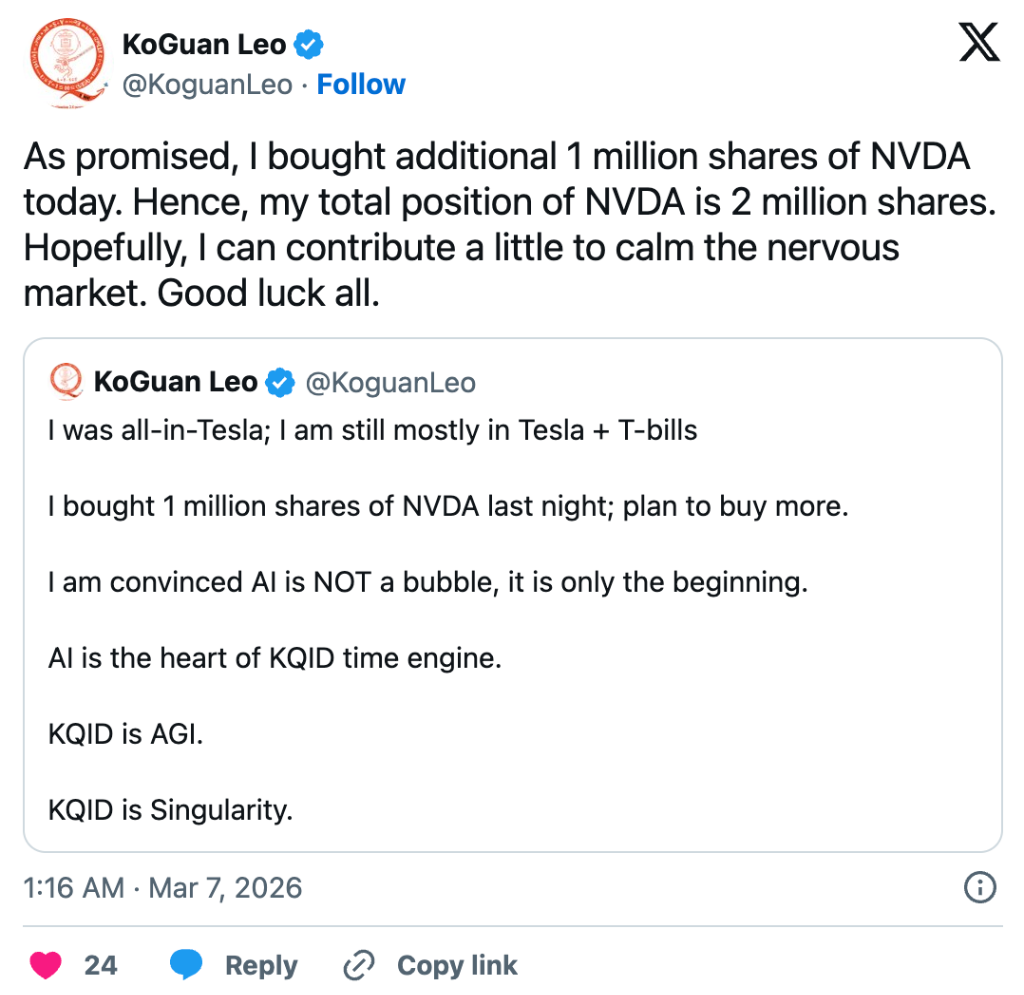
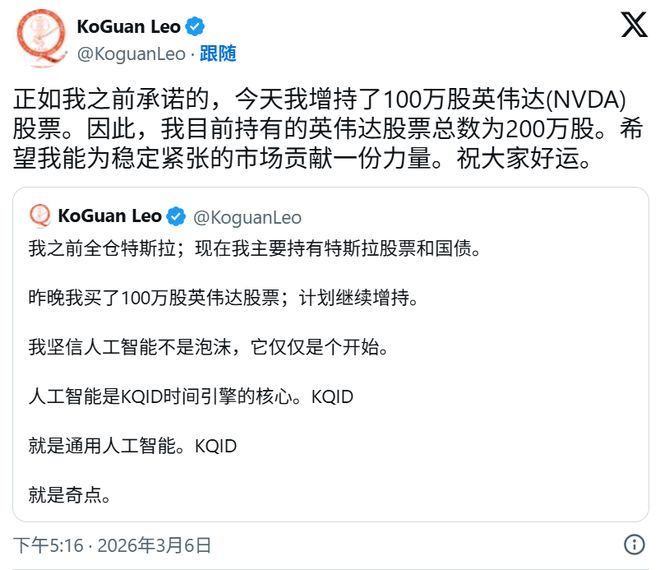
Group 1 - The core viewpoint of the news is that Leo KoGuan, a Chinese billionaire, has doubled his stake in Nvidia amidst global asset sell-offs triggered by the Middle East situation, signaling confidence in the market [1][3] - Leo KoGuan announced the purchase of an additional 1 million shares of Nvidia, bringing his total holdings to 2 million shares, with an estimated total investment of approximately $350 million [1] - This investment marks a significant shift in KoGuan's asset allocation strategy, as his net worth of around $13.4 billion has been predominantly concentrated in Tesla stock for many years [1] Group 2 - The timing of the additional investment is noteworthy, as global stock markets have been under pressure due to the ongoing US-Iran conflict, with Nvidia's stock down about 6% year-to-date and Tesla's down nearly 10% [3] - In contrast, the S&P 500 index has only seen a decline of less than 2% during the same period, indicating a relative resilience in broader market performance [3]

特斯拉“牛散”再次加仓英伟达!71岁华裔富豪狂砸3.5亿美元护盘
Xin Lang Cai Jing· 2026-03-09 08:32
Group 1 - Leo KoGuan, a prominent shareholder in Tesla, has doubled his stake in NVIDIA to 2 million shares amid a global sell-off triggered by the Middle East conflict [1][2] - KoGuan purchased an additional 1 million shares of NVIDIA, indicating a commitment to continue increasing his holdings [2] - The timing of KoGuan's investment is notable as global stock indices have generally declined since military actions involving the US and Israel against Iran began [2] Group 2 - As of last Friday's close, NVIDIA shares fell by 3.01% to $177.82, with a year-to-date decline of approximately 5% [3] - KoGuan's recent purchase is estimated to have cost around $350 million based on NVIDIA's recent closing price [4] - KoGuan, who is 71 years old and has a background in international relations and law, has previously invested heavily in various tech companies but has primarily focused on Tesla in recent years [6][8]
电子行业周报:存储涨价致消费电子市场承压,博通受益AI需求业绩超预期
Donghai Securities· 2026-03-09 08:24
Investment Rating - The report maintains a standard rating for the electronics sector, indicating a cautious outlook due to rising storage prices impacting consumer electronics [6]. Core Insights - The semiconductor industry is experiencing price increases, driven by AI demand, with structural opportunities in specific segments [3]. - Broadcom's Q1 performance exceeded expectations, with AI revenue doubling, and a forecasted 47% revenue growth for Q2 [7]. - The consumer electronics market is under pressure from rising storage chip prices, leading to increased average selling prices (ASP) and reduced product specifications [7]. Summary by Sections Industry Overview - The electronics sector is facing dual pressures from rising storage chip prices, which are expected to increase the average selling prices of PCs and smartphones while reducing product specifications [7]. - Global PC shipments are projected to decline by 11.3% in 2026, while smartphone shipments are expected to drop by 12.9% [13]. Company Performance - Broadcom reported Q1 revenue of $19.311 billion, a 29.46% year-over-year increase, with AI revenue reaching $8.4 billion, up 106% [7][13]. - The company anticipates Q2 revenue of $22 billion, a 47% increase year-over-year, driven by strong demand for AI solutions [7]. Market Trends - The report highlights a trend of market share consolidation among leading manufacturers due to rising costs, with smaller players facing survival challenges [7]. - IDC forecasts that the structural shortage of storage due to competition between AI infrastructure and consumer electronics will persist into 2027 [7]. Investment Recommendations - The report suggests focusing on structural opportunities in the semiconductor sector, particularly in companies benefiting from strong domestic and international AI demand [8]. - Specific companies to watch include those in the AIOT sector and those involved in semiconductor equipment and materials [8].
