半导体周期复苏

Search documents
国信证券晨会纪要-20260310
Guoxin Securities· 2026-03-10 01:23
Macro and Strategy - The REITs index continues to decline, with the property REITs experiencing a more significant adjustment, as the index fell by 0.8% in the week ending March 6, 2026, and the average yield of property REITs is 50 basis points lower than the average yield of the CSI dividend stocks [7][8] - The CSI REITs index closed at 789.81 points, with a year-to-date increase of 1.4%, outperforming the CSI 300 index which decreased by 1.1% [8] - The total market value of REITs decreased by 2.4 billion yuan to 225 billion yuan as of February 27, 2026, with an average daily turnover rate of 0.37% [8] Oil and Gas Industry - In February 2026, Brent crude oil futures averaged $69.4 per barrel, up $4.7 from the previous month, while WTI crude oil futures averaged $64.4 per barrel, up $4.2 [12] - The geopolitical tensions, particularly between the US and Iran, have led to fluctuations in oil prices, with significant increases following military actions [12][13] - OPEC+ plans to restore production by 206,000 barrels per day starting April 2026, following a period of voluntary production cuts [13] Semiconductor Industry - The semiconductor index saw an 18.04% increase in January 2026, but a 1.37% decrease in February, underperforming the electronic industry [16] - Global semiconductor sales in January 2026 reached $82.54 billion, marking a 46.1% year-on-year increase, with China's semiconductor sales at $22.82 billion, up 47% [17] - Investment strategies recommend focusing on the semiconductor production chain and the recovery of the analog power sector, with companies like SMIC and Huahong Semiconductor showing high capacity utilization rates [18] Mining Industry - The company reported a revenue of 17.099 billion yuan in 2025, a year-on-year increase of 25.86%, and a net profit of 2.972 billion yuan, up 36.75% [22] - The company plans to produce 7-8 tons of gold in 2026, with ongoing projects expected to enhance production capacity significantly [24] - The average selling price of gold was approximately 774 yuan per gram in 2025, slightly below the market average due to lower sales volumes in the fourth quarter [23]
半导体3月投资策略:建议关注半导体生产链及周期复苏的模拟功率板块
Guoxin Securities· 2026-03-09 11:04
Core Insights - The report suggests focusing on the semiconductor production chain and the cyclical recovery of the analog power sector, highlighting the strong growth potential in this area [5]. Group 1: Market Performance - In January, the SW semiconductor index rose by 18.04%, with valuations at the 91.62% percentile since 2019 [2]. - As of February 27, 2026, the SW semiconductor index PE (TTM) was 118.01x, positioned at the 91.23% percentile since 2019 [22]. - The semiconductor index fell by 1.37% in February 2026, underperforming the electronic sector by 3.47 percentage points [11]. Group 2: Sales and Revenue Growth - Global semiconductor sales in January 2026 reached $82.54 billion, marking a year-on-year increase of 46.1% and a quarter-on-quarter increase of 3.7% [4]. - China's semiconductor sales in January 2026 were $22.82 billion, reflecting a year-on-year growth of 47.0% [4]. - The DRAM contract prices continued to rise, with expectations for a 90-95% increase in the first quarter [49]. Group 3: Investment Strategy - The report recommends monitoring companies in the analog chip sector, such as 圣邦股份 (Sengbang), 杰华特 (Jiehuate), and 思瑞浦 (Siyipu), as well as power semiconductor firms like 新洁能 (Xinjieneng) and 扬杰科技 (Yangjiete) [5]. - 中芯国际 (SMIC) and 华虹半导体 (Huahong) reported high capacity utilization rates of 95.7% and 103.8%, respectively, indicating strong operational performance [56]. - The report emphasizes the importance of domestic production trends and the ongoing expansion of high-end chip manufacturing capabilities [5]. Group 4: Fund Holdings Analysis - In Q4 2025, active funds had a semiconductor heavy holding ratio of 11.66%, which is 5.6 percentage points above the semiconductor market cap ratio [3]. - The top five semiconductor holdings in active funds accounted for 45% of the total semiconductor holdings, up from 41% in the previous quarter [38]. - New entries in the top twenty holdings included companies like 佰维存储 (Baiwei Storage) and 长川科技 (Changchuan Technology), replacing others like 芯原股份 (Xinyuan) and 瑞芯微 (Ruixinwei) [39].
“寒王”跳水
Guo Ji Jin Rong Bao· 2026-02-23 14:29
Group 1 - The stock price of Cambrian (寒武纪, 688256) experienced a sudden drop, falling to 1070 yuan with a decline of over 13% [1] - Despite a strong performance forecast for 2025, with expected revenue of 6 to 7 billion yuan and net profit of 1.85 to 2.15 billion yuan, Cambrian's growth is still seen as not meeting investor expectations [2][3] - The overall market sentiment is shifting towards defensive stocks, with funds moving away from high-volatility tech sectors to traditional sectors with stable cash flows, impacting Cambrian's stock performance [2] Group 2 - The semiconductor industry is currently in a recovery phase, but the sustainability of this recovery is uncertain due to geopolitical tensions and economic unpredictability, which may pressure the overall valuation of the semiconductor sector [2] - Cambrian's recent performance is viewed as merely "meeting expectations" rather than exceeding them, leading some investors to prefer to exit their positions amid market uncertainties [3] - The current market volatility and external uncertainties suggest that Cambrian's stock may continue to face downward pressure, indicating potential risks for investors considering buying in at this time [3]

半导体全链涨价催生业绩回暖,非存储芯片板块有望迎价值重估
Di Yi Cai Jing· 2026-02-03 12:49
Core Viewpoint - The current semiconductor cycle is experiencing a price surge that is expanding from memory chips to non-memory sectors such as power chips and analog chips, driven by the explosive demand for AI computing power [1][2]. Group 1: Price Surge Dynamics - The price increase in memory chips is leading to a chain reaction across the semiconductor industry, affecting various segments including LED drivers, analog chips, power devices, and MCUs [2][4]. - Multiple A-share semiconductor companies have issued price increase notices, indicating a widespread trend of price hikes across the industry [1][2]. - The price adjustments range significantly, with some companies like Zhongwei Semiconductor increasing prices by 15% to 50% for certain products, while others have reported increases as high as 80% [3][4]. Group 2: Causes of Price Increases - The primary reasons for the price surge include a significant rise in costs across the entire supply chain, driven by increasing prices of raw materials and higher manufacturing costs due to price hikes from wafer foundries and packaging/testing services [4]. - The allocation of upstream capacity is increasingly focused on higher-margin products like memory chips, leading to a squeeze on traditional products such as analog chips and power semiconductors [4]. Group 3: Market Impact and Performance Outlook - The price surge is expected to lead to a recovery in performance for non-memory chip companies, with several firms already forecasting significant profit increases for 2025 [5][6]. - For instance, Silan Microelectronics anticipates a net profit increase of 50% to 80% for 2025, while Zhongwei Semiconductor expects a revenue growth of 23.07% and a net profit increase of 107.55% [6][7]. - Analysts suggest that the return of pricing power due to supply-demand dynamics will benefit companies with strong market positions and pricing capabilities, particularly in segments tied to AI and new energy [6][7].


“寒王”跳水
IPO日报· 2026-02-03 05:12
Core Viewpoint - The article discusses the recent decline in the stock price of Cambrian (寒武纪), highlighting the risks associated with investing in the current market environment, particularly in the semiconductor sector, which is facing uncertainties due to global political and economic factors [1][2]. Group 1: Market Analysis - The A-share market experienced a significant drop on February 2, leading to a shift in investor sentiment towards defensive stocks with stable cash flows, moving away from high-volatility tech stocks [2]. - Global uncertainties, including geopolitical tensions and economic policies, are impacting the semiconductor sector's recovery, with companies like Samsung and Nvidia showing strong past performance but facing uncertain future growth [2][3]. - Cambrian's stock price fell sharply, dropping over 13% to 1070 yuan, indicating a lack of confidence among investors regarding its future performance [1][4]. Group 2: Company Performance - Cambrian is projected to achieve significant milestones by 2025, with expected revenues between 6 billion to 7 billion yuan and net profits of 1.85 billion to 2.15 billion yuan, marking its first annual profit [2]. - Despite these positive projections, Cambrian's performance is viewed as merely meeting expectations rather than exceeding them, suggesting that there is still a considerable distance to reach investor targets [3]. - The current market perception is that Cambrian's stock may have limited upside potential, prompting some investors to prioritize selling over holding [4].


资金动向 | 北水扫货阿里19.76亿港元,连续7日加仓腾讯
Ge Long Hui· 2026-01-15 11:30
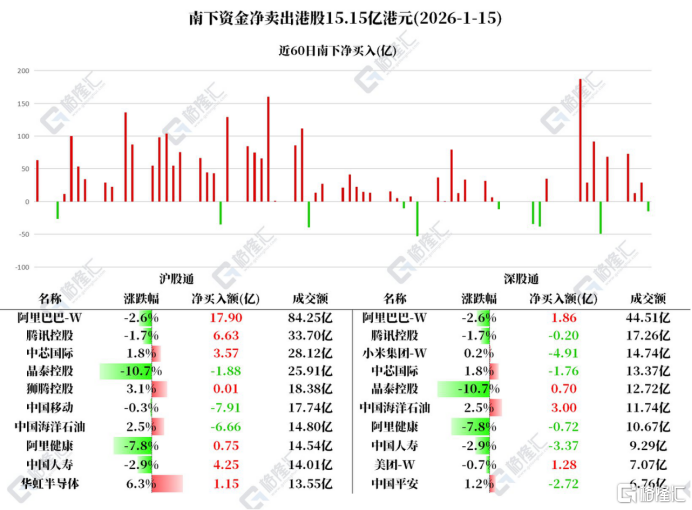
Group 1: Market Activity - Southbound funds recorded a net sell of HKD 1.515 billion in Hong Kong stocks on January 15 [1] - Notable net purchases included Alibaba-W at HKD 1.976 billion, Tencent Holdings at HKD 0.642 billion, and SMIC at HKD 0.18 billion [1] - Significant net sells were observed in China Mobile at HKD 0.791 billion, Xiaomi Group-W at HKD 0.491 billion, and China National Offshore Oil at HKD 0.365 billion [1] Group 2: Stock Performance - Alibaba-W experienced a decline of 2.6% with a net buy of HKD 1.79 billion and a trading volume of HKD 8.425 billion [3] - Tencent Holdings also saw a 1.7% drop, with a net buy of HKD 0.663 billion and a trading volume of HKD 3.370 billion [3] - China Mobile had a slight decline of 0.3% with a net sell of HKD 0.791 billion and a trading volume of HKD 1.774 billion [3] Group 3: Company Developments - Alibaba announced the integration of its Q&A app with various services, enabling AI shopping functionalities [5] - Tencent is restructuring its AI department and accelerating talent acquisition, with UBS projecting a 13% year-on-year revenue growth for Q4 [5] - SMIC is recommended by Guosen Securities due to an unexpected semiconductor market recovery and upcoming AI product launches [5] Group 4: Corporate Actions - Xiaomi Group-W repurchased 3.9 million shares for HKD 14.78 million on January 15 [6] - International oil prices dropped following comments from Trump regarding the de-escalation of tensions with Iran [6]
港股异动丨半导体股拉升 华虹半导体涨超5% 半导体景气超预期
Ge Long Hui· 2026-01-14 02:29
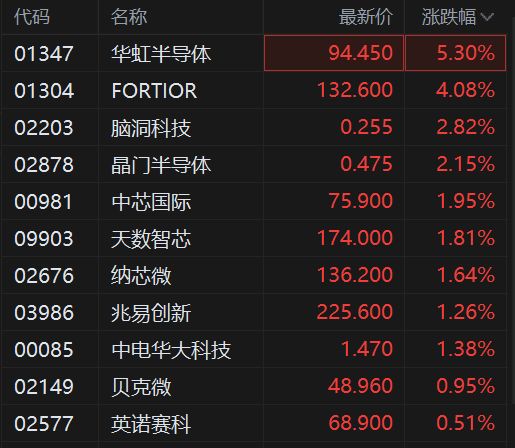
Group 1 - Semiconductor stocks in Hong Kong experienced a collective surge, with Huahong Semiconductor rising over 5%, and other companies like Jingmen Semiconductor and SMIC increasing by 2% [1] - Guosen Securities' latest report indicates that the semiconductor sector is performing better than expected, with price increases across multiple segments and the imminent release of AI glasses [1] - Research institutions predict that the average capacity utilization rate of global 8-inch wafer fabs will rise to the range of 85% to 90% by 2026, a significant improvement from 75% to 80% in 2025, reflecting a recovery in downstream applications and signaling a potential new price adjustment cycle in the foundry industry [1] Group 2 - The latest stock prices and changes for key semiconductor companies include: Huahong Semiconductor at 94.450 with a 5.30% increase, Jingmen Semiconductor at 0.475 with a 2.15% increase, and SMIC at 75.900 with a 1.95% increase [2] - Other notable companies include Naxin Micro at 136.200 with a 1.64% increase, and Zhaoyi Innovation at 225.600 with a 1.26% increase [2] - The easing of export regulations by the U.S. for Nvidia's H200 chips to China was noted, which may impact the semiconductor market dynamics [1]
【国信电子胡剑团队】半导体1月投资策略:关注FAB和存储大厂扩产链及周期复苏的模拟芯片
Xin Lang Cai Jing· 2026-01-13 09:25
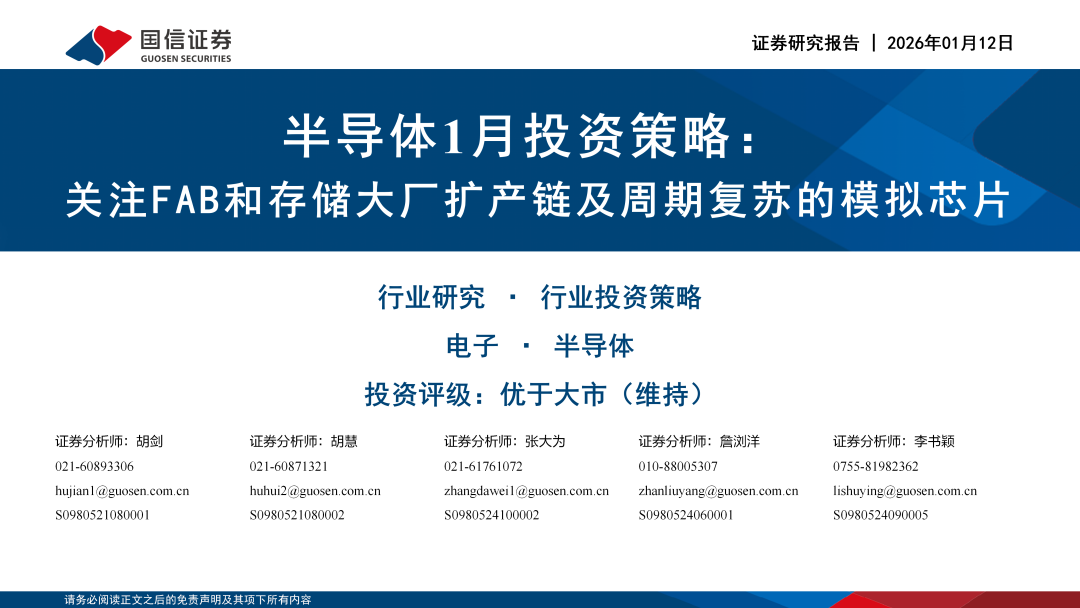
Investment Strategy - The report emphasizes focusing on FAB and storage manufacturers that are expanding production and the recovery cycle of analog chips [3] - Longxin plans to raise 29.5 billion yuan, while SMIC Southern will receive a total cash contribution of 7.778 billion USD from shareholders [3] - Recommended companies include SMIC, Hua Hong Semiconductor, Zhongwei Company, and others [3] Market Trends - Microchip CEO noted a broad recovery in multiple end markets, with initial orders for the new quarter significantly better than the same period last year [3] - The storage demand is driven by AI, with prices still in an upward cycle; TrendForce predicts a 55-60% increase in general DRAM contract prices for Q1 2026 [3][30] Company Performance - The semiconductor index rose by 4.47% in December 2025, underperforming the electronics sector by 0.69 percentage points but outperforming the CSI 300 index by 2.19 percentage points [8] - Notable stock performances included Micron Technology (+20.74%) and Microchip Technology (+18.92%) [10] Semiconductor Sales Data - Global semiconductor sales reached 75.28 billion USD in November 2025, marking a year-on-year increase of 29.8% [26] - China’s semiconductor sales accounted for 26.9% of the global total, with a year-on-year growth of 15% [36] Price Trends in Storage - DRAM and NAND Flash contract prices increased in November, with DRAM prices rising from 7.00 USD to 8.10 USD and NAND Flash prices from 5.19 USD to 4.35 USD [30] - Predictions indicate a 55-60% increase in general DRAM contract prices and a 33-38% increase in NAND Flash prices for Q1 2026 [30][32]




半导体1月投资策略:关注FAB和存储大厂扩产链及周期复苏的模拟芯片
Guoxin Securities· 2026-01-12 13:54
Core Insights - The semiconductor industry is experiencing a recovery phase, with a focus on FAB and storage manufacturers expanding production and the resurgence of analog chips [6][7] - The SW semiconductor index rose by 4.47% in December 2025, outperforming the Shanghai Composite Index by 2.19% [3][13] - Global semiconductor sales reached $75.28 billion in November 2025, marking a year-on-year increase of 29.8% [5][42] Industry Performance - The SW semiconductor index's PE (TTM) stands at 100.50x, within the 80.92% percentile since 2019, indicating a relatively high valuation [3][24] - The semiconductor equipment sector has a lower PE of 74x, while analog chip design has a higher PE of 137x [24] - In Q3 2025, active funds had a semiconductor heavy holding ratio of 12.56%, which is 6.7 percentage points above the semiconductor market cap ratio [4][32] Sales and Market Trends - The global semiconductor sales in Q3 2025 were $208.4 billion, with a year-on-year growth of 25.1% [56] - In November 2025, the sales of DRAM and NAND Flash saw price increases, with DRAM contract prices rising from $7.00 to $8.10 [49] - TrendForce forecasts a 55-60% increase in DRAM contract prices for Q1 2026, driven by demand from AI applications [7][49] Investment Strategy - The report recommends focusing on companies involved in the expansion of FAB and storage, such as SMIC, Hua Hong Semiconductor, and others [6][7] - Companies in the analog chip sector, including Sanan Optoelectronics and others, are highlighted for their potential during the recovery phase [7] - The report emphasizes the importance of AI applications in driving demand for semiconductor products [7] Company-Specific Insights - SMIC is projected to have a net profit of 6.48 billion yuan in 2025, with a PE of 118 [8] - Hua Hong Semiconductor is expected to have a net profit of 0.90 billion yuan in 2025, with a PE of 226 [8] - The report notes significant changes in the top holdings of active funds, with new entries like Huahong and Yuanjie Technology replacing previous holdings [39][40]
华泰期货:锡价迎来显著回调,长期逻辑未变
Xin Lang Cai Jing· 2025-12-31 01:55
Core Viewpoint - Recent significant pullback in tin prices, with Shanghai tin futures and spot prices declining, is a short-term phenomenon influenced by supply-demand dynamics, demand rhythm, and macroeconomic environment, but does not alter the long-term positive outlook for tin prices [2][7]. Supply Side - Geopolitical risks in the Democratic Republic of Congo and slower-than-expected resumption of overseas tin mines continue to create a tight balance in global supply, which is unlikely to reverse in the short term [7]. - Domestic smelters are still facing raw material shortages, providing long-term rigid support for tin prices from the cost side [7]. Demand Side - Although the consumer electronics sector is experiencing temporary weakness, a clear trend of recovery in the semiconductor cycle is emerging [8]. - Emerging fields such as photovoltaics, electric vehicles, and AI servers are continuously releasing incremental demand for tin, indicating a clear growth curve for tin demand in the medium to long term [8]. - Current year-end fund withdrawals and risk control factors have led to price declines, but this will not change the fundamental supply-demand trends in the tin market [8]. Long-term Outlook - The dual drivers of supply constraints and growth in emerging demand will continue to support a strong operational pattern for tin prices [9].