
银行业

Search documents
央行最新报告定调 适度宽松货币“不换挡”!
Bei Jing Shang Bao· 2026-02-10 14:58
Core Viewpoint - The People's Bank of China (PBOC) is committed to implementing a moderately loose monetary policy to support stable economic growth and financial market stability in 2025, with a GDP growth target of 5% for the year [1]. Monetary Policy Implementation - In 2025, the PBOC employed various monetary policy tools, including reserve requirement ratios and open market operations, to maintain ample liquidity and support effective credit demand from the real economy [3]. - The PBOC aims to lower the overall financing costs in society by reducing policy interest rates and specific loan rates, thereby enhancing support for key sectors and strategic areas [3]. Financial Indicators - By the end of 2025, the total social financing scale and broad money supply (M2) grew by 8.3% and 8.5% year-on-year, respectively, significantly outpacing the nominal GDP growth rate [4]. - The new corporate loan and personal housing loan rates were approximately 3.1% in December 2025, indicating a decline in financing costs [4]. - Key loan categories such as technology loans, green loans, and loans for the elderly industry saw significant year-on-year growth rates, with technology loans increasing by 11.5% and loans for the elderly industry by 50.5% [4]. Future Policy Directions - The PBOC plans to continue its moderately loose monetary policy, focusing on promoting stable economic growth and reasonable price recovery while adjusting the implementation of policies based on domestic and international economic conditions [5]. - There will be an emphasis on improving the interest rate adjustment framework and enhancing the transmission mechanism of market interest rates to lower financing costs further [6]. - The PBOC aims to maintain the stability of the RMB exchange rate while expanding financial support for key areas such as domestic demand, technological innovation, and small and micro enterprises [6].

事关货币政策下一步,央行最新报告明确
Xin Lang Cai Jing· 2026-02-10 14:56
Monetary Policy Overview - The central bank's report emphasizes the flexible and efficient use of various policy tools such as reserve requirement ratio (RRR) cuts and interest rate reductions to maintain ample liquidity and relatively loose social financing conditions [1][2] - The report highlights the importance of aligning social financing scale and money supply growth with economic growth and price level expectations [2] Interest Rate Management - The report outlines plans to further improve the interest rate adjustment framework, strengthen the guidance of central bank policy rates, and enhance the market-based interest rate formation and transmission mechanism [2] - The goal is to lower bank funding costs and promote low-level operation of comprehensive social financing costs [2] Exchange Rate Stability - The report calls for maintaining the RMB exchange rate at a reasonable and balanced level, using a managed floating exchange rate system based on market supply and demand [2] - It emphasizes the need to strengthen expectations management and prevent excessive fluctuations in the exchange rate [2] Financial Structure and Support - The report discusses the implementation of structural monetary policy tools to support key areas such as expanding domestic demand, technological innovation, and small and micro enterprises [2][3] - It highlights the collaboration between fiscal and monetary policies to enhance financial support for these sectors [4][5] Asset Management Products and Deposits - The report notes a decline in the growth rate of household deposits in Q3 2025, while asset management products have seen rapid growth, indicating a shift in financial asset allocation [8][9] - The total assets of asset management products reached 120 trillion yuan by the end of 2025, with a year-on-year growth of 13.1% [8] Liquidity Assessment - The report suggests that combining asset management products with bank deposits provides a better perspective for assessing the liquidity conditions of the financial system [9][10] - The total liquidity indicator, which aggregates various liquid financial instruments, showed a year-on-year growth of approximately 8.1% by the end of 2025, indicating stable growth trends [10]
央行重要发布
Zhong Guo Ji Jin Bao· 2026-02-10 14:50
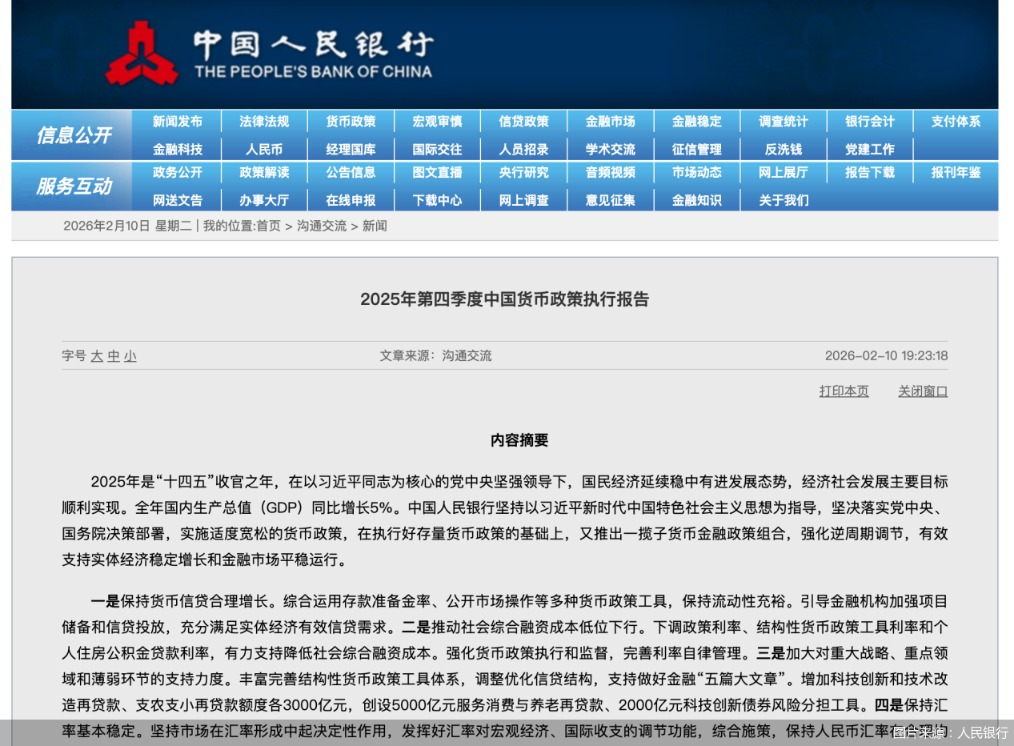
一是保持货币信贷合理增长。综合运用存款准备金率、公开市场操作等多种货币政策工具,保持流动性 充裕。引导金融机构加强项目储备和信贷投放,充分满足实体经济有效信贷需求。 2025年是"十四五"收官之年,在以习近平同志为核心的党中央坚强领导下,国民经济延续稳中有进发展 态势,经济社会发展主要目标顺利实现。全年国内生产总值(GDP)同比增长5%。中国人民银行坚持 以习近平新时代中国特色社会主义思想为指导,坚决落实党中央、国务院决策部署,实施适度宽松的货 币政策,在执行好存量货币政策的基础上,又推出一揽子货币金融政策组合,强化逆周期调节,有效支 持实体经济稳定增长和金融市场平稳运行。 2025年第四季度中国货币政策执行报告 二是推动社会综合融资成本低位下行。下调政策利率、结构性货币政策工具利率和个人住房公积金贷款 利率,有力支持降低社会综合融资成本。强化货币政策执行和监督,完善利率自律管理。 三是加大对重大战略、重点领域和薄弱环节的支持力度。丰富完善结构性货币政策工具体系,调整优化 信贷结构,支持做好金融"五篇大文章"。增加科技创新和技术改造再贷款、支农支小再贷款额度各3000 亿元,创设5000亿元服务消费与养老再贷 ...
2025年,云浮辖区办理跨境人民币结算业务39.53亿元
Sou Hu Cai Jing· 2026-02-10 14:46
Core Insights - In 2025, Yunfu City reported a cross-border RMB settlement amount of 3.953 billion yuan, marking a year-on-year increase of 12.17%, accounting for 32.80% of the total cross-border income and expenditure in the region, ranking 11th in the province, an improvement of 2 places from the previous year [1] - The growth in cross-border RMB services is attributed to the integration of party-building work with financial services, supporting the high-quality development of Yunfu's outward-oriented economy and contributing to the city's goal of becoming a green international city [1] Group 1: Cross-Border RMB Settlement Performance - The total RMB receipts and payments for goods trade in Yunfu reached 2.783 billion yuan in 2025, with a year-on-year growth of 5.36%, representing 25.58% of the total goods trade receipts and payments, ranking 6th in the province, an increase of 6 places from the previous year [1] - The People's Bank of China Yunfu Branch has implemented a "key account + first-time account" model to facilitate cross-border RMB business, ensuring that policy benefits reach market entities directly [3] Group 2: Support for Key Enterprises - In 2025, 29 key cross-border RMB enterprises in Yunfu processed a total of 2.650 billion yuan in cross-border RMB business, reflecting a year-on-year increase of 13.78% [4] - The focus is on industries such as metal manufacturing, green building materials, and modern agriculture, providing tailored services to meet enterprise needs and streamline processes [4] Group 3: Policy Collaboration and Promotion - The People's Bank of China Yunfu Branch has strengthened collaboration with the local tax bureau to promote cross-border RMB tax payment services, successfully implementing the first cross-border RMB tax payment in September 2025 [6] - A policy empowerment seminar was held in November 2025, involving multiple local agencies to educate enterprises on utilizing cross-border RMB policies effectively [6] Group 4: Experience Sharing and Future Plans - From October to December 2025, the People's Bank of China Yunfu Branch organized a selection of typical cases for cross-border RMB services, aiming to share successful practices and enhance the promotion of cross-border RMB business among banks [8] - The bank plans to continue leveraging party leadership and financial empowerment to support the internationalization of the RMB and facilitate trade and investment, contributing to Yunfu's development as a green international city [8]

晚报 | 2月11日主题前瞻
Xuan Gu Bao· 2026-02-10 14:38
Group 1: Low-altitude Economy - The Ministry of Industry and Information Technology and four other departments released an implementation opinion to strengthen the capacity building of the information and communication industry to support low-altitude infrastructure development. By 2027, the ground mobile communication network coverage for low-altitude public air routes is expected to reach no less than 90% [1] - The policy aims to create a "neural network" for the low-altitude economy by building an integrated communication network infrastructure, which will provide critical support for the development of low-altitude applications [1] - This initiative is expected to generate a new industrial chain covering communication equipment suppliers, module manufacturers, low-altitude aircraft manufacturers, and application service providers, promoting deep integration between the communication and aviation industries [1] Group 2: HBM Market - Samsung Electronics will begin mass supply of HBM4 high-bandwidth memory chips to Nvidia after the Lunar New Year, marking the first large-scale production and delivery of HBM4 chips globally [2] - The demand for advanced chips driven by a new wave of AI hardware upgrades is reshaping the supply-demand landscape of the storage industry, with HBM technology being a revolutionary development in the storage field [2] - The HBM market is projected to grow at an annual rate of 42%, increasing from $4 billion in 2023 to $130 billion by 2033, with HBM expected to account for over half of the entire DRAM market by 2033 [2] Group 3: Medical Equipment - The China International Medical Equipment and Instrument Trading Platform was launched in Tianjin, aiming to facilitate global buying and selling of medical devices and instruments [3] - The platform will provide services such as online display of pharmaceutical products, procurement information, policy information collection and publication, and market operation data analysis, promoting cross-border industrial cooperation [3] - The first batch of transactions and procurement intentions involved fields such as orthopedic surgical robots, dental implants, and color Doppler ultrasound systems [3] Group 4: Macro and Industry News - Bank of China has successfully executed two significant RMB "firsts" in the UK, including the first RMB loan after the global use of Hong Kong RMB business funding arrangements and the first RMB accounts receivable financing insured by a foreign insurance institution [4] - As the Spring Festival approaches, several excellent films will be released in theaters, with relevant departments launching a special action for copyright protection in 2026 [4]
国泰海通 · 晨报260211|固收、医疗器械
国泰海通证券研究· 2026-02-10 14:02
Group 1: Monetary Policy and Interest Rates - The recent decline in the minimum bid rate for 3-month reverse repos to 1.4% is led by major banks, which may influence the OMO interest rate in the future [2] - The adjustment in bidding methods for liquidity tools since mid-2024 has diminished the policy rate's influence, with the central bank retaining control over pricing [3] - The likelihood of an OMO rate cut in the first quarter remains low, as the current conditions do not provide sufficient motivation for the central bank to lower rates ahead of schedule [4] Group 2: Bond Market Dynamics - The narrowing spread between 1-year government bonds and certificates of deposit (CDs) since early 2026 indicates a unique pricing situation in the short end of the bond market [5] - The decline in 1-year government bonds has been more pronounced than that of government development bonds, influenced by the central bank's actions [6] Group 3: Medical Equipment Market - The medical equipment procurement scale has seen a significant decline, with MRI and CT equipment down by 22.6% and 25.6% respectively in January 2026 [9] - The implementation of a national pricing guideline for surgical robots is expected to enhance their adoption and application in clinical settings, marking a critical step in the commercialization of innovative medical equipment [10]

RIKSBANK EXCHANGES EU PAYMENT
Globenewswire· 2026-02-10 13:37
Group 1 - Sweden's EU membership requires monthly contributions to the EU budget, with payments made in Swedish kronor and exchanged into euro by a recipient central bank within the EU [1] - The Riksbank has scheduled an exchange of an EU payment amounting to SEK 5,764 million in February 2026, previously opting for exchanges to mitigate large fluctuations in the exchange rate [1] Group 2 - The exchanges conducted by the Riksbank do not serve any monetary policy purpose, and the impact on banking system liquidity is neutralized through FX-swaps [2] - The Riksbank plans to repurchase the equivalent euro amount in the foreign exchange market within two months following the exchange [2]

央妈今晚的讲话,信息量很大
表舅是养基大户· 2026-02-10 13:36
Core Insights - The current fiscal and monetary policies are in a "honeymoon period," with a strong emphasis on "fiscal-financial coordination" to enhance overall policy effectiveness [2] - Protecting bank net interest margins is a core goal of monetary policy, with a focus on lowering bank funding costs and maintaining favorable credit interest rates [3] - Maintaining low volatility in the bond market is a desirable market objective, with measures to balance government bond supply and demand [4] Fiscal and Monetary Policy - The report highlights the importance of fiscal and monetary policy coordination, stating that monetary policy has an "indirect incentive effect" while fiscal policy has a "direct incentive effect" [2] - The report indicates that the net investment of 5 trillion yuan through reverse repos and MLF in 2025 will effectively supplement the medium- and long-term funding gap [3] Insurance Sector - The insurance sector is expanding its balance sheet as a result of counter-cyclical policies, with premium income projected at 6.1 trillion yuan in 2025, a 7.4% year-on-year increase, while total assets are expected to grow by 15.1% [4] Industry Focus - The report emphasizes the importance of the consumer and pharmaceutical sectors, particularly the "online retail industry" and the pharmaceutical industry's core competitiveness [5] - The pharmaceutical sector is expected to enhance its international competitiveness through cross-border R&D cooperation and overseas clinical trials [5] Asset Management and Banking - The report discusses the shift of deposits from banks to non-bank financial institutions, indicating a trend where asset management products and bank deposits exhibit a "mutual exclusion" dynamic [5] - It is noted that the differentiation among banks is significant, with smaller banks facing challenges in attracting deposits due to lack of recognition from non-bank buyers [6] Market Trends - The report mentions the recent issuance of convertible bonds, with a notable 8 billion yuan issuance by Zhongke Zhuguang, reflecting changes in the supply-demand structure of the convertible bond market [8][9] - The report highlights the performance of the Hong Kong innovation drug sector, which saw a significant rebound, driven by strategic partnerships and market dynamics [24][31]

中国人民银行报告:继续实施好适度宽松的货币政策
Xin Hua Wang· 2026-02-10 13:25
Core Viewpoint - The People's Bank of China (PBOC) will continue to implement a moderately accommodative monetary policy, focusing on promoting stable economic growth and reasonable price recovery, while adjusting the policy's intensity, rhythm, and timing based on domestic and international economic conditions [1][2]. Group 1: Monetary Policy Implementation - The PBOC's report for the fourth quarter of 2025 indicates that it will introduce a comprehensive monetary and financial policy package to strengthen counter-cyclical adjustments, effectively supporting stable growth in the real economy and smooth operation of financial markets [1]. - By the end of 2025, the total financial volume is expected to maintain rapid growth, with the social financing scale and broad money supply (M2) increasing by 8.3% and 8.5% year-on-year, respectively, significantly outpacing nominal GDP growth [1]. Group 2: Credit Structure and Support - After adjusting for local government debt impacts, RMB loans are projected to grow by around 7%, indicating sustained strong credit support [1]. - The credit structure continues to optimize, with technology loans, green loans, inclusive loans, elderly care industry loans, and digital economy industry loans growing by 11.5%, 20.2%, 10.9%, 50.5%, and 14.1% year-on-year, respectively, all exceeding the overall loan growth rate [1]. Group 3: Future Monetary Tools and Support - In 2025, the PBOC increased the quotas for re-loans for technological innovation and agricultural support by 300 billion yuan each, established 500 billion yuan for consumer services and elderly care re-loans, and created a 200 billion yuan risk-sharing tool for technology innovation bonds [2]. - The PBOC aims to effectively implement various structural monetary policy tools, enhance financial support for key areas such as domestic demand expansion, technological innovation, and small and micro enterprises, while also improving macro-prudential and financial stability management tools [2].
央行:继续实施好适度宽松的货币政策 未来将常态化开展国债买卖操作
Jin Rong Jie· 2026-02-10 13:09
Core Viewpoint - The People's Bank of China (PBOC) continues to implement a moderately accommodative monetary policy to promote stable economic growth and reasonable price recovery, adjusting policy tools flexibly based on domestic and international economic conditions [1][8]. Group 1: Monetary Policy Implementation - The PBOC emphasizes the importance of maintaining adequate liquidity and relatively loose social financing conditions, guiding reasonable growth in financial totals and balanced credit allocation [1][8]. - A comprehensive set of monetary policies has been introduced to support stable growth in the real economy and ensure smooth financial market operations [3][4]. - The PBOC plans to enhance the market-oriented interest rate formation and transmission mechanism, ensuring that short-term market interest rates align with the central bank's policy rates [1][4]. Group 2: Government Bond Market Operations - In early 2025, the demand for government bonds exceeded supply, leading the PBOC to temporarily halt bond purchases in January, but resumed operations in October as market conditions balanced [2]. - The PBOC's net purchases of government bonds in October, November, and December were 20 billion, 50 billion, and 50 billion yuan respectively, indicating a shift towards normalizing bond market operations [2]. Group 3: Economic Growth and Financial Support - The GDP growth for 2025 is projected at 5%, with the PBOC's policies aimed at reinforcing this growth through various financial support measures [3][5]. - The PBOC has committed to lowering social financing costs by reducing policy interest rates and other related rates, thereby supporting the financing needs of the real economy [4][5]. - Significant increases in specific loan categories were noted, with technology loans growing by 11.5%, green loans by 20.2%, and loans for the elderly industry by 50.5%, all reflecting a strong focus on targeted financial support [5]. Group 4: Currency Stability and Risk Management - The PBOC aims to maintain the stability of the RMB exchange rate, with the year-end exchange rate against the USD at 6.9890, appreciating by 4.4% from the previous year [5]. - The central bank is enhancing its macro-prudential management and financial stability framework to mitigate systemic financial risks [4][6].