
家具

Search documents
金隅集团实干作答“十四五” 多维突破开新局
Bei Jing Ri Bao Ke Hu Duan· 2026-01-12 19:38
站在"十四五"圆满收官的历史坐标回望,五载春秋镌刻着大国首都能级跃升的非凡印记——首都功能布 局加快优化,民生温度浸润街巷,高质量发展蹄疾步稳。在金隅集团的发展历程中,2021年到2025年是 极不平凡的五年。高站位服务首都发展、京津冀协同和重大区域发展战略、高质量融入城市更新、高标 准履行国企责任……五年来,金隅集团深耕主责主业,融入这场波澜壮阔的城市进阶中,以刀刃向内的 深度改革筑牢发展根基,迎难而上、奋楫争先,为七十载矢志奋斗书写了坚定的时代注脚。 当实干的基因融入血脉,金隅集团将这份写满奋斗与荣光的时代答卷化作催征的鼓点。今年,是中国共 产党成立105周年,是实施"十五五"规划的开局之年,也是金隅集团聚力提质增效、加速转型升级的关 键之年。面对新开局,金隅集团将牢记"造好材料 建好房子 筑美好生活"核心使命,传承践行金隅"干事 文化",以昂扬奋斗之姿,厚积面向"十五五"的磅礴力量。 金隅冀东水泥铜川万吨线 北京隅·东序 住博会金隅集团展厅 国企担当践使命 服务首都显作为 对于金隅集团而言,服务首都发展不只是企业责任,更是流淌了七十余载的红色血脉与使命基因。这份 国企担当,在"十四五"的宏大画卷中,被诠 ...


曲美家居2025年净利润预计为负值
Bei Jing Shang Bao· 2026-01-12 09:31
对于业绩的变动,曲美家居在公告中表示,2025年受整体市场需求偏弱、并购形成的PPA摊销及债务相 关财务成本等因素影响,公司2025年全年净利润仍承压。目前,公司即将完成对境外债务的置换,完成 后将有望降低财务费用,利润与现金流有望同步恢复。 北京商报讯(记者 翟枫瑞)1月12日,曲美家居集团股份有限公司(以下简称"曲美家居")发布关于公 司2025年度预亏的提示性公告称,公司 2025 年 1 月至 9 月利润总额为-8779.93万元, 归属于上市公司 股东 的净利润为-6693.36万元,归属于上市公司股东的扣除非经常性损益的净利润为-11.11亿元。基于上述 原因,公司预计2025年度公司的利润总额、归属于上市公司股东的净利润、归属于上市公司股东的扣除 非经常性损益的净利润将均为负值。 ...

宜家关大店、开小店,在中国市场调整身位有多难? | 声动早咖啡
声动活泼· 2026-01-12 09:06
Core Viewpoint - IKEA's performance in China has declined significantly, with sales dropping from 157.7 billion yuan in FY2019 to 111.5 billion yuan in FY2024, a decrease of nearly 30% [4][5] Group 1: Market Challenges - The decline in sales is attributed to a slowdown in the real estate market, which has reduced demand for whole-home furniture [4] - The closure of seven stores, primarily located in non-core urban areas with low population density, reflects the challenges in maintaining foot traffic, with some stores seeing daily visitor numbers drop below 800, far below the 1,500 needed for basic operations [4] - IKEA's shift from large-scale expansion to a focus on smaller stores and online channels is a response to these challenges, with plans to reduce the number of physical stores from 41 to 34 [5] Group 2: Store Format and Strategy - IKEA has experimented with various small store formats, including a 2,000 square meter ordering center and an experience center, but many of these have closed within two to three years [5][6] - The company is now testing a community-oriented small store concept in Shenzhen, with a focus on personalized design services, but the network of such stores is not yet fully established [7] Group 3: Pricing and Consumer Trends - IKEA is investing in lower-priced products to appeal to a more price-sensitive consumer base, but many consumers still perceive IKEA's larger items as expensive compared to local alternatives [8] - The consumer base is becoming polarized, with some young renters finding IKEA's prices too high and turning to platforms like Pinduoduo, while others seek high-end, customized options that IKEA's standardized products do not meet [9] Group 4: Online Presence and Competition - IKEA's online strategy has been slow, with significant competition from local brands that have capitalized on e-commerce trends, leading to a decline in IKEA's visibility in online channels [10][11] - The company's traditional model of large suburban stores has limited its ability to adapt to the rapid growth of online shopping, resulting in missed opportunities during the e-commerce boom [11]

央视新闻:传统产业向“新”发展,焕发新活力
Yang Shi Xin Wen· 2026-01-12 03:53
Group 1 - Traditional manufacturing is a crucial part of the real economy, and there is a strong emphasis on leveraging market demand and enhancing technological innovation to revitalize traditional industries [1][2] - The integration of artificial intelligence with traditional industries is accelerating, with companies implementing new technologies to improve efficiency and productivity [1][3] - The transformation and upgrading of traditional industries are positioned as key to achieving high-quality economic development, with a focus on digital transformation and the adoption of advanced technologies [2][5] Group 2 - During the "14th Five-Year Plan" period, significant progress has been made in the high-end development of traditional industries, with high-tech manufacturing and equipment manufacturing values projected to grow by 42% and 37.1% respectively by 2024 compared to 2020 [3] - The intelligent transformation of traditional industries is deepening, with numerous cities piloting new technology upgrades and a substantial increase in the installation of industrial robots [3][4] - The green development of traditional industries has improved significantly, with energy consumption in key sectors reaching advanced global levels and sustainable practices being adopted [3][4] Group 3 - The integration of traditional industries with new business models is fostering innovation, as seen in various regions where companies are enhancing their service offerings through digital technologies [4] - The "15th Five-Year Plan" emphasizes optimizing and upgrading traditional industries, with recent policies aimed at stabilizing growth in key sectors and promoting the integration of artificial intelligence with manufacturing [5]
关店背后,宜家在中国不「香」了吗?
3 6 Ke· 2026-01-12 00:10
Core Insights - IKEA is facing significant challenges in China, with sales declining nearly 30% from its peak in 2019, leading to the closure of seven large stores and a shift towards smaller store formats [1][5][10] Group 1: Sales and Store Closures - IKEA's sales in China peaked at approximately 159 billion yuan in 2019, but are projected to drop to around 111.5 billion yuan in the 2024 fiscal year [1] - The company announced the closure of seven large stores, including the Shanghai Baoshan store, which was once the largest IKEA in Asia, after 12 years of operation [1][5] - The shift from large stores to smaller formats is a response to high operational costs and declining foot traffic, with new store sizes ranging from 300 to 3,000 square meters [5][6] Group 2: Restaurant and Pricing Strategy - IKEA's most popular product in China is its Swedish meatballs, reflecting the company's long-standing integration of dining into the shopping experience [2] - The pricing strategy includes low-cost items like 5 yuan hot dogs and 1 yuan ice creams to attract customers, although many other menu items have seen price increases [2][3] - Recent price hikes for items such as lamb skewers and shrimp have raised concerns about value perception among consumers [3] Group 3: Shift to Smaller Stores and Customization - IKEA is transitioning to a "small store" strategy, focusing on personalized design services and custom solutions, which are more profitable than traditional furniture sales [6][7] - The company plans to open over ten small stores in key markets like Beijing and Shenzhen within the next two years [5][6] - The exploration of pop-up stores in urban areas, including subway stations, aims to enhance brand visibility and customer engagement [7] Group 4: Online Sales and Market Adaptation - IKEA's online sales channels have been slow to develop, with significant growth in online traffic but still only accounting for 25.7% of total sales in 2025 [8][9] - The company has started to embrace social media and live streaming to drive traffic to physical stores, reflecting a need to adapt to changing consumer behaviors [9][10] - The overall market shift towards e-commerce and personalized shopping experiences has prompted IKEA to reconsider its traditional business model [10]
曲美家居,连续三年亏损!
Shen Zhen Shang Bao· 2026-01-11 12:13
Core Viewpoint - Qu Mei Home (603818) expects to incur losses for the entire year of 2025, with significant financial pressures due to weak market demand and costs associated with acquisitions and debt [1][2]. Financial Performance - For the period from January to September 2025, the total profit is projected to be -87.79 million yuan, with a net profit attributable to shareholders of -66.93 million yuan, and a net profit excluding non-recurring gains and losses of -111 million yuan [1]. - The company has reported continuous losses in its net profit excluding non-recurring gains and losses for three consecutive years, with figures of -25.6 million yuan in 2022, -286.9 million yuan in 2023, and -161.6 million yuan in 2024 [2]. Business Strategy - To alleviate financial pressure, Qu Mei Home is focusing on enhancing business adjustments and cost efficiency, including increasing rental income from idle properties [1][3]. - The company plans to lease out idle factory spaces totaling no more than 120,000 square meters, with rental income of approximately 5.06 million yuan reported for the first half of 2025 [3]. Cost Management - The company has managed to reduce operating costs by 11.17% compared to the same period last year, primarily due to decreases in labor and raw material costs [3].

观点丨刘晓光:内需主导 激发超大规模市场潜能
Sou Hu Cai Jing· 2026-01-10 18:06
Core Viewpoint - The article emphasizes the importance of expanding domestic demand and enhancing consumption as key strategies for China's economic growth in 2026, highlighting the potential for new investment opportunities and market dynamics [3][4][11]. Group 1: Economic Context and Trends - 2026 marks the beginning of the "15th Five-Year Plan," with a focus on leveraging positive factors for economic growth and investment opportunities [2]. - The consumer market in China is vibrant, driven by various trends such as the "Su Chao" economy and the popularity of rural cultural tourism, indicating the immense potential of the super-large market [2]. Group 2: Domestic Demand and Consumption - The central economic work meeting prioritizes "domestic demand as the main driver" to build a strong domestic market, underscoring the urgency of expanding domestic demand strategies [3]. - China's population of over 1.4 billion and more than 400 million middle-income individuals provide a solid foundation for domestic demand growth, despite current challenges of insufficient demand [4]. Group 3: Policy Measures and Implementation - The government aims to enhance consumer capacity through targeted policies, including the "Urban and Rural Residents Income Increase Plan," which aligns income growth with economic development [5][4]. - The implementation of consumption upgrade policies, such as the "old-for-new" program, has already driven significant sales, with over 2.5 trillion yuan in sales linked to these initiatives [9]. Group 4: Supply and Demand Adaptation - There is a need to address the mismatch between strong supply and weak demand by enhancing the adaptability of supply to changing consumer preferences [6]. - The government plans to promote high-quality goods and services, with a goal of achieving a high-quality development pattern by 2030, where supply and consumption interact positively [6]. Group 5: Future Growth Opportunities - New consumption growth points are expected to emerge in areas such as product quality enhancement, service expansion, digital upgrades, and green health [11]. - The "Implementation Plan for Enhancing the Adaptability of Consumer Goods Supply and Demand" aims to establish three trillion-yuan consumption sectors and ten hundred-billion-yuan consumption hotspots by 2027 [12].
家具集团化多品牌运营,如何避免“系统越多越混乱”?
Sou Hu Cai Jing· 2026-01-09 11:40
Core Insights - The home furnishing industry is entering a phase of stock competition, prompting many furniture companies to adopt a multi-brand strategy to seek new growth opportunities [1] - Multi-brand operations are complex and require a systematic approach involving product positioning, channel strategy, supply chain coordination, and organizational management [1] Group 1: Challenges of Multi-Brand Operations - Different sub-brands target distinct customer segments and employ varied operational models, leading to significant operational logic divergence [2] - High-end brands emphasize design services and high price points, while mass-market brands focus on standardization and quick turnover [2] - Independent system deployment for each brand can result in data silos, high operational costs, and difficulties in cross-brand collaboration [3] Group 2: Key Solutions for Multi-Brand Strategy - A smart system architecture must be "configurable, isolated, and collaborative" to support multi-brand strategies effectively [5] - Business logic should be configurable without coding, allowing for tailored pricing, discount permissions, and approval processes for different brands [5] - Data and permissions must be strongly isolated within a single system to prevent information leakage and internal competition [6] - Supply chain and financial operations should be centralized yet allow for brand-specific accounting, enabling cost-sharing and efficient resource utilization [7] Group 3: Practical Case Study - A listed custom home furnishing company operates three brands with varying price points and sales strategies [8] - The implementation of a unified smart operation platform led to a 40% reduction in IT operational costs, a 50% decrease in new product launch cycles, and a 25% increase in overall workforce efficiency [9] Group 4: Future Trends - The industry is moving towards a "one inventory" intelligent collaboration model, focusing on cross-brand customer value extraction [10] - The new generation of home furnishing ERP systems will require capabilities for full customer ID integration, cross-brand marketing automation, and intelligent recommendation engines [10] - Successful multi-brand strategies rely heavily on operational excellence and a robust digital foundation to avoid fragmentation [10] Group 5: Industry Solutions - Shufu Software has over 20 years of experience in the home furnishing industry, providing integrated platforms designed for multi-brand groups [12] - Their solutions support independent brand operations while enabling centralized control, facilitating end-to-end collaboration from design to delivery [12] - The company has assisted leading enterprises in achieving efficient operations through a unified system that accommodates multiple brands [12]
美克家居1月9日龙虎榜数据
Zheng Quan Shi Bao Wang· 2026-01-09 10:17
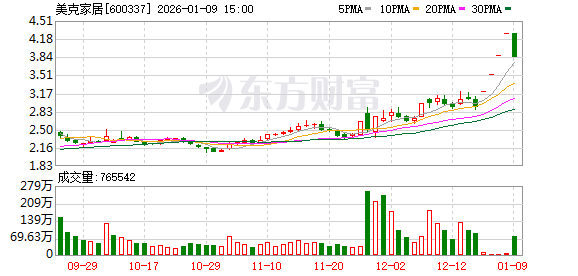
Group 1 - The stock of Meike Home (600337) experienced a limit down today, with a turnover rate of 5.33% and a transaction amount of 308 million yuan, showing a fluctuation of 11.20% [2] - The stock was listed on the Shanghai Stock Exchange's watch list due to a daily decline of 10.99%, with a total net sell of 6.0049 million yuan from brokerage seats [2] - The top five brokerage seats accounted for a total transaction of 90.9453 million yuan, with a buying amount of 42.4702 million yuan and a selling amount of 48.4751 million yuan, resulting in a net sell of 6.0049 million yuan [2] Group 2 - In the past six months, the stock has been listed on the watch list seven times, with an average price drop of 1.62% the next day and an average drop of 4.66% over the following five days [3] - The stock saw a net outflow of 108 million yuan in main funds today, with a significant outflow of 100 million yuan from large orders [3] - The latest margin trading data shows a total margin balance of 161 million yuan, with a financing balance of 161 million yuan and a securities lending balance of 196,800 yuan, indicating a recent increase of 18.53 million yuan in financing balance, a rise of 13.03% [3] Group 3 - The third-quarter report released on October 31, 2025, indicated that the company achieved an operating income of 2.223 billion yuan, a year-on-year decrease of 10.10%, and a net profit of -220 million yuan [3] - The top buying brokerage seat was Guotai Junan Securities Co., Ltd. Shanghai Changning District Tianshan Road Securities Business Department, with a buying amount of 18.4151 million yuan [4] - The top selling brokerage seat was Huayuan Securities Co., Ltd. Shenzhen Branch, with a selling amount of 12.795 million yuan [4]

美克家居跌停,财通基金旗下1只基金重仓,持有9200股浮亏损失3956元
Xin Lang Cai Jing· 2026-01-09 02:02
Group 1 - The core point of the news is that Meike Home experienced a significant drop in stock price, closing at 3.84 CNY per share, with a total market capitalization of 5.518 billion CNY [1] - Meike International Home Products Co., Ltd. is based in Urumqi, Xinjiang, and was established on August 16, 1995. The company was listed on November 27, 2000, and its main business involves the production and sales of mid-to-high-end furniture and related products [1] - The revenue composition of Meike Home includes 53.78% from international wholesale home goods, 45.24% from domestic retail home goods, and 0.98% from other sources [1] Group 2 - From the perspective of fund holdings, one fund under Caitong Fund has a significant position in Meike Home. The Caitong Yixiang Steady Pension One-Year Holding Period Mixed Fund (FOF) holds 9,200 shares, accounting for 0.02% of the fund's net value, ranking as the tenth largest holding [2] - The Caitong Yixiang Steady Pension One-Year Holding Period Mixed Fund (FOF) was established on September 10, 2024, with a latest scale of 94.9637 million CNY. Year-to-date, it has a return of 0.07%, ranking 1270 out of 1294 in its category; over the past year, it has achieved a return of 6.26%, ranking 853 out of 1034; and since inception, it has returned 9.3% [2] - The fund manager of Caitong Yixiang Steady Pension One-Year Holding Period Mixed Fund (FOF) is Chen Xi, who has been in the position for 3 years and 324 days, managing total assets of 16.9 million CNY. The best fund return during his tenure is 9.26%, while the worst is -7.53% [3]