数码

Search documents
坚持政策支持和改革创新并举
Qi Huo Ri Bao Wang· 2026-01-21 03:06
Core Viewpoint - The National Development and Reform Commission (NDRC) emphasizes the importance of macroeconomic policies aimed at strengthening domestic circulation and expanding domestic demand, while also focusing on the development of the real economy and the construction of a unified national market [1][2][5]. Group 1: Macroeconomic Policies - The NDRC plans to formulate a strategic implementation plan for expanding domestic demand from 2026 to 2030, aligning with the trends of demand upgrades and technological revolutions [1]. - The focus will be on enhancing the quality of key industries and fostering emerging and future industries, particularly through initiatives like "Artificial Intelligence+" [1]. - The NDRC aims to implement a more proactive fiscal policy and moderately loose monetary policy, with a key goal of promoting reasonable price recovery [2]. Group 2: Market Regulation and Competition - The NDRC intends to address "involution" competition by shifting from price competition to value competition, improving market access, and enhancing fair competition mechanisms [2]. - There will be a focus on regulating key industry prices and ensuring a healthy market order through the implementation of quality brand strategies [2]. - The NDRC plans to establish a national unified market construction regulation to standardize behaviors of local governments and enterprises [3]. Group 3: Energy Transition and Carbon Neutrality - The NDRC emphasizes the acceleration of energy transition by increasing the development of non-fossil energy and enhancing the capacity of the power grid [4]. - There will be a strong push for industrial upgrades towards green and low-carbon industries, including the promotion of zero-carbon parks and factories [4]. - The NDRC will implement comprehensive resource management and promote a circular economy to support carbon peak and neutrality goals [4]. Group 4: Economic Outlook - The NDRC forecasts a continuous improvement in economic structure and development momentum, with significant potential in consumption, investment, technology, and regional development [5]. - The focus will be on combining policy support with reform and innovation to transform development potential into new economic growth [5].
“消费第一城”上海火力全开
Di Yi Cai Jing Zi Xun· 2026-01-21 02:09
Core Insights - Shanghai's retail sales reached over 1.66 trillion yuan in 2025, marking a 4.6% year-on-year increase, outperforming the national average of 3.7% by 0.9 percentage points [2] - Key sectors such as new energy vehicles, communication equipment, and home appliances saw double-digit growth, with cultural and office supplies retail up by 30.4% [2] - The city welcomed a record 9.36 million inbound tourists in 2025, a 40% increase from the previous year, with tax refund sales rising by approximately 80% [2] Economic Drivers - The steady recovery in Shanghai's consumption is attributed to three main factors: targeted policy measures, innovative cultural and tourism events, and the accelerated recovery of international flights and visa facilitation [3] - Policies such as trade-in programs for automobiles and home appliances, along with service consumption vouchers, have effectively stimulated demand [3] - The implementation of the trade-in policy led to over 320,000 cars and 4.5 million digital products being replaced, generating over 120 billion yuan in sales and benefiting more than 21.95 million people [4] Future Outlook - The strong growth trend in consumption is expected to continue into 2026, with service consumption anticipated to remain a key driver [5] - Ongoing policies, including the "28 measures" for service and consumption linkage, are expected to further stimulate service consumption potential [5] - Recommendations for sustaining growth include enhancing inbound tourism measures, improving service quality, and leveraging digital tools for better consumer engagement [6]

贵州:78亿元补贴撬动738亿元消费
Sou Hu Cai Jing· 2026-01-21 01:18
Core Insights - The Guizhou government plans to implement a "trade-in" program in 2025, utilizing a subsidy of 7.828 billion yuan to stimulate consumer spending of 73.82 billion yuan [1] Group 1: Automotive Sector - The program aims to scrap and update 66,300 vehicles, with a fiscal subsidy of 1.224 billion yuan, generating 9.284 billion yuan in new automotive consumption [1] - A total of 313,900 vehicles will be replaced, using 4.223 billion yuan in subsidies, leading to 50.41 billion yuan in new automotive consumption [1] Group 2: Home Appliances - The initiative includes the replacement of 2.2423 million home appliances, supported by 1.568 billion yuan in subsidies, resulting in 8.287 billion yuan in new home appliance consumption [1] Group 3: Home Goods - The program will facilitate the replacement of 133,700 home goods, with 182 million yuan in subsidies, generating 1.25 billion yuan in new home goods consumption [1] Group 4: Digital Products - The trade-in program will also cover 1.5334 million digital products, utilizing 557 million yuan in subsidies, leading to 4.382 billion yuan in new digital product consumption [1] Group 5: Electric Bicycles - The initiative includes the replacement of 81,100 electric bicycles, with a subsidy of 73.8636 million yuan, resulting in 207 million yuan in new electric bicycle consumption [1]
来之不易成绩单彰显经济韧性活力
Ren Min Ri Bao· 2026-01-20 01:57
Core Insights - China's economy demonstrates strong resilience and vitality, with significant progress expected in innovation, industrial quality improvement, digital empowerment, and green transformation by 2025 [1][2] Supply Quality Improvement - China becomes the first country with over 5 million valid domestic invention patents, with R&D expenditure reaching 39,262 billion yuan, maintaining the second position globally [2] - The added value of high-tech manufacturing and equipment manufacturing accounts for 17.1% and 36.8% of the total industrial added value, respectively [2] - The production of civil drones and industrial robots increases by 37.3% and 28% year-on-year [2] Green Leadership - Clean energy generation from hydropower, nuclear, wind, and solar grows by 8.8%, with non-fossil energy consumption rising by approximately 2 percentage points compared to 2024 [3] - The industrial added value reaches 41.7 trillion yuan, growing by 5.8% year-on-year, contributing 35% to economic growth [3] Consumption Trends - The total retail sales of consumer goods exceed 50 trillion yuan, growing by 3.7% compared to 2024, with final consumption contributing 52% to economic growth [4] - Service retail sales increase by 5.5%, outpacing goods retail sales, with service consumption accounting for 46.1% of per capita consumption expenditure [4] - Online retail sales grow by 8.6%, driven by e-commerce and digital technologies [4] Policy Effectiveness - The number of household cars reaches 52.9 per hundred households, an increase of 1.7 from 2024 [6][7] - Policies promoting consumption upgrades lead to a 4.1% increase in retail sales of six categories of goods [7] Technological and Industrial Innovation - The added value of smart unmanned aerial vehicle manufacturing and smart vehicle-mounted equipment manufacturing grows by 57% and 26.2%, respectively [8] - The core CPI rises by 1.2% year-on-year, while the decline in industrial producer prices narrows [8] Positive Economic Trends - The economic foundation remains solid, with over 36 trillion yuan added to the economy during the 14th Five-Year Plan [9] - The manufacturing purchasing managers' index returns to expansion territory, indicating positive growth trends [9] - New production forces and reform benefits continue to emerge, with significant advancements in artificial intelligence and digital economy [9] Supportive Development Environment - More proactive macro policies are expected to ensure stable economic operations, with a focus on key project implementations [10]
武汉2026年家电数码以旧换新启动 15%补贴带动消费升级
Chang Jiang Shang Bao· 2026-01-19 06:39
Core Insights - Wuhan has launched a new subsidy program for the replacement of home appliances and digital products, effective from January 16, 2026, providing a 15% subsidy on the sales price of eligible products [1][2] - The program aims to stimulate consumer spending and promote green transformation in the industry, covering six categories of home appliances and four categories of digital products [1] Group 1: Subsidy Details - Consumers can receive a subsidy of up to 1,500 yuan for each eligible home appliance purchased, with a limit of one subsidy per category per consumer [1] - In the digital product category, items such as smartphones, tablets, and smart glasses are included, with a maximum subsidy of 500 yuan for products priced under 6,000 yuan [1] Group 2: Participation and Accessibility - The program allows consumers who received subsidies in 2025 to apply for subsidies again in 2026 for similar products, expanding the reach of the policy [2] - A total of 1,021 businesses are participating in the program, with 3,527 stores involved, including 743 home appliance companies and 278 digital product companies [2]
换新政策激活天水消费新活力
Xin Lang Cai Jing· 2026-01-19 03:42
Core Viewpoint - The implementation of the 2026 consumer goods trade-in subsidy policy in Gansu Province is expected to significantly boost consumer spending in key sectors such as automobiles, home appliances, and digital products, thereby injecting strong momentum into the local market [1][2]. Group 1: Subsidy Policy Details - The subsidy policy covers three main categories of consumer goods: automobiles, home appliances, and digital products [1]. - For automobiles, the maximum subsidy for scrapping old vehicles to purchase new energy vehicles is 20,000 yuan, while for fuel vehicles, it is 15,000 yuan. The subsidy for trade-in purchases of new energy vehicles is up to 15,000 yuan, and for fuel vehicles, it is 13,000 yuan [1]. - The home appliance trade-in subsidy includes six categories, such as refrigerators, washing machines, televisions, air conditioners, computers, and water heaters, all of which must meet energy efficiency or water efficiency standards [1]. - The digital product subsidy applies to smartphones, tablets, smartwatches, and smart glasses, with a single item price limit of 6,000 yuan [1]. Group 2: Market Response - Following the launch of the subsidy policy, local automobile dealerships have reported an increase in customer inquiries about trade-in options, with foot traffic remaining stable compared to the previous year [2]. - Consumers are showing a strong interest in upgrading their vehicles, with many taking advantage of the subsidies and additional dealer promotions [2]. - Home appliance and digital product retailers are experiencing heightened activity, with government subsidy promotions attracting many customers, particularly for energy-efficient products [2]. Group 3: Implementation and Accessibility - The city has completed the collection of businesses eligible for the trade-in program to ensure consumers can easily access the benefits [3]. - The subsidy application process is streamlined and can be completed online through the "Gankuaiban" app or via WeChat and Alipay mini-programs [3]. - The local commerce bureau will continue to promote the policy, provide support to businesses, and ensure accurate distribution of subsidy funds to maximize the benefits for consumers and stimulate healthy market growth [3].
2026年伊始“两新”政策持续加力扩围 市场活力进一步释放
Yang Guang Wang· 2026-01-19 01:50
Core Insights - The implementation of large-scale equipment updates and the "old for new" consumer goods policy in 2026 has led to a rapid market response, expanding the supply of quality goods and services, thereby enhancing market vitality [1] Group 1: Market Response - In Tonghua City, Jilin Province, a new round of subsidies launched on New Year's Day has significantly boosted the local consumer market [2] - A manager from a home appliance store in Tonghua reported a 50% increase in sales compared to January 1, 2025, highlighting the effectiveness of the subsidy program [3] - The "old for new" program allows consumers to enjoy a one-stop service from purchasing to the recycling of old appliances, enhancing convenience [3] Group 2: Product Focus and Sales Growth - Smart glasses have become a focal point in the digital sector after being included in the national subsidy program [4] - A sales representative noted a 30% increase in sales volume following the introduction of the national subsidy in 2026 [5] - In rural areas, tailored smart home appliances have been developed to meet local needs, resulting in increased single-customer spending and monthly sales reaching around 200,000 yuan [5] Group 3: Regulatory Measures - The National Development and Reform Commission emphasized the importance of maintaining market order during this renewal process [5] - Participants in the subsidy program are required to adhere to price filing, commitment, and public disclosure systems, with strict penalties for violations [5]
2026以旧换新“换”出消费新热潮:绿色化、智能化趋势明显
Yang Guang Wang· 2026-01-19 00:09
Core Viewpoint - The implementation of the large-scale equipment update and old-for-new consumption policy in 2026 has sparked a significant consumption boom across various markets, with a focus on energy-efficient products and enhanced consumer services [1] Group 1: Policy Changes - The new policy features more precise scope, flexible subsidies, and improved services, transitioning from a flat-rate subsidy to a proportional system linked to vehicle prices, ensuring fair benefits for consumers across different price ranges [1] - The household appliance subsidy specifically targets "1st-level energy efficiency or water efficiency," promoting a shift from low-efficiency to high-efficiency products, thereby emphasizing the importance of the entire product lifecycle and social benefits [1] Group 2: Market Reactions - In Tonghua, Jilin Province, the new round of subsidies initiated on New Year's Day led to a 50% increase in sales compared to the previous year, demonstrating the strong market response to the policy [2] - In Zhengzhou, a specific air conditioning model's price dropped from 4599 yuan to 2844 yuan after applying the subsidies, showcasing the tangible benefits for consumers [3] - Xiaomi stores in Jiangsu experienced a 130% increase in foot traffic and significant sales growth of 150% for mobile phones and 120% for smartwatches, indicating a robust consumer interest in new products [3] Group 3: Consumer Behavior - The introduction of subsidies has balanced the price gap between 1st-level and 2nd-level energy-efficient products, making energy-efficient options more appealing to consumers [4][5] - In rural areas, tailored smart appliances have been developed to meet local needs, resulting in increased consumer spending and sales growth in these regions [6] Group 4: Regulatory Measures - The Ministry of Commerce emphasized the need for participating businesses to have waste appliance recycling capabilities and to provide one-stop services for consumers, enhancing convenience [2] - Strict regulations are in place to ensure compliance with pricing and subsidy management, with penalties for violations to maintain market order [7]
2025年青海消费品以旧换新撬动消费197亿元
Xin Lang Cai Jing· 2026-01-18 18:29
Core Insights - The Qinghai Province's consumption upgrade policy has shown significant results in 2025, with a total investment of 1.69 billion yuan, benefiting over 1.52 million people and stimulating consumption of 19.7 billion yuan [1] - The policy has led to the replacement of 92,000 vehicles, 496,000 home appliances, 615,000 digital products, 31,900 home decoration items, and 4,000 electric bicycles [1] Group 1 - In 2026, the central government will continue to allocate long-term special treasury bond funds, with local governments providing matching funds to support the implementation of the consumption upgrade policy [2] - The Qinghai Provincial Commerce Department has announced the seamless transition of the consumption upgrade policy for 2026, optimizing the previous year's measures [2] Group 2 - The new policy for 2026 includes adjustments to the subsidy standards for vehicle replacements, with a shift from fixed subsidies to percentage-based subsidies based on vehicle prices [2] - For electric vehicles, the subsidy will be 12% of the vehicle price, with a maximum of 20,000 yuan, while for fuel vehicles, it will be 10% of the vehicle price, with a maximum of 15,000 yuan [2] - The home appliance upgrade policy will provide a subsidy of 15% of the sales price for energy-efficient products, with a maximum subsidy of 1,500 yuan [2] - The digital product purchase subsidy will cover smartphones, tablets, smartwatches, and smart glasses, offering a 15% subsidy on products priced up to 6,000 yuan, with a maximum subsidy of 500 yuan [2]
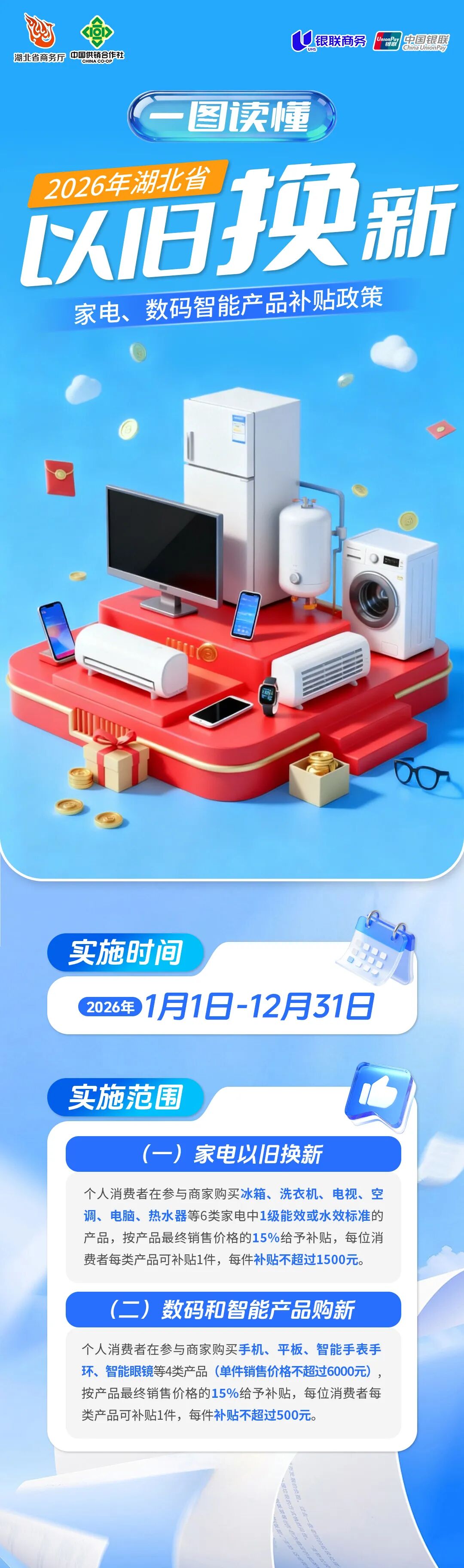
最高补贴1500元!湖北以旧换新最全攻略来了
Xin Lang Cai Jing· 2026-01-18 04:03
Core Viewpoint - The Hubei province has launched a "trade-in" subsidy policy for home appliances and digital smart products, effective from January 1, 2026, to December 31, 2026, aimed at encouraging consumer spending and upgrading household electronics [5][7][8]. Group 1: Subsidy Details - Consumers can receive a subsidy of 15% of the final sales price for purchasing energy-efficient home appliances, with a maximum subsidy of 1,500 yuan per item, limited to one item per category [7]. - The eligible home appliances include refrigerators, washing machines, televisions, air conditioners, computers, and water heaters [7]. - For digital smart products, consumers can receive a subsidy of 15% of the final sales price, with a maximum of 500 yuan per item, also limited to one item per category [8]. - Eligible digital products include smartphones, tablets, smartwatches, and smart glasses, with a single item price cap of 6,000 yuan [8]. Group 2: Implementation and Access - The subsidy program is accessible through participating merchants, and consumers must follow specific steps to claim their subsidies via the "Hubei Trade-in" WeChat public account [12][15]. - The program is designed to operate daily from 00:00 to 24:00, with the subsidy vouchers valid only for the day they are claimed [12]. - Consumers can check their eligibility and receive assistance through the WeChat mini-program dedicated to the trade-in program [15][21].