
服务

Search documents
高市早苗接棒自民党 日本将迎首位女首相! “安倍经济学2.0”蓄势待发?
智通财经网· 2025-10-04 07:42
Group 1 - The election of Sanna Takai as the new leader of the ruling Liberal Democratic Party (LDP) paves the way for her to become Japan's first female Prime Minister, following her victory over Shinjiro Koizumi with 185 votes to 156 [1] - Takai, a conservative nationalist and ally of former Prime Minister Shinzo Abe, is expected to continue the "Abenomics" policies, which focus on aggressive fiscal expansion and a cautious stance on monetary tightening [2] - The LDP remains the largest party in the Japanese parliament, increasing the likelihood of Takai's appointment as Prime Minister in the upcoming vote [1] Group 2 - Economists predict that Takai will maintain the trajectory of "Abenomics," which may lead to a long-term depreciation of the yen, while benefiting the Japanese stock market in the short term [2] - The potential for rising long-term Japanese government bond yields is anticipated, particularly for bonds with maturities of 10 years or more, due to the expected fiscal policies [2] - If Takai's administration focuses on tax cuts, cash subsidies, and significant fiscal expansion, it could catalyze a bull market for the Nikkei 225 and TSE indices, particularly benefiting sectors like AI, semiconductors, and defense [3]
汇通达网络(09878.HK)2025年中报点评:提质增效显现成效 AI+SAAS商业化开启
Ge Long Hui· 2025-09-30 20:27
Core Viewpoint - The company reported a revenue decline in the first half of 2025 due to strategic adjustments aimed at optimizing inefficient businesses, while net profit showed a positive growth trend [1][2]. Group 1: Financial Performance - In the first half of 2025, the company achieved a revenue of 24.34 billion, a year-on-year decrease of 25.9%, while the net profit attributable to shareholders was 140 million, reflecting a year-on-year increase of 10.8% [1]. - The overall gross margin for the first half of 2025 was 4.6%, an increase of 1.1 percentage points year-on-year, primarily due to the company's decision to abandon low-efficiency businesses and enhance collaboration with leading brands [2]. Group 2: Business Segments - The trading business segment generated a revenue of 23.96 billion, down 26.0% year-on-year, with declines in consumer electronics and agricultural production materials, while home appliances remained stable due to government subsidies [1]. - The service business segment reported a revenue of 310 million, showing a slight year-on-year decline, but there was significant growth in store SaaS and subscription services compared to the second half of 2024 [1]. Group 3: Strategic Initiatives - The company entered into a comprehensive partnership with Alibaba Cloud in August 2025, focusing on AI and SaaS business growth, which is expected to enhance its platform value through the integration of AI capabilities with industry data [2]. - The development of proprietary AI models, such as the Qiancheng Cloud AI, aims to penetrate various business scenarios, enhancing sales predictions and customer service capabilities [2]. Group 4: Investment Outlook - The company is expected to see net profits of 346 million, 438 million, and 533 million for the years 2025 to 2027, reflecting year-on-year growth rates of 28.3%, 26.6%, and 21.6% respectively [3]. - A target price of 21.36 HKD is set for 2026, based on a 25X PE valuation, maintaining a "recommended" rating for the company [3].
景气连升,结构性扰动仍存:——9月制造业PMI点评
Huachuang Securities· 2025-09-30 12:45
1. Report Industry Investment Rating - Not provided in the given content 2. Core Viewpoints of the Report - In September 2025, with the addition of the traditional "Golden September" peak season, the PMI slightly rebounded below the boom - bust line, but the recovery was still mild, and structural contradictions remained. The production in September drove the PMI to rise by 0.28pct, followed by the employees, while the demand and material inventory contributed less than 0.1pct. The production - new order gap widened, and the PMI increase was weaker than the average in September since 2022, falling short of the seasonality. The economic recovery foundation needs to be strengthened, and the 50 billion yuan policy - based financial instruments may be the key to "break the situation" [6][12]. - For the bond market, the PMI has been below the boom - bust line for 6 consecutive months. The market has fully anticipated the weak data. In the fourth quarter, new policy - based financial instruments will take effect. Attention should be paid to whether data such as new orders are "better than expected". The downstream construction and project expenditures may speed up in the fourth quarter, which may drive the performance of the mid - stream manufacturing industry. Attention should also be paid to whether the PMI can exceed the seasonal level and return above the boom - bust line [6][13]. 3. Summary According to the Directory I. Manufacturing PMI: Moderately Upward, Elasticity Awaits Policy Boost (1) Supply and Demand: The Supply - Demand Gap May Widen Again - New orders increased by 0.2pct month - on - month to 49.7%. The impact of high temperature and heavy rain faded, and exports showed resilience, but the intensity of demand recovery was still insufficient as the increase in September was the lowest since 2022 [2][16]. - Production increased by 1.1pct month - on - month to 51.9%, being the largest contributor to PMI improvement. The production peak season was realized, and the procurement volume and production and operation activity expectation index increased. The "production - new order" gap widened to 2.2pct, the highest since the beginning of the year, and the supply - demand differentiation intensified [2][20]. (2) Foreign Trade: New Export Orders Rebound Faster - New export orders increased by 0.6pct month - on - month to 47.8%, and imports increased by 0.1pct to 48.1%. In September, due to the Christmas product export peak season and the demand from non - US economies, exports were stable, and port freight volume remained high. The increase in new export orders in September exceeded that in August and was better than the overall new orders, showing export resilience [24]. - Imports continued the slight upward trend and were at a high level in the same period, indicating that enterprises' demand for import stocking was strong [25]. (3) Price: The Pressure of Price Decline Reappears - In September, the purchase price of raw materials and the ex - factory price decreased by 0.1pct and 0.9pct month - on - month to 53.2% and 48.2% respectively. The supply and demand of the basic raw material industry declined, dragging down the price index, while the prices of industries such as equipment manufacturing improved, showing a large industry differentiation [3][29]. (4) Inventory: Slow Destocking, Active Production, and a Sharp Increase in Product Inventory - In September, the raw material inventory index increased by 0.5pct to 48.5% due to the increase in procurement volume. However, the downstream demand destocking was slow, and the production expanded actively, resulting in a 1.4pct increase in finished product inventory to the highest level in the same period, showing the characteristic of "passive inventory accumulation" [3][31]. II. Non - Manufacturing PMI: The Construction Industry Continues to Be in Low - level Prosperity, Awaiting Policy Effect - In September, the non - manufacturing PMI was 50.0%, a month - on - month decrease of 0.3pct. The service industry PMI decreased by 0.4pct to 50.1%, and the construction industry PMI increased by 0.2pct to 49.3%, remaining below the boom - bust line [36]. - The construction industry expansion was still weak. The business activity indexes of housing construction and civil engineering construction were below 50%. The lack of new orders was the main factor restricting construction. The 50 billion yuan policy - based financial instruments may accelerate the investment rhythm in the fourth quarter and help the construction industry PMI recover [4][36]. - The service industry's prosperity declined in the off - season. After the summer vacation, tourism consumption entered the off - season. The approaching National Day holiday is expected to drive the improvement of travel service consumption [4][36].
两部门开展国际化消费环境建设工作
Xin Hua Wang· 2025-09-30 11:10
Core Points - The Chinese government aims to enhance consumption's role in stabilizing growth and improving livelihoods by selecting around 15 pilot cities for international consumption environment construction [1][2] - The policy is designed to meet diverse and quality consumption demands while promoting inbound consumption [1] Group 1: Policy Implementation - The pilot cities will include city-level and above locations, such as municipalities and provincial capitals, with a focus on cities with strong consumption potential and high foreign visitor numbers [2] - The policy will be implemented over a two-year period, with central government financial support of 200 million yuan for each international consumption center city and 100 million yuan for other selected cities [2] - Funding will be distributed in two batches, with initial funds released in the first year based on performance evaluations [2] Group 2: Support Directions - The initiative will focus on enhancing high-quality consumption supply, optimizing foreign payment services, and improving international service levels [2] - The construction of the international consumption environment is described as a comprehensive and systematic effort requiring collaboration from various stakeholders [2] - Future steps will include strengthening coordination, enhancing fund supervision, and summarizing experiences for replication and promotion [2]
关注黑色、能源上游价格波动
Hua Tai Qi Huo· 2025-09-23 05:20
Industry Overview Production Industry - The 2025 Yunqi Conference will be held from September 24th to 26th in Hangzhou with the theme of "Cloud-Intelligence Integration, Carbon-Silicon Symbiosis", featuring three main forums and over 110 aggregated topics focusing on AI, cloud computing, and industrial applications [1] Service Industry - At the press conference, the head of the central bank mentioned that the theme was about the mid - to long - term "14th Five - Year Plan" of the financial industry without short - term policy adjustments; the head of the financial regulatory agency stated that the total assets of the banking and insurance industries exceeded 500 trillion yuan with an average growth of over 9% in five years; the head of the CSRC said that the market value of the A - share technology sector accounted for over 1/4, and the number of tech companies in the top 50 market - value companies increased from 18 to 24; the deputy head of the central bank and head of the SAFE mentioned that cross - border two - way investment and financing were active, with overseas institutions and individuals holding over 10 trillion yuan in domestic stocks, bonds, and deposits by the end of July [2] Upstream - Black: Wire rod prices have rebounded [3] - Energy: Crude oil and natural gas prices have slightly declined [3] Midstream - Energy: Coal consumption by power plants has remained stable at a medium level [4] - Agriculture: The production of pig products has increased [4] Downstream - Service: The number of domestic flights has increased [4] Key Industry Price Indicators | Industry Name | Indicator Name | Frequency | Unit | Update Time | Value | YoY | | --- | --- | --- | --- | --- | --- | --- | | Agriculture | Spot price of corn | Daily | Yuan/ton | 9/22 | 2288.6 | -0.50% | | | Spot price of eggs | Daily | Yuan/kg | 9/22 | 7.8 | 1.56% | | | Spot price of palm oil | Daily | Yuan/ton | 9/22 | 9372.0 | -0.30% | | | Spot price of cotton | Daily | Yuan/ton | 9/22 | 15242.2 | -0.09% | | | Average wholesale price of pork | Daily | Yuan/kg | 9/22 | 19.6 | -1.61% | | Non - ferrous metals | Spot price of copper | Daily | Yuan/ton | 9/22 | 80233.3 | -0.95% | | | Spot price of zinc | Daily | Yuan/ton | 9/22 | 21942.0 | -1.22% | | | Spot price of aluminum | Daily | Yuan/ton | 9/22 | 20826.7 | -1.09% | | | Spot price of nickel | Daily | Yuan/ton | 9/22 | 122750.0 | -0.81% | | | Spot price of aluminum | Daily | Yuan/ton | 9/22 | 17081.3 | 0.29% | | Ferrous metals | Spot price of rebar | Daily | Yuan/ton | 9/22 | 3167.5 | 1.07% | | | Spot price of iron ore | Daily | Yuan/ton | 9/22 | 807.4 | -0.06% | | | Spot price of wire rod | Daily | Yuan/ton | 9/22 | 3410.0 | 2.87% | | Building materials | Spot price of glass | Daily | Yuan/square meter | 9/22 | 14.3 | 2.14% | | Non - metals | Spot price of natural rubber | Daily | Yuan/ton | 9/22 | 14908.3 | -1.49% | | | China Plastics City Price Index | Daily | - | 9/22 | 791.3 | -0.34% | | Energy | Spot price of WTI crude oil | Daily | US dollars/barrel | 9/22 | 62.4 | -0.46% | | | Spot price of Brent crude oil | Daily | US dollars/barrel | 9/22 | 66.0 | -1.42% | | | Spot price of liquefied natural gas | Daily | Yuan/ton | 9/22 | 3794.0 | -2.12% | | | Coal price | Daily | Yuan/ton | 9/22 | 784.0 | 1.16% | | Chemicals | Spot price of PTA | Daily | Yuan/ton | 9/22 | 4626.3 | -0.12% | | | Spot price of polyethylene | Daily | Yuan/ton | 9/22 | 7386.7 | 0.11% | | | Spot price of urea | Daily | Yuan/ton | 9/22 | 1655.0 | -0.60% | | | Spot price of soda ash | Daily | Yuan/ton | 9/22 | 1262.5 | 0.00% | | Real estate | National cement price index | Daily | - | 9/22 | 133.3 | 1.86% | | | Building materials composite index | Daily | Points | 9/22 | 114.8 | 1.48% | | | National concrete price index | Daily | Points | 9/22 | 91.7 | -0.45% | [39]
上海聂通材齐实业有限公司成立 注册资本50万人民币
Sou Hu Cai Jing· 2025-09-22 21:19
Company Overview - Shanghai Niatong Material Qi Industrial Co., Ltd. has been established with a registered capital of 500,000 RMB [1] - The legal representative of the company is Niao Zhaonian [1] Business Scope - The company operates in various sectors including wholesale and retail of hardware products, sales of metal materials and products, and sales of coatings and chemical products (excluding hazardous chemicals) [1] - Additional activities include sales of daily chemical products, construction materials, and gifts and flowers [1] - The company is also involved in landscaping engineering, urban greening management, and conference and exhibition services [1] Technical and Consulting Services - The company provides a range of technical services including development, consulting, exchange, transfer, and promotion [1] - It offers consulting planning services and information consulting services (excluding licensed information consulting services) [1] Real Estate and Logistics - The company engages in non-residential real estate leasing and general cargo warehousing services (excluding hazardous chemicals) [1] - It also provides loading and unloading services and domestic cargo transportation agency [1] Licensing and Regulatory Compliance - The company is involved in licensed projects such as construction engineering and residential interior decoration [1] - It is required to obtain approval from relevant departments before conducting certain business activities [1]
欧盟第二季度劳动力成本稳定增长,克罗地亚劳动力成本增速放缓至9.2%
Shang Wu Bu Wang Zhan· 2025-09-22 17:00
Core Insights - The nominal hourly labor cost in the Eurozone increased by 3.6% year-on-year in Q2 2025, compared to a 3.4% increase in Q1 2025 [1] - The overall nominal hourly labor cost in the EU rose by 4.0% year-on-year in Q2 2025, slightly down from 4.1% in Q1 2025 [1] - Croatia's nominal hourly labor cost growth slowed to 9.2% in Q2 2025, down from 13.5% in Q1 2025 [2] Labor Cost Breakdown - In the Eurozone, wages and salaries grew by 3.7% year-on-year in Q2 2025, while non-wage costs increased by 3.4% [1] - In the EU, wages and salaries rose by 4.1%, and non-wage costs increased by 3.8% [1] - The construction sector saw the highest labor cost increases, with Eurozone and EU costs rising by 4.7% and 4.8% respectively [1] Country-Specific Insights - Bulgaria recorded the highest nominal hourly labor cost increase at 13.2%, followed by Hungary at 10.9%, Romania at 10.4%, and Estonia at 10.3% [1] - France had the slowest growth in labor costs at 1.4%, with Malta following at 1.8% [1]
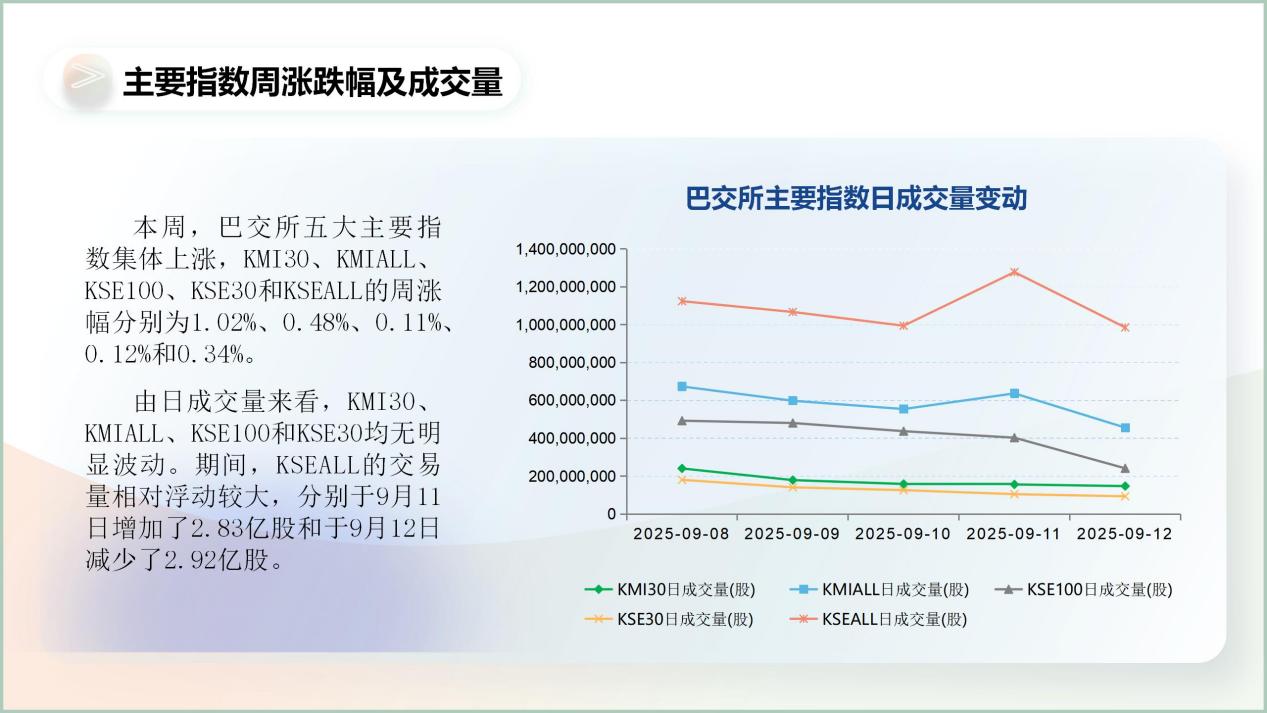
中经资料:巴基斯坦证券市场一周回顾(2025.09.08 - 2025.09.12)
Zhong Guo Jing Ji Wang· 2025-09-15 06:56
Group 1: Company Registrations and Economic Indicators - In August 2025, Pakistan registered 3,278 new companies, with a total paid-up capital of 7.74 billion PKR, bringing the total number of registered companies to approximately 265,600 [9] - The information technology and e-commerce sector led the new registrations with 670 companies, followed by trade (413), services (394), and real estate and construction (297) [9] - Worker remittances in August 2025 amounted to 3.1 billion USD, showing a 2.38% decline from the previous month but a 6.6% increase year-on-year [9] Group 2: Government Debt and Tax Expenditures - The total government debt for the fiscal year 2024-2025 reached 77.888 trillion PKR, a 13% increase from the previous fiscal year's 68.914 trillion PKR, raising the debt-to-GDP ratio to 73.2% [10] - The Federal Board of Revenue (FBR) estimated tax expenditures for the fiscal year 2023-2024 at 2.43 trillion PKR, which is 26.18% of the total revenue (9.3 trillion PKR) and 2.32% of the GDP (105.14 trillion PKR) [10] Group 3: Banking Sector Performance - The banking sector's asset size grew by 11.0% in the first half of 2025, with deposits increasing by 17.7%, while the ratio of non-performing loans slightly worsened to 7.4% [11] - The banking sector's credit risk remains manageable, with a decrease in non-performing loans reported [11] Group 4: Automotive Industry Growth - In the first two months of the fiscal year 2025-26, automobile sales and production in Pakistan increased by 40.06% and 100.93%, respectively, with sales rising from 12,274 units to 17,192 units [12] - Motorcycle sales also saw significant growth, increasing by 44.06% from 189,227 units to 272,601 units during the same period [12] Group 5: International Financial Support - The Asian Development Bank (ADB) and the Asian Infrastructure Investment Bank (AIIB) agreed to provide a total guarantee of 285 million USD to assist Pakistan in issuing 250 million USD in panda bonds, with commitments to use the funds for green projects [11]

国家统计局:8月限上单位家用电器和音像器材类零售额同比增14.3%
Guo Jia Tong Ji Ju· 2025-09-15 02:15
Group 1 - In August, the industrial added value of enterprises above designated size increased by 5.2% year-on-year and by 0.37% month-on-month [1] Group 2 - In August, the total retail sales of consumer goods reached 39,668 billion yuan, with a year-on-year growth of 3.4% and a month-on-month growth of 0.17% [2] - Urban retail sales amounted to 34,387 billion yuan, growing by 3.2% year-on-year, while rural retail sales reached 5,281 billion yuan, increasing by 4.6% [2] - Retail sales of goods were 35,172 billion yuan, up by 3.6%, and catering revenue was 4,496 billion yuan, growing by 2.1% [2] - Sales of basic living goods and some upgraded products showed strong growth, with retail sales of daily necessities, grain and oil food, and sports and entertainment products increasing by 7.7%, 5.8%, and 16.9% respectively [2] - The effects of the consumption upgrade policy continued to show, with retail sales of furniture, home appliances, audio-visual equipment, cultural and office supplies, and communication equipment increasing by 18.6%, 14.3%, 14.2%, and 7.3% respectively [2] - From January to August, the total retail sales of consumer goods reached 323,906 billion yuan, with a year-on-year growth of 4.6% [2] - National online retail sales reached 99,828 billion yuan, growing by 9.6%, with physical goods online retail sales at 80,964 billion yuan, increasing by 6.4%, accounting for 25.0% of total retail sales [2] - From January to August, service retail sales increased by 5.1%, with significant growth in cultural and recreational services, tourism consulting and leasing services, and transportation services [2]
内蒙古政府采购合同融资规模突破20亿元
Sou Hu Cai Jing· 2025-09-14 00:44
Core Insights - Inner Mongolia's government procurement contract financing has exceeded 2.08 billion, marking significant progress in supporting SMEs through government procurement policies [1] - The funds are utilized for key areas such as production expansion, equipment upgrades, and technology research, enhancing market competitiveness for enterprises [1] - The financing distribution shows that Ordos, Baotou, and Hohhot account for 19%, 15%, and 12% of the total financing respectively [1] Financing Mechanism - The government procurement contract financing service platform was launched in June 2021, facilitating collaboration between financial institutions and fiscal authorities to support SME development [1] - Over 700 SMEs across various industries, including manufacturing, services, and construction, have received financing through this platform [1] - The core of the financing business relies on the credit value of government procurement contracts, providing a new and efficient financing pathway for SMEs [1] Efficiency Improvements - The Finance Department of Inner Mongolia has partnered with financial institutions to launch a "financing express" pilot program, optimizing various aspects of the financing process [2] - The time from loan application to bank disbursement has been significantly reduced, with funds potentially available within one hour after contract issuance [2] - The maximum credit limit can reach 10 million, with single financing amounts determined at 90% of the winning contract value, effectively meeting the financing needs of enterprises [2]