
硬件设备

Search documents
小米,放量大跌
中国基金报· 2025-09-26 10:21
【 导读 】 小米集团跌逾8%,成交额超200亿港元 中国基金报记者 格林 消息面上, 9月26日,小米法务部在社交平台发文公布维权工作进展 称, 2025年至今,小米法务已完成对16465条舆情线索的法律评 估,重点监测网络账号231个,并针对其中92个恶意侵权账号提起民事诉讼,依法追究相关侵权人的法律责任。目前,部分案件已进入法 院审理阶段,将适时公布案件进展。其亦关注到部分小米车主无端遭受网络攻击的情形 。 小米法务已协助部分车主进行维权,目前已发起 车主维权诉讼共计35件,后续将持续重点关注此类网络侵权行为。 地平线机器人大跌 9月26日 早间,地平线机器人 发布 公告 称, 公司拟以 每股9.99港元 (折价约5.75%)配售股份, 筹资净额约63.39亿港元。 配售股 份占公司现有已发行股本约4.6%及公司已发行股本在股东大会上的投票权约1.9%。 9月26日,港股三大指数齐跌。恒生指数收跌1.35%,报26128.20点 ; 恒生科技指数跌2.89%,恒生国企指数跌1.49%。全日大市成交 额为3237亿港元,南向资金净买入105.4亿港元。 | 序号 | 代码 | 名称 | 现价 | 涨跌 | ...


小米,放量大跌
Zhong Guo Ji Jin Bao· 2025-09-26 10:19
【导读】小米集团跌逾8%,成交额超200亿港元 中国基金报记者格林 9月26日,港股三大指数齐跌。恒生指数收跌1.35%,报26128.20点;恒生科技指数跌2.89%,恒生国企指数跌1.49%。全日大市成交额为3237亿港元,南向 资金净买入105.4亿港元。 | 序号 | 代码 | 名称 | 现价 | 涨跌 | 涨跌幅 | 成交额 | 年初至今 | | --- | --- | --- | --- | --- | --- | --- | --- | | 1 | HSI | 恒生指数 | 26128.20c | -356.48 | -1.35% | 3237亿 | 30.25% | | 2 | HSTECH | 恒生科技 | 6195.11c | -184.08 | -2.89% | 1216亿 | 38.65% | | 3 | HSBIO | 恒生生物科技 | 16799.15c | -420.04 | -2.44% | 182亿 | 94.86% | | 4 | HSCEI | 恒生中国企业指数 | 9303.10c | -141.12 | -1.49% | 1257亿 | 27.62% | | 5 | ...
倒车接人,把握三个机会
Sou Hu Cai Jing· 2025-09-26 05:22
Market Overview - A-shares and Hong Kong stocks are experiencing a synchronized adjustment, with a cautious market risk preference as growth sectors retreat and second-tier themes rotate [1] - A-shares are influenced by the continuous decline of the Nasdaq and the upcoming long holiday, leading to a general adjustment in hard technology sectors, while funds shift towards automotive, wind power, and real estate sectors [1][2] - Hong Kong stocks are weakened by large technology stocks, but essential consumption and energy sectors provide counter-support [1][2] Index Performance - A-share market shows significant differentiation between large and small caps, with blue-chip sectors demonstrating resilience [2] - The Shanghai Composite Index fell 0.18% to 3846.33 points, while the Shenzhen Component Index dropped 0.79% to 13339.82 points [2] - The Hang Seng Index decreased by 0.65% to 26312.90 points, with the Hang Seng Technology Index down 1.04% [2] Industry Hotspots and Driving Logic - A-share market sees a rotation towards policy-sensitive sectors and cyclical stocks, with the petrochemical sector leading gains due to international oil price fluctuations [3] - The real estate sector stabilizes as ongoing property policies improve industry expectations [3] - The automotive and military sectors present thematic opportunities, with optimistic expectations for the new energy vehicle supply chain [3][4] Underperforming Sectors and Driving Logic - A-share technology growth sectors are experiencing a comprehensive pullback, particularly in AI hardware and media [5] - The hardware equipment index fell by 3.97%, with Apple-related and robotics stocks following the technology sector's adjustment [5] Investment Strategy Recommendations - The market is in a transitional phase of "growth retreat and defensive rise," suggesting a focus on policy dividends and low-valuation sector rotation [6] - Recommended areas include sectors with strong policy certainty such as real estate, national defense, and environmental protection [6] - Attention should also be given to energy and resource sectors under cyclical recovery logic, as well as high-dividend blue-chip stocks amid increased market volatility [6] Long-term Focus - Long-term attention should be on the opportunities arising from the correction in technology sectors, particularly in semiconductors and new energy storage, while waiting for signs of valuation digestion and stabilization in fund sentiment [7]
0925港股日评:三大股指涨跌不一,港股通电子领涨-20250925
Changjiang Securities· 2025-09-25 13:44
Core Insights - On September 25, 2025, the Hong Kong stock market recorded a total trading volume of HKD 314.89 billion, with net inflows from southbound funds amounting to HKD 11.046 billion [2][8] - The market exhibited structural differentiation, with the Hang Seng Index declining by 0.13%, while the Hang Seng Technology Index rose by 0.89% [5][8] - The copper price surged due to supply concerns following a landslide incident at a major copper mine in Indonesia, leading to a strong performance in the Hong Kong non-ferrous metals sector [2][8] - The Alibaba Cloud Summit released several positive developments in technology, boosting expectations for the artificial intelligence industry chain and driving gains in the hardware equipment sector [2][8] Market Performance - The Hang Seng Index closed at 26,484.68, down 0.13%, while the Hang Seng Technology Index closed at 6,379.19, up 0.89% [5][8] - The Hang Seng China Enterprises Index increased by 0.01% to 9,444.22, and the Hang Seng High Dividend Yield Index fell by 1.24% [5][8] - In the A-share market, the Shanghai Composite Index decreased by 0.01%, while the CSI 300 Index rose by 0.60% [5][8] Sector Analysis - Among the primary sectors in the Hong Kong stock market, Electronics (+2.33%), Power Equipment and New Energy (+2.28%), and Non-Ferrous Metals (+1.94%) led the gains, while the Comprehensive (-3.92%), Home Appliances (-3.26%), and Banking (-1.63%) sectors lagged [5][8] - Concept indices showed significant movements, with the Cobalt Metal Index rising by 11.38%, the Minor Metals Index by 8.00%, and the Rare Earth Permanent Magnet Index by 5.34% [5][8] Future Outlook - The report suggests three potential directions for the Hong Kong stock market to reach new highs: 1. AI technology and new consumption are expected to have significant growth potential, which could drive the market upward [8] 2. Continuous inflows from southbound funds are anticipated to enhance marginal pricing power in the market [8] 3. The transition from loose monetary policy to loose credit in China, along with potential interest rate cuts in the U.S., could further support the market's upward trajectory [8]
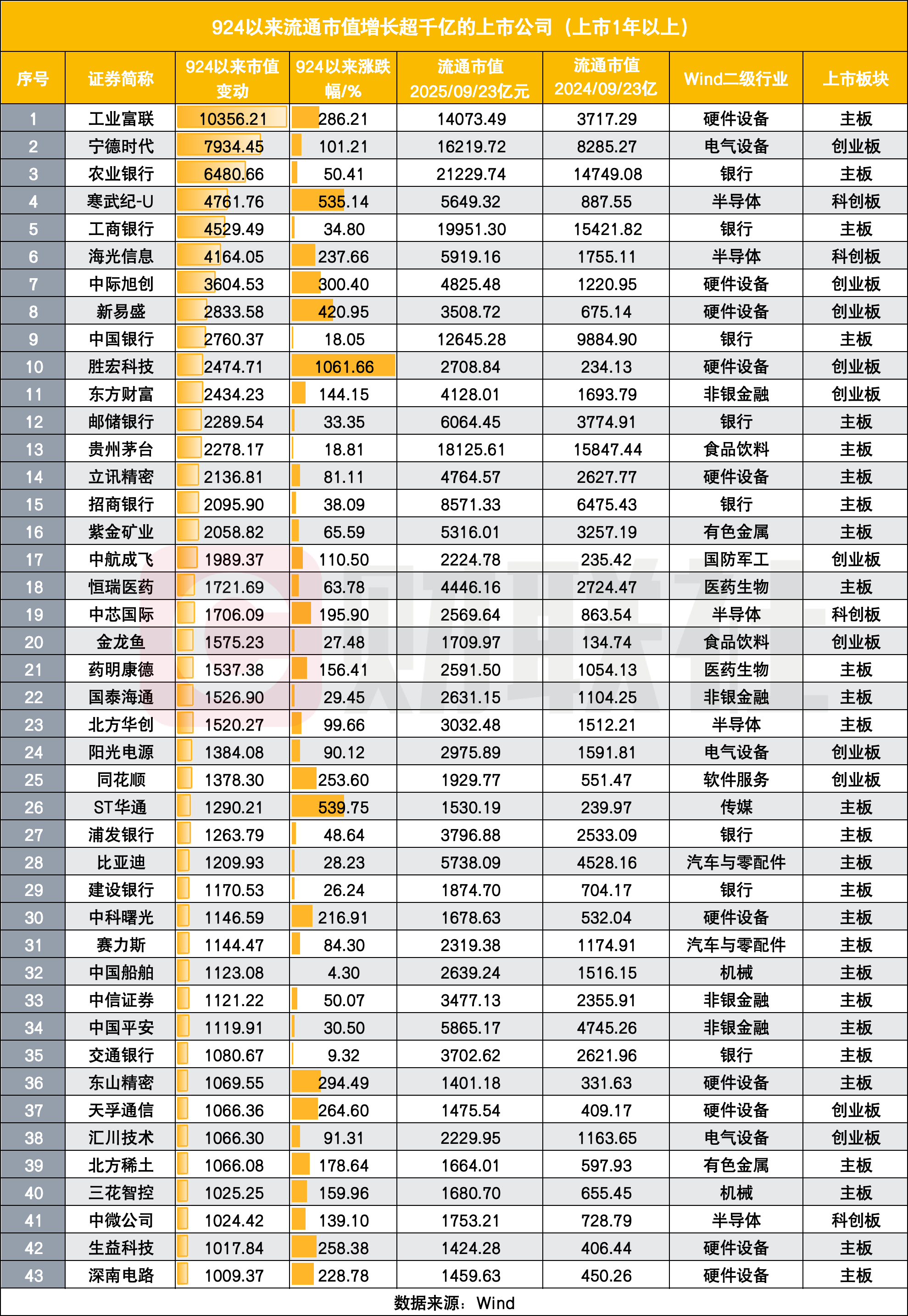
924新政这一年:43家上市公司市值增长超千亿 双创成高增长摇篮
Feng Huang Wang· 2025-09-24 02:46
Core Insights - The new policy implemented a year ago has led to significant market capitalization growth for 43 listed companies, totaling over 9.5 trillion RMB, highlighting the emergence of core competitive companies in the A-share market [1][6][11] Industry Performance - The hard technology sector, particularly the semiconductor and hardware equipment industries, has shown remarkable performance, contributing 15 companies to the market capitalization growth, with Industrial Fulian and Cambricon leading the way [1][7][11] - The semiconductor industry saw Cambricon's stock price surge by 535.14%, resulting in a market capitalization increase of 4.76 billion RMB, while Industrial Fulian topped the list with a market capitalization increase of 10.36 billion RMB [1][7][8] Company Highlights - Industrial Fulian achieved a market capitalization increase of 10,356.21 million RMB, with a stock price increase of 286.21% [4][6] - Ningde Times, a leader in the battery sector, saw its market capitalization grow by 7,934.45 million RMB, with a stock price increase of 101.21% [11][12] - Agricultural Bank and Industrial and Commercial Bank recorded market capitalization increases of 6,480.66 million RMB and 4,529.49 million RMB, respectively, indicating a recovery in undervalued blue-chip stocks [6][8] Financial Sector Growth - The financial sector, including banks and non-bank financial institutions, has also experienced significant growth, with several banks seeing market capitalization increases exceeding 2 billion RMB [2][8] - Dongfang Wealth emerged as a standout in the non-bank financial sector, with a market capitalization increase of 2,434.23 million RMB and a stock price increase of 144.15% [10] Market Structure - The ChiNext and Sci-Tech Innovation Board have become important platforms for nurturing high-growth companies, with over 30% of the 43 companies listed on these boards [11][12] - Traditional industry leaders, including Guizhou Moutai and Hengrui Medicine, have also seen value recovery, with Guizhou Moutai's market capitalization increasing by 2,278.17 million RMB [13]




0923港股日评:风格切换,港股通银行领涨-20250924
Changjiang Securities· 2025-09-24 02:27
Core Insights - The Hong Kong stock market experienced a collective decline on September 23, 2025, with the Hang Seng Index down by 0.70% to 26,159.12, the Hang Seng Tech Index down by 1.45% to 6,167.06, and the Hang Seng China Enterprises Index down by 0.86% to 9,290.34 [3][6][10] - The market's total trading volume reached HKD 294.56 billion, with southbound funds recording a net sell of HKD 4.069 billion [3][10] - The industrial sector saw a notable shift, with the Hong Kong banking sector (+0.77%) and public utilities (+0.25%) gaining favor, while hardware equipment (-1.84%) and food and beverage (-1.94%) sectors faced declines [6][10] Industry Analysis - The Minister of Industry and Information Technology highlighted new industrial opportunities at the 25th China International Industry Fair, which positively impacted the Hong Kong machinery sector, leading to a strong performance [10] - A significant rotation in market preferences was observed, with defensive sectors like banking and public utilities attracting investment, while previously high-performing sectors like hardware equipment faced profit-taking [10] - Future growth in the Hong Kong market may be driven by AI technology and new consumption trends, with expectations of continued inflows from southbound funds and improved liquidity from potential U.S. interest rate cuts [10]
【长江策略戴清团队】9月W3港股资金:南向流入互联网,外资加码硬件设备——“重估牛”系列之港股资金面
Xin Lang Cai Jing· 2025-09-23 17:28
Market Overview - The Hong Kong stock market experienced an increase from September 5 to 19, 2025, with the Hang Seng Index rising by 0.59% and the Hang Seng Tech Index increasing by 5.09% [3][12] - The main drivers for this growth include a 25 basis point interest rate cut by the Federal Reserve, which aligns with market expectations, leading to increased liquidity in overseas markets that benefits the Hong Kong stock market [3] - The signing of strategic cooperation agreements between major internet stocks in Hong Kong and state-owned enterprises has contributed to the significant rise in the technology sector [3] Southbound Capital Flow - From September 5 to 18, 2025, southbound capital inflow reached HKD 550.84 billion, primarily directed towards sectors such as consumer discretionary retail, non-bank financials, pharmaceuticals, automotive, and non-ferrous metals [3] - The top five sectors for net inflow were: consumer discretionary retail (HKD 259.66 billion), non-bank financials (HKD 91.69 billion), pharmaceuticals (HKD 40.14 billion), automotive (HKD 37.55 billion), and non-ferrous metals (HKD 21.99 billion) [3] - Notably, there was a net outflow from durable consumer goods, hardware equipment, and telecommunications services, totaling HKD -11.89 billion, -6.54 billion, and -5.88 billion respectively [3] Foreign Institutional Capital Flow - Foreign institutional capital saw a net outflow of HKD 294.95 billion, with significant inflows into hardware equipment, consumer services, food and beverage, durable goods, and media sectors, totaling HKD 204.27 billion [4] - The top five sectors for foreign institutional net inflow were: hardware equipment (HKD 83.73 billion), consumer services (HKD 48.63 billion), food and beverage (HKD 33.16 billion), durable goods (HKD 19.75 billion), and media (HKD 19 billion) [4] - Conversely, there was a substantial outflow from consumer discretionary retail (HKD -323.72 billion), non-bank financials (HKD -111.32 billion), automotive (HKD -47.48 billion), pharmaceuticals (HKD -27.16 billion), and textiles (HKD -15.03 billion) [4] Sector Performance - The Hong Kong industrial sector led the market performance during the specified period, reflecting strong investor interest and capital inflow [3][24] - The technology sector also showed significant gains, driven by strategic partnerships and collaborations aimed at enhancing industrial intelligence in China [3][24] - Overall, the market sentiment appears positive, with various sectors experiencing varying degrees of capital inflow and performance metrics [3][24]



策略点评:降息落地,波动提升
Tebon Securities· 2025-09-18 11:30
Market Analysis - The A-share market experienced increased volatility and a significant rise in trading volume, with the overall market liquidity being ample [2][3] - The Shanghai Composite Index fell by 1.15% to 3831.66 points, while the Shenzhen Component Index and the ChiNext Index dropped by 1.06% and 1.64% respectively, indicating a broad market decline [3][8] - The technology sector showed resilience, with the semiconductor and hardware equipment sectors leading the recovery towards the end of the trading session [3][8] Monetary Policy Impact - The Federal Reserve's decision to cut interest rates by 25 basis points on September 18, 2025, has created a more optimistic outlook for future rate cuts, with a total of 50 basis points expected by the end of the year [6][8] - The market's risk appetite is anticipated to rise further due to recent positive developments in U.S.-China relations and domestic technological advancements [6][8] Bond Market Dynamics - The bond market is experiencing a "short strong long weak" pattern, with the 30-year main contract falling by 0.17% to 115.62 yuan, indicating a general downward trend in government bond futures [8] - The People's Bank of China continues to provide liquidity support, with a net injection of 195 billion yuan on September 18, 2025, enhancing the demand for interest rate bonds [8] Commodity Market Trends - The domestic commodity futures market is generally weak, with a higher number of declining products compared to those that increased, particularly in the agricultural sector [8] - The focus on anti-involution products is expected to remain a hot topic in the domestic commodity market, with price fluctuations anticipated due to profit-taking and policy changes [8] Investment Opportunities - Key investment themes include precious metals, driven by central bank purchases and expectations of further rate cuts by the Federal Reserve [9] - The artificial intelligence sector is gaining traction due to accelerated capital expenditures by global tech giants, presenting significant investment opportunities [9] - The domestic chip industry is poised for growth due to technological breakthroughs and the potential for domestic substitution [9] Strategic Recommendations - The report suggests focusing on strong industry trends such as artificial intelligence and solid-state batteries, as well as benefiting from the depreciation of the U.S. dollar in the metals sector [10] - In the bond market, the report highlights the value of deeply discounted long-term government bonds, indicating a potential for increased allocation [10] - For commodities, the report recommends a long-term positioning in precious and base metals, while actively following policy developments in the industrial sector [10]
哔哩哔哩涨2.78%,港股市场半日成交1600亿港元
Sou Hu Cai Jing· 2025-09-16 05:37
Group 1 - The Hang Seng Index rose slightly by 0.07%, while the Hang Seng Tech Index increased by 0.39%, and the Hang Seng China Enterprises Index saw a minor rise of 0.10% with a market turnover of HKD 160.18 billion [1] - The recent interest rate cut by the Federal Reserve, approximately 9 months ago, has historically led to better performance in growth styles and small-cap stocks in A-shares and Hong Kong stocks, while dividend styles lagged [1] - The hardware, semiconductor, and environmental protection sectors in Hong Kong stocks have shown significant gains over the past 20 weeks [1] Group 2 - The Hong Kong Stock Connect Technology ETF (159101) provides investors with a convenient tool to invest in the Hong Kong tech sector, closely tracking the National Index of Hong Kong Stock Connect Technology [2] - The ETF selects 30 large-cap, high R&D investment, and fast-growing tech leading companies, making it one of the most focused products in its category, with the top ten constituents accounting for 77% [2] - Major constituents include Xiaomi, Tencent, Alibaba, Meituan, BYD, SMIC, and BeiGene, making it a quality tool for investors to gain exposure to leading Chinese tech companies [2]

今年A股再融资总额超八千亿元
Yang Zi Wan Bao Wang· 2025-09-15 10:33
Group 1 - The A-share refinancing market has seen significant activity in 2023, with total funds raised reaching 800.21 billion yuan, a substantial increase of 258.7% compared to 223.12 billion yuan in the previous year [1] - The private placement market has been particularly strong, with 108 projects completed, raising a total of 756.43 billion yuan, marking a growth of 337.1% year-on-year [1] - There have been 29 convertible bond projects completed, with a total fundraising amount of 43.78 billion yuan [1] Group 2 - The growth trend in the private placement market appears to be sustainable, with 424 private placement proposals disclosed this year, averaging an expected fundraising of 1.10 billion yuan each [1] - The manufacturing and high-tech industries are the main drivers of refinancing, with numerous projects in the chemical, machinery, hardware, and semiconductor sectors [1] - In the chemical industry, 11 companies completed private placements, while the machinery and hardware sectors each had 10 companies complete similar transactions [1] Group 3 - The dominance of private placements in the refinancing market is attributed to their large financing scale, high approval efficiency, and flexible use of funds, along with regulatory support for economic development [2] - The key reasons for the warming of the refinancing market this year include the resonance of policies and market conditions, with the registration system reform significantly optimizing the refinancing process and lowering financing thresholds for companies [2] - The demand for funds has surged due to economic recovery and the need for industrial upgrades, particularly in strategic areas such as new energy and semiconductors, where companies need to overcome technological bottlenecks [2]