
科技行业

Search documents
硅谷超级富豪们正在仓皇逃离加州
Xin Lang Ke Ji· 2026-01-11 23:43
Group 1 - The article discusses the potential implementation of a one-time 5% wealth tax on billionaires in California, driven by the state's ongoing budget deficit and increasing public spending, particularly in healthcare [2][5][27] - California is facing a projected budget deficit of nearly $18 billion for the 2026-27 fiscal year, marking the fourth consecutive year of fiscal shortfall, with structural deficits potentially rising to $35 billion by 2027-28 [2][5] - The wealth of California billionaires has surged from $300 billion in 2011 to over $2.2 trillion by 2025, with a significant disparity in tax rates compared to average Americans [5][26] Group 2 - The proposal for the wealth tax is supported by various labor unions and progressive groups, aiming to collect approximately $100 billion over five years, primarily for healthcare services [5][23] - However, there is notable division within the Democratic Party regarding the proposal, with Governor Gavin Newsom opposing it due to concerns about innovation and economic outflow [7][8] - Historical examples from Europe show that wealth taxes often lead to capital flight and do not yield the expected revenue, raising concerns about the potential impact on California's economy [8][27] Group 3 - Prominent billionaires, including Google co-founders Larry Page and Sergey Brin, have begun relocating their businesses and residences out of California in anticipation of the proposed tax [11][13] - Elon Musk has already moved his residence to Texas, significantly reducing his tax burden, which highlights the trend of wealthy individuals leaving California due to tax concerns [15][17] - The article emphasizes the challenges of taxing wealth primarily held in stock, as many billionaires may lack sufficient liquid assets to cover substantial tax bills, potentially leading to stock sales that could depress market values [20][22] Group 4 - The political climate surrounding the wealth tax reflects a broader shift in American politics, with increasing calls for wealth redistribution amid growing income inequality [24][26] - The article suggests that the outcome of the wealth tax debate could set a precedent for other states and influence the future of wealth distribution in the U.S. [28] - The discussion also highlights the need for a balance between fostering innovation and ensuring fair wealth distribution, as the current economic model faces sustainability challenges [28][30]




中产「大逃杀」,正在席卷全球
3 6 Ke· 2026-01-11 02:28
Core Insights - The article highlights the precarious situation of the American middle class, illustrating how a single event such as job loss, illness, or mortgage default can lead to homelessness, emphasizing the fragility of their financial stability [1][18][45]. Group 1: Economic Vulnerability - Approximately 770,000 people in the U.S. are expected to be homeless in 2024, many of whom were once middle-class workers [1]. - About 80% of Americans could face financial crises due to a single medical emergency, as only 21% of households have over $5,000 in savings [4][5]. - Medical expenses, even for minor issues, can lead to significant debt, with emergency consultations costing hundreds of dollars and surgeries potentially leading to thousands in out-of-pocket costs [7][9]. Group 2: Housing and Living Costs - The median price for single-family homes in the U.S. is projected to be around $460,000 by 2025, with prices in high-cost areas exceeding $700,000 [12]. - A typical American family needs an annual income of about $120,000 to afford median housing costs, which can consume 30-40% of their income [15][20]. - Living in middle-class neighborhoods incurs higher costs, with rents and property taxes significantly elevated compared to ordinary areas [13][18]. Group 3: Employment and Income Stability - As of October 2025, nearly 1.17 million layoffs have been announced, a 54% increase from the previous year, particularly affecting government and tech sectors [21]. - Unemployment leads to an inability to pay mortgages, resulting in credit collapse and further job loss, creating a vicious cycle [22][25]. - Even unemployment benefits are insufficient to cover the basic annual needs of a family, which can reach $140,000 [23]. Group 4: Debt and Financial Management - Many middle-class Americans struggle with student loan debt, which can take decades to repay, hindering their ability to save [26][29]. - The average monthly salary is around $5,183, but many face high monthly student loan payments that complicate financial stability [26]. - A significant portion of Americans cannot access emergency funds, with about 37% unable to cover an unexpected expense of $400 [32]. Group 5: Global Context - The concept of the "killing line" reflects a broader trend of middle-class decline globally, with similar financial pressures observed in countries like South Korea and China [49][48]. - The article suggests that the middle class worldwide is experiencing stagnation, rising living costs, and increasing debt burdens, leading to a potential retreat from the middle class [49][50].

中外资机构:2026年中国将是全球投资者瞩目的市场
Sou Hu Cai Jing· 2026-01-10 12:33
Group 1 - China is expected to be a focal market for global investors by 2026, driven by the rise in the valuation and quality of its technology sector, which has developed an independent AI ecosystem with vast applications and market potential [5][6][21] - Since April 2025, there has been a trend of global investors reallocating assets away from the US, which is likely to continue into 2026, leading to increased capital allocation towards Chinese assets [7] - The Chinese stock market is anticipated to experience a valuation reassessment driven by innovation, with future upward momentum expected to shift from valuation recovery to profit improvement [8] Group 2 - The "barbell strategy" is recommended for asset allocation, combining high-dividend stocks for defensive positioning with a focus on technology stocks benefiting from self-reliance and international expansion [8][9] - The core drivers for the A-share market in 2026 are expected to be policy support, profit recovery, and favorable liquidity conditions, with a focus on sectors such as technology innovation and manufacturing [9][10] - The Hong Kong stock market is projected to benefit from strong capital inflows and active IPO activities, supported by policies favoring artificial intelligence [21] Group 3 - The 14th Five-Year Plan emphasizes the construction of a modern industrial system and expansion of domestic demand, with investment opportunities in traditional industry upgrades, advanced manufacturing, and emerging sectors like renewable energy and aerospace [10][11] - The focus on technology self-reliance and high-quality development is expected to drive policy initiatives aimed at stimulating consumption and stabilizing the real estate market [11] - The anticipated US Federal Reserve interest rate cuts are expected to enhance global liquidity and lower financing costs, benefiting risk assets and corporate earnings [14][19] Group 4 - In the context of a reshaped global order, investment strategies for 2026 should focus on diversified paths to enhance portfolio resilience, particularly in technology sectors related to capital expenditure expansion and energy transition [20] - Asia is identified as a core growth engine, with positive outlooks for stock markets in mainland China, Hong Kong, Singapore, and South Korea, while maintaining a cautious approach towards US equities [20][21] - The emphasis on diversification includes emerging market bonds outperforming developed market bonds, with gold expected to continue its upward trend in 2026 [22]

探秘商品超级周期与展望
Hua Xia Shi Bao· 2026-01-09 08:35
Group 1: Macroeconomic Environment - The macroeconomic environment of developed economies, particularly in the West, is at a critical point of accelerating risk accumulation, with a deep binding of fiscal and monetary policies due to negative debt accumulation [2] - Modern Monetary Theory (MMT) is transitioning from theoretical research to implicit practice, suggesting that sovereign nations with monetary autonomy can continuously issue currency for fiscal financing as long as inflation is controllable [2] - The excessive liquidity created by central banks has not directly flowed into the real economy but has instead surged into long-term narratives in technology and virtual economies, leading to asset bubbles [2] Group 2: Wealth Distribution and Employment - The wealth effect from asset prices is exacerbating social divisions in Western societies, while technological innovations, particularly in AI, are increasing employment pressures without a corresponding rise in overall productivity [3] - The internal wealth gap and employment issues in Western countries are spilling over into geopolitical tensions, manifesting as anti-immigrant sentiments and the rise of nationalism [3] Group 3: Investment Trends - Central banks are likely to continue injecting new currency into the financial system, benefiting primarily large commercial banks and wealthy individuals who can leverage complex financial instruments to hedge risks [3][4] - Ordinary workers, at the end of the monetary circulation, will see their purchasing power diluted as inflation rises, leading to an exacerbation of wealth inequality [4] Group 4: Shift in Asset Preferences - The global trend of "de-dollarization" is accelerating, with a decline in the dollar's share in global foreign exchange reserves, which is expected to lead to increased volatility in markets and a heightened demand for hedging against interest rate and currency risks [5] - Gold and digital currencies are being positioned as alternative assets, with gold serving as a hedge against sovereign currency credit risks amid the de-dollarization trend [5] Group 5: Future of Gold and Precious Metals - The future of gold faces significant challenges, including potential liquidity shocks during financial crises, which could lead to a temporary loss of gold's safe-haven status [7] - The restructuring of the U.S. energy system under policies that promote domestic energy production could strengthen the dollar and U.S. Treasury credit, reducing gold's appeal as an alternative asset [8] - The widespread application of robotics and AI in production could lead to structural deflation, undermining gold's core value as an inflation hedge [9] - The potential commercialization of controlled nuclear fusion could disrupt gold's value by making it more abundant, fundamentally altering its status as a scarce asset [11] Group 6: Strategic Metals and National Security - The demand for strategic metals such as tungsten, lithium, and cobalt is expected to rise due to their critical roles in defense and energy security, with significant implications for investment strategies [15][16] - The geopolitical landscape is driving nations to stockpile key strategic materials, which may lead to increased prices and demand for these metals [13][15]

深圳去年末贷款余额近10万亿 存贷款稳居全国城市第三
2 1 Shi Ji Jing Ji Bao Dao· 2026-01-09 08:16
Group 1: Monetary Policy and Financial Support - The People's Bank of China and the State Administration of Foreign Exchange in Shenzhen aim to implement a moderately loose monetary policy, targeting a credit structure with technology and inclusive loans at 2 trillion each, and green and digital economy loans at 1 trillion each by the end of 2025 [1] - Shenzhen's deposit balance is expected to exceed 14 trillion yuan and loan balance to approach 10 trillion yuan by 2025, maintaining the third-largest scale among cities in China [1] - New loans for service consumption and elderly care in Guangdong province account for over 60% of the total [1] Group 2: Technology and Innovation Financing - Shenzhen has launched the first batch of technology boards in the bond market, with an issuance scale exceeding 40 billion yuan, and three financing models have been promoted nationwide [2] - Over 5,100 technology enterprises in their initial and growth stages have received more than 16 billion yuan in loans through the "Tengfei Loan," "Technology Startup Pass," and "Tech Exchange" models [2] - A total of 611 billion yuan in loans has been issued to 2,843 technology enterprises and 122 technology transformation projects, ranking third among cities in China [2] Group 3: Payment Services and Cross-Border Transactions - Shenzhen has established a comprehensive payment demonstration zone, enhancing inbound consumption by over 30% year-on-year [3] - The city has implemented a tax refund system that allows for refunds to domestic and international electronic wallets, resulting in a 199% increase in sales of tax refund goods [3] - Cross-border payment services have facilitated nearly 1 million transactions amounting to approximately 4 billion yuan, becoming a key method for residents and businesses in Shenzhen and Hong Kong [7] Group 4: Currency Settlement and Trade Facilitation - Shenzhen's cross-border RMB settlement for goods trade has reached 30%, with a total of 12.317 billion yuan in cross-border RMB receipts and payments, marking a significant increase since 2009 [4] - The number of trial banks for cross-border trade has expanded to seven, with transaction amounts increasing by 90% [4] - Financial support for foreign trade has saved over 600 million yuan in settlement fees for more than 250,000 enterprises [5] Group 5: Green Finance Initiatives - Shenzhen has initiated the first national pilot for green foreign debt, issuing over 40 billion yuan in loans to support green development projects [8] - Carbon reduction loans amounting to 200.46 billion yuan are expected to facilitate a reduction of 4.2 million tons of carbon emissions [8] - The climate investment and financing project loan balance is nearing 250 billion yuan, with new loans of 38.39 billion yuan issued in 2025 [8] Group 6: Tax Refund and Fraud Prevention - Efficient tax refund services have benefited nearly 5.6 million individuals, with a total of 90.5 billion yuan in personal tax refunds processed [10] - The introduction of online tax refund for personal postal items has reduced processing time by 3-5 working days [10] - Anti-fraud initiatives have been actively promoted in schools and communities, targeting youth and elderly populations [10]
伯恩斯坦拉响警报:流动性泛滥催生“全面泡沫“,AI仅是冰山一角
美股IPO· 2026-01-09 00:22
Core Viewpoint - Richard Bernstein Advisors (RBA) warns that excess liquidity is driving asset prices far beyond fundamental support levels, leading to a "broad-based frenzy" in the market, extending beyond artificial intelligence (AI) [1][3] Group 1: Market Conditions - The current market is described as being in a "full-blown bubble," affecting not only AI but also cryptocurrencies, meme stocks, SPACs, investment-grade bonds, and high-yield bonds [3] - The loose monetary and fiscal policies are identified as the primary causes of this disconnection from fundamental valuations [3] Group 2: Concerns in Credit Investments - The AI boom raises particular concerns for credit investors, as they cannot share in the excess returns if AI succeeds, and will bear losses if it fails [4] - Major tech companies are expected to invest approximately $440 billion in AI infrastructure over the next year, with a 34% increase in capital expenditures [4] Group 3: Investment Strategy Adjustments - RBA has completely exited the corporate bond market, having previously been overweight in this area, due to the relative value proposition no longer being valid when spreads fall below 90 basis points [4] - As of now, the U.S. high-grade credit risk premium has risen to 78 basis points, remaining below 90 basis points since May of the previous year [4] Group 4: Future Outlook - There is a warning that if the Federal Reserve's rate cuts do not meet market expectations, credit spreads may widen further this year [5] - RBA is shifting focus towards collateralized loan obligations (CLOs), mortgage-backed securities (MBS), high-grade floating-rate debt, and European equities, which are seen as more attractive due to fiscal stimulus and supportive monetary policy [5]

获利了结拖累美股早盘小幅下滑 科技股承压 国防板块表现亮眼
Xin Lang Cai Jing· 2026-01-08 15:18
美股周四早盘小幅走低,受到大型科技股的拖累。在前期人工智能板块推动大幅上涨后,交易员纷纷锁 定获利,同时评估有关美国经济的喜忧参杂的信号。国防板块上扬,因美国总统特朗普暗示计划提高军 费开支。 截至发稿,标普500指数跌0.1%;纳斯达克100指数跌0.3%,或终结三日涨势;道指跌0.2%。洛克希德 马丁和Kratos Defense & Security Solutions Inc.等企业股价上涨逾7%,此前特朗普表示计划到2027年将 军事开支提高至1.5万亿美元。 美股周四早盘小幅走低,受到大型科技股的拖累。在前期人工智能板块推动大幅上涨后,交易员纷纷锁 定获利,同时评估有关美国经济的喜忧参杂的信号。国防板块上扬,因美国总统特朗普暗示计划提高军 费开支。 截至发稿,标普500指数跌0.1%;纳斯达克100指数跌0.3%,或终结三日涨势;道指跌0.2%。洛克希德 马丁和Kratos Defense & Security Solutions Inc.等企业股价上涨逾7%,此前特朗普表示计划到2027年将 军事开支提高至1.5万亿美元。 全球债券涨势停滞。美国企业12月宣布裁员人数降至17个月低点,可能缓解对 ...
股市上涨动力正发生结构性变化 外资机构集体看多中国资产
Jing Ji Ri Bao· 2026-01-07 23:46
Group 1 - Major foreign institutions, including Goldman Sachs, JPMorgan, Morgan Stanley, and UBS, express optimistic expectations for Chinese assets in their 2026 market outlook [1] - Goldman Sachs predicts a 38% increase in the Chinese stock market by the end of 2027, while JPMorgan upgrades China's market rating to "overweight" due to reasonable valuations and light international investor positions [1] - Morgan Stanley slightly raises its target for the CSI 300 index to 4840 points by December 2026, and UBS sets a target of 100 points for the MSCI China Index, indicating a potential 14% upside from current levels [1] Group 2 - UBS analyst Meng Lei forecasts that the overall A-share profit growth rate will rise from 6% in 2025 to 8% in 2026, driven by GDP growth, corporate revenue increases, supportive policies, and the "anti-involution" policy [2] - JPMorgan's Liu Mingdi notes that the proportion of companies in the MSCI China Index with upward earnings revisions has risen significantly, indicating improved corporate quality through reduced capital expenditures and increased R&D investments [2] - The technology sector is highlighted as the most promising area for profit growth, with Paris Asset Management's Daniel Morris emphasizing its resilience due to a greater focus on services rather than goods exports [2] Group 3 - A report from Huatai Securities shows that as of December 20, 2025, global investment in Chinese assets through ETFs has seen a net inflow of $83.1 billion, with the technology sector receiving the most inflow at $9.5 billion [3] - Morgan Stanley reports that as of November 2025, foreign long-term funds have net bought approximately $10 billion in A-shares and H-shares, contrasting sharply with the $17 billion outflow in 2024 [3] - The trend indicates a significant inflow of passive foreign capital into the Chinese stock market, with active funds expected to increase their allocation to Chinese assets in the near future [3]


A股头条:央行开年第一会再提“向非银机构提供流动性的机制性安排”;高标股批量公告提示风险,国晟科技、嘉美包装停牌核查
Jin Rong Jie· 2026-01-06 23:58
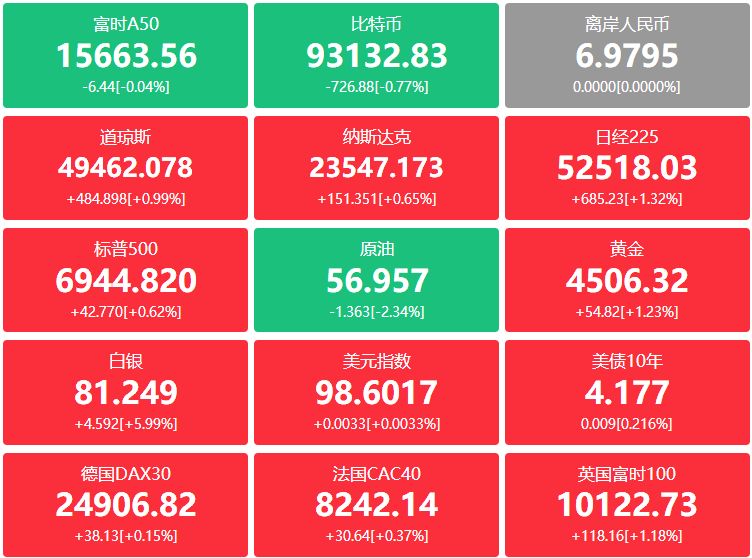
Monetary Policy - The People's Bank of China (PBOC) will continue to implement a moderately loose monetary policy, enhancing counter-cyclical and cross-cyclical adjustments to support high-quality economic development and financial market stability [1][1][1] - The PBOC aims to improve financial services for the real economy, deepen financial reforms, and enhance macro policy coordination to expand domestic demand and optimize supply [1][1][1] Export Control - The Ministry of Commerce has announced strengthened export controls on dual-use items to Japan, prohibiting exports to military users and any entities that could enhance Japan's military capabilities [2][2][2] Financing in Brain-Computer Interface Sector - Qiang Brain Technology, a brain-computer interface "unicorn," has completed approximately 2 billion yuan in financing, marking the second-largest financing in the sector after Neuralink [3][3][3] - The investment round included prominent investors such as IDG and various strategic partners, indicating strong interest in the brain-computer interface market [3][3][3] Regulatory Insights - Financial regulators are conducting research to address barriers preventing long-term capital from entering the market, focusing on enhancing bank wealth management investments in A-shares [5][5][5] - The State Administration for Market Regulation is seeking public opinions on the draft review guidelines for dairy product production licenses to improve quality and safety oversight [4][4][4] Stock Market Activity - Two high-performing stocks, Guosheng Technology and Jiamei Packaging, have announced temporary suspensions for stock price investigations due to significant price fluctuations of 370.2% and 230%, respectively [6][6][6] - The U.S. stock market saw significant gains, with the Dow Jones Industrial Average rising by 484.90 points, marking a new historical closing high [7][7][7] Commodity and Currency Market - The ICE U.S. Dollar Index increased by 0.30%, while gold and silver prices saw notable rises, with gold futures up by 1.21% [9][9][9] - Bitcoin futures decreased by 0.81%, while Ethereum futures rose by 1.23%, reflecting mixed trends in the cryptocurrency market [9][9][9] Strategic Developments - The National Bureau of Statistics plans to establish data standards in advanced fields such as intelligent agents and embodied intelligence, aiming to enhance data infrastructure and quality [12][12][12] - The Ministry of Water Resources emphasizes the need to accelerate the construction of a modern water network to support agricultural modernization and disaster prevention systems [13][13][13]

市场持续走强,中证500ETF易方达(510580)涨2.2%,高盛建议高配中国股票
Sou Hu Cai Jing· 2026-01-06 07:06
Group 1 - The core market index, the Shanghai Composite Index, has surpassed the peak reached on November 14, 2025, marking a new high not seen since late July 2015 [1] - The CSI 500 index, which focuses on quality mid-cap companies in the A-share market, has shown strong performance, with the CSI 500 ETF from E Fund (510580) rising by 2.2% today and a total increase of 4.83% over the first two trading days of 2026 [1] - The CSI 500 index represents a balanced mix of traditional and emerging sectors, covering cyclical industries like energy and materials, as well as core tracks in new productivity such as electronics, pharmaceuticals, electric equipment, and computers, aligning with the theme of economic transformation and upgrading [1] Group 2 - The CSI 500 ETF from E Fund (510580) is highlighted as an efficient tool for investors to diversify their investments in quality mid-cap stocks in the A-share market [1] - Goldman Sachs released a macro report on January 5, 2026, titled "China 2026 Outlook: Exploring New Momentum," recommending an overweight position in Chinese stocks for the year [1]